
Did you know that over 90% of face-to-face payments in the UAE are now contactless? If your checkout process still relies on aging hardware, you aren't just losing time; you're losing the confidence of a digital-first customer base. Finding the right pos system for small business uae has evolved from a simple purchase into a critical strategic decision. You need a solution that eliminates operational barriers, connects your inventory, and secures your data.
It's frustrating to watch high transaction fees and hidden costs drain your revenue while legacy systems fail to integrate with your accounting software. You deserve a setup that offers total visibility and absolute reliability. This guide provides the blueprint to master modern payment technology; ensuring you achieve a seamless checkout experience, real-time inventory tracking, and reduced merchant discount rates. We'll examine the 2026 e-invoicing mandates, explore different provider structures, and show you how our specialized selection tool can help you identify the perfect fit for your specific infrastructure needs.
Key Takeaways
• Modern POS systems act as strategic command centers; transforming simple transactions into opportunities for data management; customer engagement; and business expansion.
• High-performance software delivers real-time visibility into inventory across all national locations; facilitating operational fluidity; informed stock management; and performance enhancement.
• Identifying the right pos system for small business uae involves auditing operational bottlenecks; evaluating technical requirements; and calculating the total cost of ownership.
• NFC-enabled hardware and mobile POS solutions are essential tools for meeting the speed; security; and convenience demands of a cashless economy.
• Unified commerce integration removes operational barriers by connecting in-store and online sales data into a single; frictionless financial reconciliation stream.
Understanding the Modern POS Ecosystem in the UAE
The digital economy moves fast. In this environment, the Point of Sale is no longer just a place to swipe cards; it's the strategic intersection where customer experience meets actionable data management. Identifying the ideal pos system for small business uae requires looking beyond the hardware. You're selecting a cloud-based command center that synchronizes your entire operation in real time.
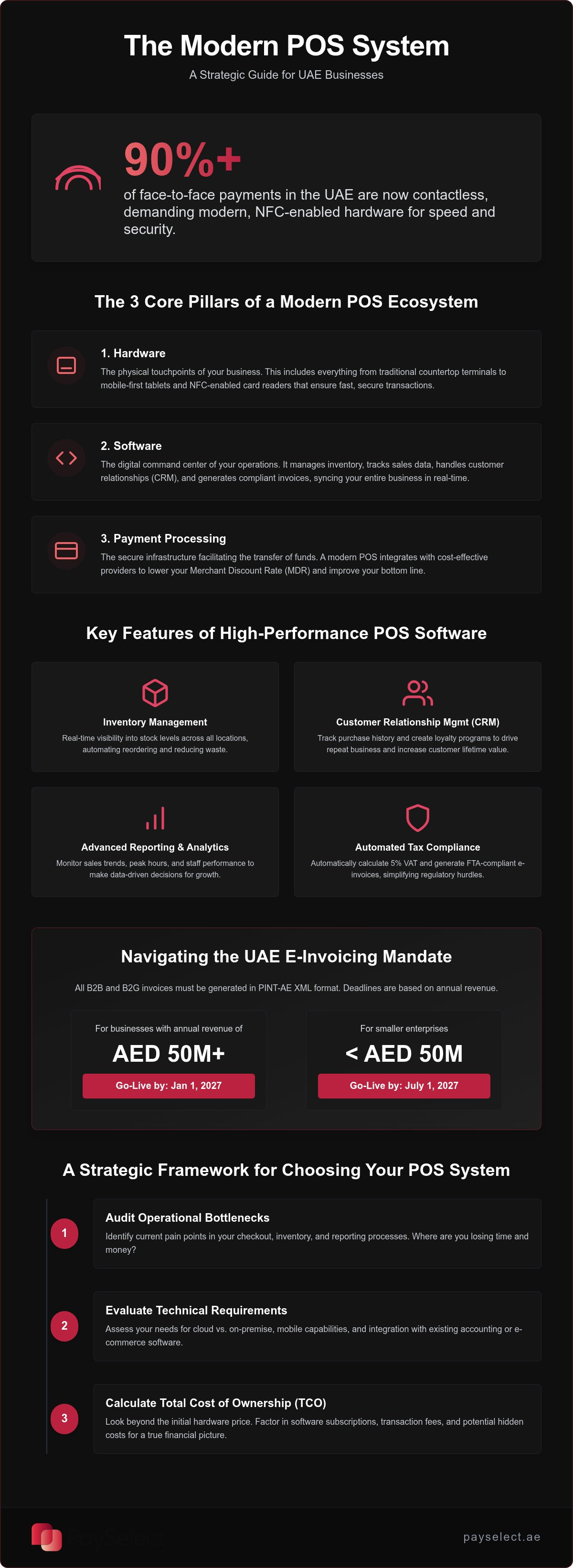
A modern ecosystem relies on three core pillars to function effectively:
Hardware
The physical touchpoints, ranging from traditional countertop terminals to mobile-first tablets.
Software
The digital brain that manages inventory, tracks sales, and generates compliant invoices.
Payment Processing
The secure infrastructure that facilitates the movement of funds from the customer to your business account.
As we move through 2026, unified systems have become essential for national business expansion. These systems ensure that whether a customer buys from you in person or online, your data remains consistent. Utilizing a specialized POS System Selection Tool is the most efficient way to navigate these complexities and find a solution that scales with your ambition.
The Evolution of Transactional Technology
We've moved past the era of manual entry. Modern systems have replaced tedious paperwork with automated, real-time data synchronization. This shift is driven by a market where over 90% of face-to-face payments are now contactless. To stay competitive, businesses are adopting NFC-enabled hardware that supports speed and security. The 2026 e-invoicing mandate adds another layer of necessity, requiring systems to generate structured XML invoices in the PINT-AE format. Modern technology removes these regulatory and operational barriers, allowing you to focus on growth rather than compliance hurdles.
Why POS Infrastructure is a Strategic Asset
A sophisticated pos system for small business uae does much more than process a checkout. It serves as a comprehensive management tool for staff performance, customer loyalty programs, and inventory levels across multiple locations. For enterprises and SMEs alike, data-driven decision-making is the only way to maintain high margins. By analyzing real-time sales trends, you can optimize your stock and reduce waste. Different payment providers offer varying fee structures, so selecting a system that integrates with the most cost-effective processing is vital for your bottom line. A modern POS system is the central catalyst for operational fluidity, removing barriers to growth while synchronizing every facet of your commercial infrastructure.
Key Features of High-Performance POS Software
Selecting a high-performance pos system for small business uae transforms your software from a simple ledger into a sophisticated growth engine. It's no longer enough to just record sales. You need a digital command center that offers total visibility into your operations. High-end software integrates Customer Relationship Management (CRM) tools to provide personalized service based on detailed purchase history. This connectivity allows you to recognize loyal customers and tailor promotions to their specific habits; driving repeat business and increasing lifetime value.
Advanced reporting and analytics are equally vital for performance enhancement. Modern systems track sales velocity, peak hours, and staff performance with absolute precision. This data-driven approach helps you identify which products are driving revenue and which are draining resources. By monitoring your Merchant Discount Rate (MDR) and transaction volumes through your software, you can optimize your provider selection to reduce overhead costs. Data is the new currency of the retail sector. Connectivity drives speed.
Automated tax compliance is a non-negotiable requirement for 2026. The UAE is implementing a decentralized e-invoicing model, requiring all B2B and B2G invoices to be generated in the PINT-AE XML format. Businesses with annual revenue of AED 50 million or more must go live by January 1, 2027, while smaller enterprises have until July 1, 2027. High-performance software handles these regulatory frameworks automatically, calculating the standard 5% VAT and ensuring every transaction meets Federal Tax Authority standards. If you're struggling to map these requirements to your current setup, using a POS System Selection Tool can help you find a compliant solution.
Inventory and Supply Chain Connectivity
Managing stock across multiple national locations requires real-time synchronization. High-performance systems provide instant updates; ensuring that an item sold in one branch is immediately reflected in the central database. This prevents lost sales opportunities through automated stock alerts that trigger when levels hit a predefined threshold. Centralizing this data allows you to manage national supply chains with total precision. By syncing in-store inventory with online sales channels, you create a unified commerce experience that removes operational barriers and eliminates the risk of overselling.
Security and Regulatory Compliance
Security is the foundation of institutional integrity in a digital-first economy. Modern software adheres to UAE Central Bank digital payment standards, utilizing end-to-end encryption to protect sensitive merchant and customer data. This level of protection is essential as digital transactions now account for over 70% of the retail market. Managing user permissions is another critical layer of security. It allows you to restrict access to sensitive financial reports or inventory adjustments, ensuring that only authorized personnel can make changes to your core business data. This structural clarity maintains security without sacrificing operational speed.
Selecting the Right POS Hardware for Operational Speed
Selecting the right hardware for your pos system for small business uae is about more than just processing payments; it's about defining the physical efficiency of your brand. Your choice of equipment impacts queue speed, staff mobility, and the overall aesthetic of your retail or service environment. Initial hardware costs for a terminal typically range from AED 1,200 to AED 2,500. This makes it a significant investment that requires a careful evaluation of your specific operational needs and floor-plan layout.
NFC-enabled hardware has become a mandatory requirement. With over 90% of face-to-face transactions in the UAE now being contactless, any delay at the terminal due to aging tech directly translates to lost revenue. Beyond the terminal itself, high-performance operations require a suite of essential peripherals. High-speed barcode scanners, thermal receipt printers, and secure cash drawers must integrate seamlessly with your central unit to maintain a frictionless flow. This connectivity ensures that every physical component of your checkout station works in total harmony.
Hardware aesthetics also play a role in customer perception. Choosing sleek, modern devices reflects a sophisticated brand image and signals to your clients that you are an elite, forward-thinking business. Whether you opt for a minimalist tablet setup or a robust industrial terminal, the hardware should complement your professional environment while removing operational barriers. A cluttered or outdated checkout area can undermine the confidence you've built throughout the customer journey.
Mobile vs. Fixed Infrastructure
Deciding between mobile and fixed infrastructure depends entirely on your service model. Mobile POS (mPOS) solutions allow your staff to provide floor-side service and take payments anywhere in your location, which drastically reduces queue times during peak hours. In contrast, fixed countertop terminals offer superior stability and reliability for high-volume environments where high-speed processing is the absolute priority. You can find a detailed POS machine comparison to help you weigh these options against your current operational bottlenecks.
Integration with Payment Terminals
Compatibility is the cornerstone of a unified system. Your hardware must support various national payment providers to ensure you aren't locked into a single ecosystem with unfavorable rates. We're seeing a clear move toward all-in-one devices that handle both the software interface and the payment processing on a single screen. This consolidation reduces the number of points of failure and simplifies your technical setup. Future-proofing your hardware for 2026 means selecting devices that can adapt to emerging payment methods and evolving security protocols without requiring a total system overhaul.
A Strategic Framework for Choosing Your POS System
Implementing a pos system for small business uae requires a structured methodology to ensure long-term ROI and operational fluidity. You shouldn't simply choose the most popular option. Instead, start with a rigorous audit of your current operational bottlenecks. Identify where your current setup fails; whether it's frequent downtime, slow checkout speeds, or a lack of integration with your inventory software. This audit defines your technical requirements and prevents you from paying for redundant features that don't serve your growth objectives.
Total cost of ownership (TCO) is the next critical metric. Beyond the initial hardware investment, which typically ranges from AED 1,200 to AED 2,500, you must account for recurring software fees between AED 199 and AED 499 per month. Factor in the Merchant Discount Rate (MDR) for local cards, which generally sits between 1.5% and 2.9%, plus any fixed transaction fees. Evaluating the system's scalability is vital for national expansion. A solution that works for a single outlet must be able to synchronize data across dozens of locations without losing performance or security integrity.
Identifying Industry-Specific Requirements
Tailoring your selection to your specific sector is the only way to achieve maximum efficiency. Retailers require robust SKU tracking and multi-location inventory synchronization, while hospitality businesses need sophisticated table management and split-billing capabilities. Professional service sectors might prioritize appointment scheduling and CRM integration. Our specialized POS System Selection Tool simplifies this process by providing independent advisory tailored to your unique operational profile, removing the guesswork from your digital transformation.
Cost Optimization and Fee Transparency
Hidden costs can quickly erode your margins. You must decode the complexities of merchant discount rates and identify any hidden subscription costs, such as premium support tiers or API access fees. Evaluate the ROI of premium features versus basic functionality; don't invest in advanced AI analytics if your immediate need is stable, high-speed transaction processing. PaySelect enables merchants to identify significant cost-saving opportunities through professional infrastructure consulting and pricing comparisons, ensuring your technology remains a strategic asset rather than a financial burden. Testing the user experience for both staff efficiency and customer speed before final implementation is the final step in securing a frictionless checkout environment.
Unified Commerce: Integrating POS with Payment Gateways
The distinction between physical retail and e-commerce has effectively vanished. In 2026, a high-performance pos system for small business uae must operate as a unified commerce engine that bridges the gap between offline and online sales. This integration removes operational barriers, allowing you to manage inventory, sales data, and customer profiles from a single, centralized dashboard. By consolidating your payment ecosystem, you eliminate the fragmentation that often leads to data silos and manual entry errors.
Streamlining financial reconciliation is perhaps the most immediate benefit of this technical synergy. When your POS hardware and digital storefront share the same reporting infrastructure, your accounting teams can verify daily settlements with absolute precision. This is particularly critical for managing the 5% standard VAT rate and ensuring compliance with the 9% corporate tax on taxable income exceeding AED 375,000. Automated reporting ensures that your financial records are always audit-ready, reducing the administrative burden on your staff and allowing them to focus on high-value growth activities.
PaySelect serves as the elite facilitator for this technical stack optimization. We act as the bridge between complex global infrastructures and your intuitive business needs, helping you identify the most efficient combinations of hardware and software. This structural clarity ensures that your systems are ready for implementation from day one.
Synergy with Online Payment Gateways
Integrated systems provide a 360-degree view of the customer journey. You can track a customer who browses online and buys in-person, or vice versa, creating a seamless experience that builds deep loyalty. This connectivity reduces transaction friction across all digital and physical touchpoints, ensuring that your brand remains accessible and reliable. If you're looking to unify your digital presence, exploring our tools for payment gateway selection is the next logical step in your infrastructure audit.
Cross-Border Expansion from the UAE
Your POS data is a strategic asset for international growth. By analyzing national purchasing patterns and payment preferences, you can make informed decisions about entering new markets. A robust, connected payment infrastructure is the foundation of this expansion. Utilizing specialized cross-border payment solutions allows you to scale your operations while maintaining the same level of security and efficiency you've established at home. This global perspective ensures that your business isn't just participating in the modern economy; it's actively leading it.
Empowering Your National Expansion
The shift toward unified commerce and automated compliance isn't just a trend; it's a fundamental requirement for the modern economy. Integrating your pos system for small business uae with a robust digital infrastructure removes operational barriers and secures a competitive advantage. You've learned how high-performance software handles e-invoicing mandates and how hardware choices impact customer perception. It's time to transition from fragmented legacy tools to a synchronized command center that drives performance.
PaySelect provides an independent comparison of UAE payment providers to ensure you never overpay for connectivity. Our expert advisory for enterprise infrastructure and data-driven cost optimization audits help you identify every opportunity for efficiency. We act as the bridge between complex technical protocols and your business's intuitive needs. Take the PaySelect Test to find your perfect POS system match and start your transformation today. Your growth is limited only by the tools you use; choose the ones that fuel your ambition.
Frequently Asked Questions
What is the primary difference between a POS system and a payment gateway?
A POS system is the physical and digital interface where sales are recorded and managed, while a payment gateway is the secure infrastructure that authorizes fund transfers. The POS handles your inventory, staff, and customer data; the gateway connects your storefront to the banking network. Selecting a high-performance pos system for small business uae requires ensuring these two distinct layers communicate perfectly to maintain operational fluidity.
How much should a business expect to pay for a POS system in the UAE?
You should budget between AED 1,200 and AED 2,500 for initial hardware per terminal. Monthly software subscriptions typically range from AED 199 to AED 499 per outlet. Transaction fees represent a recurring cost; expect to pay between 1.5% and 2.9% for domestic credit cards. International cards usually carry higher rates of approximately 3.25%. These costs are manageable when balanced against the efficiency gains and data visibility provided.
Can a cloud-based POS system operate during an internet outage?
Modern cloud-based systems include an offline mode that allows you to continue processing transactions during an internet outage. The system stores transaction data locally on the device and synchronizes it with the cloud once your connection is restored. This functionality is a critical safeguard against operational downtime. It ensures your checkout remains frictionless even when external infrastructure fails, protecting your revenue and customer experience without any interruption.
What are the essential security features to look for in a POS provider?
Look for end-to-end encryption, PCI-DSS compliance, and robust user permission controls to protect your business. These features secure sensitive customer data and prevent unauthorized access to your financial records. A secure pos system for small business uae should also offer real-time fraud detection and secure cloud backups. Prioritizing these protocols builds institutional trust and ensures your digital transactions remain protected against evolving cyber threats in a fast-moving landscape.
How does POS integration improve inventory management accuracy?
Integration improves accuracy by automating the link between your sales transactions and stock levels. Every time a product is scanned, the system updates your database across all national locations instantly. This removes the risk of manual counting errors and provides real-time visibility into your supply chain. You'll receive automated alerts when stock is low; ensuring you never miss a sale due to inventory mismanagement or phantom stock levels.
Is it possible to integrate my existing UAE bank account with a new POS?
It's entirely possible to integrate your existing UAE bank account with a new POS system through a compatible payment processor. Most modern systems are built with open connectivity in mind, facilitating smooth settlements into your preferred corporate account. The setup process varies depending on the provider's technical requirements and regulatory protocols. Our platform helps you compare how different solutions manage these bank integrations to avoid technical friction during your upgrade.
What hardware is required to accept contactless and NFC payments?
To accept contactless and NFC payments, you need a terminal with a built-in NFC reader and current security certifications. This hardware allows customers to pay using tap-to-pay cards, mobile wallets, and smartwatches. Since over 90% of UAE face-to-face transactions are now contactless, this equipment is essential for operational speed. Whether you use a fixed terminal or a mobile mPOS device, ensuring NFC compatibility is a strategic necessity for business growth.
How can PaySelect help me reduce my current POS transaction fees?
PaySelect helps you reduce fees by providing a transparent comparison of merchant discount rates and hidden service costs. We perform cost optimization audits that analyze your specific transaction volumes to find more efficient provider matches. Our independent advisory removes the guesswork from infrastructure selection, allowing you to negotiate better terms and keep more of your revenue. We act as your strategic partner in optimizing payment performance and removing operational barriers.
Disclaimer
This content is for informational purposes only and should not be considered financial, legal, or regulatory advice. Payment provider availability, pricing, and approval processes vary depending on individual business circumstances. PaySelect does not guarantee provider acceptance or specific outcomes. Businesses should conduct their own due diligence before entering into any agreements.
Empowering businesses to achieve greater growth