
Payment fraud can involve stolen card details, altered supplier bank information, or a customer disputing a transaction after receiving an order. Knowing how to protect your business from payment fraud starts with spotting unusual activity early and setting clear checks for payments, refunds, and disputes.
Focus on security without creating unnecessary friction for legitimate customers. A first-time buyer placing an unusually large order, repeated transactions on one card, or a sudden request to change supplier bank details can each warrant closer review.
This guide covers practical ways UAE businesses can reduce exposure: set risk rules, review suspicious transactions, keep records to support dispute responses, and tailor safeguards to your sector. Payment fraud can affect hospitality, digital businesses, and retail in different ways, so build controls around the transactions your business handles.
Key Takeaways
• Learn how online and in-store payment safeguards help reduce exposure while keeping payment journeys practical for customers.
• Recognise why hospitality, digital businesses and retail face different dispute patterns, and what records can support a chargeback response.
• Use transaction reviews to spot suspicious orders, payment changes and refund activity before they create wider problems.
• See how PaySelect’s comparison tools can help assess gateway, POS and cross-border payment options for your business.
What Is Payment Fraud?
Payment fraud is the use of stolen, false, or misused payment details to obtain money or goods. It can happen online, in person, or through changed supplier bank instructions. For example, someone may use another person’s card for purchases, or pose as a supplier and request payment to a new account.
Card-not-present transactions happen when the cardholder and card aren’t physically present, such as online checkout. A practical answer to how to protect your business from payment fraud is to use a secure e-commerce payment gateway, enable 3-D Secure, and verify unusual orders before fulfilment. Check billing and delivery details, order value, and customer contact information together. A mismatch is a reason for review, not proof of fraud.
A secure e-commerce platform should protect customer accounts and payment information. Require account login where appropriate, use multi-factor authentication (MFA), and avoid collecting card details by email. Tokenization replaces sensitive card data with a token, reducing the need to store card numbers in business systems. Restrict access to staff who need it.
In the UAE, contact your bank immediately if you see unauthorized activity in an account. The response depends on the incident and the payment setup involved.
For small businesses in the UAE, the cost of prevention tools depends on the platform, security features, and transaction volume. Compare recurring platform and transaction charges with the controls included, such as authentication or risk alerts.
MFA adds an extra identity check, while 3-D Secure helps authenticate online card payments. For UAE payment services like Rentify that enable digital checkout and instalment options, these authentication protocols ensure transactions remain protected against unauthorized use. Transaction limits can restrict exposure by flagging or stopping payments above thresholds suited to normal order patterns. Review those thresholds as products, customers, and sales trends change.
For in-store payments, look for signs of card tampering and use a chip reader rather than manually entering card details. Train staff to pause when a transaction seems unusual, and do not accept expired cards. These steps make face-to-face payment checks more consistent.
Verify online orders before shipping high-value goods. Contact the customer using details obtained independently of a suspicious order, and review requests to change delivery or supplier account details. A consistent verification process helps teams distinguish routine purchases from activity that needs further review.
Payment Fraud Risks Across Hospitality, Digital Businesses and Retail
Fraud patterns vary by sector. In UAE hospitality, a stolen card may fund an online booking, followed by a dispute after the stay. Supplier-payment interception poses another risk: altered bank details can redirect a hotel’s payment. Confirm account changes through a trusted contact already on file, not just the email requesting them.
Digital businesses face card-not-present fraud and friendly fraud. Friendly fraud occurs when a customer receives an order, then tells their bank the payment was unauthorized. Subscription merchants may also face disputes when customers do not recognize a charge or identify the billing descriptor. Clear receipts, cancellation terms, and support records help explain the transaction.
Retailers selling electronics, jewellery, or furniture face particular exposure because these goods can be resold. A fake-return claim may involve a customer saying an item was returned when the business never received it. Keep dispatch records and delivery confirmation linked to each order, and document the condition of returned goods on arrival.
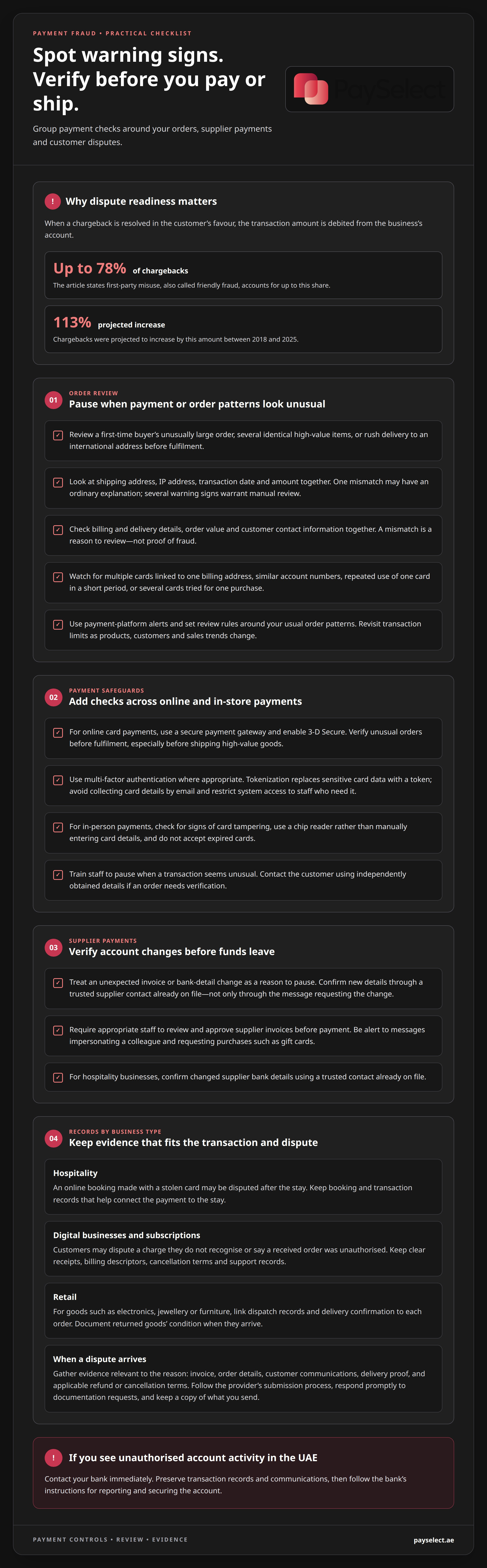
Chargebacks can turn a completed sale into a financial loss. If a dispute is resolved in the customer’s favour, the transaction amount is debited from the business’s account. First-party misuse, also known as friendly fraud, accounts for up to 78% of chargebacks. Chargebacks were projected to increase by 113% between 2018 and 2025.
To dispute a claim, collect evidence relevant to its reason. This may include the invoice, order details, customer communications, delivery proof, and applicable refund or cancellation terms. Respond promptly to documentation requests, follow the payment provider’s submission process, and keep a copy of what you sent. A clear timeline connects the evidence to the disputed transaction.
If suspected fraud affects a UAE business, contact the bank immediately when unauthorized account activity appears. Preserve transaction records and communications, then follow the bank’s instructions for reporting and securing the account. Financial exposure may include refunds, disputed transaction amounts, and lost goods. Depending on the incident and the business’s obligations, legal or contractual reviews may also follow.
Practical Ways to Protect Your Business from Payment Fraud
Set risk rules around the transactions your business usually accepts. Flag a first-time customer’s unusually large order, several identical high-value items, or rush delivery to an international address. Review the shipping address, IP address, transaction date, and amount together. One mismatch may have an ordinary explanation, but several warning signs warrant manual review before fulfilment.
Look for patterns across orders, not just individual payments. Multiple cards linked to one billing address, similar account numbers, or repeated use of one card within a short period can signal attempted fraud. A customer trying several cards for one purchase also warrants review. Use your payment platform’s alerts and set review rules based on usual order patterns. This gives your team a practical starting point for protecting your business from payment fraud.
For funds-transfer requests, treat unexpected invoice changes as a reason to pause. Verify new bank details through a known supplier contact using information already on file. Require appropriate staff to review and approve supplier invoices before payment. These checks can help detect business email compromise, including messages impersonating a team member and asking employees to buy gift cards.
Invoice controls should also catch duplicate invoices, unauthorized vendors, and attempts to bypass approval steps. Assign approval responsibilities clearly, and train employees to recognize unusual contacts and urgent payment requests. A designated person can lead fraud awareness and help staff follow the same escalation process when something looks wrong.
Refund controls matter too. Match each refund to the original sale, and issue it only to the card used for that transaction. Keep the return policy clear so customers understand the process. Do not split a declined transaction into smaller amounts or accept expired cards. These rules help staff handle exceptions consistently.
Build a fraud prevention process that combines automated alerts with human review. Record why a transaction was approved, declined, or escalated. If unauthorized account activity appears, contact the bank immediately. A response plan should define immediate actions, internal notifications, investigation steps, and any required external notifications. Review the plan and controls as fraud tactics and sales trends change.
How PaySelect Can Help with Payment Decisions
PaySelect helps UAE businesses compare payment options against their operational needs, including the controls they use to manage fraud risk. The goal is to make comparisons clearer: assess which payment setup fits your sales channels, customer markets, and transaction patterns before deciding.
For online sales, PaySelect’s Payment Gateway Comparison Tool helps businesses compare gateway options. Merchants can consider security needs such as online authentication, transaction monitoring, and how providers handle suspicious orders. A retailer selling high-value goods, for example, may prioritize different checkout controls from a business processing smaller, repeat purchases—such as high-volume consumer stores like Pet ID Tags Australia managing direct retail sales.
Businesses taking payments in person can use PaySelect’s POS System Selection Tool to compare options for their operations. Consider the checkout environment, how staff handle card payments, and the processes used to review unusual transactions. A hospitality business may need a setup that supports in-person payments alongside online bookings, with controls considered across both channels.
For businesses collecting payments or paying suppliers across borders, PaySelect’s Cross-border Payment Solution Matching helps compare suitable options. International activity can add complexity, so include the business’s markets, payment flows, and internal approval processes in the decision. The right comparison depends on how the business collects funds and manages outgoing payments.
PaySelect’s payment pricing comparison can help merchants understand how provider pricing relates to their payment setup. When reviewing current arrangements, examine transaction and settlement reports, compare pricing, and identify areas for discussion. Changing providers is not the only option. Pricing matters, but so do fraud controls, payment acceptance, and operational fit.
PaySelect’s independent comparison and advisory services help merchants evaluate payment options without promoting a single provider. For larger or more complex operations, payment infrastructure consulting can bring payment flows, multiple acquiring arrangements, and international requirements into a broader strategy. Decisions should reflect the business’s actual sales channels and fraud risks.
For tailored guidance on your payment requirements, contact PaySelect.
Frequently Asked Questions
What is payment fraud?
Payment fraud is deliberate deception involving a payment or payment account. This distinguishes it from a processing error, such as a duplicate charge caused by a system issue. To assess a reported incident, separate what the customer authorized from what the transaction record shows, then match the payment reference to the order, invoice, and fulfilment records.
What are the most common types of financial fraud?
Financial fraud can target business funds, records, or access credentials. Examples include account takeover, payroll diversion, expense claim manipulation, and false vendor records. These schemes can evade payment checks when approvals rely on one person or system. Separating who creates a payment, who approves it, and who reconciles it gives finance teams distinct control points.
What industries are most at risk?
Risk depends on the transaction flow, not just the industry. A marketplace may need controls around seller onboarding and payouts; a travel business may handle advance bookings; a subscription company may face recurring billing disputes. Map where money enters and leaves the business, then identify points where identity, fulfilment, or payment instructions could be changed.
What are the most common types of payment fraud targeting businesses in the UAE?
There is no single risk ranking for every UAE business. Relevant risks include unauthorized card use, disputed purchases, manipulated supplier payment instructions, and deceptive refund claims. The mix depends on how the business accepts payments and pays vendors. Finance teams can group incident records by payment channel, trigger, and loss type, then focus controls on recurring patterns.
What steps can UAE businesses take to prevent card-not-present and online payment fraud?
Tie online payment confirmations to records from the payment system, not screenshots or forwarded emails supplied by a customer. Match each order to its payment reference before dispatch, and restrict checkout administration access to staff who need it. Review gateway and order records together to spot unusual authorization patterns without relying on customer-facing messages alone.
Disclaimer
This content is for informational purposes only and should not be considered financial, legal, or regulatory advice. Payment provider availability, pricing, and approval processes vary depending on individual business circumstances. PaySelect does not guarantee provider acceptance or specific outcomes. Businesses should conduct their own due diligence before entering into any agreements.
Empowering businesses to achieve greater growth