
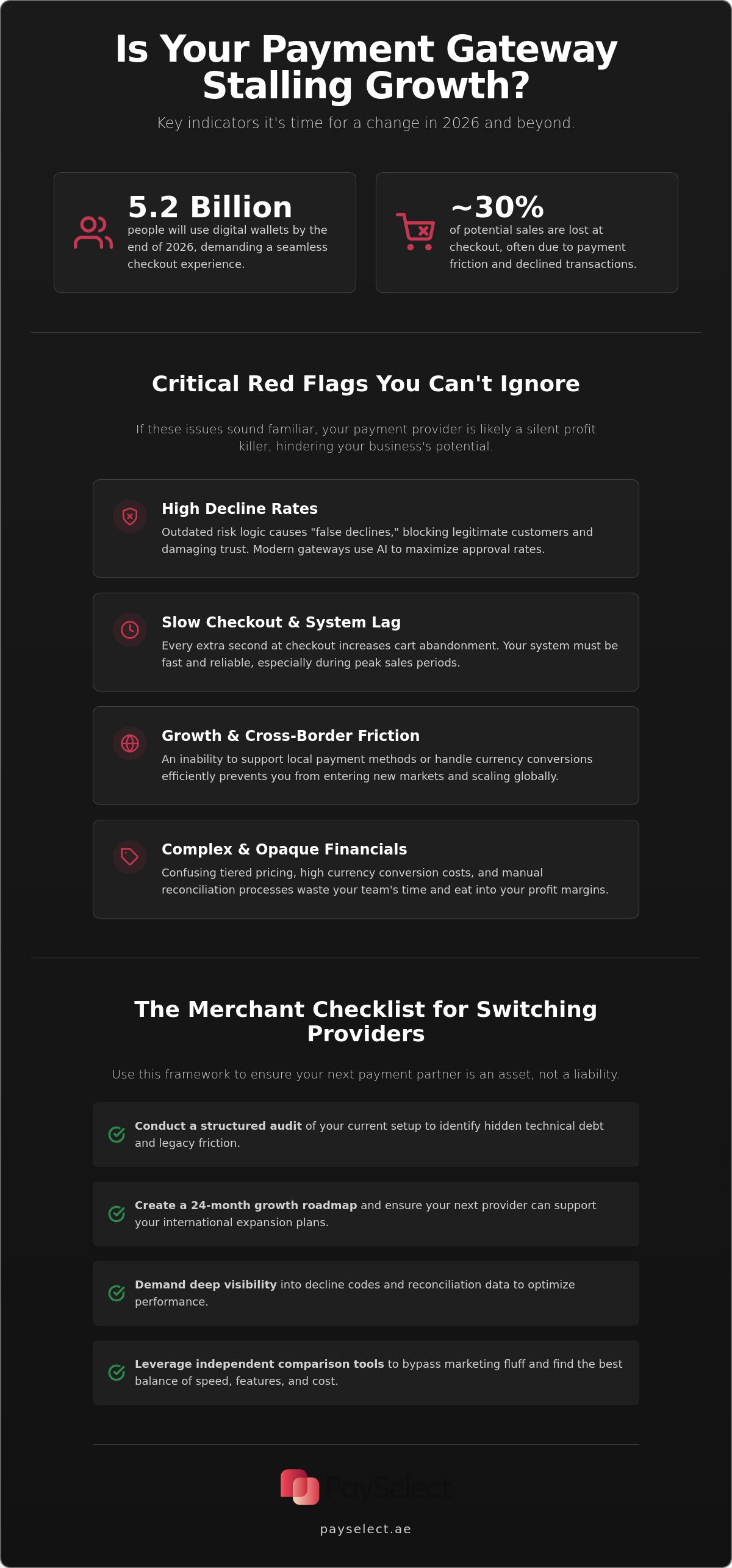
By the end of 2026, over 5.2 billion people will use digital wallets, yet many businesses still lose nearly a third of their potential sales at the checkout stage. You likely feel the sting of high transaction fees and the frustration of seeing customers abandon their carts just as they are ready to buy. It's exhausting to watch your hard-earned margins shrink because of outdated infrastructure or rigid processing terms that no longer serve your scale. Identifying the specific signs you need to switch your payment gateway is the first step toward reclaiming your profit and expanding your reach into new markets.
Discover the technical and financial red flags that indicate your current provider is hindering your growth and learn how to transition to a more efficient solution. We will examine seven critical indicators, ranging from integration barriers with your existing systems to the lack of support for modern regulatory standards like ISO 20022. This overview provides the clarity you need to move from a stagnant setup to a high-performance payment infrastructure that drives conversion and operational fluidity.
Key Takeaways
• Identify hidden technical debt and legacy friction that creates unnecessary barriers for your modern customers.
• Recognize unexplained decline rates and slow checkout speeds as critical signs you need to switch your payment gateway.
• Pinpoint financial inefficiencies, such as complex tiered pricing and high currency conversion costs, that eat into your margins.
• Use a structured audit and a 24-month growth roadmap to ensure your next provider supports long-term international expansion.
• Leverage independent comparison tools to bypass marketing fluff and find a solution with the best balance of speed and cost.
Why Your Current Payment Gateway Might Be Stalling Your Growth
Technical debt in your payment infrastructure is a silent profit killer. While your original setup might have served you well during your launch phase, legacy systems often lack the agility required for 2026's hyper-connected economy. If your current provider relies on rigid, monolithic code, you're likely experiencing invisible friction that frustrates customers and stalls your expansion. Understanding what is a payment gateway in the modern context means viewing it as a strategic orchestration layer rather than just a simple utility for moving money. Recognizing the signs you need to switch your payment gateway early prevents your business from becoming tethered to a provider that cannot scale at your pace.
Staying with a "good enough" provider often leads to significant revenue leakage. This happens through lower authorization rates, higher processing costs, and a poor user experience that drives customers to competitors. Modern commerce requires a shift toward payment orchestration, where you can dynamically route transactions to ensure the highest success rates. Without this flexibility, you're essentially leaving money on the table every single day. Growth requires a partner that facilitates speed, not one that acts as a bottleneck.
The Evolution of Payment Technology in 2026
Consumer expectations have shifted dramatically. By 2026, digital wallet adoption is projected to surpass 5.2 billion users, accounting for over 60% of the global population. Shoppers now demand fluid commerce, where the checkout process is nearly invisible and completely frictionless. If your integration is still based on 2023 standards, you're likely missing out on essential features like network tokenization and real-time settlement. These aren't just perks; they're the new baseline for trust and efficiency in a digital-first market. You can explore modern options using a payment gateway comparison tool to see how current leaders stack up against your existing provider.
Recognizing Growth-Related Friction
Scaling a business introduces complexities that basic gateways simply aren't built to handle. You might notice your system struggling as transaction volumes spike, or perhaps you're finding it impossible to enter new regional markets due to limited local payment support. This friction manifests in several ways:
Inability to scale
System lag or timeouts during peak sales periods that lead to abandoned carts.
Limited reach
A lack of cross-border payment solutions that cater to local preferences in new territories.
Retention issues
Customers abandoning checkouts because their preferred digital wallet or local method isn't available.
If your infrastructure prevents you from executing your 24-month growth plan, it's a clear indicator that your current partnership has reached its expiration date. A strategic switch ensures your payments remain an asset rather than a liability.
Performance Red Flags: Technical Indicators You Need a Change
Technical reliability is the bedrock of digital commerce. If your infrastructure falters during the final milliseconds of a transaction, you lose more than a single sale; you lose customer lifetime value. Modern systems must operate with absolute precision, speed, and transparency. When your current setup begins to lag, it creates a ripple effect of inefficiency that touches every department from customer service to accounting. Recognizing these technical signs you need to switch your payment gateway is essential for maintaining a competitive edge in 2026.
The Cost of High Decline Rates
Unexplained decline rates are often the most visible indicator of a failing system. Many legacy gateways rely on outdated risk logic that triggers "false declines," blocking legitimate customers even when they have sufficient funds. This happens because the provider lacks the sophisticated AI-driven routing necessary to navigate complex bank authorization paths. Modern gateways solve this by using adaptive risk scoring and real-time network tokenization to increase approval rates. If your current provider keeps your authorization data in a "black box," you're likely suffering from avoidable revenue loss. Moving to a partner that offers deep visibility into decline codes allows you to optimize your checkout flow and restore consumer trust.
Reporting and Reconciliation Gaps
Your finance team shouldn't have to spend hours manually matching bank statements to transaction logs. In 2026, automated reconciliation is a requirement, not a luxury. Outdated gateways often provide fragmented data, leaving "black holes" where transactions become difficult to track across different regions or currencies. This lack of visibility prevents you from making informed, data-driven decisions about your expansion. A sophisticated system provides real-time reporting that integrates directly with your existing ERP or POS systems, ensuring every cent is accounted for instantly. Conducting a thorough payment pricing comparison often reveals that providers with better technical reporting also offer more transparent fee structures.
Security and compliance standards have also evolved. With PCI DSS v4.0 requirements now mandatory, your gateway must provide continuous monitoring and robust validation of security controls. Recent shifts in federal oversight of digital payment apps highlight the increasing pressure on merchants to protect personal data and prevent fraud. If your provider hasn't updated its mobile optimization or native app support to meet these heightened security and UX expectations, your business remains vulnerable. Speed, security, and clarity are the three pillars of a high-performance gateway. If your current system lacks any of them, it's time to evaluate more sophisticated alternatives.
Analyzing the Financial Impact: Fees and Cross-Border Inefficiencies
Profit margins are the lifeblood of any scaling enterprise. While small fees might seem negligible at first, they compound into significant revenue loss as your transaction volume grows. Credit card processing fees in 2026 typically range from 1.5% to 3.5% per transaction, plus fixed costs. However, the way these fees are structured often hides the true cost of doing business. One of the clearest signs you need to switch your payment gateway is the presence of opaque, tiered pricing models that make it impossible to predict your monthly expenses accurately. When your provider bundles different card types into "qualified" and "non-qualified" tiers, you often end up paying a premium for transactions that should be processed at a lower rate.
Your Merchant Discount Rate (MDR) should reflect your current business scale, not the size you were when you first signed your contract. As your business matures, you gain the leverage to move away from flat-rate models toward more transparent structures like interchange-plus pricing. This allows you to see the exact breakdown of interchange fees, network assessments, and the processor markup. If your current provider refuses to offer this level of transparency, they are likely capturing a larger portion of your margin than necessary. Efficiency in 2026 requires a partner that aligns its costs with your growth trajectory.
The Complexity of Cross-Border Payments
Expanding into international markets is a primary goal for many modern entrepreneurs, yet inefficient payment setups often act as a barrier. International transactions carry additional layers of complexity, including higher interchange rates and currency conversion spreads. You can identify if you are overpaying for cross-border payments by reviewing how your gateway handles multi-currency settlement. A sophisticated solution should allow you to accept payments in local currencies and settle them in your home currency without excessive markups. Without local acquiring capabilities in your target regions, you are essentially paying an "international tax" on every sale, which can be one of the most compelling signs you need to switch your payment gateway.
Optimizing Your Payment Infrastructure Costs
Managing payment costs is an ongoing strategic task rather than a one-time setup. Periodically requesting a Payment Cost Optimization Audit is essential to ensure your stack remains lean and effective. This process involves comparing fixed-fee models against percentage-based structures to see which aligns better with your average transaction value. High-volume businesses can often leverage their data to negotiate better terms, but this is only possible if you have a clear view of your transaction patterns. By optimizing your infrastructure, you remove the financial friction that prevents you from reinvesting in other areas of your business.
The 2026 Merchant Checklist for Switching Providers
Once you recognize the signs you need to switch your payment gateway, you must move from observation to execution. A successful transition requires a structured framework that minimizes downtime and maximizes long-term ROI. In 2026, the complexity of global commerce means you can't afford a trial-and-error approach. Start by auditing your transaction logs to pinpoint exactly where your current provider fails. This data becomes your baseline for comparing new solutions. Gather specific metrics on decline codes, settlement times, and total cost of ownership to build a clear case for change.
Defining your 24-month growth goals is the next critical step. Are you planning to launch a native mobile app? Do you need to support new regional digital wallets across the GCC or Europe? Your future requirements dictate whether you should choose a developer-first API integration for total control or a simpler hosted checkout for speed. Finally, conduct a rigorous cost-benefit analysis. Factor in the long-term savings from lower fees and higher conversion rates against the initial migration effort. A strategic switch is an investment in your company's scalability.
Evaluating Integration and Compatibility
Your payment stack must function as a single, cohesive unit. This means ensuring your new gateway syncs perfectly with your existing POS machines to maintain omnichannel consistency. Look for providers that offer robust, developer-friendly documentation to speed up the implementation process. A smooth switch depends on how well the new system talks to your ERP and inventory management tools. Testing the user experience across all digital touchpoints ensures that the transition remains invisible to your customers while delivering immediate performance gains. Fluidity in your backend operations leads directly to a better frontend experience.
Regulatory and Security Due Diligence
Security isn't a "set and forget" feature. Your new provider must meet the latest encryption and tokenization standards while remaining fully compliant with Central Bank of UAE regulations. One often overlooked factor is data portability. You must ensure you can move your customer payment data between providers without losing your stored card-on-file information. Avoiding vendor lock-in is essential for maintaining operational independence. If you're ready to find a partner that meets these high standards and fits your specific business model, you can compare payment gateways using our independent comparison tool to find the perfect match for your growth trajectory.
Streamlining the Selection Process with Independent Advisory
Guesswork has no place in high-stakes payment transitions. While identifying the signs you need to switch your payment gateway is a critical first step, the subsequent selection process often becomes a significant operational burden. Merchants frequently find themselves bogged down in manual research, trying to decode complex fee structures and technical specifications across dozens of competing platforms. This is where independent advisory transforms a chaotic search into a structured, data-driven decision. Moving away from biased sales pitches and toward objective comparison data ensures that your next infrastructure choice aligns perfectly with your long-term expansion goals.
Why Independence Matters in Payments
Independence is your greatest asset during a migration. Most providers operate within closed ecosystems designed to keep you locked in. By using an objective payment gateway comparison tool, you gain the transparency needed to negotiate from a position of strength. This approach removes the emotional friction of the sales process and replaces it with cold, hard performance data. You can compare processing speeds, cross-border capabilities, and actual cost-to-serve metrics without the influence of provider-specific marketing. A "Take the Test" methodology allows you to filter out noise and focus only on the solutions that meet your specific technical and financial thresholds.
Taking the Next Step with PaySelect
PaySelect acts as a bridge between complex global infrastructures and your intuitive business needs. We specialize in simplifying the intricate MENA payment landscape by providing tools that match your unique requirements with the right provider capabilities. Whether you need a Payment Cost Optimization Audit to find hidden inefficiencies or a Cross-border Payment Solution Matching service to reach new markets, our platform delivers clarity. We don't just list providers; we provide a strategic framework for selection. Our POS System Selection Tool and Payment Links comparison features ensure that every digital and physical touchpoint is optimized for conversion.
For larger enterprises, our Payment Infrastructure Consulting offers a deep dive into your current transaction environment. We help you identify the signs you need to switch your payment gateway before they impact your bottom line. We provide a clear roadmap for a seamless transition, ensuring your setup remains a catalyst for growth rather than a source of friction. By leveraging our independent data, you can move forward with the calm assurance that your new gateway is built for the demands of 2026 and beyond. Efficiency, transparency, and fluidity are now within reach.
Future-Proof Your Payment Infrastructure
Your payment gateway should be a powerful engine for growth, not a source of friction. We have explored how technical debt, unexplained declines, and inefficient cross-border fee structures can silently erode your profit margins. Moving from a legacy system to a modern orchestration layer is no longer a luxury for international merchants; it's a requirement for survival in a digital-first economy. Recognizing the signs you need to switch your payment gateway allows you to reclaim operational fluidity and deliver a superior customer experience across every touchpoint.
PaySelect provides the independent and unbiased advisory you need to navigate this transition with absolute confidence. As MENA region payment industry experts, we offer customized cost-optimization audits for enterprises and data-driven comparison tools for businesses of all sizes. Don't let an outdated provider dictate your growth trajectory. Match your business with the ideal payment provider today and build a foundation for global expansion. Your journey toward a more efficient and profitable future starts with a single, informed decision.
Frequently Asked Questions
How long does it typically take to switch to a new payment gateway?
The transition process generally takes between two to six weeks. This timeline depends on whether you choose a simple hosted checkout or a more complex API integration. Providing all required KYC documentation early and having a clear technical roadmap will significantly accelerate your onboarding speed and ensure a smooth migration.
Will my customers notice any downtime during the transition?
Your customers won't experience any service interruptions if you manage the switch correctly. The best practice is to run your new provider in parallel with your existing one before making the final cutover. Once you've verified that the new system is processing transactions successfully, you can seamlessly redirect all traffic to the more efficient solution.
Can I keep my existing customer credit card data when I switch?
Yes, you can migrate your stored customer data through a secure PCI-to-PCI transfer. Most modern providers facilitate this data portability to ensure you don't lose valuable card-on-file information. This ensures a frictionless experience for your returning customers while maintaining the highest security standards throughout the entire migration process.
What are the most common hidden fees in gateway contracts?
Merchants often encounter unexpected settlement fees, monthly maintenance charges, and high markups on "non-qualified" card types. These opaque costs are often the most compelling signs you need to switch your payment gateway to a more transparent model like interchange-plus pricing. Reviewing your statements for these "junk fees" is essential for protecting your profit margins.
Is it possible to use multiple payment gateways at the same time?
Yes, many high-growth businesses use a strategy called payment orchestration to route transactions through multiple gateways simultaneously. This approach allows you to optimize for the lowest fees and highest approval rates based on the customer's location or card type. It also provides a critical backup if one provider experiences technical difficulties; in these scenarios, StatusPulse can provide the necessary uptime monitoring and public status pages to keep your users informed.
How do I know if a new gateway is compliant with UAE regulations?
You should verify that the provider holds the necessary licenses from the Central Bank of UAE. Compliance also requires adherence to local data residency laws and the latest PCI DSS v4.0 security protocols. Ensuring your partner stays current with regional regulatory shifts is vital for maintaining long-term operational stability and consumer trust in the MENA market.
Does switching gateways affect my website SEO or user experience?
Switching gateways has no direct impact on SEO, but it significantly enhances the user experience. Faster processing speeds and a more intuitive checkout flow reduce session timeouts and cart abandonment. A modernized interface, such as those crafted by the professionals at shay-david.com, signals to your customers that your brand is a sophisticated leader in the digital landscape, which indirectly supports your brand authority.
What is the first step I should take if I suspect I am overpaying?
The first step is to perform a Payment Cost Optimization Audit to identify where your current margins are leaking. Analyzing your transaction volume and identifying signs you need to switch your payment gateway will give you the leverage needed for better negotiations. Independent comparison tools can then help you find a partner that matches your specific scale.
Disclaimer
This content is for informational purposes only and should not be considered financial, legal, or regulatory advice. Payment provider availability, pricing, and approval processes vary depending on individual business circumstances. PaySelect does not guarantee provider acceptance or specific outcomes. Businesses should conduct their own due diligence before entering into any agreements.
Empowering businesses to achieve greater growth