


A card payment connects two banks before funds reach a business. The difference between an acquiring bank and an issuing bank is their role in the transaction: the acquirer works with the merchant, while the issuer provides the card to the customer and decides whether to approve the payment.
It’s easy to focus on the card tap or online checkout, but payment decisions and fund movements happen behind the scenes. In the standard four-party model, the cardholder, merchant, issuing bank and acquiring bank each play a distinct role.
This guide explains how issuers provide cards and assess authorisation requests, how acquirers route payments and settle funds, and how the two banks work together. It also explains why the distinction matters to UAE businesses reviewing payment declines, settlement timing, fees and international card acceptance.
Key Takeaways
• Identify which bank serves the merchant and which serves the cardholder to understand each party’s role.
• Learn how an issuer reviews a payment request and what can affect an approval or decline.
• Follow the transaction from authorisation through settlement to see how funds reach a business.
• Understand how payment pricing comparison can help assess whether your current setup fits your business needs.
What’s the difference between an acquirer and issuer?
In a standard four-party card payment, the acquiring bank works with the merchant, while the issuing bank serves the cardholder. The acquirer supports the business accepting payment. The issuer provides the customer’s card and approves or declines the transaction. They sit at opposite ends of the same purchase. Understanding the difference between an acquiring bank and an issuing bank helps clarify who handles each part.
The acquiring bank establishes a merchant relationship through an agreement to accept and process payments. An acquirer contracts with a payee to accept and process payments that transfer funds to that payee. The merchant account enables the business to receive card-payment funds and records account activity, including fees, deposits and withdrawals.
For a UAE business, the acquirer connects the merchant’s payment setup to card networks such as Visa and Mastercard. When a customer pays online or taps a credit card, the acquirer routes the authorisation request to the issuer. After approval, it receives transaction funds through the payment network and arranges settlement to the merchant account. This illustrates the difference between an acquiring bank and an issuing bank during payment processing.
Merchant agreement
The acquiring bank contracts with the business to accept card payments and sets the terms for that relationship.
Merchant account
The account receives payment funds on the merchant’s behalf and tracks related deposits and withdrawals.
Payment processor
A processor handles transaction messages; the acquirer manages the merchant relationship and payment routing.
Financial risk
The acquirer assesses merchant risk and may face exposure when a business cannot cover refunds or chargebacks.
For example, when a café accepts a customer’s card, its acquirer handles the merchant-side transaction. The customer’s issuer checks the cardholder’s account and approves or declines the charge. An acquirer may also manage merchant-side chargebacks, while the issuer handles the cardholder’s dispute process. One institution can offer both acquiring and issuing services, but its role depends on which side of the transaction it serves.
Issuing bank definition and card issuance
An issuing bank is the financial institution that provides a payment card to a customer. It links the card to the cardholder’s account and decides whether transactions can proceed. With a credit card, the issuer also extends credit; debit payments draw on available account funds. A prepaid card uses funds loaded onto the card rather than credit.
When issuing a card, the institution approves or declines an application, then provides a card connected to the customer’s account. When the customer pays online or in person, the payment request travels from the merchant’s setup through the acquiring side and card networks to the issuer. The issuer authenticates the customer and reviews account details, available funds, account status and fraud indicators.
That review determines whether the issuer approves the transaction. If approved, the response returns through the network to the merchant, usually through its payment processor. A decline can occur when funds are unavailable, the account has a restriction or the request raises fraud concerns. The cardholder’s bank therefore controls the account-side decision, while the acquiring side arranges for funds to reach the merchant.
Authorisation
The issuer checks the card and account, then sends an approval or decline through card networks.
Clearing
Transaction details are exchanged after authorisation so the payment can be recorded and amounts reconciled.
Settlement
The issuer transfers the authorised transaction value through the payment network toward the acquirer, which facilitates payout to the merchant account.
For example, a customer in the UAE paying online with a debit card triggers an issuer check against the customer’s account. An approved response lets the transaction continue; it doesn’t mean the merchant has received settled funds. Later clearing and settlement stages complete the movement of payment value. This distinction helps businesses separate a successful authorisation from the timing of a payout.
Example distinguishing acquiring and issuing banks
Consider a UAE online retailer accepting a Mastercard payment from a customer using a debit card. The retailer’s acquirer serves the merchant; the issuer serves the cardholder.
Acquirer and Issuer Roles
The acquirer supports the retailer’s acceptance setup, while the issuer assesses the customer’s card transaction. A payment gateway can carry the payment request into the acquiring side, and card networks route it to the issuer. This distinction matters when a payment is declined: the issuer makes the account-side decision, while the merchant’s acquiring arrangement handles acceptance and subsequent payment processing.
Bank Examples and Dual Roles
Acquiring banks contract with merchants to accept card payments; issuing banks provide payment cards to customers. The retailer example shows how a single Mastercard transaction can involve both roles. The same bank can act as an acquirer in one transaction and an issuer in another. Its role depends on whether it serves the merchant or the cardholder in that payment.
Issuing banks start the chargeback process when cardholders dispute transactions. The acquirer is involved on the merchant side of a dispute, while the issuer is involved on the cardholder’s side. For a UAE retailer, clear transaction records can help support its response to a disputed online purchase.
In the UAE, the roles follow the same card-network flow: the merchant’s acquirer and the cardholder’s issuer work through the relevant network. A local business accepting a Mastercard debit card relies on its acquiring arrangement, while the customer’s issuer reviews the card transaction. The network connects the two sides; it does not make their responsibilities interchangeable.
Risk also differs by role. An acquirer assesses merchant risk and may face financial exposure if a business cannot cover refunds or chargebacks. An issuer reviews transaction risk and, for a credit card, carries exposure if the cardholder fails to repay. These responsibilities help explain why a dispute can involve both institutions, even though each manages a different relationship.
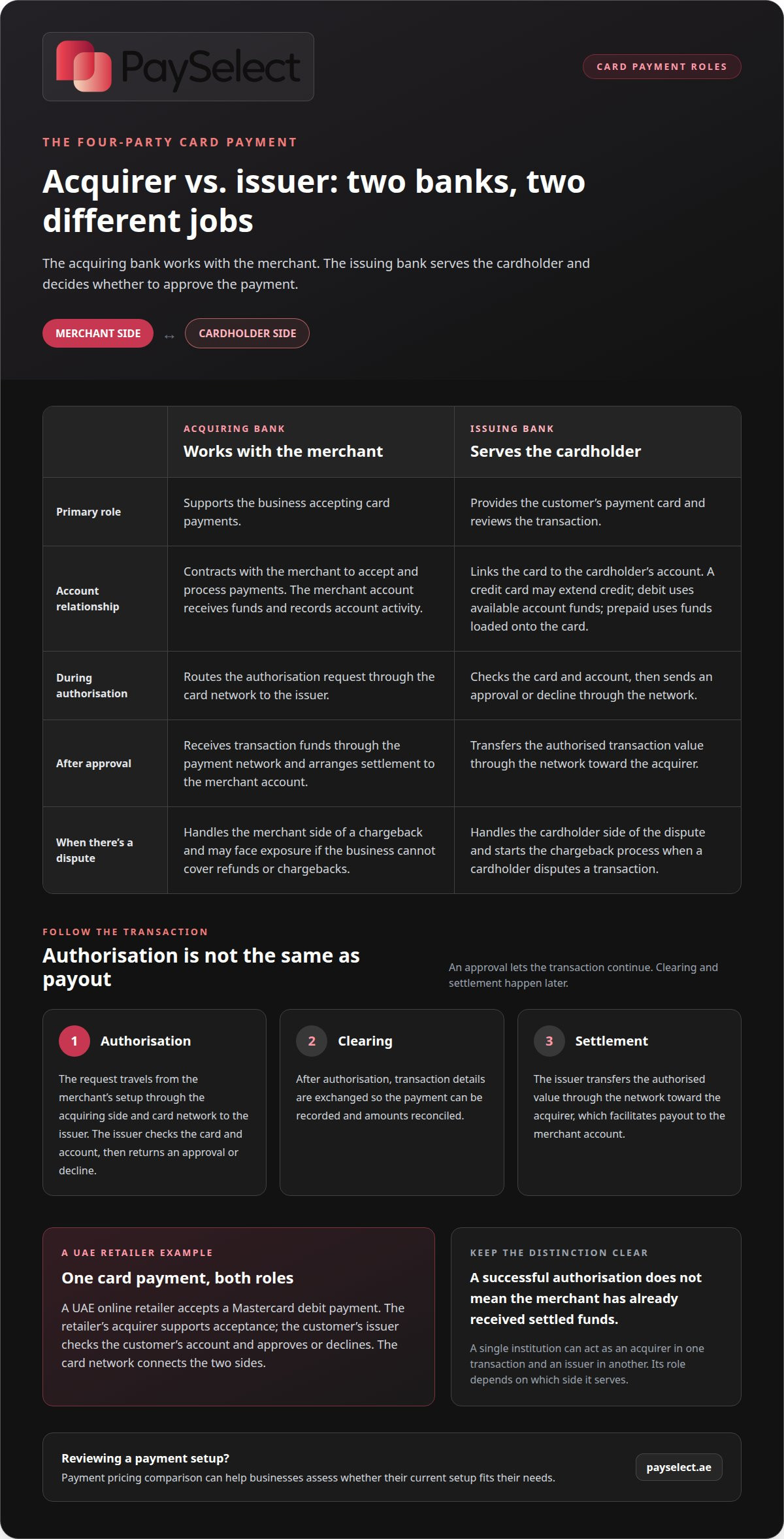
Authorization and settlement flow
A card payment moves from approval to reconciliation and payout. For a UAE merchant, a payment gateway can send transaction details into the acquiring arrangement, which routes them through card networks to the issuer.
Authorisation
The issuer reviews the request and returns an approval or decline through the network.
Clearing
Transaction records are exchanged and amounts due are reconciled.
Settlement
Funds move through the network to the acquirer, which arranges the merchant payout.
An approved transaction doesn’t mean the merchant has received a deposit. Payout timing depends on the acquiring or payment service arrangement and how transactions are processed. Under net settlement, fees are deducted before payout; under gross settlement, fees are invoiced separately. This distinction helps businesses reconcile sales with the amount deposited into their accounts.
Reserves or payout holds can also affect available funds. A rapid rise in transactions, a chargeback spike or a shift into a higher-risk category can prompt a new risk review. That review may lead to a reserve requirement or temporary hold, affecting cash flow even when transactions were authorised.
International card payments can bring additional costs for UAE merchants. A provider’s pricing may distinguish domestic and international cards, while currency conversion can add FX costs when the transaction and settlement currencies differ. Interchange is set by card networks and paid by the acquirer to the issuer; it’s typically passed on to the merchant as part of acceptance costs. Scheme fees and the merchant service charge are handled under the relevant commercial arrangements, so review them alongside currency-related deductions.
To assess how pricing and payout terms fit your transaction mix, compare payment gateway arrangements and consider the costs tied to international cards and currency conversion.
PaySelect
PaySelect helps UAE businesses assess payment options through comparison tools and payment consulting. Its platform can help identify options suited to a business’s channels and customer markets, including online, in-person and cross-border payments. Matching business requirements with provider criteria can also clarify onboarding options before a merchant proceeds.
Its hands-on advisory services can review transaction and settlement reports, identify unnecessary costs, benchmark existing fees, recommend improvements and support negotiations with current providers. For larger businesses, PaySelect can also advise on settlement optimisation and payment strategy across complex arrangements, including multiple acquiring providers and international acceptance needs.
For example, a business adding new markets may need to consider how its provider arrangements, collections and payouts work together. PaySelect can help assess those requirements and compare relevant options. It does not process payments or manage the merchant-provider relationship.
Contact PaySelect to discuss your business’s payment setup and the options you’re considering.
Make your payment setup work for your next stage
Knowing the difference between an acquiring bank and an issuing bank can help you ask better questions about your payment setup. Next, assess whether your current arrangement supports your business model, sales channels and customer markets, especially as your needs change.
PaySelect helps UAE businesses assess payment options through its Payment Gateway Comparison Tool, POS System Selection Tool and Cross-border Payment Solution Matching. These tools support decisions about online acceptance, in-person payments and international payment requirements. If you already have a provider, payment pricing comparison can also help you understand how your current commercial arrangement fits your needs.
Consider your next payment decision in the context of the whole setup, not just a single transaction. For practical guidance on payment options for your business, contact PaySelect to discuss payments and take a clear next step with confidence.
Frequently Asked Questions
What is an acquirer?
An acquirer is the institution that holds the merchant-side relationship for accepting card payments. For an online or in-person seller using a dedicated payment provider—an example being UK businesses setting up card machines and gateway services via dojoconsultant.co.uk—the provider may manage the merchant-facing arrangement while an acquiring bank supports card acceptance underneath. This distinction explains why a business’s checkout provider and its acquiring bank may be different organisations, even though both contribute to the payment setup.
What is an issuing bank?
An issuing bank is the financial institution that provides a payment card to its customer. For a merchant, recognising the issuer can help make sense of card-related outcomes, such as a customer reporting an unfamiliar transaction or asking why a payment was declined. The issuer’s relationship is with the cardholder, so account-specific questions generally belong with that institution rather than the merchant’s payment provider.
What do issuing banks do?
Issuing banks provide cards, assess payment requests and support cardholders with account and dispute matters. For businesses, it’s useful to distinguish an issuer-side decline from a checkout or technical failure. If a customer reports a failed payment, the merchant can review the payment status and error information in its payment system to help identify whether the issue relates to the card account or checkout process.
What is an issuer?
An issuer is the organisation that provides a payment card to the cardholder. The word describes a role in a transaction, not necessarily a separate kind of company: a bank can issue cards and also provide acquiring services. For merchants handling several payment methods, identifying whether an organisation is acting as issuer or acquirer helps direct account, acceptance and transaction questions to the appropriate party.
Do I need a relationship with an acquiring bank to sell online?
Yes, online card acceptance requires an acquiring arrangement, but the merchant may not contract with the acquiring bank directly. A payment facilitator can provide the merchant-facing service while relying on its own acquiring bank underneath. For a business setting up online sales, the contractual provider, checkout technology and institution supporting card acceptance may be distinct parts of the arrangement. For enterprises seeking tailored advice on configuring their acceptance infrastructure, payment consultancies like PenguinPay help merchants find bespoke card payment and EPOS solutions.
How does the transaction process work?
A card payment starts when the customer presents card details at checkout. The merchant’s payment setup sends the request through the relevant network for an account decision, then returns the result to the checkout. After an approved sale, later processing reconciles the transaction and moves funds toward the merchant. In operational reviews, distinguish an approved payment status from a completed payout in settlement records.
Disclaimer
This content is for informational purposes only and should not be considered financial, legal, or regulatory advice. Payment provider availability, pricing, and approval processes vary depending on individual business circumstances. PaySelect does not guarantee provider acceptance or specific outcomes. Businesses should conduct their own due diligence before entering into any agreements.
Empowering businesses to achieve greater growth
