Best Payment Gateway for Shopify in the UAE: The 2026 Merchant Selection Guide

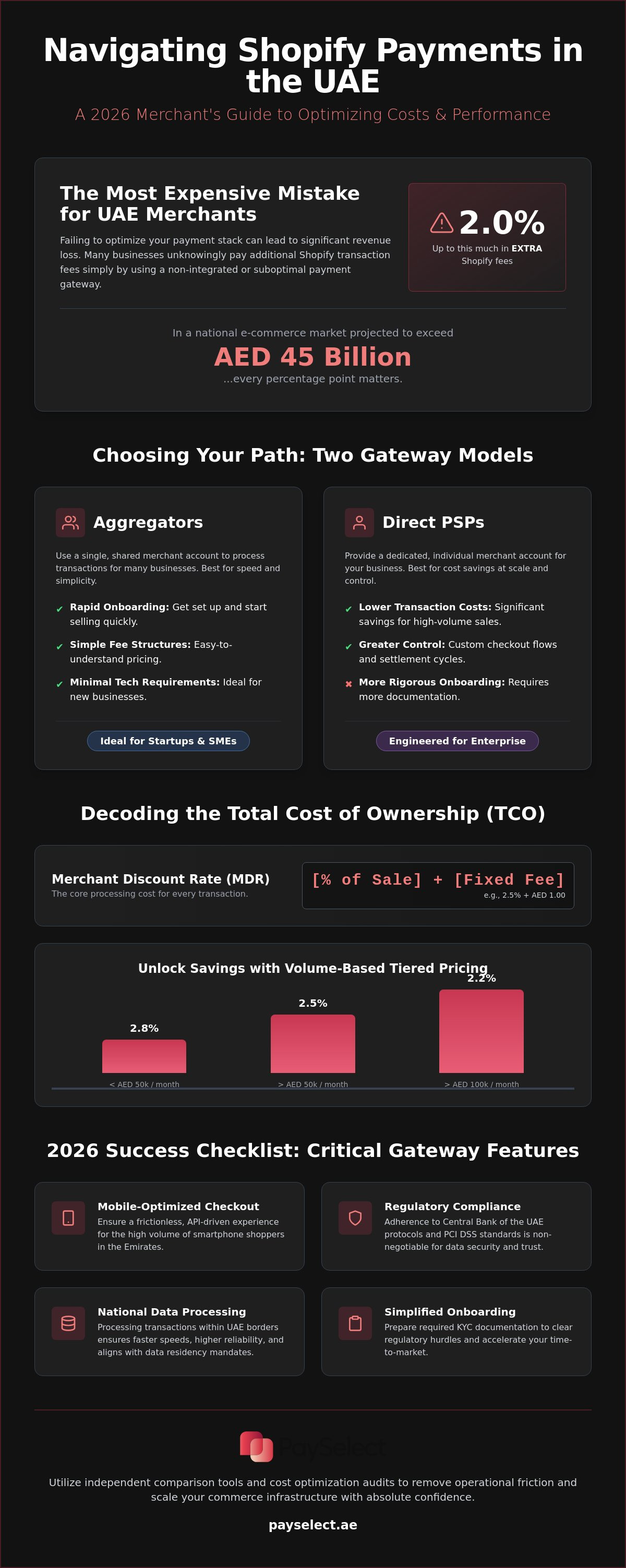
The most expensive mistake a UAE merchant can make in 2026 isn't their marketing spend; it's an unoptimized payment stack. While the national e-commerce market is projected to reach over AED 45 billion this year, many businesses still lose significant revenue to additional Shopify transaction fees of up to 2.0% simply because they haven't secured the right integration. Finding the best payment gateway for shopify uae is no longer just about processing cards; it's about protecting your margins.
You've likely dealt with the stress of unpredictable merchant discount rates and settlement cycles that leave your cash flow stagnant. It's frustrating when technical friction at checkout turns a ready buyer into a lost opportunity. We understand that you need a solution that provides calm assurance through reliability and speed. This guide helps you navigate the complexities of the national landscape to lower your overhead and accelerate your access to funds. We'll break down the 2026 landscape of fee structures, regulatory requirements, and performance metrics. You'll gain the clarity needed to choose a gateway that offers a seamless, secure experience for your customers while maximizing your bottom line.
Key Takeaways
• Navigate the 2026 digital landscape to identify the best payment gateway for shopify uae that aligns with current national economic shifts and consumer behavior.
• Break down the total cost of ownership by analyzing merchant discount rates and fixed transaction fees in AED to protect your profit margins.
• Prioritize mobile-optimized, API-driven checkouts to ensure a frictionless experience for the high volume of smartphone shoppers in the Emirates.
• Simplify the onboarding process by preparing the specific KYC documentation required to clear national regulatory hurdles and accelerate your time to market.
• Utilize independent comparison tools and cost optimization audits to remove operational friction and scale your commerce infrastructure with absolute confidence.
The Shopify Payment Ecosystem in the UAE for 2026
A payment gateway acts as the secure digital bridge between your Shopify storefront and the UAE’s national financial networks. It authorizes credit card or direct payments for your e-commerce business, ensuring funds move safely from the customer to your bank. With the national e-commerce market projected to surpass AED 45 billion in 2026, selecting the best payment gateway for shopify uae has become a critical strategic decision. National economic initiatives have accelerated a digital-first shift, moving consumers away from cash toward mobile and biometric payments. This evolution requires a gateway that isn't just a utility, but a catalyst for growth.
Many merchants assume a generic global provider is the most efficient path. It's a common misconception. These global solutions often lack native AED settlement and carry hidden currency conversion costs that eat into your profits. Relying on international infrastructure can result in unnecessary overhead and slower dispute resolution. Choosing a partner deeply embedded in the local landscape ensures you avoid the 2.0% additional transaction fees Shopify applies when its own payment systems aren't utilized or available.
Aggregators vs. Direct Payment Service Providers
Understanding the distinction between aggregators and direct providers is essential for cost management. Aggregators use a single merchant account to process transactions for many different businesses. They offer rapid onboarding, simple fee structures, and minimal technical requirements. This makes them an excellent choice for startups and small-scale merchants who value speed and simplicity over deep customization.
In contrast, a direct Payment Service Provider (PSP) provides a dedicated merchant account. These are engineered for high-volume enterprise merchants who require lower transaction costs, greater control over the checkout flow, and bespoke settlement cycles. While the onboarding process is more rigorous, the long-term operational savings are significant. You must weigh the trade-offs between immediate setup speed and long-term financial efficiency.
National Regulatory Standards and Security
The Central Bank of the UAE has introduced rigorous 2026 payment protocols to maintain market stability and consumer trust. Compliance is a non-negotiable requirement for any merchant operating in the region. You need to ensure your partner adheres to the latest PCI DSS standards to protect sensitive customer data. Security isn't just about encryption; it's about maintaining the integrity of every transaction.
Data residency has become a focal point for national operations. Processing transactions within national borders ensures faster processing speeds and aligns with 2026 data protection mandates. It reduces technical friction and provides a more reliable checkout experience for your customers. Navigating these regulatory layers can be daunting. PaySelect simplifies this journey by providing a payment gateway comparison tool that filters providers based on their compliance status and technical capabilities, ensuring you find a match that is secure, reliable, and efficient.
Analyzing the Total Cost of Ownership for UAE Gateways
Selecting the best payment gateway for shopify uae requires a deep dive into the total cost of ownership (TCO) rather than just looking at the headline rate. While a provider might advertise a low percentage, the accumulation of fixed fees, monthly maintenance, and Shopify’s own third-party transaction fees can quickly erode your margins. For merchants in the Emirates, these additional Shopify fees range from 0.5% to 2.0% depending on your plan, making every dirham in your gateway's fee structure significant. You must evaluate how these costs scale with your transaction volume to ensure long-term profitability.
The core of your processing cost is the Merchant Discount Rate (MDR). This is typically structured as a percentage of the sale plus a fixed fee, often ranging from AED 0.50 to AED 1.10 per transaction. For low-ticket items, a high fixed fee is a major pain point. Conversely, high-volume businesses should prioritize providers that offer tiered pricing. As your monthly turnover crosses thresholds like AED 50,000 or AED 100,000, many national providers unlock lower percentage rates. This volume-based optimization is a strategic growth asset that keeps your infrastructure efficient as you scale.
Decoding Transaction and Processing Fees
Transaction costs are heavily influenced by the origin of the customer's card. Domestic cards issued by UAE banks generally incur lower interchange fees than international ones. In a market where over 58% of shoppers frequently purchase from international sites, you must account for the additional 1.5% to 2.0% fees often applied to non-domestic cards. Compliance with UAE e-commerce regulations ensures that your fee structures remain transparent and legally sound. To see how these variables impact your specific business model, you can access a comprehensive payment gateway pricing comparison to audit current market rates.
Cash Flow and Settlement Cycles
Operational liquidity is the lifeblood of any Shopify store. Settlement cycles in the UAE vary significantly, moving from T+1 (next day) to T+7 (weekly) fund availability. Longer cycles can create cash flow bottlenecks, especially for businesses with high inventory turnover. Some providers offer 'instant payout' features, though these often come with a premium fee. You should also factor in the hidden costs of refund processing and chargeback management. Many gateways do not return the original processing fee during a refund, which acts as a quiet drain on your revenue. Utilizing a payment infrastructure audit can help identify these leakages and optimize your settlement strategy for better liquidity.
Selection Criteria: Finding Your Perfect Shopify Match
Finding the best payment gateway for shopify uae isn't just about securing the lowest rate. It's about technical fluidity and strategic alignment. Your choice determines whether your checkout is a high-speed conversion engine or a source of operational friction. You must assess how a provider integrates with your existing workflow, specifically looking at the depth of the Shopify connection. While some gateways offer simple hosted payment pages that redirect customers, elite merchants prefer seamless, API-driven checkouts that keep the user within the brand environment. This continuity directly impacts trust and reduces cart abandonment.
Mobile-first design is a non-negotiable priority in the Emirates. Statistics from 2025 show that smartphones accounted for 78.67% of e-commerce transactions, a trend that continues to accelerate through 2026. If your gateway doesn't provide a responsive, lightning-fast mobile interface, you're effectively ignoring the majority of your market. Beyond the customer interface, you need to evaluate the quality of the merchant dashboard. A sophisticated platform provides real-time financial reconciliation and detailed reporting. This allows you to manage your cash flow with absolute confidence, rather than spending hours on manual data entry across different systems.
Technical Integration and Shopify Compatibility
The technical architecture of your gateway should match your internal resources. Most businesses benefit from 'plug-and-play' Shopify apps that require zero coding and offer immediate connectivity. However, enterprise-level organizations might require custom SDK development for deeper control over the payment experience. It's vital to ensure your provider supports local digital wallets and accelerated checkout options. These tools are essential for capturing the modern UAE consumer who expects speed. You should also test gateway latency; even a two-second delay during authorization can lead to a significant drop in conversion rates.
Expansion Readiness and Cross-Border Support
Growth-oriented merchants must look beyond national borders. With 58% of UAE shoppers frequently purchasing from international sites, the ability to manage multi-currency transactions through a single unified dashboard is a competitive advantage. Your infrastructure should be ready for future expansion into neighboring GCC markets without requiring a complete system overhaul. Evaluating cross-border payment solutions early in your journey prevents technical debt as you scale. Don't overlook the importance of localized technical support. Having access to an account manager who understands the nuances of the regional market ensures that any technical hurdles are cleared quickly, keeping your business in motion.
Overcoming Onboarding and Implementation Pain Points
Securing the best payment gateway for shopify uae involves more than a technical integration; it requires clearing rigorous regulatory hurdles. Onboarding is often the most significant point of friction for national merchants, with approval timelines ranging from a few business days to several weeks. You can accelerate this phase by approaching risk assessment with absolute transparency and meticulous documentation. Preparing your infrastructure for 2026 standards means ensuring your corporate identity is verified, your financial history is accessible, and your operational model is compliant with Central Bank mandates.
Technical debt often accumulates during a transition between providers. If you're migrating from a legacy system to a more efficient Shopify integration, you must prioritize data integrity and minimal downtime. A strategic implementation plan focuses on three pillars: secure data migration, redundant testing environments, and seamless API connectivity. By optimizing your checkout flow to include biometric authentication and instant payment options, you align with national consumer expectations for speed. This reduces technical friction and transforms your payment stack into a strategic growth asset.
The National KYC Checklist for Merchants
The Know Your Customer (KYC) process is the foundation of trust in the UAE’s financial ecosystem. To avoid application delays, you must provide a complete set of verified corporate documents. Essential requirements include a valid trade license from the relevant Department of Economic Development, a memorandum of association, and copies of Emirates IDs or passports for all ultimate beneficial owners. Most delays occur due to incomplete bank statements or a mismatch between the license activity and the e-commerce store's offerings. Understanding the difference between a simple gateway and a full merchant account is also vital, as the latter requires more rigorous financial vetting but offers greater control over your settlement cycles.
Omnichannel Integration and Unified Commerce
Modern commerce in the Emirates is no longer confined to a single channel. High-growth businesses are increasingly syncing their Shopify storefronts with physical POS systems to create a unified commerce experience. This integration ensures that your inventory, customer data, and financial reporting remain consistent across all touchpoints. Unified reporting allows you to analyze performance with absolute clarity, whether the transaction happened on a smartphone or at a retail counter. Additionally, leveraging payment links has become essential for social commerce, allowing you to close sales directly on platforms like Instagram or TikTok. To find a partner that supports these expansive capabilities, you can compare payment providers using our independent matching tool to ensure your infrastructure is ready for the future of national retail.
Optimizing Your Infrastructure with PaySelect
Identifying the best payment gateway for shopify uae shouldn't involve guesswork or endless spreadsheets. In a market where transaction fees and regulatory requirements evolve rapidly, having a neutral starting point is essential for operational clarity. The PaySelect 'Take the Test' tool provides this foundation. It allows you to bypass the noise of individual provider sales pitches and focus on data-driven matching. By inputting your specific business parameters, you receive a tailored analysis that aligns your transaction volume with the most cost-effective infrastructure available in the Emirates.
Our platform maintains absolute independence by not offering direct processing services. This ensures that the comparison data you receive is transparent, unbiased, and focused solely on your bottom line. Regular reviews of your payment stack are vital as your business scales. What worked for a startup processing AED 20,000 monthly will not be the most efficient solution once you cross the AED 500,000 threshold. PaySelect acts as a strategic partner, helping you remove operational barriers and capitalize on new market conditions as they arise.
The Advantage of Independent Comparison
Researching individual terms takes time. Most providers present their rates in the most favorable light, often obscuring hidden costs like currency markups or withdrawal fees. PaySelect removes this bias. Our payment gateway comparison tool processes complex data sets to identify the best-fit provider for your specific industry. This saves you dozens of hours of manual research and prevents the technical debt of integrating a gateway that doesn't support your long-term goals. We provide the structural clarity needed to turn your payment setup into a competitive advantage.
Strategic Advisory for National Enterprises
For large-scale organizations, a standard integration is rarely enough. Enterprise-level merchants often manage complex, multi-layered payment infrastructures that require bespoke optimization. PaySelect offers professional advisory services and payment cost optimization audits to identify leakages in your transaction flow. We help you develop a strategy that balances security, speed, and cost-efficiency across both online and physical retail environments. This high-end consulting ensures that your financial infrastructure is as sophisticated as the technology driving your brand. To begin your journey toward a more efficient checkout experience, take the test and find your ideal payment partner today.
Securing Your Competitive Edge in the National Market
Success in the 2026 e-commerce landscape requires more than just a storefront; it demands a high-performance financial engine. We've explored the critical importance of decoding Merchant Discount Rates and navigating the specific KYC requirements of the Emirates. You've seen that finding the best payment gateway for shopify uae isn't a search for the most famous brand, but a quest for the most efficient technical and strategic match. By optimizing your settlement cycles and prioritizing mobile-first checkouts, you transform your payment stack into a strategic growth asset.
PaySelect provides the structural clarity needed to make these decisions with absolute confidence. Our platform offers an independent comparison of all major national providers and expert advisory for enterprise-scale infrastructure. We utilize a zero-bias matching tool to ensure every business size finds its ideal path to expansion. Don't let unpredictable fees or technical friction stall your momentum.
Match your business with the ideal UAE payment gateway today. The future of commerce in the Emirates is digital and fast; it's time to build your foundation for long-term success with confidence.
Frequently Asked Questions
What is the average transaction fee for a Shopify gateway in the UAE?
Most providers in the region charge between 2.5% and 3.0% plus a fixed fee of AED 1.00 to AED 1.10 per transaction. You must also factor in Shopify’s additional transaction fee, which ranges from 0.5% to 2.0% if you don't use their native payment system. This combination makes finding the best payment gateway for shopify uae a matter of balancing both provider rates and platform overhead.
Do I need a national trade license to set up a payment gateway?
Yes, a valid UAE trade license is a mandatory requirement for all e-commerce businesses. Whether you are registered in a Free Zone or on the Mainland, providers require this document to fulfill Know Your Customer (KYC) obligations. The license must explicitly include e-commerce activities to ensure your business remains compliant with national regulatory standards and can successfully clear the risk assessment process.
How long does the gateway approval process typically take for UAE businesses?
Onboarding timelines generally range from three business days to several weeks. The speed of approval depends on the complexity of your business model and the completeness of your documentation. Aggregators often provide a faster path to market for startups, while direct merchant accounts require more rigorous financial vetting. Preparing your Emirates ID, bank statements, and trade license in advance is the best way to accelerate this timeline.
Can I accept international currencies on my Shopify store using a local gateway?
Yes, most local gateways support major global currencies, though funds are typically settled in UAE Dirham (AED). It's important to note that international card transactions often carry an additional fee of 1.5% to 2.0% on top of the standard rate. If a significant portion of your revenue comes from abroad, you should evaluate providers based on their currency conversion markups to protect your margins.
What is the difference between an aggregator and a direct PSP?
An aggregator processes transactions for many merchants under a single master account, offering simple setup and rapid onboarding for smaller businesses. A direct Payment Service Provider (PSP) provides a dedicated merchant account tailored for high-volume enterprises. While direct PSPs involve a more intensive application process, they offer greater control over settlement cycles and more competitive rates for businesses that have reached significant transaction volumes.
How do I switch payment providers without losing my transaction history?
Your order history remains securely stored within your Shopify dashboard, but your specific gateway transaction logs are tied to the individual provider. To ensure a smooth transition, you should export your historical data into a centralized financial tool before deactivating your old gateway. PaySelect assists merchants in this process by auditing their current infrastructure to ensure the new integration aligns with their existing reporting needs.
Are there specific security certifications required for UAE merchants?
All merchants must be PCI DSS compliant to handle sensitive cardholder data securely. In addition to this global standard, the Central Bank of the UAE has implemented 2026 protocols that prioritize biometric authentication and 3D Secure 2.0. Choosing a partner that adheres to these national security mandates is essential for reducing fraud and ensuring that your checkout experience inspires absolute confidence in your customers.
Do most UAE payment gateways charge a setup fee?
Many providers have eliminated setup fees to attract new merchants, but they may still charge monthly maintenance or subscription fees. These monthly costs can range from AED 99 to AED 349 depending on the tier of service and transaction volume. You should compare the total cost of ownership by looking at the annual accumulation of fixed fees rather than focusing solely on the initial setup price.
Disclaimer
This content is for informational purposes only and should not be considered financial, legal, or regulatory advice. Payment provider availability, pricing, and approval processes vary depending on individual business circumstances. PaySelect does not guarantee provider acceptance or specific outcomes. Businesses should conduct their own due diligence before entering into any agreements.
Empowering businesses to achieve greater growth