
Every dirham lost to inefficient payment processing is a direct hit to your restaurant's expansion potential in a market where F&B sales are projected to grow by 5.5% annually through 2026. Finding the best pos system for restaurant operations isn't just about taking orders; it's about protecting your margins from high transaction fees and technical friction. You've likely felt the frustration of software that fails to sync with local delivery apps or the struggle of tracking stock across three different emirates simultaneously. Managing these complexities shouldn't slow down your service or drain your resources.
We provide a strategic framework to help you select a system that streamlines operations, offers real-time inventory tracking, and secures the lowest possible Merchant Discount Rate (MDR). This guide offers independent insights into the technical capabilities and integration standards required to empower UAE merchants. You'll discover how to transition from fragmented tools to a unified platform that facilitates seamless payments, accelerates growth, and scales your brand across the national landscape.
Key Takeaways
• Identify the best pos system for restaurant by shifting from legacy servers to agile, cloud-based ecosystems built for 2026.
• Ensure full UAE VAT compliance and streamline service with bilingual Arabic and English support for both staff and customers.
• Calculate the total cost of ownership in AED, uncovering hidden fees and optimizing your hardware strategy for maximum ROI.
• Connect your payments, accounting, and delivery channels through seamless API integrations to reduce manual errors and accelerate performance.
• Leverage objective comparison tools to cut through industry noise and empower your restaurant with a future-proof digital infrastructure.
What Defines the Best POS System for a Restaurant in 2026?
The concept of a cash register is dead. In the current UAE market, the best pos system for restaurant operations is a comprehensive digital ecosystem. It's a platform that unites payments, inventory, and staff management into a single interface. Modern restaurateurs across the UAE no longer view the Point of Sale as a cost center. Instead, they see it as a strategic asset that drives growth and simplifies complex operations. This shift ensures that businesses remain competitive in a landscape that demands instant results and flawless service.
The transition to 2026 has solidified the need for systems that adapt to specific service models. A Quick Service Restaurant (QSR) in a busy mall requires speed above all else. Conversely, a fine dining establishment in a premier dining district prioritizes table management and guest history. The Point of Sale (POS) system you choose must mirror your operational reality. It's about moving from simple transaction recording to high-level predictive analytics. These tools now forecast inventory needs before you run out of stock, allowing for leaner operations and higher margins.
Cloud-Based vs. Legacy Systems
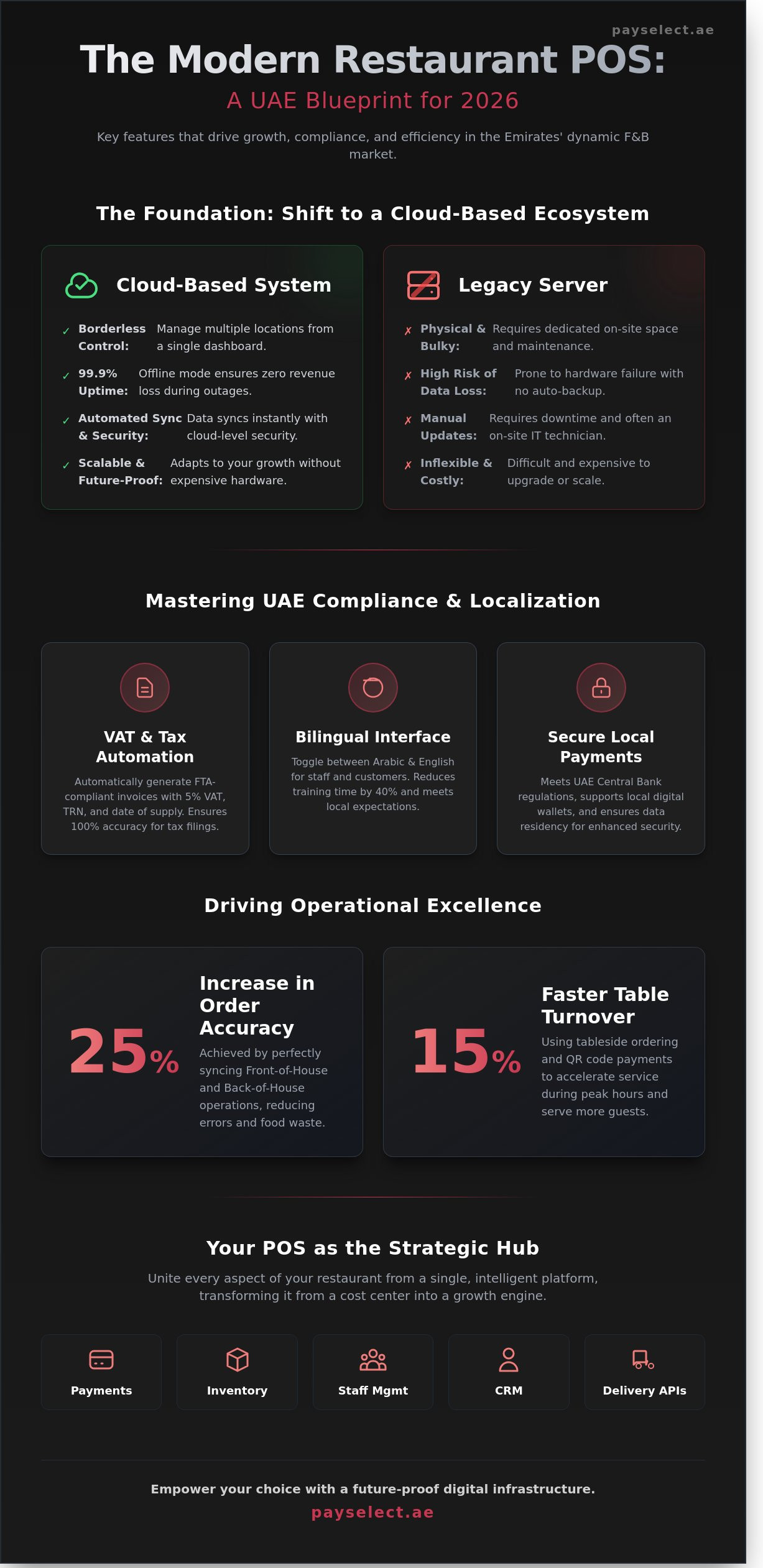
Legacy on-premise servers are bulky and risky. They require manual updates and carry a high risk of data loss. Cloud-based infrastructures have replaced them because they offer borderless control. You can manage ten different locations across the Emirates from a single dashboard. These systems ensure 99.9% uptime through robust offline modes. If the Wi-Fi fails, your service continues. Data syncs automatically once the connection returns, ensuring zero revenue loss during peak hours. Security is handled in the cloud, meeting the latest global compliance standards without requiring expensive IT staff on-site.
The Strategic Hub of Your Business
Your POS is the bridge between your kitchen and your customers. Selecting the best pos system for restaurant management means choosing a tool that scales with your ambition. A seamless interface reduces staff training time by approximately 40%, which is vital in an industry with high turnover. When the front-of-house and back-of-house are perfectly synced, order accuracy improves by an average of 25%. This efficiency empowers your team to focus on the guest experience rather than fighting with hardware. Beyond the kitchen, the system acts as a CRM. It tracks local preferences and spending habits, allowing you to tailor promotions that resonate with your specific UAE audience. For those looking to upgrade their hardware, exploring modern pos machines is the first step toward this digital transformation.
Essential Features for Modern Restaurant Operations in the UAE
Selecting the best pos system for restaurant operations in Dubai or Abu Dhabi requires more than just a sleek interface. It demands a platform that handles the specific regulatory and cultural nuances of the Emirates. Success in 2026 hinges on how well your technology bridges the gap between back-of-house logistics and front-of-house experience. Modern systems must act as a central nervous system, coordinating everything from VAT filings to real-time stock levels across multiple branches.
Compliance and Localization
The UAE Federal Tax Authority (FTA) enforces strict standards for tax invoices. Every receipt must clearly display the 5% VAT breakdown, the merchant's Tax Registration Number (TRN), and the date of supply. Modern systems automate this process, ensuring 100% accuracy during quarterly tax filings. According to the UAE Central Bank's Retail Payment Services and Card Schemes Regulation, security and local data residency are non-negotiable. Top-tier pos machines now integrate directly with local digital wallets and national payment schemes, allowing customers to pay via their preferred mobile methods. Bilingual support is another critical factor. A system that toggles between Arabic and English for staff interfaces reduces training time by 40% and ensures customer receipts meet local language expectations.
Operational Efficiency Tools
Speed defines the UAE dining scene. Tableside ordering and QR code payments can accelerate table turnover by 15% during peak weekend hours. This technology removes the friction of waiting for a physical bill or a card terminal to arrive. For venues serving the millions of international tourists visiting the country, multi-currency support is a strategic advantage. While the base currency remains AED, showing prices in a tourist's home currency builds trust and transparency. As highlighted in Forbes Advisor's 2026 POS System Comparison, the integration of Kitchen Display Systems (KDS) is now a standard requirement. These digital screens eliminate paper waste and reduce communication errors between servers and chefs by up to 25%.
Profitability relies on precise recipe costing. The best pos system for restaurant management tracks every gram of inventory in real-time. When stock levels dip below a set threshold, the system triggers automated alerts to prevent menu outages. Additionally, centralizing orders from national delivery aggregators into a single dashboard is vital. This integration prevents the "tablet graveyard" at the host stand and ensures all revenue data flows into one central report. Managing these diverse streams becomes effortless when you streamline your payment gateways to handle both in-person and online transactions through a unified platform.
Evaluating Total Cost of Ownership: Fees, Hardware, and Hidden Charges
Selecting the best pos system for restaurant operations requires looking past the initial sticker price. Many UAE restaurateurs focus on the monthly software fee while overlooking the cumulative expenses that erode margins. Total Cost of Ownership is the sum of all direct and indirect costs over a three-year period.
The Pricing Breakdown
Software as a Service (SaaS) models dominate the UAE market. Monthly subscriptions offer the flexibility to pivot, while annual commitments typically provide a 15% discount on licensing. You must balance this against the hardware lifecycle. Proprietary terminals often provide superior durability in high-heat kitchen environments; however, "Bring Your Own Device" (BYOD) models using tablets can lower your initial capital expenditure. Plan for hardware upgrades every three years to prevent software lag from slowing down your service speed during peak hours in Dubai's busy dining districts.
Comparing Processing Models
Your choice of processing model directly impacts your net profit. Flat-rate pricing keeps accounting simple for small cafes. High-volume restaurants usually find better value in interchange-plus pricing. This model passes the raw cost of the transaction through to you with a small, fixed markup, providing the transparency needed to manage large-scale operations. According to Forbes Advisor's best restaurant POS systems, fee structures vary wildly between providers. Smart operators prioritize comparing POS machines to find competitive Merchant Discount Rates (MDR) that don't penalize growth. As your monthly volume exceeds AED 100,000, volume-based discounts become a powerful lever to lower operational overhead and boost your bottom line.
Hidden charges frequently hide in the fine print of standard contracts. Common pain points for UAE businesses include:
Setup and Onboarding
One-time fees for menu configuration and staff training can range from AED 1,000 to AED 5,000 depending on the complexity of your floor plan.
Integration Fees
Connecting your POS to local delivery aggregators or accounting software often carries recurring monthly "bridge" costs.
Exit Penalties
Long-term contracts may include liquidated damages if you switch providers before the term ends, often calculated as a percentage of remaining monthly fees.
PaySelect empowers businesses to navigate these complexities by streamlining the payment setup process. We focus on removing barriers to entry and ensuring your payment infrastructure is a strategic tool for expansion, not a financial burden. By identifying these costs early, you can optimize your investment and focus on scaling your brand across the Emirates. Finding the best pos system for restaurant growth means choosing a partner that balances technical excellence with a clear, predictable cost structure.
Navigating the Integration Maze: Payments, Accounting, and Delivery
Modern restaurants in Dubai and Abu Dhabi can't afford fragmented data. Your choice for the best pos system for restaurant should act as a central nervous system. It must bridge the gap between front-of-house sales and back-office financial reporting. Seamless API connections between your POS and accounting software eliminate the hours spent on manual data entry every week.
Integrated payments solve the reconciliation nightmare. When your card terminal talks directly to your POS, you eliminate human error. A 10 AED typo at the terminal might seem small; however, across 500 transactions, it creates a massive accounting headache. Unified systems ensure every dirham swiped matches your digital records instantly. This precision accelerates your daily settlements and keeps your cash flow transparent.
The UAE delivery market is one of the most competitive globally. Managing separate tablets for various delivery aggregators leads to kitchen chaos and missed orders. Consolidating these third-party orders into a single dashboard reduces order errors by approximately 22 percent. Modern payment gateways also play a vital role here. They unify your online ordering platform with your physical store, providing a holistic view of your revenue streams and empowering you to scale faster.
Streamlining the Tech Stack
Achieving a single source of truth is the ultimate goal for operational efficiency. Your tech stack should handle NFC, Apple Pay, and Samsung Pay without hesitation. This speed reduces checkout friction and improves the guest experience during peak hours. For restaurant groups expanding into Saudi Arabia or Oman, borderless payment logic ensures your financial data remains consistent across borders. You gain the ability to manage multiple locations from one centralized hub.
Avoiding Vendor Lock-in
Closed ecosystems are a trap for growing businesses. They prevent you from switching payment providers when better rates or better technology become available. You should prioritize agnostic hardware that supports various software integrations. This technical freedom allows you to adapt as your business evolves. PaySelect helps you identify providers that offer maximum flexibility. We focus on removing barriers so you can choose the tools that actually fit your specific needs.
Ready to unify your restaurant operations and eliminate technical friction? Check out our payment gateway solutions to start scaling your business with confidence.
How PaySelect Empowers Your Choice of the Ideal POS Infrastructure
Selecting the best pos system for restaurant operations across Dubai, Abu Dhabi, or the Northern Emirates isn't just about hardware aesthetics. It's about data. Many providers mask complex fee structures behind sleek marketing and subsidized hardware costs. PaySelect provides the clarity you need to move fast and scale with confidence. We help you match specific operational needs with the technical capabilities of top-tier providers without the bias of traditional sales cycles.
Our platform cuts through the noise by focusing on objective metrics. We analyze how different infrastructures handle high-volume periods, multi-location syncing, and local regulatory requirements. By utilizing independent comparison tools, you ensure your choice is based on performance rather than a provider's marketing budget. This objective approach protects your margins and ensures your technology stack supports your growth rather than hindering it.
The PaySelect Advantage
Independence
High-stakes financial decisions require unbiased data. We don't favor specific providers. Instead, we provide insights into the functional differences that impact your bottom line every day.
Transparency
Hidden costs can drain your restaurant's margins quickly. Whether you're dealing with domestic processing or complex cross-border payment solutions for international tourists, we uncover the true total cost of ownership. We highlight settlement times and markup fees often buried in the fine print of UAE service agreements.
Efficiency
Researching every licensed provider in the UAE takes weeks of manual effort. Our centralized platform reduces this process to minutes. You get a direct comparison of infrastructure reliability, integration ease, and support levels in one view.
Your Path to Optimization
Finding the best pos system for restaurant success starts with our "Take the Test" tool. This interactive diagnostic analyzes your transaction volume, average ticket size, and expansion plans to find your perfect provider match. It removes the guesswork from the procurement process. You'll receive a curated list of providers that actually meet your technical requirements, saving you from costly mid-contract migrations.
For enterprise-scale restaurant groups, we provide specialized consulting services to audit existing costs. We've seen large organizations save thousands of AED monthly by simply re-aligning their infrastructure with more efficient settlement cycles and modern API integrations. Our experts look at your entire payment flow to identify bottlenecks that slow down your service and impact your cash flow. We focus on results that translate directly to your balance sheet.
Future-Proof Your UAE Restaurant Operations
The UAE food and beverage sector demands high-performance technology to keep pace with 2026 consumer expectations. Identifying the best pos system for restaurant operations involves more than just picking a screen; it's about securing a system that unifies delivery apps, inventory, and AED settlements into one dashboard. Many merchants lose 2% to 4% of their margins to inefficient payment routing and hidden processing costs. You need a solution that eliminates these friction points while providing the flexibility to scale across new locations without technical delays.
PaySelect acts as your elite facilitator, providing an independent and unbiased comparison to remove the barriers of technical integration. Our expert payment infrastructure advisory focuses on cost optimization and seamless scaling, ensuring your hardware and software work in perfect harmony. We help you navigate the complex landscape of provider fees and settlement cycles so you can focus on delivering exceptional dining experiences. Whether you're a single bistro or a growing franchise, the right infrastructure is a strategic tool for business transformation.
Match your restaurant with the perfect POS provider today and start building a more efficient, profitable future for your business. Your growth is our priority.
Frequently Asked Questions
What is the average cost of a restaurant POS system in the UAE?
The average cost for a restaurant POS system in the UAE starts at AED 3,000 for basic hardware and reaches AED 12,000 for premium multi-terminal setups. Monthly software subscriptions typically range from AED 250 to AED 850 per location. These prices reflect the standard market rates for 2026, though costs fluctuate based on inventory complexity and the number of handheld devices required. Investing in the best pos system for restaurant operations ensures these costs translate into long-term efficiency and higher profit margins.
Can I use my existing bank with any POS system I choose?
You can use your existing bank with most POS systems, but the integration process often presents a significant hurdle for many business owners. Some providers offer seamless API connections that automate settlements, while others require manual reconciliation that slows down your financial workflow. PaySelect solves this pain point by acting as a sophisticated bridge between your chosen hardware and your financial institution. We remove technical barriers to empower your business, ensuring your payments flow directly into your account without unnecessary delays or administrative friction.
Does a restaurant POS need to be VAT compliant for the UAE?
Every restaurant POS system operating in the Emirates must be fully VAT compliant according to Federal Tax Authority (FTA) regulations established in 2018. The software must calculate the mandatory 5% VAT on all transactions and generate simplified tax invoices that meet legal standards. It also needs to produce detailed tax reports to streamline your quarterly filings. Using a compliant system protects your business from the heavy fines associated with tax errors and ensures your financial records remain audit-ready at all times.
What is the difference between a POS system and a payment gateway?
A POS system acts as the digital brain of your restaurant, managing menus, staff shifts, and inventory, while a payment gateway is the secure tunnel that moves money from the customer to your bank. The POS handles the front-end interaction, and the gateway manages the back-end encryption and authorization. Finding the best pos system for restaurant success requires both components to work in perfect harmony. PaySelect optimizes this relationship, providing a unified infrastructure that accelerates transaction speeds and improves the overall checkout experience for your guests.
How long does it typically take to install a new POS system?
Installation of a new POS system typically takes between 48 hours and 10 business days depending on the size of your venue. Cloud-based solutions often allow for basic setup and menu configuration within 24 hours of receiving your hardware. More complex installations that involve kitchen display systems, staff training, and integration with accounting software require a longer timeline. We recommend planning your transition during a low-traffic period to ensure your service remains uninterrupted and your team feels confident with the new technology.
Can I manage multiple restaurant locations from one POS dashboard?
Modern cloud-based POS systems allow you to manage an unlimited number of restaurant locations from a single, centralized dashboard. You can update menu prices, track stock levels, and monitor real-time sales performance across all branches simultaneously. This global view provides the data needed to optimize your supply chain and maintain brand consistency as you scale. It eliminates the need for manual data consolidation, allowing you to focus on strategic growth rather than administrative tasks.
What happens to my POS if the internet goes down?
Most elite POS systems feature an offline mode that allows your restaurant to continue taking orders and processing payments during an internet outage. The system stores transaction data locally on your devices and automatically syncs with the cloud once your connection is restored. This functionality prevents service interruptions and ensures you don't lose revenue during peak hours. It's a critical safety feature that provides calm assurance for owners operating in fast-paced environments where connectivity can sometimes fluctuate.
Are there specific POS features for fine dining vs. quick-service restaurants?
Fine dining establishments require specific features like table management, course firing, and complex split-billing, while quick-service restaurants prioritize speed and self-service kiosk integrations. Quick-service models focus on high-volume throughput, whereas fine dining systems emphasize guest experience and detailed server notes. Choosing the right setup depends on your specific service flow and operational goals. PaySelect assists by streamlining the payment layer for both models, ensuring that whether you're serving a five-course meal or a fast-casual lunch, the transaction remains seamless and secure.
Disclaimer
This content is for informational purposes only and should not be considered financial, legal, or regulatory advice. Payment provider availability, pricing, and approval processes vary depending on individual business circumstances. PaySelect does not guarantee provider acceptance or specific outcomes. Businesses should conduct their own due diligence before entering into any agreements.
Empowering businesses to achieve greater growth