
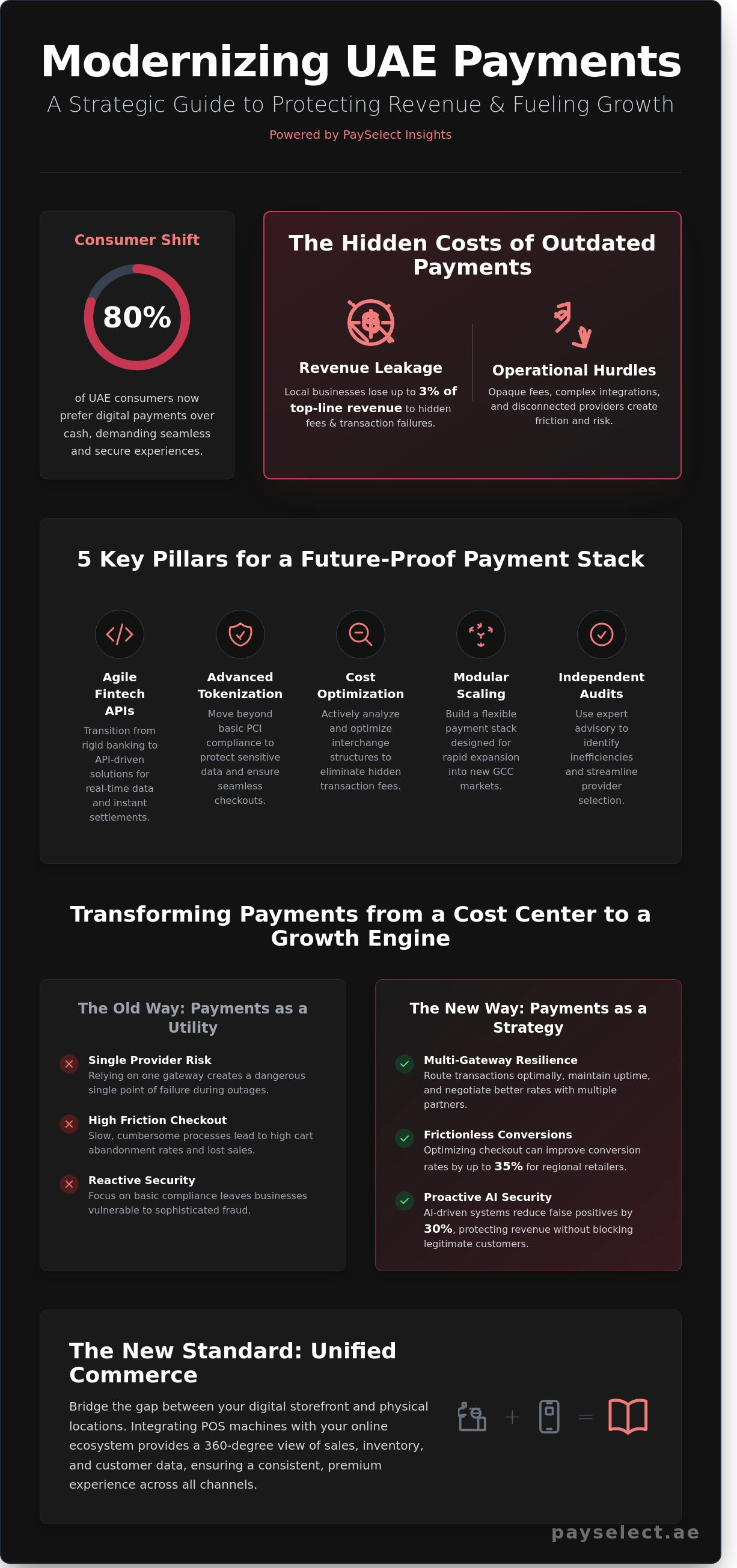
According to recent industry data, 80% of UAE consumers now prefer digital payments over cash, yet many local businesses lose up to 3% of their top-line revenue to hidden fees and avoidable transaction failures. Adopting the best practices in Payments is the only way to protect your margins and ensure long-term stability. You've likely felt the frustration of opaque fee structures that drain your AED reserves or technical integrations that feel more like hurdles than bridges. It's exhausting to worry about whether your checkout will hold up during a high-traffic sales event across the UAE while you're forced to manage multiple, disconnected providers.
This guide empowers you to secure your revenue and scale your infrastructure with the calm assurance of a sophisticated fintech partner. You'll learn how to optimize your merchant discount rates (MDR) and build a borderless experience that converts global customers into loyal advocates. We'll provide a clear framework to evaluate providers, streamline your technical stack, and show you how PaySelect removes barriers to help you scale, integrate, and succeed. It's time to transform your payment processing from a technical utility into a strategic tool for business growth.
Key Takeaways
• Transition from traditional banking to agile, API-driven fintech solutions to eliminate revenue leakage and modernize your organization's financial infrastructure.
• Move beyond basic compliance by implementing advanced tokenization strategies that protect sensitive merchant data and ensure a seamless checkout experience.
• Identify and eliminate hidden transaction costs by implementing best practices in Payments to optimize your interchange structures and protect your bottom line.
• Build a modular payment stack designed for rapid scaling, allowing your business to enter new GCC markets with speed and operational efficiency.
• Navigate the complex UAE fintech landscape using independent audits to identify infrastructure inefficiencies and streamline your provider selection process.
The Evolution of Payment Infrastructure in the UAE (2026)
The UAE has fundamentally transformed its financial core. By 2026, the transition from legacy banking to agile, API-driven fintech is complete. Businesses that once relied on static payment system infrastructure now demand real-time data, instant settlements, and borderless connectivity. This shift has turned the UAE into a global fintech hub, supported by the Central Bank's focus on digital transformation and the Aani instant payment platform.
Sticking to a "set and forget" strategy is a critical mistake that costs UAE merchants millions in hidden revenue leakage. These losses stem from unoptimized routing, excessive transaction fees, and failed authorizations that often go unnoticed. Modern Best practices in Payments require constant monitoring and optimization. Businesses must move beyond simple transaction processing to stay competitive in an economy that moves at the speed of light.
Unified commerce is the new standard. It bridges the gap between digital storefronts and physical locations, ensuring a consistent experience for every customer. This integration allows businesses to streamline operations, accelerate growth, and scale with confidence.
From Utility to Strategic Business Asset
Payments are no longer just a back-office utility. They're a primary driver for customer retention and conversion. Implementing Best practices in Payments means focusing on frictionless checkouts that reflect your brand’s prestige. A checkout process that is slow or cumbersome leads to immediate cart abandonment. In fact, reducing checkout friction can improve conversion rates by as much as 35% for regional retailers.
Relying on a single provider creates a dangerous point of failure. Transitioning to a multi-gateway approach builds resilience into your business model. This strategy empowers you to:
• Route transactions through the most efficient channels.
• Maintain uptime during provider outages.
• Negotiate better rates by leveraging multiple partners.
PaySelect helps businesses identify these pain points by offering insights into provider performance, ensuring your setup is always optimized for maximum success.Meeting Modern Consumer Expectations
UAE consumers are some of the most tech-savvy in the world. They expect invisible payments and biometrically authenticated transactions that happen in seconds. Offering local payment methods is non-negotiable for any brand looking to expand within the region. If a customer can't pay with their preferred local card or wallet, they will take their business elsewhere.
Holistic business management requires a 360-degree view of your sales. Integrating POS machines with your digital ecosystem is essential. This connection ensures that inventory, customer data, and financial reports are synced across all channels. Whether a customer buys online or taps their watch in a boutique, your data remains accurate and actionable. This level of sophistication transforms payments from a technical necessity into a strategic tool for total business transformation.
Core Pillars of Secure and Seamless Transaction Processing
Modern commerce demands more than basic setups. Implementing Best practices in Payments requires a shift from passive compliance to active protection. While PCI-DSS remains the baseline, high-growth merchants now utilize tokenization to replace sensitive card data with unique identifiers. This ensures that even if a breach occurs, the data remains useless to bad actors. It's a critical layer for any business handling high volumes of AED transactions daily.
Multi-factor authentication (MFA) is no longer a choice; it's a necessity for digital trust. Smart systems use behavioral biometrics to keep the user experience smooth, triggered only when risk is detected. AI-driven fraud detection helps here by analyzing patterns in real-time. These systems reduce false positives by up to 30% compared to legacy rule-based filters. This means legitimate customers aren't blocked, and revenue remains protected without manual intervention.
Advanced Security Protocols Beyond Compliance
The UAE market is evolving rapidly. 3D Secure 2.0 acts as a bridge between security and speed by using data-rich authentication. This reduces checkout friction while meeting the rigorous standards of the UAE National Payment Systems Strategy. End-to-end encryption standards protect data during every stage of transit, from the customer's device to the final settlement. By maintaining transparent billing and robust verification, businesses can reduce chargeback risks by approximately 25% annually. Clear communication at the point of sale prevents disputes before they start.
Leveraging Automation for Operational Efficiency
Efficiency defines the winners in the digital economy. Automating reconciliation removes manual accounting errors that typically plague 15% of back-office operations. Real-time settlement is vital for healthy cash flow. It allows businesses to access their AED funds faster than traditional three-day windows, providing the liquidity needed for rapid scaling. Streamlining recurring billing ensures predictable revenue for subscription models, automatically handling card updates and retries. This level of automation turns payment processing from a cost center into a strategic advantage. For those looking to optimize their digital storefront, choosing the right payment gateways can simplify these complex integrations into a single, manageable interface.
Different payment providers offer varying levels of integration depth. Some focus on speed of setup, while others prioritize deep data analytics. Understanding these differences is a core part of Best practices in Payments. A business must evaluate if a provider offers the flexibility to scale across borders or if they're limited to local processing. The goal is to remove every barrier between the customer's intent to buy and the final confirmation of the sale.
Optimising Payment Costs and Interchange Structures
Every transaction processed in the UAE involves a complex flow of capital. To master best practices in Payments, you must look beyond the headline rate. A processing fee isn't a single charge. It's a combination of three distinct layers. First, the Interchange fee goes to the card-issuing bank. Second, Assessment fees are paid to networks like Visa or Mastercard. Finally, the Processor Markup is what your provider charges for their service. Businesses often focus only on the final number, but understanding these layers is the key to negotiation.
The cheapest headline rate often masks the highest total cost of ownership. Low entry rates might be offset by high "junk fees" hidden in your monthly statement. Look for charges labeled as statement fees, administrative overhead, or PCI non-compliance penalties. These can add hundreds of د.إ to your monthly expenses without providing any functional value. High transaction volume gives you the leverage to negotiate better Merchant Discount Rates (MDR), but you can only do this if you know exactly where your money is going.
Decoding Complex Fee Structures
Merchant Discount Rate is the total percentage a merchant pays per transaction.
Startups often prefer blended pricing for its simplicity. However, as your volume exceeds 100,000 د.إ monthly, switching to an Interchange-plus model often reveals significant savings. This model separates the non-negotiable bank costs from the provider's margin, offering the transparency needed for scaling. You should also scrutinize currency conversion costs. In the UAE, FX markups on international transactions can range from 1% to 3% above mid-market rates. These hidden costs frequently outweigh the base processing fee for businesses with a global customer base.
The Power of Real-Time Analytics and Reporting
Data-driven decision-making is central to best practices in Payments. High-risk transaction patterns often lead to false declines, which cost global merchants billions in lost revenue annually. By analyzing decline codes in real time, you can optimize your checkout flow to improve approval rates. This ensures legitimate customers aren't turned away by over-sensitive fraud filters.
Monitoring settlement cycles is equally vital for healthy cash flow. In the local market, moving from a T+5 to a T+2 settlement cycle significantly improves working capital management. This liquidity allows you to reinvest in inventory or marketing without delay. Selecting the right partner requires a thorough payment gateway comparison to ensure your tech stack supports this level of granular reporting. Transparency isn't just about costs; it's about having the visibility to scale your operations with confidence.
Strategic Implementation for Scaling and Cross-Border Growth
Scaling a business across the GCC requires more than just a merchant account. It demands a strategic approach to your financial infrastructure. Best practices in Payments dictate that your stack must be modular. This flexibility allows you to swap or add providers without rebuilding your entire system from scratch. You need a setup that handles the complexity of the UAE market while remaining agile enough to enter new territories like Saudi Arabia or Oman.
Many businesses struggle with fragmented systems that don't communicate. This creates data silos and manual work for your finance team. By focusing on a unified strategy, you can eliminate these bottlenecks. A well-designed payment architecture acts as a catalyst for expansion. It ensures that as your transaction volume grows, your operational costs don't spiral out of control. Success depends on your ability to process transactions efficiently across different jurisdictions and currencies.
Building a Future-Proof Payment Stack
Your payment architecture should be a bridge to your customers. Prioritize API flexibility to ensure your payment data flows directly into your ERP and CRM systems. This automation eliminates manual reconciliation errors and provides a real-time view of your cash flow. Payment orchestration is the next logical step for a growing enterprise. It allows you to manage multiple payment providers through a single interface, providing essential redundancy. If one provider experiences technical issues, your system can automatically reroute the transaction to another. This ensures your checkout remains active 24/7. Your infrastructure must also support 2024 trends like BNPL and digital wallets. These methods now account for over 45% of e-commerce volume in the UAE, and failing to offer them can lead to significant cart abandonment.
Navigating the Nuances of International Commerce
Expanding into new markets involves distinct regulatory hurdles and technical challenges. You can optimize cross-border payments to protect your margins from high FX fees. Many businesses lose between 3% and 5% of their transaction value through poor currency conversion strategies. Following Best practices in Payments means implementing local acquiring. Processing a transaction through a bank located in the same country as the customer can increase authorization rates by up to 25%. This approach reduces the likelihood of transactions being flagged as suspicious by issuing banks. Consider these strategies for regional growth:
Multi-Currency Settlements
Collect in various GCC currencies but settle in AED to keep your accounting simple.
Regional Compliance
Stay updated on MENA-specific data residency and security requirements to avoid heavy fines.
Local Payment Methods
Integrate domestic card schemes specific to each GCC country to build trust with local shoppers.
A sophisticated payment partner helps you manage these variables without increasing your internal workload. This allows you to focus on your core product while the technical complexities of money movement are handled in the background.
Ready to take your business global? Accelerate your international expansion with PaySelect today.
Streamlining Selection with Independent Payment Advisory
The UAE fintech market has expanded rapidly, with hundreds of providers competing for your business. This abundance often leads to the paradox of choice. Merchants find themselves paralyzed by options, unable to distinguish between genuine technical superiority and clever marketing. Selecting the wrong partner doesn't just result in higher fees; it creates technical debt that slows your growth. Adopting best practices in Payments requires moving beyond brand recognition to focus on data-driven infrastructure audits.
Overcoming the Paradox of Choice
Many businesses choose a payment provider based on name recognition alone. This is a high-stakes gamble. A brand that excels in retail might lack the specific recurring billing features needed for a subscription service. You need a structured evaluation matrix to compare technical capabilities accurately. This matrix should weigh factors like API flexibility, settlement speeds in AED, and success rates for local cards like Mercury.
Industry-specific needs are equally critical. A hospitality business requires pre-authorization and seamless PMS integrations, while an e-commerce platform prioritizes checkout conversion and fraud detection. Failing to align your stack with these specific demands leads to manual reconciliation errors and lost revenue. Independent audits identify these inefficiencies, showing where your current setup fails to meet best practices in Payments.
How PaySelect Empowers UAE Businesses
PaySelect removes the bias from the selection process. We don't favor specific providers; we favor results. Our platform transitions your business from manual, time-consuming comparisons to automated matching based on real-time data. By analyzing your transaction volume, average ticket size, and target demographics, we pinpoint the providers that offer the most efficient path to settlement.
The "Take the Test" Tool
This diagnostic matches your specific merchant profile with providers that excel in your sector.
Bespoke Consulting
For enterprise-scale operations, we conduct deep-dive audits to restructure payment strategy and reduce hidden costs.
Objective Analysis
We provide transparency in a market that is often opaque, ensuring you understand the true cost of every transaction.
Don't let legacy systems or biased advice hold your business back. It's time to optimize your financial infrastructure with a partner that understands the local landscape. Optimize your payment stack with PaySelect today and experience the clarity of independent advisory.
Secure Your Competitive Edge in the 2026 UAE Economy
Success in the UAE's digital economy requires more than just accepting cards. It demands a strategic approach to infrastructure that prioritizes seamless integration and interchange transparency. By 2026, the Central Bank of the UAE's digital transformation initiatives will make legacy systems obsolete. Adopting Best practices in Payments allows your business to reduce transaction friction and reclaim lost revenue from inefficient fee structures. Many enterprises face the pain of opaque pricing and technical bottlenecks that stall expansion into new MENA markets.
PaySelect acts as your elite fintech partner, offering independent and unbiased advisory services tailored to the unique regulatory environment of the Emirates. We specialize in the UAE and MENA payment landscape, delivering proven cost-optimization strategies that empower enterprises to scale without borders. Don't let complex settlement cycles or high provider margins limit your potential. It's time to transform your payment setup from a utility into a powerful driver of global growth today.
Start your independent payment provider comparison now
Your journey toward a more profitable and borderless future starts with the right technical foundation.
Frequently Asked Questions
What are the most important best practices for payment security in 2026?
The most important best practices in payments for 2026 center on AI-powered fraud prevention and mandatory biometric authentication. Under CBUAE 2023 regulations, businesses must implement multi-factor authentication to secure transactions effectively. PaySelect streamlines this by integrating advanced encryption that protects customer data while maintaining a frictionless checkout experience. This approach reduces chargeback risks and builds consumer trust across the Middle East.
How can I lower my merchant discount rate (MDR) in the UAE?
You can lower your merchant discount rate (MDR) in the UAE by leveraging local payment schemes like Mercury and increasing your monthly transaction volume. Merchants processing over 500,000 AED monthly often negotiate better rates with acquirers. PaySelect helps businesses optimize costs by routing transactions through the most efficient channels. This strategy minimizes cross-border fees and ensures you pay only for the value you receive.
What is the difference between a payment gateway and a payment processor?
A payment gateway acts as the digital bridge that encrypts data, while a payment processor executes the actual fund transfer. Think of the gateway as the front-end connector and the processor as the back-end engine. PaySelect bridges this gap by offering a unified interface that manages both functions. This integration removes technical barriers and allows your business to scale without managing multiple complex relationships.
Is it better to use a single payment provider or multiple gateways?
Using multiple gateways offers better redundancy and higher success rates compared to relying on a single provider. If one system experiences downtime, your business remains operational by switching traffic automatically. PaySelect empowers entrepreneurs to manage multiple providers through a single dashboard. This setup ensures 99.9% uptime and allows you to choose the best-performing route for every transaction.
How long does it typically take to integrate a new payment system?
Integrating a new payment system typically takes between 3 and 14 business days depending on the complexity of your API requirements. Simple plug-and-play solutions for major e-commerce platforms are faster, while custom enterprise setups require more testing. PaySelect accelerates this timeline by providing clear documentation and dedicated support. Our goal is to get your business processing live transactions with minimal delay.
What are the common hidden fees to look for in a payment provider contract?
Common hidden fees include monthly maintenance charges, PCI compliance penalties, and settlement fees that can cost up to 50 AED per transfer. Many providers also hide non-qualified surcharges deep in their contracts. PaySelect eliminates these pain points by offering transparent structures that highlight every cost upfront. This clarity helps you maintain healthy margins and avoid unexpected expenses at the end of the month.
Can I use the same payment system for both online and in-store sales?
You can use the same payment system for both online and in-store sales through an omnichannel integration. This unified approach syncs your inventory and financial reporting into one central location. PaySelect facilitates this by connecting your digital storefront with physical point-of-sale terminals. It creates a borderless experience for your customers, whether they're shopping on a smartphone or at a physical counter in Dubai.
What is payment orchestration and does my business need it?
Payment orchestration is a technology layer that automatically routes transactions to the best-performing processor to increase approval rates. Your business needs it if you process high volumes or operate in multiple regions across the globe. PaySelect provides sophisticated orchestration tools that analyze transaction data in real-time. This optimization reduces failed payments and ensures your global reach isn't limited by technical friction.
Disclaimer
This content is for informational purposes only and should not be considered financial, legal, or regulatory advice. Payment provider availability, pricing, and approval processes vary depending on individual business circumstances. PaySelect does not guarantee provider acceptance or specific outcomes. Businesses should conduct their own due diligence before entering into any agreements.
Empowering businesses to achieve greater growth