
The lowest-fee option may end up costing your ecommerce business more in time or operational effort. Choosing the best payment gateway for ecommerce uae means looking beyond the headline rate: checkout experience, the payment methods your customers expect, and how well the setup supports daily operations all matter.
Provider differences can be difficult to compare. Pricing structures, payment capabilities, and international support vary, while an unclear or cumbersome checkout can create friction just as a customer is ready to pay. A setup that works now may also need to accommodate changing transaction volumes and new markets as your business grows.
This 2026 guide gives you a practical way to compare gateways against your customers, operations, and growth plans. It covers checkout and payment-method fit, commercial and operational trade-offs, and cross-border requirements, without treating one provider as a universal winner. PaySelect helps make the decision more manageable by matching options to your industry, transaction volume, and international requirements, so you can build a focused shortlist.
Key Takeaways
• The best payment gateway for ecommerce uae depends on how well it fits your customers, checkout, operations, and growth plans, not on a universal ranking.
• Compare payment options and ecommerce platform compatibility against your customers’ actual needs. This helps keep checkout convenient without adding unnecessary complexity.
• Weigh trade-offs across payment choice, integration effort, and operational fit instead of focusing on a single feature or headline fee.
• Build a shortlist by separating essential requirements from useful additions and future considerations, including the markets you plan to serve.
• PaySelect helps narrow gateway options using your industry, transaction volume, and international requirements.
What makes a payment gateway the right fit for UAE ecommerce?
Gateway fit is how well a payment option supports your customers’ checkout, your daily operations, and your plans to grow. That’s a more useful test than asking which option is “best” in general. A setup that suits a shop selling locally may not suit an international seller. And a long feature list doesn’t automatically make an option right for your business.
A payment gateway connects an online checkout with the services that handle payment information. It isn’t the same as the wider processing and acquiring arrangements behind a transaction. For a foundational overview of What is a Payment Gateway?, see the linked reference. Here, the focus is on choosing a gateway arrangement that fits how your ecommerce business sells and operates.
How ecommerce business models shape payment needs
A shop selling in one market may prioritise a straightforward local checkout. An international seller needs to consider customers in different markets and whether its payment setup supports its intended reach. Neither model automatically calls for a particular provider or feature. The key question is whether the payment experience suits the customers the business serves.
Sales models also shape expectations. Someone buying a one-off product may want a quick, clear payment decision. A subscription business needs to consider how payment fits into an ongoing customer relationship, while a marketplace must account for the needs of both buyers and sellers. Product type matters too: customers may approach a considered purchase differently from a routine order.
Start with the actual checkout journey: who pays, what they’re buying, and where they’re shopping from. This keeps the decision grounded in customer needs rather than assumptions about what every UAE ecommerce business should offer.
What “best” means for your checkout and operations
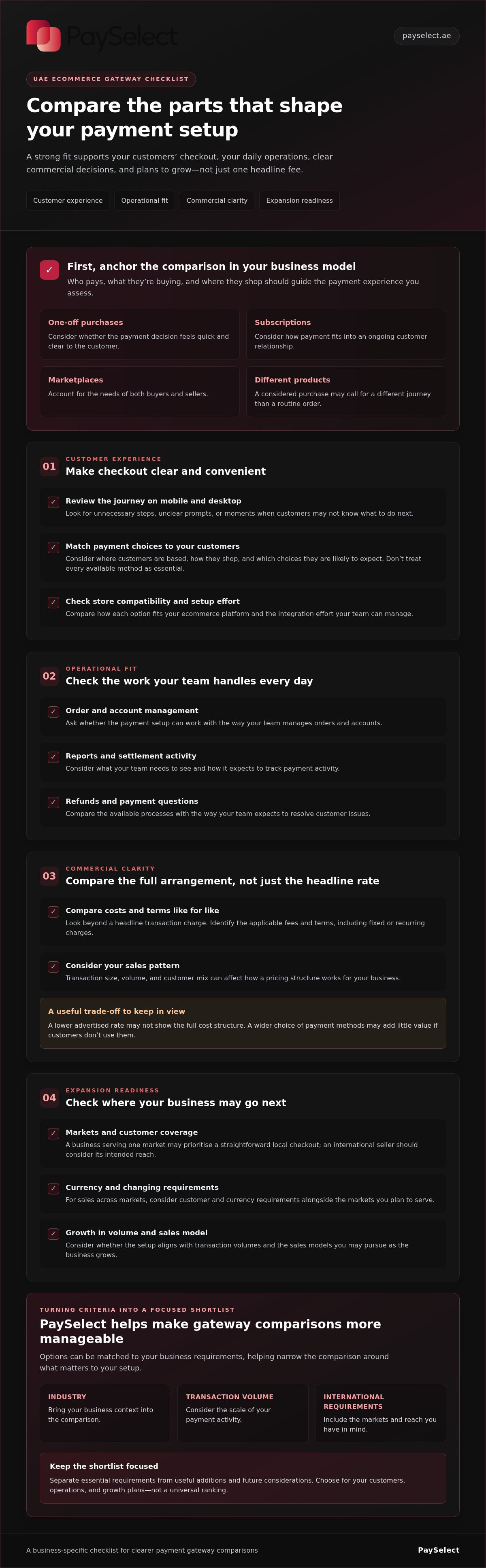
Assess fit across four areas:
Customer experience
Is the checkout clear and convenient for your intended customers? Review the steps a customer takes and whether the payment choices make sense for them.
Operational fit
Can the payment setup work with the way your team manages orders and accounts?
Commercial clarity
Can you understand the costs and terms well enough to assess the overall trade-off?
Expansion readiness
Does the setup align with the markets and sales models you may pursue next?
The best payment gateway for ecommerce uae is therefore a business-specific choice, not a universal winner. A small merchant may value a manageable setup and clear costs; a larger business may need to consider how payments connect with wider operations. A broad range of features matters only when it serves a real requirement. Extra options can add complexity without improving the customer journey or supporting a clear business goal.
A focused comparison can help bring those priorities into view. PaySelect’s UAE payment gateway comparison helps businesses assess options against their requirements, rather than relying on a generic ranking.
Which ecommerce payment gateway criteria should UAE merchants compare?
A useful comparison starts with your customers and day-to-day requirements, not a provider’s longest feature list. Some criteria affect the checkout directly; others shape how clearly your team can manage transactions, resolve issues, and understand the commercial arrangement. Compare every option against the same needs so the differences are easier to judge.
For a UAE merchant, the best payment gateway for ecommerce uae is the one that meets essential requirements without adding unnecessary complexity. Fees matter, but they’re only one part of the decision. A lower advertised rate may not reveal the full cost structure, just as a wide selection of payment options may add little value if your customers don’t use them.
Payment experience and customer coverage
Start with the people who buy from you. Consider where your customers are based, how they shop, and which payment choices they’re likely to expect. A business serving a defined customer group may prioritise a focused checkout; one selling across markets may need to consider a wider range of customer and currency requirements. Don’t treat every available method as essential.
Review the checkout on both mobile and desktop. Look for unnecessary steps, unclear prompts, or points where a customer may not know what to do next. Compare how each option fits your ecommerce platform and the integration effort your team can manage. The aim is a familiar, coherent payment journey that works with your online store, not a long list of technical features.
Commercial and operational fit
Compare pricing on a like-for-like basis. Look beyond a headline transaction charge and identify the full set of applicable fees and terms, including fixed or recurring charges. Consider your expected sales pattern too: the same pricing structure can affect businesses differently depending on transaction size, volume, and customer mix. Clear terms make the trade-offs easier to understand.
Daily management matters as well. Consider what your team needs to see in reports, how it will track settlement activity, and how it expects to handle refunds and payment questions. Treat these as comparison points, not assumed features. The question is whether the available information and processes fit your internal workflow. For a small shop, simplicity may be central; a larger merchant may need a closer fit with established finance and customer-service routines.
Use the same checklist for every option: customer payment relevance, mobile checkout, platform compatibility, integration effort, pricing structure, reporting, settlement visibility, refunds, and support arrangements. Mark each item as essential, useful, or not currently needed. This keeps the evaluation focused and prevents attractive extras from outweighing practical requirements.
PaySelect’s payment gateway comparison information can help you organise these requirements and narrow the field around your business needs, rather than selecting on fees alone.
How should you compare gateway trade-offs without chasing a single winner?
A useful comparison shows what each option could mean for your business, not which one has the most features. The right balance depends on your customers, sales markets, and how much payment complexity your team can manage. A focused setup may suit straightforward requirements; a merchant with international sales or more involved workflows may need to weigh additional capabilities against their operational impact.
Use the same questions for every option. The table below keeps the comparison merchant-focused, without turning it into a provider ranking.
| Criteria | Merchant question | Potential trade-off |
|---|---|---|
| Payment choice | Do these options match the payment habits and markets of my actual customers? | More choice may support a wider customer base, but options that customers don’t use can add unnecessary selection and management. |
| Operational complexity | Can my team manage the payment setup as part of its existing work? | A simpler arrangement may be easier to oversee, while additional capabilities could require more attention or coordination. |
| International requirements | Does the setup align with the countries where I sell and the needs of those customers? | Broader international suitability may support expansion, but can be unnecessary for a business focused on one market. |
| Workflow fit | Does the arrangement suit how my business handles orders and payment administration? | A closer fit can support daily operations; a mismatch may create extra steps even if the feature list looks extensive. |
Balancing checkout breadth with operational simplicity
More capability is valuable when it solves a real customer or business need. For example, a seller serving distinct customer groups may have reason to compare a broader range of payment options. But breadth alone doesn’t prove better fit. For each extra option, ask: who needs it, which market does it support, and what will the team need to manage?
Consider both sides before deciding. A compact offering isn’t automatically easier to operate, and a feature-rich one isn’t automatically harder. The effect depends on how the setup fits your checkout and internal routines. Avoid prioritising capabilities that don’t serve a current need or a credible growth plan.
When cross-border requirements change the comparison
International sales can change which questions matter most. The markets you serve, customer expectations there, and the workflows your team needs to support may shift the balance between simplicity and broader capabilities. If you’re preparing to expand, include those plans in your comparison without assuming you need every international feature from the outset.
Keep the assessment specific: identify target markets and customer needs, then compare options against them. PaySelect’s cross-border payment solutions help businesses consider international requirements as part of their gateway comparison. This makes it easier to judge the best payment gateway for ecommerce uae by actual fit, rather than feature count alone.
How can you shortlist the best ecommerce gateway for your business?
A useful shortlist starts with how your business sells, not with a list of popular features. Define your requirements first, then assess each available option against the same priorities. This makes the decision easier to explain and helps prevent a prominent feature or attractive headline from distracting from day-to-day fit.
Turn business requirements into a clear shortlist
Write down your customer markets, sales model, typical transaction profile, and operational constraints. Include the payment experience customers need and the work your team must handle. Then classify each requirement as essential, useful, or a future consideration. This ranking helps distinguish a genuine business need from a feature that sounds appealing but has no clear purpose.
Describe the business model.
Note whether you sell directly to consumers, operate a subscription service, or manage a marketplace. Record the markets you serve and the customer groups using your checkout.
Set payment priorities.
Identify what matters most to customers and staff, such as a straightforward checkout, suitable payment choices, or manageable payment administration. Rank these by their effect on customer experience and operations.
Separate needs by timing.
Mark each item as essential for your current operation, useful but not critical, or relevant only to a future plan. Keep essential criteria focused on real requirements.
Compare options consistently.
Apply the same criteria to every option. Note where each appears to align, where there is a trade-off, and what information still needs review. Don’t score one option on features you haven’t considered for the others.
This process works for a small UAE online shop as well as a larger merchant with established payment workflows. The scale differs, but the discipline is the same: compare like with like. Leave detailed fee calculations or technical implementation steps for their dedicated evaluations.
Validate the shortlist against future plans
Once you have a shortlist based on current needs, test it against realistic possibilities for the business. You might plan to serve additional markets, change how customers buy, or adjust internal payment workflows. Keep future needs distinct from essential requirements so a hypothetical expansion doesn’t outweigh what the business needs today.
For each future consideration, ask whether it is specific enough to affect the choice. A defined target market or sales-model change may warrant a place in the comparison. A vague ambition may not. This keeps the shortlist adaptable without turning it into a search for a gateway that can do everything.
The best payment gateway for ecommerce uae is the option that aligns with your ranked requirements and reasonable plans, not necessarily the one with the longest list of capabilities. PaySelect’s comparison tool helps narrow options using your industry, transaction volume, and international requirements. Use PaySelect to compare gateway options against your business needs.
How PaySelect helps UAE ecommerce businesses compare gateways
Comparing payment options can be difficult when providers present different capabilities, pricing structures, and terms. PaySelect makes the decision more manageable through its comparison tool and advisory support. PaySelect does not process payments. It helps businesses assess options and identify a relevant shortlist, while the merchant makes the final choice.
There isn’t one gateway that suits every UAE ecommerce business. A practical comparison starts with the business itself, then considers how well available options align with its needs. PaySelect’s “Take the Test” matching tool uses a merchant’s industry, transaction volume, and international requirements to help narrow the field. This gives you a more relevant starting point than a generic ranking or a feature list viewed in isolation.
What the PaySelect comparison process considers
Industry helps frame a comparison, while transaction volume describes the scale of a business’s payment activity. If the merchant serves customers internationally, those requirements can inform the match too. Together, these details help identify options to evaluate against the business’s priorities.
The match is a starting point, not a final verdict. Use the resulting shortlist to compare specific requirements, review trade-offs, and decide which option best fits your operation. This keeps the focus on practical suitability rather than declaring one provider the winner for every business. The best payment gateway for ecommerce uae is the one that aligns with the merchant’s circumstances and plans.
PaySelect provides comparison information and receives success-based fees for qualified merchant leads. This relationship is transparent: the platform supports comparison and connections, while the merchant retains control of the decision.
When tailored payment advisory can help
A comparison tool can help clarify the options, while larger organisations may have broader payment infrastructure needs. A business with multiple workflows or established systems, and a hotel group reviewing payment operations, may benefit from tailored infrastructure advisory. This work helps bring operational requirements and payment costs into a more structured assessment.
Payment cost optimisation is a consulting service, not a promise of savings. It examines the organisation’s situation and identifies areas for review based on its specific payment setup. For an enterprise, this can complement gateway comparison by considering how payment infrastructure supports wider operations, rather than focusing on a single checkout decision.
For a focused comparison, start with the requirements that matter to your business, then use PaySelect to narrow the options. Compare ecommerce payment gateways and build a shortlist around your needs.
Make your next payment decision with confidence
Your payment setup should be reviewed as your customers, sales model, and priorities evolve. Treat the choice as part of your ecommerce operations, not a one-time feature decision. A periodic review can help you spot when your current arrangement no longer fits the way your business serves customers or plans to expand.
Finding the best payment gateway for ecommerce uae starts with a clear view of what matters now and what may matter next. PaySelect’s independent comparison guidance helps businesses narrow options, while larger organisations can use tailored payment infrastructure advisory for more complex needs.
Take the next step with a shortlist grounded in your business requirements. Compare payment gateway options for your ecommerce business and move forward with greater clarity.
Frequently Asked Questions
What is the best payment gateway for ecommerce in the UAE?
There’s no single gateway that’s best for every UAE ecommerce business. The best payment gateway for ecommerce uae is the one that supports your customers’ checkout and suits your business operations. A store selling only within the UAE may prioritise different requirements from one serving overseas customers. Compare options against your sales model, customer needs, and store setup rather than relying on a general ranking.
Can an ecommerce business use more than one payment gateway?
Some ecommerce businesses use more than one gateway, but whether that makes sense depends on their platform, payment setup, and internal processes. Multiple arrangements may add work, such as keeping reports aligned or managing refunds across systems. Consider the specific reason for adding another option, such as serving a distinct market, and weigh that benefit against the additional administration.
How do I compare payment gateway fees for an online store?
Compare the full pricing structure using the same categories for each option. Review percentage-based and fixed transaction charges, recurring or setup fees if applicable, and terms that may affect international transactions. Then consider how those charges relate to your typical order size and sales pattern. A headline rate alone can hide differences, so compare the complete commercial terms rather than choosing by one figure.
Can an ecommerce payment gateway support international customers?
That depends on the gateway arrangement and the markets your business serves. List the countries where you currently sell or plan to sell, then consider the payment experience customers in those markets expect. Compare international requirements alongside your store’s operational needs. A gateway that suits local sales may not automatically fit a cross-border business, so include your target markets in the evaluation.
Do I need technical skills to choose an ecommerce payment gateway?
No. You can compare options by describing your business needs in plain language, including your ecommerce platform, customer markets, and preferred checkout experience. Technical input can help assess platform compatibility and integration effort, especially if your store has complex workflows, but it isn’t necessary to define your priorities. Keep gateway selection separate from implementation planning, which may involve your ecommerce or technical team.
What information should I prepare before comparing payment gateways?
Prepare a short profile of how your store sells: its industry, ecommerce platform, sales model, customer markets, and approximate transaction volume. Note whether sales are one-time, recurring, or a mix, and identify any operational constraints that affect payment management. Separate must-have requirements from potential future needs. These details make comparisons more relevant and help you avoid evaluating options against assumptions that don’t match your business.
Is PaySelect a payment gateway?
No. PaySelect is an independent UAE-based comparison platform that helps businesses compare and select payment gateways, POS systems, and cross-border payment solutions. It doesn’t process customer transactions. Its matching tool helps merchants identify options to consider, while the business makes the final selection and engages with its chosen payment provider for payment services. Larger organisations can also use PaySelect’s advisory and consulting for payment infrastructure needs.
Disclaimer
This content is for informational purposes only and should not be considered financial, legal, or regulatory advice. Payment provider availability, pricing, and approval processes vary depending on individual business circumstances. PaySelect does not guarantee provider acceptance or specific outcomes. Businesses should conduct their own due diligence before entering into any agreements.
Empowering businesses to achieve greater growth