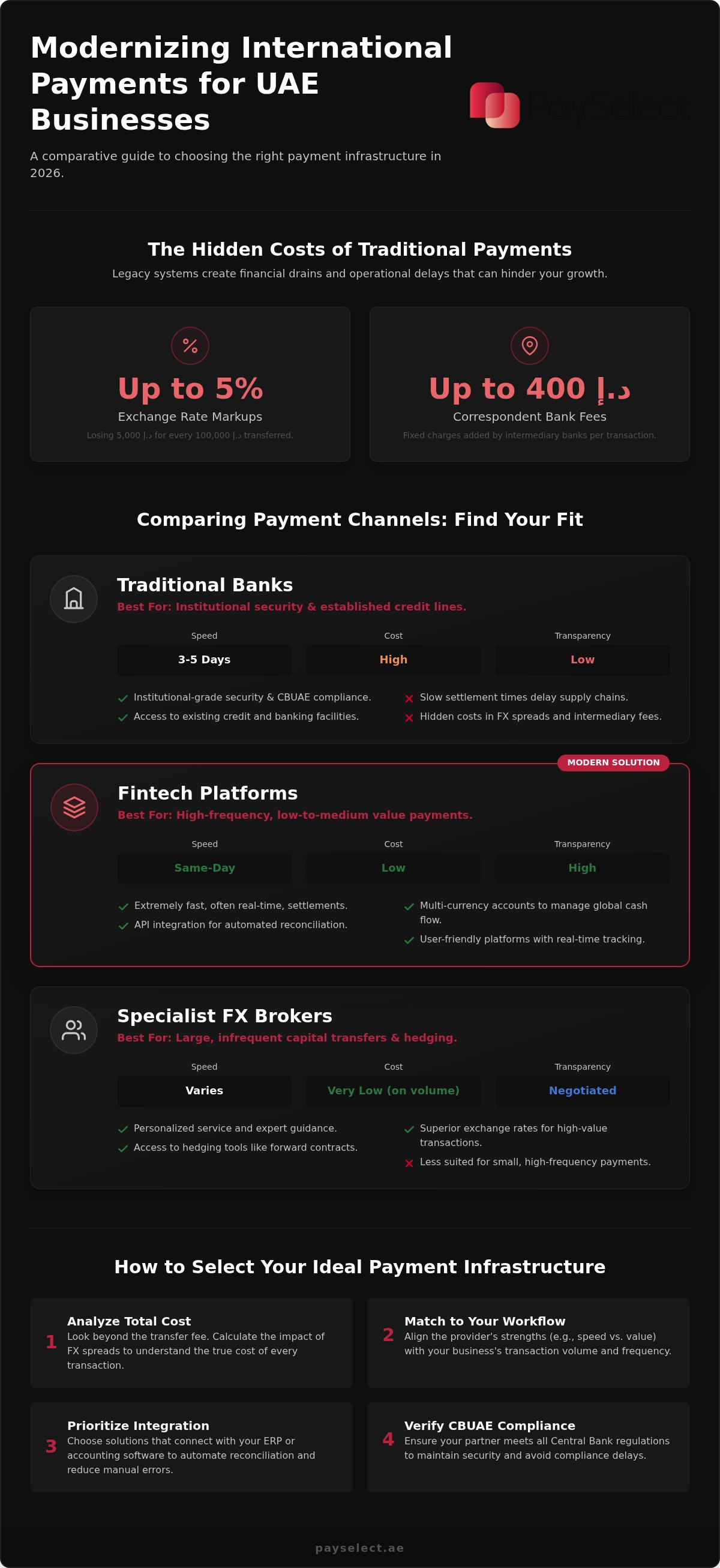
Did you know that traditional exchange rate markups can reach 5%, while correspondent bank fees often climb as high as 400 د.إ per transaction? In the fast paced economy of 2026, losing significant capital to opaque banking fees isn't just a nuisance. It's a direct hit to your bottom line. Finding the best way to pay international invoices uae companies can rely on means looking past legacy institutions toward modern, high speed infrastructure.
We understand the frustration of watching your supply chain stall because of delayed settlements or complex Central Bank compliance. You want transfers that land in hours, not days, with every fils accounted for. This guide shows you how to slash transaction costs and accelerate global transfers by selecting the right payment framework for your specific needs. We'll break down the shift toward specialized fintech providers, the impact of the latest CBUAE regulations, and how to achieve seamless reconciliation with your accounting software. It's time to transform your cross border payments from a bottleneck into a competitive advantage.
Key Takeaways
• Understand why UAE businesses are shifting from legacy SWIFT banking to hybrid fintech ecosystems to secure faster, more transparent global settlements.
• Discover why the best way to pay international invoices uae involves calculating the total cost of ownership, including hidden FX spreads and correspondent bank fees.
• Compare the strengths of tier-1 banks against specialized fintech providers to find the right balance between institutional security and digital efficiency.
• Learn how to integrate modern payment infrastructure with your existing ERP or accounting software to automate reconciliation and eliminate manual entry errors.
• Use independent matching tools to audit your current transaction costs and identify the specific infrastructure that aligns with your transaction volume.
The Evolution of International Invoice Payments in the UAE
The UAE financial landscape has shifted from a bank-centric model to a diverse ecosystem of digital-first payment systems. For years, the SWIFT network was the only viable path for global trade. However, by 2026, many local businesses have adopted hybrid models that combine the reliability of institutional banks with the agility of fintech. This transition is driven by a need for transparency and speed that legacy systems simply cannot match. Defining the best way to pay international invoices uae companies use now requires looking at a "Modern Payment Stack" that prioritizes direct currency corridors and real-time settlement.
Why Traditional Banking is No Longer the Default
Legacy bank transfers often rely on a chain of correspondent banks. Each intermediary adds a layer of cost and delay, sometimes taking three to five business days to settle a single invoice. Beyond the slow pace, the hidden costs are significant. Traditional institutions often profit from the "spread," which is the difference between the interbank rate and the rate offered to the client. These markups can reach 5%, meaning you might lose 5,000 د.إ for every 100,000 د.إ sent. Modern platforms offer a clearer alternative by providing mid-market rates and fixed fees, allowing for predictable cash flow management.
The Role of Compliance and Security in 2026
Security remains the anchor of UAE commerce. Under Federal Decree-Law No. (6) of 2025, the Central Bank of the UAE (CBUAE) expanded its oversight to include open finance and virtual assets. All financial institutions must achieve full compliance by September 16, 2026. This regulatory rigor ensures that even as transfers become faster, they remain protected by world-class AML (Anti-Money Laundering) protocols. Digital verification has also evolved. The "Know Your Business" (KYB) process is now a streamlined, automated experience. Choosing a provider that aligns with these cross-border payment standards is essential for maintaining supply chain integrity and avoiding unnecessary delays.
Comparing Payment Channels: Banks vs. Fintechs vs. FX Specialists
Identifying the best way to pay international invoices uae requires a strategic look at three distinct infrastructure pillars. While traditional tier-1 banks offer institutional-grade security and pre-existing credit facilities, they often struggle with the agility required for high-velocity trade. Modern businesses must decide between the safety of legacy systems and the efficiency of digital alternatives that prioritize speed and transparency.
Fintech Platforms: Speed and Integration
The UAE's financial technology sector has matured into a powerhouse of API-driven solutions. These platforms prioritize the user experience, offering multi-currency accounts that allow businesses to hold and send funds without constant conversion. For an SME paying multiple suppliers across Europe or Asia, these tools provide a central hub for global cash flow. The primary advantage is speed; many transfers settle on a same-day or next-day basis, keeping supply chains fluid and suppliers satisfied. This digital-first approach removes the friction of manual entry and provides real-time tracking for every د.إ sent.
Specialist FX Brokers: Deep Value for Large Transfers
For large, infrequent capital transfers, specialist brokers provide a level of personalized service that digital apps and retail banks rarely match. They specialize in negotiating the "spread" for high-volume transactions, which can save your business thousands of د.إ on a single transfer. Brokers also offer sophisticated hedging tools like forward contracts. These allow you to lock in a favorable exchange rate today for an invoice due in six months, providing a shield against market volatility. This human-led approach is particularly valuable for complex corporate requirements where automated systems might lack the necessary nuance.
Selecting the best way to pay international invoices uae businesses utilize depends on your specific operational needs. If you handle high-frequency, low-value payments, fintech is usually superior. For massive, strategic acquisitions or equipment purchases, an FX broker offers the best value. To find your ideal match, you should compare cross-border payment solutions based on your unique transaction data.
Banks
Best for established corporations that require integrated trade finance and institutional-grade oversight.
Fintechs
Ideal for agile SMEs needing fast, automated, and multi-currency payment capabilities for frequent trade.
FX Specialists
Perfect for businesses managing large-scale, periodic transfers where securing the lowest possible exchange rate is the priority.
Analyzing the Total Cost of International Transfers
Many providers market their services with the promise of "zero fees." This is rarely the full reality. Most institutions generate revenue through the FX spread, which is the difference between the interbank exchange rate and the rate they offer you. When seeking the best way to pay international invoices uae businesses must look beyond the sticker price. The FX spread isn't just a small margin; it's often the largest single cost component. For a 200,000 د.إ transfer, a 2% markup costs you 4,000 د.إ. These costs are frequently hidden because they aren't listed as a line-item fee on your statement.
You must also account for intermediary bank charges. During the SWIFT journey, correspondent banks often deduct between 90 د.إ and 180 د.إ without prior notice. The UAE's official payment systems provide the regulatory framework for these transfers, but individual providers determine the specific cost layers. Finally, consider the landing fees your supplier’s bank might deduct. If your supplier receives 50 د.إ less than the invoiced amount, it can strain vendor relationships and create reconciliation headaches for your finance team.
How to Calculate Your Real Transaction Cost
To find your true cost, use this simple formula: subtract the total amount received by your supplier from the total AED amount you sent, then divide by the total sent. This reveals the actual percentage lost to the financial system. Currency corridors play a major role in this calculation. Since the AED is pegged to the USD, these transfers are generally more stable and cost-effective. In contrast, moving funds to EUR or GBP often involves wider spreads and higher volatility. Flat fees are another trap. A 100 د.إ fee is negligible for a high-value transfer, but it represents a massive 5% cost on a 2,000 د.إ invoice.
Cost Optimization Strategies for 2026
Efficiency starts with volume, timing, and negotiation. Batching your monthly supplier payments into a single transfer can significantly reduce the impact of fixed per-transaction costs. If your annual volume is substantial, don't accept standard rates. Negotiate preferred pricing based on your total transacted value to secure thinner spreads. For organizations looking to audit their current overheads, using a payment pricing comparison tool is the most direct path to identifying waste. This independent review ensures your infrastructure aligns with your actual transaction patterns rather than outdated legacy contracts.
Optimizing Your Business Workflow for Global Invoices
Efficiency in global trade isn't just about the rate; it's about the entire operational cycle. For many UAE firms, the primary bottleneck isn't the transfer itself, but the hours spent on manual data entry and reconciliation. Building a frictionless process starts with integrating your payment infrastructure directly into your accounting software. Whether you use Xero, QuickBooks, or Oracle, modern platforms now allow for two-way synchronization. This means when an invoice is settled, your ledger updates automatically. This connectivity is vital for accurate UAE VAT reporting. It ensures that every input tax claim is backed by a verifiable payment trail, making your quarterly filings audit-ready. Establishing this level of automation is often the best way to pay international invoices uae businesses can optimize their overheads.
Step 1: Verification and Validation
Accuracy is the foundation of speed. You must ensure IBAN and SWIFT/BIC codes are validated at the point of entry. Many digital providers now offer automated verification tools that cross-reference supplier bank details against global databases. This doesn't just prevent "returned" funds; it acts as a critical shield against payment diversion fraud. In 2026, the administrative friction of a single failed international transfer can cost a UAE business over 500 د.إ when accounting for bank investigation fees and lost productivity. By validating details early, you eliminate the risk of capital being trapped in the correspondent banking system for weeks.
Step 2: Timing and FX Monitoring
Executing a payment at the right moment can yield significant savings. Setting rate alerts allows you to capitalize on minor fluctuations when the AED is strongest against your target currency. You also need to master "cut-off times." Missing a 2:00 PM window can push a settlement to the next business day, potentially triggering late fees from your supplier. While "Express" settlement carries a premium, it's often worth the cost for urgent supply chain milestones. For routine payments, standard settlement via local clearing networks usually offers the most cost-effective path. Finding the best way to pay international invoices uae relies on this balance between technical speed and strategic timing.
To streamline your operations, you can match with a cross-border payment solution that fits your specific ERP requirements.
Selecting the Right Infrastructure with PaySelect
The 2026 financial landscape offers an overwhelming array of choices. Between digital-first fintechs, traditional tier-1 banks, and specialized FX brokers, the best way to pay international invoices uae businesses can utilize is rarely a one-size-fits-all answer. PaySelect acts as an independent bridge in this crowded market. We provide the neutral data required to move past marketing promises and focus on technical utility. Our platform ensures that your payment infrastructure isn't just a cost center, but a strategic tool for international expansion.
Tailored Solutions for Different Scales
Operational needs vary wildly based on your business size and sector. For agile SMEs, the priority is often a user-friendly gateway that facilitates fast payouts with minimal administrative friction. Large enterprise groups, such as multi-national hotel chains or industrial firms, require a different level of sophistication. These organizations benefit from bespoke consulting that audits complex treasury requirements and high-volume currency corridors. If your business also maintains a physical presence, you can explore our POS machine selection tool for physical locations to ensure your in-person and digital payment stacks are fully aligned.
Get Started with a Payment Audit
Many businesses lose thousands of د.إ every month simply because they are locked into legacy contracts with inefficient providers. Identifying these leaks is the first step toward optimization. A structured payment infrastructure audit provides an immediate ROI by highlighting where FX spreads are too wide or where hidden landing fees are eroding your margins. Beyond switching providers, this data gives you the leverage needed to negotiate better rates with your current bank. By presenting clear benchmarks, you can secure thinner spreads and lower transaction costs. To begin optimizing your global trade process, take the test and find your ideal payment partner today through our independent matching tool.
Future-Proof Your Cross-Border Payments
Transitioning to a modern payment stack is no longer optional for UAE businesses looking to scale in 2026. By moving away from legacy bank markups and embracing API-driven automation, you protect your margins and strengthen global supplier relationships. The best way to pay international invoices uae involves making a data-driven choice between fintech agility and institutional security based on your specific transaction corridors and volume.
PaySelect provides the independent and unbiased comparison you need to navigate this evolving landscape. We offer specialized UAE market expertise to help you identify hidden costs and operational bottlenecks. Whether you are an SME seeking a streamlined gateway or a large organization requiring a zero-commission advisory for a full infrastructure audit, we ensure your payment systems align with your strategic goals. Take the PaySelect Test to find the best international payment solution for your business and start optimizing your global commerce today. Your business deserves a payment infrastructure that moves as fast as the UAE economy.
Frequently Asked Questions
What is the cheapest way to send money internationally from the UAE?
Specialized digital platforms typically offer the lowest rates, with total costs between 0.4% and 0.8% of the transfer value. This is a sharp contrast to traditional banks, where total overheads can reach up to 7% once you account for exchange rate markups and intermediary fees. Choosing a provider that offers mid-market rates is the most effective strategy for minimizing your annual transaction spend.
How long do international invoice payments usually take in 2026?
Most global transfers in 2026 settle within 24 to 48 hours. The implementation of ISO 20022 messaging standards across the UAE has removed many of the manual bottlenecks that used to cause week-long delays. While some emerging market corridors might still take longer, major routes to Europe, North America, and Asia now frequently achieve same-day settlement for business clients who use modern digital infrastructure.
Are fintech payment platforms as safe as traditional UAE banks?
Regulated fintech providers operate under the same strict CBUAE oversight as legacy financial institutions. Federal Decree-Law No. (6) of 2025 mandates that all payment service providers meet rigorous security and capital requirements by September 2026. These platforms utilize advanced encryption and multi-factor authentication, making them a rock-solid choice for businesses that prioritize both speed and institutional-grade protection for their capital.
What documents are required for a UAE business to make international transfers?
You generally need your UAE Trade License, the Emirates ID of the manager, and the specific supplier invoice. For electronic transfers, there's no legal limit on the amount you can send, but transfers exceeding 60,000 د.إ often trigger additional internal compliance checks. Having your Tax Registration Number (TRN) ready is also essential for accurate VAT accounting and fulfilling your 2026 corporate tax reporting obligations.
Can I pay international invoices in local currencies like EUR, GBP, or INR directly from the UAE?
Settling invoices in local currencies like EUR, GBP, or INR is a standard feature of modern payment stacks. This is often the best way to pay international invoices uae businesses use to maintain price certainty with global suppliers. By paying in the recipient's currency, you avoid the "double conversion" trap where both sending and receiving banks take a cut of the exchange rate.
What are the hidden fees I should look for in a cross-border payment contract?
The most common hidden cost is the FX Spread, which can secretly add 2% to 5% to your total bill. You should also watch for correspondent bank fees, which might deduct up to 400 د.إ from the amount your supplier actually receives. Always check your contract for landing fees or priority processing surcharges that aren't included in the headline transfer price advertised by the provider.
How does the UAE Central Bank regulate international payment providers?
The Central Bank of the UAE (CBUAE) maintains strict oversight through a comprehensive licensing framework that includes the 2025 Open Finance regulations. This ensures all providers adhere to global anti-money laundering (AML) standards and protect client funds in segregated accounts. This regulatory environment fosters a competitive market while ensuring that every transaction remains transparent, secure, and fully compliant with national and international law.
Is it possible to automate my international supplier payments?
Automation is easily achieved by connecting your payment platform to ERP systems like Xero, QuickBooks, or Oracle. This setup allows you to schedule recurring payments and benefit from real-time reconciliation, which is the best way to pay international invoices uae companies can adopt to reduce manual errors. Automation ensures that your finance team spends less time on data entry and more on strategic growth.
Disclaimer
This content is for informational purposes only and should not be considered financial, legal, or regulatory advice. Payment provider availability, pricing, and approval processes vary depending on individual business circumstances. PaySelect does not guarantee provider acceptance or specific outcomes. Businesses should conduct their own due diligence before entering into any agreements.
Empowering businesses to achieve greater growth