
The easiest payment rate to understand isn’t always the one that costs your business less. In the blended MDR vs IC++ comparison, a headline rate can look clear while concealing how card types, transaction patterns and separate fees shape your actual costs.
If payment statements feel difficult to interpret, you’re not alone. Blended MDR combines key processing charges into a consolidated rate, while IC++ separates interchange, card-scheme fees and the acquirer’s markup. One can make costs easier to forecast; the other can make their components easier to see. Which works better depends on your transactions, not just the rate on a proposal.
This guide explains how both models work and how to compare them using your own transaction and statement data. You’ll see how card mix and international payments can affect the comparison, and what to weigh when choosing between simplicity and cost visibility. PaySelect helps businesses compare payment options in light of factors such as industry, transaction volume and international requirements.
Key Takeaways
• Don’t compare payment offers by headline rate alone; review what each price includes and how charges appear on statements.
• Blended MDR groups processing charges into a consolidated rate, while IC++ itemises key components, including interchange, scheme fees and the acquirer’s markup.
• In the blended MDR vs IC++ comparison, the better fit depends on your transaction mix, reporting preferences and forecasting needs, not on a universal cost advantage.
• Compare both offers using the same period, payment channels and transaction scope, and distinguish quoted rates from costs shown in actual statements.
• Use your business and payment data to assess how clearly each model supports cost review and day-to-day planning.
Blended MDR vs IC++: Why the Pricing Model Matters
Two payment offers can look comparable at first glance, then prove difficult to reconcile once you review the contract or statement. One may show a consolidated rate, while another separates several charges. The headline alone doesn’t tell you whether the offers cover the same transaction types or include the same fees.
Blended pricing groups charges into a rate; IC++ shows key charges as separate line items. That distinction affects how you review costs, not just how a price is presented. For businesses in the UAE comparing payment gateway options, understanding the pricing structure makes the comparison more meaningful.
What does blended MDR mean for a merchant?
A blended model groups payment-processing costs into a consolidated rate, or set of rates. Instead of seeing each underlying charge separately, a merchant sees a simpler price applied under the provider’s terms. This can make forecasting and invoice review more straightforward, particularly when a business wants a clear pricing reference. The exact components included in the rate depend on the offer and contract, so review how the rate applies to your transactions.
What does IC++ include?
IC++ separates key pricing components so they can be viewed individually. Interchange is a cost associated with a card transaction and is generally paid to the cardholder’s bank. A concise overview of the interchange fee provides useful context for this part of the pricing structure. Card-scheme fees appear as another component, while the payment provider’s markup is shown separately.
Itemised pricing can make the components easier to identify, but it also means the total can vary with the transactions processed. A statement may therefore require closer review than one showing a consolidated rate. Neither format, by itself, establishes which offer costs less for a particular business.
Terms matter as much as labels. Before comparing proposals, review how each price applies to your payment channels and transaction types, and note whether other charges appear separately. Don’t assume that two offers described as “blended” include identical costs, or that every charge is represented in the same way under IC++.
Start by matching the pricing language in each offer to the line items on an actual statement. For a single-rate proposal, identify how the rate is applied. For an itemised proposal, identify each named component and how the total is presented. This gives you a clearer basis for comparing the structures.
How Blended MDR and IC++ Pricing Work Transaction by Transaction
At checkout, a customer selects a payment method and completes a purchase. That visible experience doesn’t show whether the merchant is on blended MDR or IC++ pricing. The pricing model appears in the merchant’s agreement and statement, where payment costs are grouped together or displayed as separate components.
Consider one card transaction as a conceptual example, not a rate quote:
With blended pricing
the transaction is charged under a consolidated rate, according to the provider’s terms. The underlying components aren’t necessarily listed separately.
With IC++
the statement separates interchange, card-scheme fees and the payment provider’s markup. These components are then reflected in the total charge.
The precise labels and treatment can differ between providers. Follow the transaction through the offer and statement rather than assuming every provider groups or names charges in the same way.
Which costs may appear in an IC++ breakdown?
Interchange, scheme fees and provider markup are distinct elements in an IC++ breakdown. A statement might use its own labels or abbreviations for these components. Match each label to the definitions in the contract before comparing totals, so you’re comparing like with like. For background on a consumer payment type, the Consumer Financial Protection Bureau’s prepaid card guide explains how prepaid cards work; it doesn’t set out merchant pricing terms.
Why transaction mix affects the comparison
The components behind a transaction can vary with factors such as card type, payment channel and whether the activity is international. That means two businesses using the same pricing model may have different transaction profiles and totals. It doesn’t mean one card category always costs more across every provider.
The same pricing model can produce different merchant totals because each business processes a different mix of transactions. For example, a business that mainly takes payments through one channel may see a different pattern of statement entries from a business that accepts payments across several channels or serves international customers. The model’s name alone won’t explain that difference.
For a practical review, group transactions by relevant details shown in your records, then compare how each offer treats those groups. Keep the time period and transaction scope consistent, and use the contract definitions to interpret statement labels. PaySelect’s payment gateway comparison helps organise pricing options around factors such as transaction volume and international requirements.
Blended MDR vs IC++: Compare Total Cost, Clarity, and Predictability
A useful comparison looks beyond how a price is displayed. Review both models against the same transactions over the same period, then assess the total observed cost, how clearly charges are shown, and how easily you can plan for them. A consolidated rate may be easier to interpret, but that doesn’t prove it is cheaper. Itemised charges may offer more detail, but don’t automatically mean lower costs or simpler budgets.
Cost visibility
Blended MDR: Costs appear through a consolidated rate, subject to the provider’s terms.
IC++: Key pricing components appear separately, making their individual treatment more visible.
Ease of forecasting
Blended MDR: A consolidated rate can make planning simpler, though the rate’s application and other terms still matter.
IC++: The total can vary with transaction details, so forecasts may need to account for changes in transaction mix.
Statement detail
Blended MDR: Statements may present charges in a more grouped format.
IC++: Statements can show separate components, with labels and presentation varying by provider.
To compare total costs, select a consistent period and transaction set, then compare the actual charges recorded for that scope. Include the same payment channels and transaction types where your records allow. Keep quoted pricing separate from observed statement costs: a proposal describes the offered terms, while a statement shows charges applied to transactions that have already taken place.
When a consolidated rate may suit a business
A consolidated rate may suit a business that prioritises straightforward reporting and a simpler reference for forecasting. It can reduce the effort needed to interpret individual pricing lines. Suitability still depends on the contract and how the rate applies to your transactions. A simpler presentation is a reporting advantage, not evidence of a lower total processing cost.
When itemised pricing may suit a business
Itemised pricing may be useful when a business wants more detail to review cost components and understand changes in statements. That visibility doesn’t guarantee lower costs or make totals easier to predict. Larger or more complex operations may benefit from structured analysis across transaction types, channels and relevant business requirements.
For the blended MDR vs IC++ decision, weigh the results against your reporting preferences, forecasting needs and actual transaction profile. A payment pricing comparison can help organise options around those factors. Businesses assessing gateway costs can compare payment gateway options in relation to their operating needs.
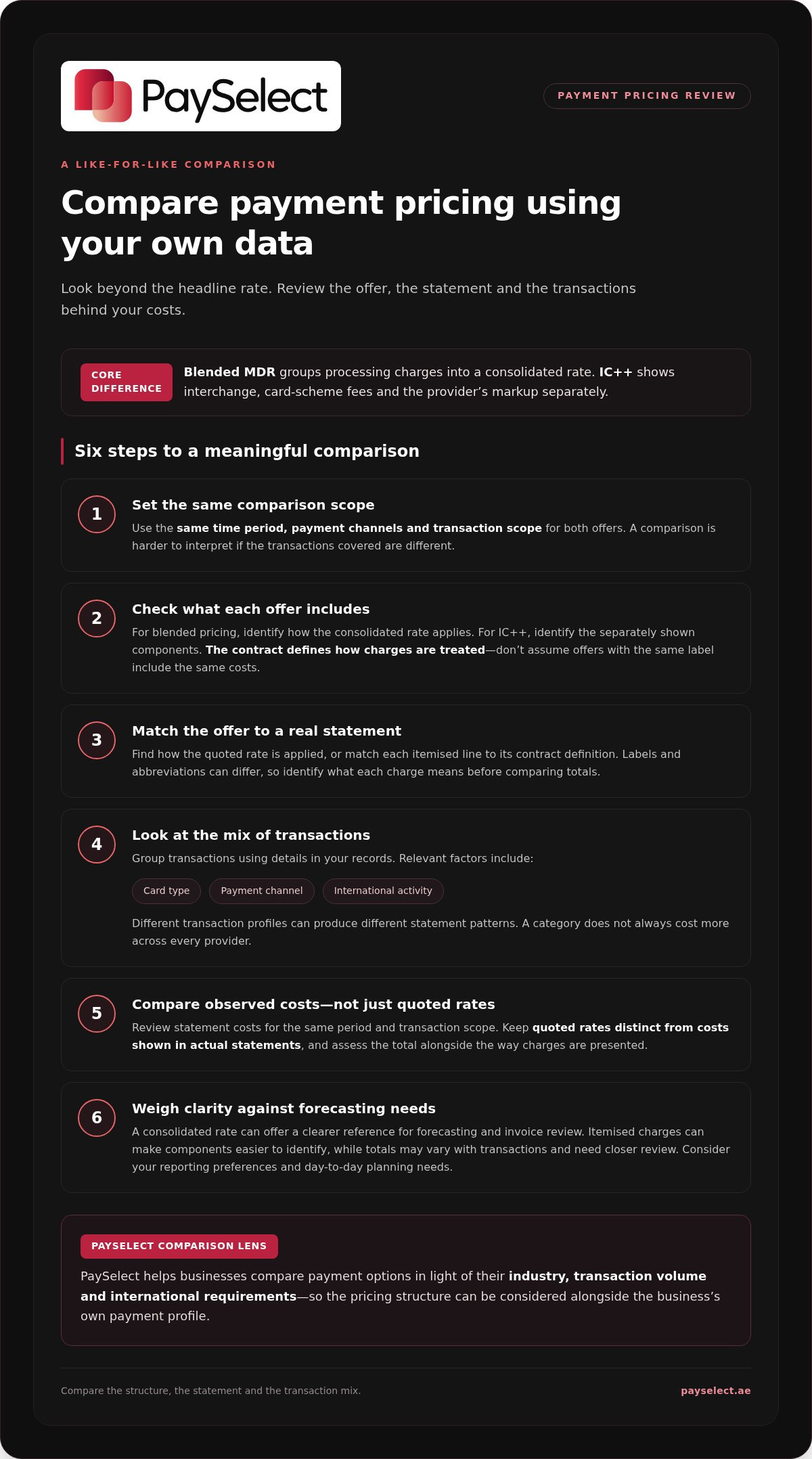
How to Compare Blended MDR and IC++ Using Your Own Payment Data
A fair comparison starts with your own records, not a sample transaction or a headline rate. Use the same period, payment channels and transaction scope for each offer. This helps show how each pricing structure would apply to your business, while keeping quoted terms distinct from charges already recorded on statements.
Set one review period.
Choose a period covered by statements and use it consistently across the offers. Note any gaps, such as a channel or transaction type that isn’t represented.
Match the transaction scope.
Compare the same channels and types of payment. Keep transaction volume and total transaction value in view, since proposals may use different assumptions from your actual activity.
Gather the source documents.
Bring together provider proposals, relevant statements, transaction volumes and channel breakdowns. Use business-level summaries where possible; you don’t need to include customer names, card numbers or other unnecessary personal information.
Separate quoted and observed figures.
Record what the proposal says separately from what statements show was charged. They answer different questions: the first describes offered pricing, while the second reflects charges for completed transactions under the terms in effect.
For each offer, create a short data checklist:
• Period covered and transaction scope
• Channels and transaction volumes included
• Transaction-based and fixed charges, where documents separate them
• Contract terms, exclusions and any additional charges stated in the documents
• Assumptions, missing data and labels you can’t map to a contract definition
Record exclusions and additional charges as stated, rather than assuming they apply. Mark unclear items as gaps. That keeps the comparison useful without presenting an estimate as an exact prediction.
Build a like-for-like pricing comparison
Put both offers against the same transaction set and note how each applies its terms. Separate fixed charges from transaction-based charges where the documents allow, then compare observed totals for the chosen period. If one proposal uses assumptions that differ from your statements, flag the difference instead of adjusting figures silently. This makes the result easier to explain and review.
Account for international and multi-channel payments
Identify whether cross-border activity is a meaningful part of your payment mix, and record the relevant channels and currencies represented in your business records. Currency and transaction context can affect how an offer compares with observed activity, so avoid treating domestic and international transactions as interchangeable. For businesses with international requirements, cross-border payment solutions are an important part of the comparison.
Once your records are organised, PaySelect can help structure a payment pricing comparison around your transaction profile and requirements. Compare payment pricing options with PaySelect.
Choose a Payment Pricing Model That Fits Your Business
There’s no universal winner in the blended MDR vs IC++ decision. The right fit depends on how your business takes payments and what you need from its reporting. A consolidated rate may support simpler reviews and forecasting, while itemised pricing may provide more detail for analysing charges. Neither presentation guarantees a lower total cost.
Base your choice on four factors: your preference for straightforward or detailed reporting, your transaction profile, the payment channels you use, and how you forecast processing costs. Then compare the terms against consistent transaction and statement data. This connects the pricing structure to day-to-day operations instead of relying on the format alone.
Questions to resolve before selecting a model
Before deciding, make sure the proposal and statement tell a consistent story. Compare the components included in the offer with the charges displayed in the statement. Consider whether a consolidated view or separate line items better support your internal reporting. Finally, check that you’re comparing offers over the same period and transaction scope, including the payment channels relevant to your business.
Your review should also reflect how your business may change. A model that is easy to manage with a limited set of payment channels may be less suitable if transaction patterns or international requirements become more complex. Revisit the comparison when your payment mix or reporting needs shift, using current records rather than assuming earlier results still apply.
How PaySelect supports an informed comparison
PaySelect’s comparison tool matches merchants with payment options based on industry, transaction volume and international requirements. This gives you a structured way to assess pricing alongside the context that shapes your payment setup. For enterprise-scale operations, PaySelect’s fixed-fee advisory and consulting services support payment infrastructure analysis and strategy development, helping businesses review their setup and costs without presuming a particular pricing model will deliver savings.
PaySelect is independent and may receive success-based fees from selected providers. Keep that disclosure in view as you assess the comparison, and focus on how each option aligns with your requirements and the data you’ve reviewed. A sound decision accounts for both pricing terms and the practical needs of your operation.
Choose the structure that best supports your cost review, transaction profile and forecasting process. If the evidence points to a different fit as your business grows or changes, reassess rather than treating the decision as permanent. Compare payment gateway options with PaySelect to find a suitable fit for your business needs.
Make Your Next Payment Decision with Confidence
Your pricing choice can support more than today’s statement review. Treat it as part of how your business plans for growth: as transaction patterns, payment channels or international needs change, revisit whether your current structure still supports clear reporting and sound decisions.
The blended MDR vs IC++ decision is strongest when it reflects your operating priorities, not assumptions about which model should cost less. PaySelect is an independent payment comparison and advisory platform helping businesses in the UAE bring greater structure to payment decisions. For enterprise-scale requirements, payment infrastructure analysis and strategy development can provide a focused basis for planning.
Take the next step with a comparison shaped around your business. Compare payment options for your business with PaySelect and move forward with a clearer view of your choices.
Frequently Asked Questions
Is blended MDR cheaper than IC++?
Not necessarily. The blended MDR vs IC++ label alone can’t show which option costs less for your business. Compare charges for the same transaction period and payment mix, and include any separate charges stated in the proposal or statement. Reconcile the offer against a completed statement period and note whether the same payment channels and transaction types are included.
Can a business switch from blended MDR to IC++?
Possibly, but a change depends on your provider relationship, contract terms and available service arrangements. Review any notice or transition clauses, then consider how a change could affect payment operations, statement formats and internal reconciliation. Compare current statements with the proposed terms using equivalent periods and channels. That helps distinguish a change in pricing from a change in the transactions being measured.
How do I calculate my effective payment processing cost?
For a simple effective-cost percentage, divide the payment-related charges for a period by the transaction value those charges cover, then multiply by 100. Separate fixed and transaction-based charges where your records allow, and document any exclusions. Use the same activity scope for alternative offers. If a charge covers services beyond transaction processing, identify it separately so your calculation reflects what you intend to compare.
Does IC++ always show every payment fee?
No. IC++ separates key pricing components, but statement labels and detail can vary between provider documents. A line item may use an abbreviation or a label that doesn’t match the wording in your agreement. Compare the statement with the contract’s definitions and fee schedule, and note any charge you can’t confidently map. This creates a clearer record of what the documents explain and what remains unclear.
Why can payment costs differ between businesses using the same pricing model?
Because the model is only one part of the pricing picture. Businesses may process different volumes, card mixes and payment channels, or have different international requirements and agreement terms. For example, a business accepting payments through both online and in-person channels may have a different pattern of charges from one using a single channel. Compare your own records rather than using another merchant’s results as a benchmark.
What information should I prepare to compare payment pricing?
Start with statements, transaction volumes, channel summaries and available proposals or agreements. Add a note of the period covered, currencies involved and any exclusions described in the documents. Use aggregated business data rather than customer names or card details. If a statement label or proposal assumption is unclear, flag it rather than guessing. This gives your comparison a reliable foundation without sharing unnecessary customer information.
Is blended MDR or IC++ better for international payments?
Neither model is automatically better for international activity. Review how each offer treats the cross-border transactions your business actually processes, including the currencies and channels shown in your records. If the proposal or statement describes currency conversion or settlement terms, include those details in the comparison. Keep international transactions within the same scope across offers, so you can assess the pricing against your business activity rather than a headline rate.
Disclaimer
This content is for informational purposes only and should not be considered financial, legal, or regulatory advice. Payment provider availability, pricing, and approval processes vary depending on individual business circumstances. PaySelect does not guarantee provider acceptance or specific outcomes. Businesses should conduct their own due diligence before entering into any agreements.
Empowering businesses to achieve greater growth