
Did you know that by 2026, digital wallets are expected to account for more than half of all in-store payments globally? If your current setup still struggles with mobile payments or forces your team into hours of manual reconciliation, you're likely paying a hidden friction tax on every sale. High transaction fees and legacy hardware don't just eat your margins; they stall your momentum. Building a strong business case for upgrading your POS system is no longer just about buying new equipment. It's a strategic move to secure your infrastructure against mandatory PCI DSS 4.0 requirements and reclaim lost operational hours.
You already know that inefficient systems lead to errors and missed opportunities. We'll show you exactly how to quantify the ROI of a modern upgrade, transforming your payment setup from a cost centre into a growth engine. This article explores how to achieve lower operational costs, seamless accounting integration, and a future-proofed environment for 2026 and beyond. We'll provide the data you need to justify the transition to your board while ensuring your business remains agile, compliant, and ready for international expansion in a digital-first economy.
Key Takeaways
• Identify the hidden "friction tax" within legacy systems and understand how outdated hardware limits your transaction speed and security.
• Quantify both direct financial gains and recovered staff time to build a robust business case for upgrading your POS system.
• Master the transition to unified commerce by connecting physical terminals with digital payment gateways for a frictionless customer journey.
• Implement a phased rollout strategy that addresses common implementation barriers while ensuring zero operational downtime during the upgrade.
• Utilise independent advisory tools to compare infrastructure options and avoid the long-term costs associated with restrictive vendor lock-in.
The Hidden Cost of Inaction: Identifying the Friction Tax
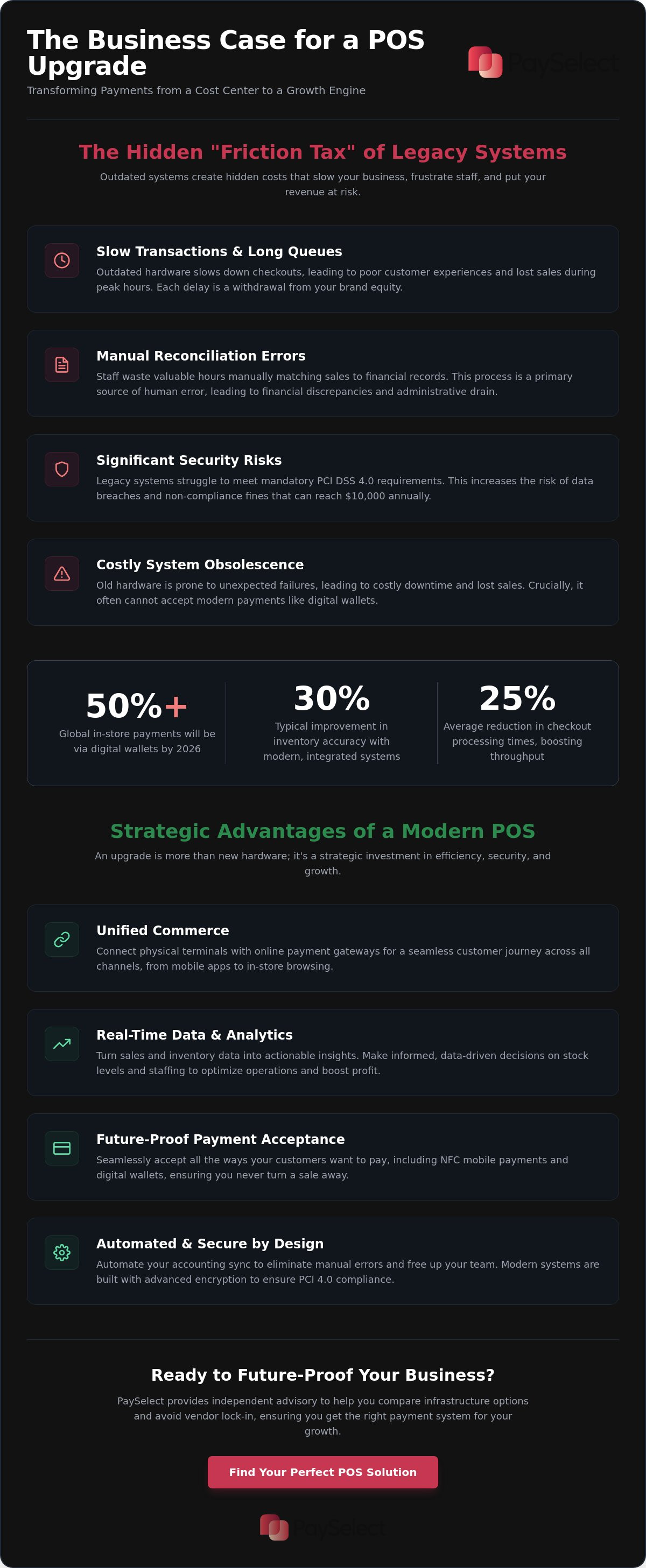
Every second a customer waits at the counter is a withdrawal from your brand equity. In 2026, we define this as the "friction tax." It's the cumulative cost of slow checkouts, manual reconciliation errors, and missed digital wallet opportunities. A legacy Point of sale (POS) is no longer just a tool for taking money. It's often a bottleneck that prevents your business from scaling and meeting modern consumer expectations for speed and fluidity.
Building a robust business case for upgrading your POS system requires looking beyond the initial hardware price. It's about the opportunity cost of siloed data. When your sales information doesn't talk to your inventory, you lose the ability to make informed, real-time decisions. Modern infrastructure turns these data points into actionable insights, helping you predict stock needs and understand customer behaviour across all channels. Research indicates that businesses implementing modern systems often see a 30% improvement in inventory accuracy, proving that the cost of doing nothing is far higher than the investment in new technology.
Security is another critical factor that legacy systems fail to address. Operating on outdated standards isn't just a technical oversight; it's a financial liability. With the mandatory shift to PCI DSS 4.0, businesses must implement more comprehensive authentication and tighter controls on payment pages. For instance, Requirement 8.4.2 now mandates multi-factor authentication for all access to cardholder data environments. Legacy systems often struggle with these modern encryption requirements, which increases the risk of data breaches and significant non-compliance penalties that can range from $1,000 to $10,000 annually for small businesses.
Quantifying Manual Reconciliation Errors
Think about how many hours your staff spends on end-of-day reporting. Manual reconciliation is a major drain on resources and a primary source of financial discrepancies. Human error during data entry doesn't just frustrate your team; it creates gaps in your financial records that are difficult to trace. By automating the accounting sync through modern POS machines, you reduce administrative overhead and ensure your books are accurate in real-time. This allows your staff to focus on customer service rather than spreadsheets.
The Risk of System Obsolescence
Legacy hardware is prone to failure at the worst possible moments. The cost of emergency repairs and lost sales during downtime often exceeds the price of a planned upgrade. In markets like the UAE, staying ahead of regulatory shifts in fraud prevention is essential for maintaining consumer trust. Modern hardware is built to handle advanced encryption and future-proof your payment acceptance, ensuring you're never left behind by evolving industry standards or the rapid adoption of digital wallets, which are expected to account for over half of all in-store payments by 2026.
Strategic Advantages: How Modern POS Systems Drive Growth
Modern POS systems aren't just payment terminals; they are growth engines. By moving beyond simple transaction processing, businesses can unify their entire operation. Unified commerce bridges the gap between your physical storefront and your online payment gateways. This connectivity ensures that a customer's journey remains fluid, whether they shop on a mobile app or browse in-store. It transforms your payment infrastructure from a passive utility into a strategic asset that captures every possible sale.
This integration is a central pillar of the business case for upgrading your POS system. When your systems talk to each other, you eliminate the data silos that lead to stockouts or overstocking. Real-time inventory mastery allows for a 30% improvement in accuracy, ensuring you never miss a sale due to poor visibility. Additionally, leveraging deep sales analytics helps you optimize staffing levels and promotional timing based on actual consumer behavior patterns. Efficiency translates directly to profit. Businesses using modern systems often see a 25% reduction in checkout processing times, which significantly boosts throughput during peak hours.
Accepting Every Way the Modern Customer Pays
Consumer habits are shifting at a breakneck pace. By 2026, digital wallets will account for more than half of all in-store transactions globally. If your hardware doesn't support seamless NFC mobile payments or national digital wallets, you're effectively turning customers away. Modern systems also allow you to integrate "Buy Now, Pay Later" (BNPL) options directly at the point of sale. This flexibility reduces cart abandonment at the counter and increases average transaction values by offering customers more financial control. Providing these options ensures your brand remains relevant to a tech-savvy demographic.
Operational Fluidity and Scalability
Cloud-based management is the gold standard for multi-location businesses. Whether you're operating across the UAE or expanding internationally, a modern POS allows you to manage inventory, pricing, and staff from a single dashboard. This operational fluidity extends to your team. Intuitive interfaces mean you can onboard new staff in minutes, not days. You can also scale your infrastructure without the need to replace expensive hardware every year, thanks to software-agnostic platforms that grow with your ambitions. To find the right fit for your specific needs, you can compare modern POS machines that align with your growth objectives.
Calculating the ROI: Quantifying the Value of an Upgrade
Building a compelling business case for upgrading your POS system requires a shift in perspective. You must view the transition not as a sunk cost, but as a high-yield investment. The return on investment (ROI) stems from two primary streams: direct savings on transaction costs and the "efficiency dividend" gained from streamlined operations. In the UAE market, where regional digital wallet adoption is accelerating, failing to optimize these streams means leaving significant revenue on the table. By quantifying these gains, you transform a technical necessity into a strategic financial decision.
The financial impact of an upgrade is often immediate. When you factor in a 25% reduction in checkout processing times and a 30% improvement in inventory accuracy, the payback period for a typical $750 to $1,700 hardware setup often occurs within the first year. Beyond hardware, integrated marketing tools provide a "Loyalty Lift" by capturing customer data at the point of sale. This allows you to drive repeat business through personalized promotions, turning a one-time visitor into a long-term asset. This data-driven approach ensures your infrastructure is built for expansion, not just existence.
Transaction Fee Optimisation Strategies
Merchant service charges are often the largest ongoing expense in payment processing. In 2026, standard transaction fees for in-person payments range from 2.3% to 3.5% plus a flat fee of $0.10 to $0.30. Understanding the difference between pricing models is crucial. Flat-rate pricing offers simplicity, but interchange-plus models provide transparency by separating the card network's cost from the provider's markup. A modern, hardware-agnostic POS system empowers you to switch providers to find better rates without being trapped by proprietary equipment. Your transaction volume and average ticket size should ultimately dictate your choice of provider to ensure maximum margin retention.
The Efficiency Dividend
Indirect gains are often more impactful than direct fee reductions. Consider the value of saving five seconds per transaction. Across thousands of monthly sales, this efficiency reduces customer wait times and allows staff to handle higher volumes during peak hours. Modern software further cuts costs by reducing the time required to train new employees; intuitive, smartphone-like interfaces mean your team can be productive in hours rather than days. You can compare POS machines to find the most efficient hardware for your specific environment. This reduction in administrative friction allows your team to focus on high-value customer interactions instead of troubleshooting legacy software.
Overcoming Implementation Barriers and Objections
Data integrity is often the primary concern during this shift. Moving years of historical sales records from a siloed legacy database to a modern cloud environment requires precision. Unlike legacy systems that often trap data in proprietary formats, modern migration tools handle complex field mapping. This ensures your inventory history and customer profiles transfer without corruption. This transition creates a single source of truth, enabling the unified commerce benefits discussed earlier and giving your finance team the clean data they need for accurate forecasting.
Minimising Operational Disruption
Downtime is not an option for a growing business. A phased rollout allows you to test new hardware in a single location or on a specific terminal before a full-scale launch. Running parallel systems during the initial testing phase provides a safety net, ensuring your team remains confident while they adapt. Training should happen before the system goes live, utilizing the intuitive interfaces that mimic the apps your staff already use on their phones; for hospitality businesses, using a platform like shiftify.io can help streamline this transition through specialized digital onboarding. Reliable technical support during this window ensures that minor setup questions don't turn into major operational delays.
Security and Compliance Confidence
Security is a non-negotiable requirement in 2026. Modern systems simplify the path to PCI DSS 4.0 compliance by handling complex encryption and authentication protocols natively. This protects your business from the rising costs of data breaches and non-compliance fines, which can reach $10,000 annually for smaller entities. By implementing end-to-end encryption at the point of interaction, you ensure that sensitive cardholder data never touches your local network in an unencrypted state. This secure environment builds long-term trust and provides the rock-solid foundation needed for international expansion. To ensure you select a platform that meets these rigorous standards, you can use our POS machine selection tool to find a compliant partner.
Optimising Your Choice with Independent Advisory
Selecting the right infrastructure is a high-stakes decision that dictates your operational speed for years. Most guides in the market are published by the payment providers themselves, which naturally creates a conflict of interest in their recommendations. To build a truly objective business case for upgrading your POS system, you need an independent perspective that prioritises your specific operational needs over a provider's sales quota. An unbiased audit ensures that every dollar spent on new hardware or software directly contributes to your bottom line.
One of the most significant risks in payment technology is "vendor lock-in." This occurs when a business invests in proprietary hardware that only functions with a single payment processor. If that provider decides to increase their transaction fees or if their service quality diminishes, you're left with a difficult choice: accept the higher costs or reinvest in entirely new equipment. Selecting hardware-agnostic software allows you to remain agile. You can switch between providers to secure better rates or superior features without the need to replace your entire terminal fleet. This flexibility is a core component of a future-proof business case for upgrading your POS system.
PaySelect acts as a strategic facilitator, bridging the gap between complex global infrastructures and the intuitive needs of modern entrepreneurs. We don't process payments directly; instead, we provide the comparison tools and consulting expertise required to match UAE merchants with the right providers. This independence ensures that our recommendations are based on performance, security, and cost-efficiency rather than commission structures. Our goal is to remove the operational barriers that prevent your business from scaling internationally.
Simplifying the Complex Payments Landscape
The payments market in the UAE is crowded and often fragmented. Using data-driven tools to filter providers by your specific industry and transaction volume is the only way to ensure you aren't overpaying for features you don't use. You can compare UAE payment gateways to find a match that aligns with your digital sales strategy. For enterprise-scale infrastructure, expert consulting helps navigate the technical nuances of multi-terminal setups and complex API integrations, ensuring a smooth transition between systems.
Your Roadmap to a Modern POS
Your journey toward a modern POS begins with a clear audit of your current pain points. Identifying whether you need better inventory tracking, lower merchant service charges, or faster checkouts helps narrow the field. If your business serves international clients, it is also essential to optimise cross-border payments to reduce the impact of currency conversion fees and international transaction markups. Your final step is to move from theory to implementation. Start your upgrade journey today with a free payment infrastructure audit to identify immediate savings and long-term growth opportunities.
Future-Proof Your Payment Infrastructure
Upgrading your infrastructure in 2026 is no longer an optional IT project; it's a strategic necessity for any business aiming to scale. By eliminating the friction tax of legacy systems, you reclaim lost revenue and ensure full compliance with mandatory PCI DSS 4.0 standards. A modern setup transforms your point of sale from a simple transaction hub into a unified commerce engine that captures every digital wallet sale and automates your accounting flow. This transition ensures your operations remain agile in a fast-moving digital economy.
Building a robust business case for upgrading your POS system allows you to quantify these operational gains and secure the support needed for a seamless transition. PaySelect provides the independent and unbiased comparison tools required to navigate the specialised UAE payment market without the risk of vendor lock-in. Whether you need a cost optimization audit or expert advisory for complex, multi-location infrastructures, we help you find the most efficient path forward. Find the perfect POS system for your business with our comparison tool and turn your payment setup into a catalyst for international growth. Your business deserves a platform that works as hard as you do.
Frequently Asked Questions
How often should a business in the UAE upgrade its POS system?
Most businesses should consider a hardware and software refresh every 3 to 5 years to maintain peak operational efficiency. This cycle ensures your terminals remain compatible with evolving security standards like PCI DSS 4.0 and can handle the latest digital wallet protocols. Regular updates prevent system slowdowns and protect your brand from the "friction tax" associated with aging, unreliable technology.
Can I keep my current bank while upgrading to a new POS software?
Yes, many modern POS solutions are designed to be provider-agnostic, allowing you to integrate with various merchant acquirers or local banks. You should verify that the new software supports your existing payment gateway to ensure smooth settlement cycles. This flexibility allows you to improve your customer-facing technology without the need to overhaul your entire corporate banking relationship or treasury workflow.
What is the average ROI period for a modern POS system upgrade?
Most enterprises achieve a full return on investment within 12 to 18 months through direct fee savings and recovered labour hours. With hardware costs in 2026 typically ranging from $750 to $1,700, the combination of faster checkouts and reduced manual errors provides a clear financial benefit. Quantifying these specific gains is the most effective way to build a business case for upgrading your POS system.
Is cloud-based POS secure for businesses operating in the UAE?
Cloud-based systems offer superior security compared to legacy on-premise solutions by providing automatic patches and real-time threat monitoring. These platforms are built to meet mandatory PCI DSS 4.0 requirements, including robust multi-factor authentication for all cardholder data access. Your sales information is stored in encrypted, redundant data centres, which significantly reduces the risk of data loss from local hardware failure or theft.
How do I choose between a mobile POS and a traditional countertop terminal?
Your choice depends entirely on your service model and how you intend to manage customer flow. Mobile POS (mPOS) is ideal for hospitality and retail environments where staff need to take payments directly to the customer to reduce queues. Traditional countertop terminals are better for high-volume fixed points that require heavy-duty peripherals like cash drawers. Many modern UAE businesses now deploy a hybrid of both.
What are the hidden fees I should look for in a new POS contract?
Review your contract for non-obvious costs such as PCI compliance fees, statement charges, and early termination penalties. Some providers also apply surcharges for specific software integrations or after-hours technical support. Always request a transparent breakdown of the monthly subscription versus the per-transaction processing costs. This clarity ensures your business case for upgrading your POS system remains accurate and predictable over the long term.
How does a modern POS system help with VAT compliance in the UAE?
Modern systems are designed to handle FTA-compliant tax calculations and invoice generation automatically at the point of sale. They track your VAT liabilities in real-time and can export formatted data directly to your accounting software for quarterly filings. This automation eliminates the risk of manual data entry errors, ensuring your records are audit-ready and compliant with local tax regulations without additional administrative burden.
Can I integrate my existing loyalty programme into a new POS system?
Most advanced platforms offer flexible API integrations that allow you to sync your existing customer database and rewards structure seamlessly. This connectivity ensures your customers don't lose their points or status during the transition to new hardware. If your current programme is manual, an upgrade provides the perfect opportunity to digitise your loyalty offering, allowing you to track behaviour and drive repeat business more effectively.
Disclaimer
This content is for informational purposes only and should not be considered financial, legal, or regulatory advice. Payment provider availability, pricing, and approval processes vary depending on individual business circumstances. PaySelect does not guarantee provider acceptance or specific outcomes. Businesses should conduct their own due diligence before entering into any agreements.
Empowering businesses to achieve greater growth