
Choosing the right business payment solutions in the UAE has become a strategic survival skill rather than a simple administrative task. You've likely felt the frustration of complex MDR structures and the long onboarding delays that stall your momentum. It's exhausting to see your hard earned margins eroded by hidden transaction fees while you struggle to sync your online and in-person data. You deserve a payment stack that works for you, not against you.
This guide provides an independent framework to help you master the UAE payments landscape with absolute confidence. You'll learn how to compare gateways, POS systems, and cross-border solutions to lower your costs and maximize your margins. We'll break down the latest 2026 regulatory requirements, explain how to verify provider claims, and show you how to build a future-proof infrastructure ready for GCC expansion. It's time to stop guessing and start optimizing your financial flow.
Key Takeaways
• Navigate the shift to a digital-first economy and understand how 2026 Central Bank of the UAE regulations impact your operational compliance.
• Identify the most efficient mix of gateways, POS systems, and cross-border business payment solutions uae to support your expansion across the GCC.
• Decode complex Merchant Discount Rate (MDR) structures and hidden fees to protect your margins and optimize every transaction.
• Overcome implementation hurdles by streamlining the KYC process and reducing cart abandonment with frictionless checkout designs.
• Use independent comparison tools and expert audits to build a high-performance payment stack tailored to your specific industry needs.
The UAE Business Payment Landscape in 2026
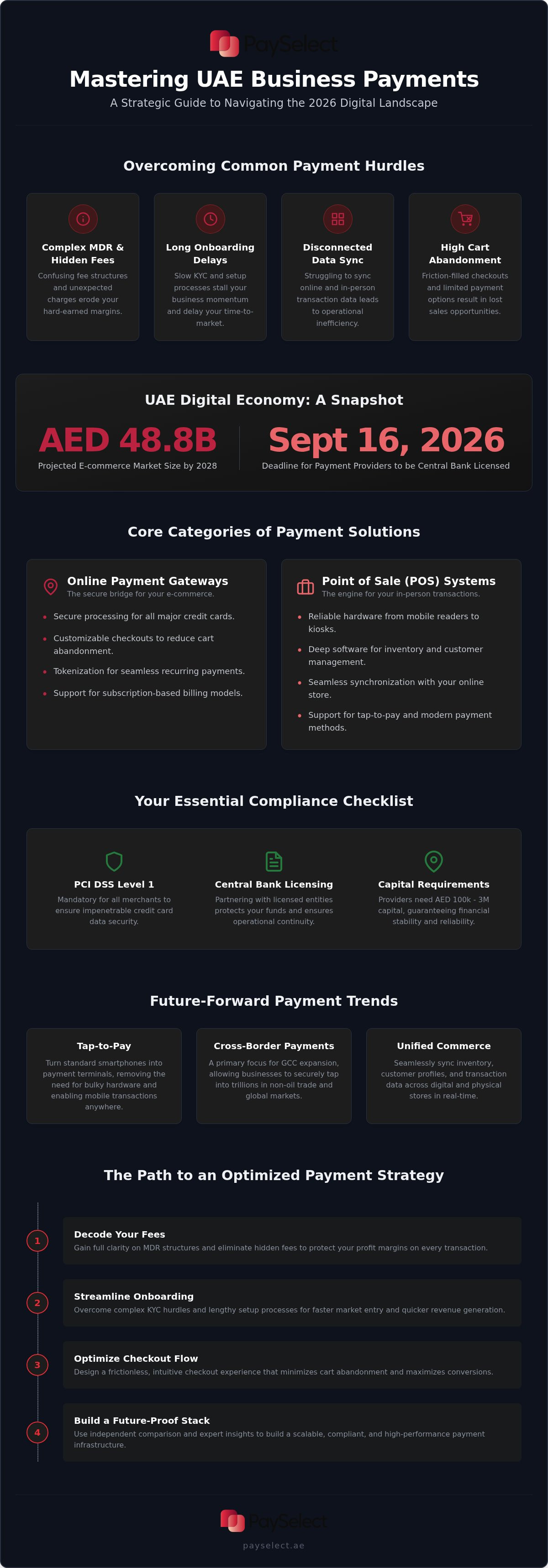
Cash has moved from the center of the economy to the periphery. The UAE e-commerce market is projected to grow to AED 48.8 billion by 2028, driven by a population that expects instant, frictionless transactions. In this environment, selecting the right business payment solutions uae is no longer a back-office administrative task. It's a strategic growth lever that determines your ability to scale, protect your margins, and enter new markets across the GCC. Modern entrepreneurs don't just look for a way to "accept cards"; they build a stack that integrates data, reduces friction, and ensures absolute compliance.
The shift toward unified commerce has redefined retail. It bridges the gap between digital storefronts and physical locations, ensuring that a customer's journey is consistent regardless of where they pay. This connectivity allows for better inventory management and deeper customer insights, turning every transaction into a data point for future expansion. Choosing a provider that facilitates this flow is essential for maintaining a competitive edge in a fast-moving digital landscape.
Regulatory Standards and Compliance
Security is the foundation of trust in the UAE financial sector. All merchants must adhere to PCI DSS Level 1 requirements to ensure credit card data remains impenetrable. This technical standard is reinforced by the Retail Payment Services and Card Schemes (RPSCS) Regulation, which provides a rigid framework for operational safety. Under the new Central Bank Law (Federal Decree-Law No. 6 of 2025), the regulatory perimeter has expanded to include any service that facilitates financial activity.
Compliance isn't optional. Entities providing payment services must be licensed by the Central Bank of the UAE by September 16, 2026. This push for transparency is part of the broader UAE's e-government initiatives which have long championed digital transformation. Operating with licensed partners ensures fund security and operational continuity, protecting your business from the legal risks of using unregulated technology enablers. Capital requirements for these providers now range from AED 100,000 to AED 3,000,000, ensuring only stable, well-capitalized institutions handle your revenue.
Emerging Trends in National Commerce
Innovation is moving toward hardware-free acceptance. The rise of 'Tap-to-Pay' allows merchants to turn standard smartphones into payment terminals, removing the need for traditional bulky hardware. This fluidity is particularly vital for SMEs and mobile service providers who require speed and portability. As businesses look beyond local borders, cross-border payments have become a primary focus, especially with the UAE handling trillions in non-oil trade. In 2026, unified commerce is the seamless synchronization of inventory, customer profiles, and transaction data across digital storefronts and physical retail points in real time. This technical utility is a strategic tool for business transformation, allowing you to manage your entire operation from a single, connected dashboard.
Core Categories of Business Payment Solutions
Identifying the right business payment solutions uae requires a clear understanding of your operational needs. Whether you're a digital-native startup or a traditional brick-and-mortar retailer, your payment stack is the engine of your commerce. A scalable stack ensures that as your transaction volume grows, your operational overhead doesn't. Comparing payment gateways is the first step in identifying the right technical fit for your specific model.
The architecture of your payment system should reflect your business's unique lifecycle. High-growth enterprises often require a modular approach, where they can swap or add specific tools as they expand into new territories. This flexibility prevents technical debt and ensures you aren't locked into a system that can't handle your future ambitions. Success in the modern economy is built on a foundation of connectivity and speed.
Online Payment Gateways
Digital gateways act as the secure bridge between your website and the global financial networks. Beyond just accepting credit cards, modern gateways offer checkout customization to reduce cart abandonment and tokenization to secure recurring payments. You'll need to evaluate whether your business requires subscription billing support or simple one-time transaction processing. Ease of integration with popular e-commerce platforms is a critical performance factor that directly impacts your time-to-market and user experience.
Point of Sale (POS) Systems
For businesses with a physical presence, the focus shifts to hardware reliability and software depth. Modern POS system selection involves choosing between mobile card readers for on-the-go service or integrated kiosks for high-volume retail. These systems do more than process payments; they provide real-time inventory management and sophisticated reporting that helps you make data-driven decisions. The goal is to create a frictionless experience for the customer while maintaining tight control over your back-end operations.
Cross-Border and B2B Payments
Expanding beyond the UAE requires managing foreign exchange (FX) risks and multi-currency settlements. B2B operations often benefit from virtual IBANs, which simplify international transfers and reduce the cost of receiving funds from global clients. Exploring cross-border payment solutions is essential for businesses aiming to capitalize on the UAE's position as a global trade hub. You can take the test on PaySelect to find the exact configuration that matches your industry requirements and expansion goals.
Critical Criteria for Comparing Payment Providers
Selecting the right business payment solutions uae requires looking beyond superficial marketing claims. A headline rate of 2.8% or 2.9% might look attractive, but the total cost of ownership often includes layers of complexity that can drain your profits. You need an independent framework to evaluate providers based on their actual impact on your bottom line. Success depends on your ability to decode fee structures and verify technical performance before you commit to a long-term contract.
Speed to live is another vital metric that businesses often overlook. While some modern enablers offer near-instant onboarding, traditional institutions may require weeks of manual document verification and physical signatures. If your business model relies on rapid deployment or seasonal scaling, these delays represent significant opportunity costs. You should also prioritize providers that offer local technical assistance; having a support team in the same time zone can be the difference between a minor glitch and a day of lost revenue.
Cost Structure and Fee Optimization
Most providers in the region offer blended pricing, which combines interchange fees, scheme fees, and the processor's margin into one flat rate. While this is simple to understand, it often hides the potential for savings that come with IC+ (Interchange Plus) models. You must also account for hidden charges such as refund fees, where the provider keeps the original commission, and chargeback fees that can exceed AED 100 per instance. As your monthly transaction volume scales beyond AED 100,000, your leverage to negotiate lower custom rates or shift to an IC+ model increases significantly.
Technical Compatibility and Uptime
Your payment stack is only as strong as its technical foundation. High-quality API documentation and dedicated developer support are essential for a smooth integration with your existing ERP or e-commerce platform. Beyond the code, you must evaluate historical uptime and the presence of redundant processing paths to ensure your checkout never goes offline. Security is equally paramount; ensure your partner supports 3D Secure 2.0 and provides advanced risk management tools to minimize fraud without hurting your conversion rates.
For large-scale organizations, a Payment Cost Optimization Audit can reveal significant inefficiencies in your current infrastructure. PaySelect provides the independent data you need to compare these technical and financial variables side-by-side, ensuring you don't overpay for utility. It's about moving from a standard setup to a precision-engineered payment strategy that supports your international ambition.
Solving Common Implementation Pain Points
Implementation is often where the most ambitious growth plans lose momentum. While the technology for business payment solutions uae is more advanced than ever, the operational hurdles of setup and integration remain significant barriers. Many merchants struggle with fragmented data across sales channels, leading to reconciliation nightmares that consume hours of administrative time. Identifying these friction points early allows you to build a more resilient, automated financial operation.
Independent advisory acts as a catalyst for efficiency by removing these operational barriers. By auditing your current setup, you can pinpoint exactly where conversion drops occur and where manual processes can be replaced with automated connectivity. This strategic approach transforms payments from a technical necessity into a high-performance tool for business transformation. Success in 2026 requires a move away from siloed data toward a unified, transparent infrastructure.
Streamlining the Onboarding Process
Navigating the Know Your Customer (KYC) requirements is the first major hurdle for any UAE merchant. To ensure a smooth approval, you must prepare a comprehensive documentation package, including your valid trade license, corporate bank account details, and the passports of all ultimate beneficial owners. Rejections are frequently caused by mismatched address proof or incomplete financial histories, so precision is essential from day one. Managing your expectations regarding settlement cycles is also vital; while some providers offer daily payouts, others operate on T+2 or weekly schedules.
Trade License
Must be valid and issued by a Mainland or Freezone authority.
Corporate Account
A local UAE bank account is mandatory for fund settlement.
KYC Precision
Ensure all shareholder documents are up to date to avoid onboarding delays.
Optimizing the Customer Checkout Experience
Reducing cart abandonment is directly linked to the fluidity of your checkout UX. Customers in the UAE expect a mobile-responsive interface that supports their preferred digital wallets and local payment methods. Frictionless experiences, such as one-click payments and biometric authentication, significantly increase conversion rates by removing unnecessary steps from the transaction journey. Every second saved during checkout protects your margins and builds long-term customer loyalty.
You can eliminate the guesswork of implementation by using an independent platform to verify provider claims and technical compatibility. To find the right fit for your specific operational model, take the test on PaySelect and receive a tailored recommendation that solves your unique pain points.
How PaySelect Simplifies Your Payment Strategy
In a market saturated with provider-led marketing, finding objective data is a significant challenge. Most information regarding business payment solutions uae comes directly from the companies selling the services, creating an inherent conflict of interest. PaySelect eliminates this bias by operating as a 100% independent digital platform. We don't process your payments; we ensure you choose the partner that protects your margins, supports your operational scale, and provides the best technical fit for your model.
Our 'Take the Test' matching tool simplifies the selection process by aligning your specific industry requirements with the documented strengths of various providers. Whether you need a high-performance payment gateway, a robust POS system, or complex cross-border payment solutions, we provide the clarity you need to move forward. This data-driven approach removes the guesswork, allowing you to implement a stack that is technically sound and financially optimized from day one.
The Independent Advantage
Unbiased data leads to better long-term financial outcomes. By acting as a bridge between modern entrepreneurs and complex global infrastructure, we ensure that technical utility becomes a strategic advantage. We focus on results, removing the operational barriers that typically stall international expansion. Our platform provides a smooth, frictionless path to choosing a partner that values your security as much as your growth. We act as an elite facilitator, translating complex regulatory frameworks into manageable business decisions.
Next Steps for Your Business
For large-scale organizations, a bespoke Payment Infrastructure Consulting session or a Payment Cost Optimization Audit is the logical next step to refine your business payment solutions uae. These deep-dive assessments identify immediate savings, benchmark your current provider against the latest 2026 market standards, and highlight inefficiencies in your settlement cycles. You can also use our payment pricing comparison tools to ensure your MDR remains competitive as your transaction volume increases. Continuous optimization is the only way to stay ahead of fee shifts and technological advancements in a fast-moving landscape.
It's time to remove the operational barriers to your growth and build a future-proof payment strategy today.
Future-Proof Your UAE Payment Strategy
The UAE's transition to a digital-first economy is complete. By 2026, absolute compliance with Central Bank regulations is the baseline for any ambitious merchant. You've seen how decoding complex fee structures and integrating unified commerce tools can protect your hard earned margins. Building a high-performance stack for business payment solutions uae requires moving away from stagnant legacy systems toward dynamic, scalable infrastructure.
PaySelect provides the only independent and unbiased comparison platform tailored specifically to the UAE national market. We act as your strategic partner, offering expert advisory for enterprise cost optimization and technical audits that remove operational barriers. Stop guessing and start optimizing your financial flow with data you can trust. Take the Test and find your perfect payment match to ensure your business is ready for international expansion. It's time to lead with confidence in a fast-moving digital landscape.
Frequently Asked Questions
How do I choose the best payment gateway for my UAE business?
Choosing the best gateway involves matching your technical needs with provider performance. You should evaluate API stability, checkout customization, and the ease of integration with your e-commerce platform. Don't rely solely on marketing claims. Instead, use an independent comparison platform to verify speed to live and support quality. Every business model has unique requirements, so a solution that works for a startup might not suit an enterprise scale operation.
What are the average transaction fees for payment solutions in the UAE?
Fees for business payment solutions uae generally range from 2.5% to 3.5% per transaction, plus a fixed fee of approximately AED 1.00. While SMEs often start with blended pricing, high-volume merchants can negotiate IC+ models that offer more transparency. You must also account for monthly maintenance fees and setup costs, which vary significantly between providers. Independent audits help uncover these hidden charges to protect your margins.
Can I accept international payments with a local UAE payment solution?
Most local solutions allow you to accept international payments through major card schemes like Visa and Mastercard. To expand effectively, choose a provider that supports multi-currency settlements and offers competitive foreign exchange rates. This prevents your global revenue from being eroded by high conversion fees. It's also vital to ensure the provider supports local payment methods in your target export markets to reduce cart abandonment.
How long does it take to get a payment gateway approved in the UAE?
Approval timelines range from 24 hours to three weeks depending on the provider's technical infrastructure and your business category. Modern digital-first enablers often provide near-instant onboarding for low-risk industries. Conversely, traditional financial institutions require a more manual KYC process that can take significantly longer. Preparing all your documentation in advance is the most effective way to accelerate this process and avoid unnecessary delays.
What is the difference between a payment gateway and a merchant account?
A payment gateway is the software that securely transmits data from the customer's card to the processor. In contrast, a merchant account is a specialized financial account that holds the funds until they are settled into your corporate bank account. Modern business payment solutions uae often bundle these services together for simplicity. However, larger enterprises may separate them to achieve better pricing and more control over their financial flow.
Is it possible to integrate one payment solution for both online and offline sales?
Integrating a single solution for both online and offline sales is a core component of unified commerce. This setup allows you to manage inventory, track customer behavior, and reconcile all transaction data from a single dashboard. It eliminates the need for manual data entry and reduces the risk of accounting errors. Choosing a provider that offers both robust APIs and reliable POS hardware ensures a frictionless experience for your team.
What documents are required to set up a business payment account in the UAE?
You must provide a valid UAE trade license, a corporate bank account, and the passports of all ultimate beneficial owners. Some providers also require proof of your physical office address and recent bank statements to verify your business activity. Ensuring these documents are accurate and up to date is essential for passing the mandatory AML and CFT compliance checks required by the Central Bank of the UAE.
How can I reduce my merchant discount rates (MDR)?
Reducing your MDR is best achieved through a combination of volume-based negotiation and cost optimization audits. As your transaction volume increases, you gain the leverage needed to move away from standard blended rates. You should also look for providers that don't charge for refunds or have high chargeback fees. An independent assessment can reveal if you're overpaying for technical utility and help you switch to a more profitable structure.
Disclaimer
This content is for informational purposes only and should not be considered financial, legal, or regulatory advice. Payment provider availability, pricing, and approval processes vary depending on individual business circumstances. PaySelect does not guarantee provider acceptance or specific outcomes. Businesses should conduct their own due diligence before entering into any agreements.
Empowering businesses to achieve greater growth