
Digital payments in the UAE have surged by over 45% annually since 2024, yet for many entrepreneurs, this expansion comes at a hidden cost. You likely see your card machine transaction fees uae quietly eroding your bottom line, with averages often reaching between 3.0% and 3.2% of your gross volume. It's a common pain point to face opaque monthly statements where Merchant Discount Rates and fixed fees create unnecessary confusion. Your payment infrastructure should be a catalyst for growth, not a drain on your resources.
This guide helps you master these complexities and optimize your business margins. We'll provide a clear breakdown of fee components, terminal comparisons, and cost-reduction strategies. You'll gain the ability to evaluate different offers and identify the specific levers that lower your monthly operational costs. PaySelect acts as the bridge between this complex infrastructure and your intuitive business needs. By taking our test to match with the ideal provider, you can move quickly from technical confusion to operational efficiency, ensuring your business is ready for the national digital transaction targets of 2026.
Key Takeaways
• Decode the Merchant Discount Rate (MDR) by breaking down the three-party fee structure of interchange, assessment, and markup costs.
• Compare flat-rate versus interchange-plus pricing models to find the most efficient card machine transaction fees uae for your operational scale.
• Identify hidden costs beyond the headline percentage, including monthly gateway fees and the impact of dynamic currency conversion on your revenue.
• Master negotiation strategies and audit techniques to lower your total cost of ownership as your transaction volume grows.
• Streamline your provider selection process using independent comparison tools designed to remove operational barriers and optimize your margins.
The Anatomy of UAE Card Machine Fees
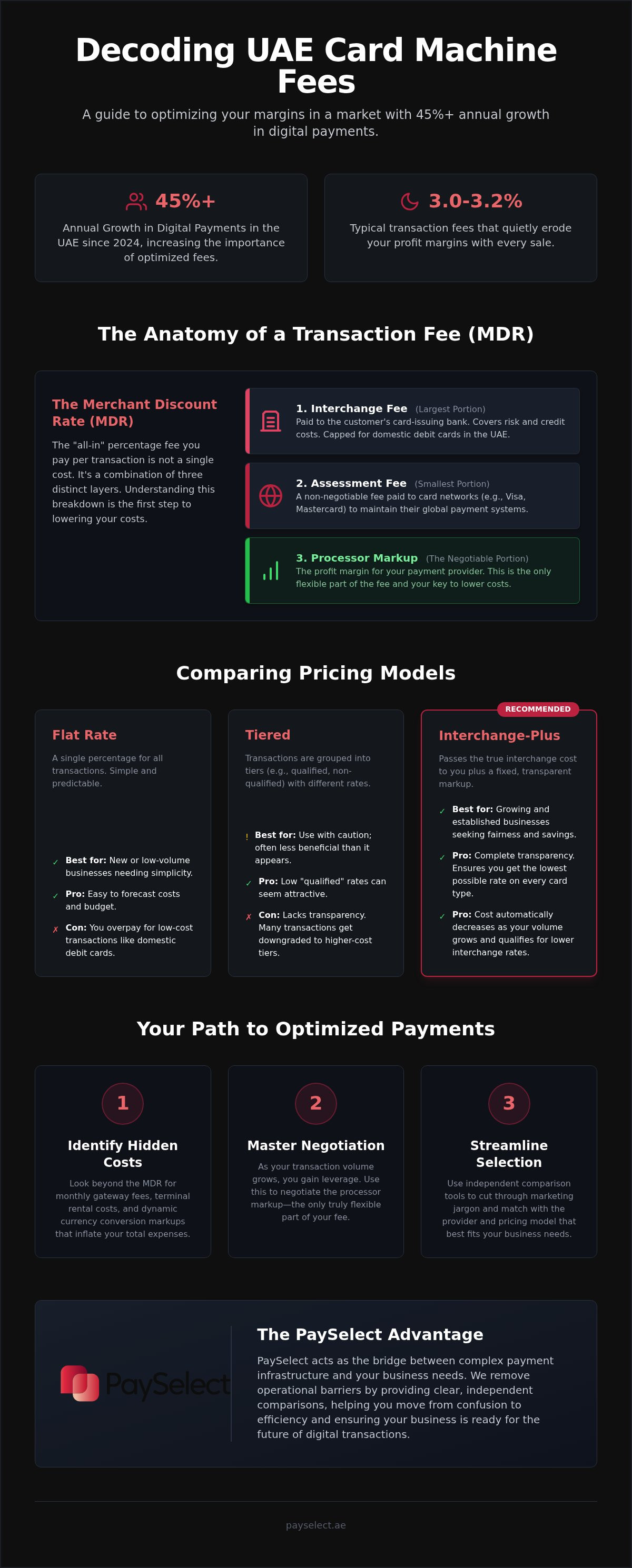
The UAE payments market processes AED 1.6 trillion annually, reflecting a massive shift in consumer behavior. Digital payments have grown by over 45% annually since 2024, making card machine transaction fees uae a central concern for modern entrepreneurs. Most businesses see a single percentage deducted from their daily settlements, yet this figure is actually a composite of multiple financial layers. Mastering these components is essential for maintaining healthy business margins in an increasingly cashless economy.
Understanding the Merchant Discount Rate (MDR)
The Merchant Discount Rate is the comprehensive percentage fee paid per transaction. It is calculated as a percentage of gross sales, acting as the "all-in" price for processing. This rate balances the base costs of the financial system with the profit margin of your service provider. While the headline rate might seem like a single cost, it covers system connectivity, security protocols, and operational support. Understanding that your provider splits this fee with other institutions is the first step toward optimizing your margins.
Interchange and Assessment Fees Explained
Your fees break down into three distinct layers that determine the final cost of every swipe or dip. These layers include:
• The Interchange fee: This is the primary cost, paid directly to the bank that issued your customer's card. It covers the risk of fraud and the cost of credit.
Assessment fees
Card networks set these non-negotiable costs to maintain their global payment rails. They ensure every transaction connects instantly to the global banking network.
The Processor Markup
This is the profit margin added by your payment provider. It is the only portion of the fee that is truly flexible and subject to negotiation.
National regulations directly impact these baseline costs. For instance, the Central Bank of the UAE has mandated interchange caps for domestic consumer debit cards at 0.75% for in-person sales and 1.00% for online transactions. These caps are why domestic cards carry significantly lower fees than international or premium "rewards" cards, which often carry rates 1.5% higher than local equivalents.
As the nation moves toward a 90% digital transaction target by the end of 2026, your processing volume will likely increase. High volume provides the leverage needed to negotiate the markup portion of your fees. Using POS machines that offer transparent pricing models ensures your business benefits from local regulatory advantages rather than losing them to hidden markups. PaySelect helps bridge the gap between these technical infrastructure layers and your intuitive business needs, allowing you to focus on expansion rather than administrative confusion.
Comparing Transaction Fee Models: Fixed vs. Variable
Selection of a pricing model dictates your long-term profitability. While hardware represents a one-time expense, your card machine transaction fees uae are recurring operational costs that require strategic management. In the current market, providers generally offer three distinct structures: flat-rate, tiered, or interchange-plus pricing. Each model serves a different business scale, and choosing the wrong one can lead to significant margin erosion as your volume grows.
Flat Rate vs. Tiered Pricing Models
SMEs often prefer flat-rate models for their simplicity and predictability. You pay a single, fixed percentage for every transaction, which typically averages between 2.2% and 2.9% plus a small fixed fee for new businesses. This model makes accounting straightforward because the cost of a local debit card is the same as a premium international credit card. However, simplicity comes at a price, as you may overpay for low-cost domestic transactions.
Tiered pricing takes a different approach by categorizing transactions into qualified, mid-qualified, and non-qualified tiers. While the "qualified" rate for local debit cards might look attractive, many transactions often get downgraded to higher-cost tiers. Your Merchant Category Code (MCC) also influences these rates. For instance, businesses in high-risk sectors like travel or crypto often see rates climbing toward 5%, making tiered structures difficult to audit without specialized tools.
The Interchange Plus Advantage
Transparency is becoming the 2026 standard in the UAE. The Interchange Plus model, also known as pass-through pricing, separates the direct cost of the transaction from the processor's markup. This allows you to see the exact interchange fee paid to the issuing bank and the assessment fee paid to the card network. It removes the "black box" of tiered pricing and ensures you benefit from domestic interchange caps, which are currently set at 0.75% for in-person debit sales.
For businesses scaling past AED 50,000 in monthly volume, this model offers the most significant cost-optimization potential. It provides a clear audit trail and makes it easier to negotiate the provider's markup as your performance enhances. Beyond the transaction model, maintaining the Payment Card Industry Data Security Standard (PCI DSS) is vital. Compliance ensures you avoid non-compliance penalties that can quietly inflate your effective processing rate.
Identifying the right structure for your specific industry and volume is a strategic necessity. If you want to see how different market offers stack up against your current turnover, you can compare POS machine pricing models to find a solution that aligns with your expansion goals.
Identifying Hidden Costs Beyond the Transaction
Success in the UAE's digital economy requires looking past the headline percentage. While the Merchant Discount Rate is the most visible expense, the true Total Cost of Ownership includes several administrative and operational layers. These secondary costs can quietly inflate your card machine transaction fees uae, turning a seemingly competitive rate into a heavy financial burden. Precision in auditing these expenses ensures your margins remain protected as you scale.
Dynamic Currency Conversion (DCC) represents one such complexity. While it offers international customers the convenience of paying in their home currency, the revenue share and associated processing markups vary significantly between providers. Merchants often overlook how these international transactions impact their net take-home pay. Beyond currency conversion, basic administrative charges like statement fees and PCI compliance fees can add hundreds of dirhams to your monthly overhead.
Terminal Hardware and Connectivity Costs
Hardware selection involves a strategic choice between one-time capital expenditure and recurring rental models. Purchasing a terminal typically costs between AED 2,000 and AED 7,000, whereas rental options start at approximately AED 199 per month. Your choice impacts more than just the upfront cost; it dictates your access to modern infrastructure. Consider these three factors:
Connectivity
5G and Wi-Fi enabled smart terminals ensure smooth, frictionless payments but often carry higher monthly service fees.
Maintenance
Support costs and hardware replacement guarantees are frequently omitted from initial quotes but are vital for operational continuity.
Integration
Advanced POS software licensing fees may apply if you require deep connectivity between your terminal and inventory systems.
Ancillary Service and Penalty Fees
Operational barriers often take the form of penalty-based charges. Minimum monthly service fees are a common pain point for low-volume merchants; if your processed volume falls below a specific threshold, providers may charge a flat fee to bridge the gap. Chargeback fees, ranging from AED 60 to AED 175 per instance, pose a significant risk for businesses in high-growth or high-risk sectors.
Early termination fees also deserve scrutiny. Many contracts include restrictive clauses that penalize merchants for switching providers before the term ends. To avoid these traps, businesses use POS system selection tools to compare the full spectrum of costs before signing. By identifying these hidden triggers early, you can maintain liquidity and ensure your payment infrastructure acts as a catalyst for expansion rather than a financial constraint.
Strategies to Optimize and Lower Processing Costs
Optimizing your card machine transaction fees uae requires moving from passive observation to active management. Many merchants treat these fees as a fixed tax on growth. In reality, they are a controllable operational expense. By implementing structured review cycles and leveraging your transaction data, you can reclaim significant portions of your margin. Efficiency is not just a technical goal; it's a strategic necessity for businesses looking to scale in a competitive landscape.
Reducing "Card Not Present" (CNP) transactions is a fast track to lower fees. CNP transactions carry higher risk profiles, with rates often ranging from 2.5% to 3.8% due to increased fraud potential. In contrast, card-present transactions in the UAE typically range from 1.8% to 2.5%. Modernizing your hardware to support biometric authentication and mobile wallets can shift more volume into these lower-risk, lower-cost categories, directly improving your bottom line.
How to Audit Your Merchant Statement
Statements often obscure the true cost of processing. You must distinguish between the nominal rate, which is the headline percentage, and the effective rate, which represents the actual percentage after all fees are included. Look for hidden markups in international transaction processing, where currency conversion spreads can quietly add 1% to 2% to your costs. To find your true cost, calculate your total fees paid divided by your total gross sales for the month. This single number reveals the efficiency of your current setup and identifies where your margins are leaking.
Negotiation Tactics for National Businesses
Volume is your strongest leverage. Once your monthly turnover exceeds AED 50,000, you gain the ability to negotiate tier-based pricing or interchange-plus models. Use multi-provider data to benchmark your current offer against the wider market. If you don't have this data, seeking Payment Infrastructure Consulting provides the unbiased intelligence needed to challenge existing contracts. Independent advisory ensures you aren't just comparing rates, but analyzing the total cost of ownership across your entire payment stack.
Negotiation is most effective when backed by a clear understanding of your risk profile and transaction mix. Presenting a clean processing history with low chargeback rates allows you to push for lower markups. If your current provider is unwilling to adjust their terms, it's time to evaluate alternative solutions that reward your business growth. You can request a cost optimization audit to identify exactly how much you could save by switching to a more transparent pricing structure.
Streamlining Selection with PaySelect
The complexity of card machine transaction fees uae often creates operational friction that slows business expansion. Identifying the right balance between hardware costs, merchant discount rates, and hidden service fees requires significant manual effort. PaySelect removes these barriers by acting as an independent facilitator. We bridge the gap between complex global infrastructures and your specific business needs, ensuring you move from technical confusion to strategic implementation without delay.
Transitioning from opaque legacy systems to transparent modern solutions is no longer a luxury; it's a requirement for margin protection. In a fintech landscape that moves at high speed, having an unbiased partner allows you to evaluate providers based on performance and total cost of ownership rather than marketing claims. Our platform ensures that technical utility becomes a strategic tool for your business transformation. We provide the clarity needed to navigate the 2026 digital transaction landscape with absolute confidence.
The Comparison Tool Advantage
Selecting the wrong fee structure can lead to thousands of dirhams in lost revenue annually. Our POS system selection tool automates the evaluation process, matching your industry-specific needs with the most efficient market offers. By removing the manual labor of comparing dozens of provider quotes, we allow you to focus on your core operations. Whether you are a high-volume retailer or a specialized service provider, our tool ensures your payment setup aligns with your monthly turnover and risk profile. It's a frictionless way to secure the most competitive card machine transaction fees uae available in the current market.
Bespoke Advisory for Enterprise Growth
For large-scale organizations and hospitality groups, standard tools are only the beginning. PaySelect offers bespoke payment infrastructure audits designed to identify deep-seated inefficiencies in your current processing stack. This high-level advisory service acts as a catalyst for growth, providing the data-driven insights needed for multi-provider negotiations and international expansion. We help you secure the most competitive merchant discount rates while ensuring full system connectivity and operational fluidity.
Take the first step toward optimizing your margins today. Use our comparison tool to find a solution that removes operational barriers and supports your international ambition. Your payment infrastructure should empower your growth, and with PaySelect, you gain the calm assurance that your business is operating at peak financial efficiency. Start your cost optimization audit now and transform your payment setup into a strategic advantage.
Optimizing Your Payment Infrastructure for 2026
Mastering your card machine transaction fees uae is a strategic necessity for any business aiming to scale in the national digital economy. You've seen that these costs aren't fixed taxes but manageable operational expenses. By decoding the Merchant Discount Rate and auditing hidden administrative charges, you protect your margins and ensure long-term liquidity. Efficiency in your payment stack is the bridge to sustainable expansion.
PaySelect provides the independent and unbiased data you need to make these critical decisions. Trusted by UAE enterprises, our platform offers expert advisory services and a specialized comparison tool to remove operational barriers. You can find the most cost-effective card machine for your business today to optimize your processing stack instantly. Our bespoke audits ensure that your technology serves your bottom line.
Transforming your payment infrastructure into a strategic asset is within reach. Take control of your financial performance and position your business for a seamless transition into the future of commerce. Your growth starts with clarity.
Frequently Asked Questions
What is the average card machine transaction fee in the UAE in 2026?
Average card machine transaction fees uae typically range between 3.0% and 3.2% of the gross payment volume as of 2026. For newly established businesses, the entry-level range generally falls between 2.2% and 2.9% plus a fixed fee per transaction. These rates fluctuate based on your specific industry sector and total monthly turnover. High-risk industries often see rates approaching 5.0% to account for increased fraud protection requirements and regulatory standards.
Can I negotiate my merchant discount rate with my current provider?
You can negotiate your Merchant Discount Rate once your monthly processing volume reaches approximately AED 50,000. Providers are often willing to adjust their profit markups to retain high-performing merchants with clean processing histories. Using independent data to benchmark your current offer is a critical step in this process. PaySelect provides bespoke infrastructure audits to identify these negotiation opportunities and ensure your margins remain protected as your business continues to expand.
Is it cheaper to buy or rent a POS terminal in the UAE?
Choosing between purchasing or renting depends on your capital expenditure strategy and technical requirements. Purchasing a terminal involves a one-time cost between AED 2,000 and AED 7,000, while rentals often start at AED 199 per month. Rental models typically include ongoing technical support and periodic hardware upgrades, ensuring your business stays current with modern 5G or Wi-Fi standards. Purchasing avoids recurring monthly overhead but requires managing your own maintenance and eventual hardware replacement.
What happens if I don't meet the minimum monthly transaction volume?
Falling below the agreed threshold usually triggers a minimum monthly service fee. This charge ensures the provider covers the cost of maintaining your merchant account and terminal connectivity during low-activity periods. These fees can range significantly between different providers, making it essential to compare contract terms before signing. PaySelect's comparison tool highlights these hidden triggers, helping low-volume merchants avoid unnecessary operational barriers and maintain better liquidity throughout the fiscal year.
Are fees higher for international credit cards than domestic ones?
Fees for international credit cards are typically 1.5% higher than domestic alternatives. This difference exists because domestic consumer debit cards are subject to national interchange caps of 0.75% for in-person sales. International transactions involve higher risk and cross-border processing costs that card networks pass on to the merchant. Understanding your card mix is vital for businesses in the hospitality or tourism sectors where international card usage is a primary driver of revenue.
How does NFC and contactless payment affect transaction fees?
NFC and contactless payments are processed as "Card Present" transactions, which carry lower risk and lower fees than standard e-commerce sales. Contactless rates generally range from 1.8% to 2.5%, whereas "Card Not Present" transactions can reach 3.8%. Implementing modern terminals that support mobile wallets and biometrics helps shift your volume into these more cost-effective categories. This technical upgrade acts as a strategic tool for lowering your overall card machine transaction fees uae.
What is Dynamic Currency Conversion and how does it affect my fees?
Dynamic Currency Conversion allows international customers to pay in their home currency at the point of sale. While this provides a convenient user experience, it introduces complex fee structures where the provider and merchant share the conversion markup. These markups can range from 1% to 2% on top of standard transaction fees. Auditing these revenue shares is a key component of our payment infrastructure consulting services, specifically designed for large-scale organizations and hospitality groups.
How long does it take to switch to a provider with lower fees?
Switching providers typically involves a setup period followed by settlement cycles that range from one day (T+1) to seven days (T+7). While the technical transition can be fast, the administrative approval process depends on your industry risk profile and document readiness. PaySelect streamlines this transition by matching you with the ideal provider through our selection tool. This removes the manual labor of comparing dozens of complex contracts and speeds up your path to lower costs.
Disclaimer
This content is for informational purposes only and should not be considered financial, legal, or regulatory advice. Payment provider availability, pricing, and approval processes vary depending on individual business circumstances. PaySelect does not guarantee provider acceptance or specific outcomes. Businesses should conduct their own due diligence before entering into any agreements.
Empowering businesses to achieve greater growth