
The lowest advertised transaction rate is frequently a strategic trap that hides the true cost of doing business in the Emirates. While a provider might promote a competitive 2.80% MDR, hidden AED 1 flat fees and the mandatory 5% VAT on service charges can quickly erode your bottom line. You likely feel the frustration of watching hard-earned margins disappear into a black hole of settlement delays and opaque maintenance costs. Finding the cheapest payment gateway uae requires a shift from chasing headline numbers to analyzing the total cost of ownership.
We've designed this guide to help you decode complex fee structures so you can reclaim your capital and scale with confidence. It's time to move past the confusion of fluctuating cross-border surcharges and rigid settlement cycles that choke your liquidity. We will explore the 2026 regulatory landscape, including the impact of CBUAE licensing standards on merchant pricing. You'll discover how PaySelect acts as a bridge to transparent infrastructure, providing the independent audits and matching tools necessary to optimize your payment performance without the traditional operational barriers.
Key Takeaways
• Analyze the total cost of ownership by decoding how Merchant Discount Rates (MDR), fixed fees, and VAT impact your net margins.
• Identify the cheapest payment gateway for your specific business model by comparing flat-rate predictability with the transparency of interchange-plus structures.
• Safeguard your liquidity by identifying hidden operational costs, including setup fees, monthly maintenance charges, and minimum activity penalties.
• Establish a clear comparison framework based on your average transaction value and projected volume to ensure your infrastructure scales efficiently.
• Eliminate provider bias and onboarding friction by utilizing independent matching tools and bespoke payment infrastructure audits from PaySelect.
Understanding the True Cost of Payment Processing in the UAE
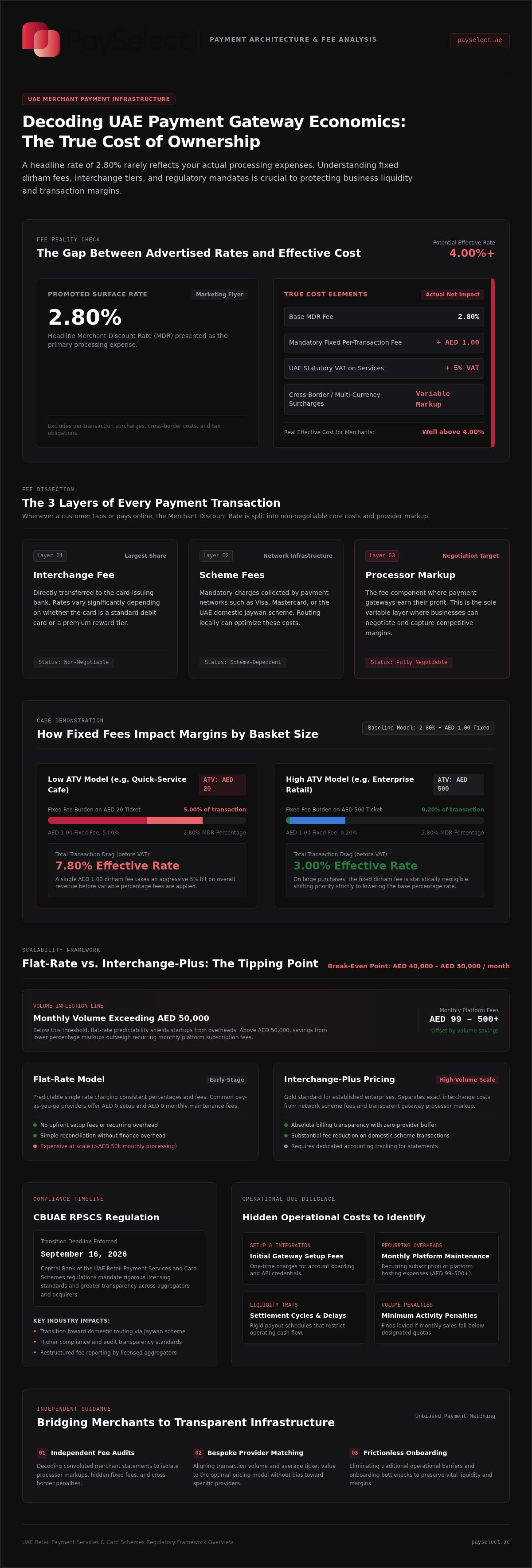
Identifying the cheapest payment gateway uae isn't about finding the lowest percentage on a marketing flyer. It's about auditing the total cost of ownership across every transaction. Since the transition deadline for the Central Bank of the UAE (CBUAE) Retail Payment Services and Card Schemes (RPSCS) Regulation passed on September 16, 2026, the market has matured. This regulatory framework ensures that all licensed aggregators and acquirers operate with higher levels of transparency, but it also means fee structures have become more nuanced. A headline rate of 2.80% might seem attractive until you account for fixed costs and cross-border surcharges that can push the effective rate well above 4%.
The Components of a Transaction Fee
Every time a customer taps a card or completes an online checkout, the resulting Merchant Discount Rate (MDR) is split into three distinct layers. Understanding these layers is the first step in optimizing your payment infrastructure:
Interchange Fees
This is the largest component, paid directly to the bank that issued the customer's card. These rates are non-negotiable and vary based on card type, such as premium rewards cards versus standard debit cards.
Scheme Fees
These are mandatory costs paid to international networks like Visa and Mastercard, or the UAE's domestic Jaywan scheme. Routing transactions through domestic schemes is often a key strategy for reducing these costs.
Processor Markup
This is the only portion of the fee where the payment gateway earns its profit. When comparing payment gateways, this markup is the primary area where businesses can negotiate or find competitive advantages.
Fixed vs. Variable Cost Structures
The architecture of your pricing model should depend entirely on your average transaction value (ATV). Most UAE providers charge a blended rate, such as 2.80% plus a fixed fee of AED 1.00. For a high-end retailer with an ATV of AED 500, that AED 1.00 fee is negligible. However, for a quick-service cafe with an ATV of AED 20, that single Dirham represents a 5% hit to revenue before the percentage fee is even applied.
Established enterprises often benefit from Interchange-Plus pricing, which separates the direct costs from the processor's markup. This model provides absolute transparency, ensuring you don't pay a "buffer" to the provider. Conversely, smaller businesses might prefer the predictability of a flat-rate model to simplify accounting. The break-even point typically occurs when monthly volumes exceed AED 40,000 to AED 50,000. At this stage, the savings from a lower percentage rate usually outweigh the cost of a monthly platform subscription fee, which can range from AED 99 to over AED 500.
Evaluating Pricing Models: Which Fits Your Business Volume?
Selecting the cheapest payment gateway uae requires a strategic match between your transaction volume and the provider's billing architecture. A model that saves a startup money might become a significant financial drain as that business scales to thousands of transactions per month. The UAE market primarily offers four distinct pricing structures, each designed to serve different stages of corporate maturity. Choosing correctly involves more than just looking at the percentage; it requires a deep dive into how your specific sales mix interacts with these structures.
Flat-Rate Models for Early-Stage Merchants
The flat-rate model serves as the baseline for predictability by charging a single, consistent percentage and fixed fee for every transaction regardless of card type. For startups and small businesses, this simplicity often outweighs the potential for lower rates found in more complex models. Many pay-as-you-go providers in the UAE offer AED 0 setup and monthly maintenance fees; this allows new ventures to avoid fixed overheads while they establish their customer base.
The primary advantage here is the removal of operational barriers. You don't need a dedicated finance team to reconcile complex statements; you simply know that a fixed portion of every sale is dedicated to processing. However, as your volume grows, these flat rates can become expensive. Once your monthly processing exceeds AED 50,000, the lack of granularity in flat-rate pricing may hide opportunities for cost optimization.
Interchange-Plus for High-Volume Transparency
Interchange-plus pricing is the gold standard for established enterprises seeking absolute transparency. This model breaks down the fee into the actual interchange cost from the bank, the scheme fee from the card network, and a specific markup from the gateway. By revealing the exact margin charged by the provider, high-volume organizations can ensure they aren't overpaying for low-risk domestic transactions.
While this model offers the most significant potential for reduced costs, it requires more robust technical systems to manage. Reconciliation becomes more complex because every transaction may have a slightly different fee attached. Large organizations prefer this complexity because it allows them to audit their infrastructure and identify exactly where their margins are being eroded. Using a payment gateway comparison tool allows you to model these costs against your specific average transaction value before committing to a contract.
Beyond these two pillars, you may encounter tiered pricing or subscription models. Tiered pricing often categorizes transactions as "qualified," "mid-qualified," or "non-qualified." This can be a trap for the unwary, as many common transactions, like rewards cards or international payments, often fall into the higher-priced non-qualified tier. Subscription-based gateways offer an alternative by charging a fixed monthly fee, often between AED 99 and AED 500, in exchange for significantly lower per-transaction percentages. This model is ideal for businesses with high ticket prices where the savings on the percentage fee quickly cover the monthly subscription cost.
The Hidden Fees: Beyond the Transaction Rate
The pursuit of the cheapest payment gateway uae often ends in frustration when monthly statements reveal charges that weren't in the initial sales pitch. High-level percentages are only one part of the financial equation. You must account for the secondary costs that keep your infrastructure running. These expenses can quietly diminish your margins if you don't audit them before signing a contract. Understanding these layers is essential for maintaining a healthy bottom line.
Setup and integration fees represent the first major hurdle. For complex enterprise systems, these one-time costs often range between AED 1,000 and AED 2,500. Subscription-based models also carry monthly maintenance fees, typically between AED 99 and AED 500. Some providers also enforce minimum activity penalties. If your sales volume drops below a certain level, you're charged a flat fee to keep the account active. Security protocols like 3D Secure and PCI-DSS compliance are essential for CBUAE standards, yet they often come with per-transaction or annual fees that are passed directly to you.
Liquidity management has its own price tag. While standard settlement cycles take two to five business days, many firms need faster access to cash. Providers often charge a premium of 0.20% to 0.45% for same-day or next-day batch settlements. This is a critical factor for merchants who rely on rapid inventory turnover and cannot afford to have capital locked in a multi-day queue.
Operational and Administrative Costs
Administrative friction is a significant financial risk. Chargeback management fees are standard, usually costing between AED 100 and AED 150 per dispute. These are debited regardless of the outcome. Refund processing is another area where costs hide. Most UAE providers don't return the original transaction fee when you refund a customer. Annual renewal fees for your merchant account can also appear as unexpected lump-sum deductions that impact your annual ROI calculations.
Cross-Border and Currency Complexity
International expansion introduces layers of currency complexity. Cards issued outside the UAE routinely incur a cross-border surcharge of 1.00% to 1.50% on top of standard rates. Foreign exchange conversion markups range from 1.00% to 2.00% when customers pay in currencies other than AED. Selecting specialized cross-border payment solutions helps minimize these costs. This strategic approach ensures that international growth doesn't neutralize the savings you've secured on domestic processing.
A Framework for Comparing UAE Payment Providers
Identifying the cheapest payment gateway uae is a strategic exercise that requires a structured methodology. A generic decision based on a single percentage rate often leads to long-term financial friction. To ensure your payment infrastructure acts as a catalyst for growth rather than an operational burden, follow this five-step framework to evaluate potential partners.
Step 1: Calculate your average transaction value (ATV).
Determine whether your sales are dominated by high-volume micro-transactions or large, infrequent tickets. This dictates whether you should prioritize low fixed fees or low percentage markups.
Step 2: Project your monthly and annual processing volume.
Use realistic growth forecasts to see when a tiered or subscription model might become more cost-effective than a simple pay-as-you-go structure.
Step 3: Map your customer base.
Analyze the split between domestic cardholders and international tourists. High international volume requires a gateway with superior cross-border routing to avoid excessive FX spreads.
Step 4: Audit your technical stack.
Evaluate how easily a gateway integrates with your existing ERP, CRM, or e-commerce platform to minimize expensive developer hours.
Step 5: Use an independent tool.
Remove supplier bias by running your specific data through a cost-benefit analysis tool designed for the UAE market.
Financial Audit: Calculating Total Cost of Ownership
A 12-month financial projection is the only way to visualize the true impact of merchant fees on your net margins. You must account for the 5% VAT on all service charges and the opportunity cost of slow settlement cycles. National business research indicates that 62% of local trading enterprises cite delayed receivables as their primary working capital bottleneck. When searching for the cheapest payment gateway uae, remember that if a provider offers a slightly higher rate but settles funds in 24 hours instead of five days, the improved liquidity often outweighs the incremental cost. The lowest percentage doesn’t always equal the highest net profit.
Technical and Support Evaluation
Technical utility is a strategic tool for business transformation. When evaluating providers, prioritize those offering 24/7 local support over automated global helpdesks. Local expertise is vital when navigating CBUAE regulatory updates or resolving domestic settlement issues. The gateway should natively support local payment methods, including the national Jaywan scheme and digital wallets like Apple Pay. These are essential for the national goal of reaching 90% digital transactions by the end of 2026. High-quality API documentation can save your team weeks of integration time, directly impacting your initial ROI.
To find the most efficient solution for your specific business profile, compare payment gateway pricing using our independent matching tool.
Optimising Your Infrastructure with Independent Guidance
Finding the cheapest payment gateway uae is often complicated by the fact that most available information is published by the providers themselves. These sources naturally highlight their own strengths while omitting critical details about the total cost of ownership or the hidden fees discussed in previous sections. Independence is essential in the UAE market to ensure you aren't funneled into a solution that serves a provider's commission structure rather than your business's bottom line. PaySelect acts as a strategic bridge, removing operational barriers by offering an unbiased digital platform for infrastructure comparison.
The PaySelect Advantage for UAE Merchants
Bypassing the aggressive sales cycles of multiple providers saves weeks of administrative time. Instead of manually requesting quotes and deciphering complex compliance requirements, you can access transparent, side-by-side data immediately. The specialized "Take the Test" tool allows you to input your specific transaction volume and industry risk profile to receive a curated list of licensed, CBUAE-compliant partners. This automated matching mechanism ensures that the technical utility of your chosen gateway aligns with your strategic goals. You can initiate this process right now using our payment gateway comparison tool to perform a real-time cost audit.
We focus on the removal of operational barriers at every stage. Merchants frequently face friction during the KYC (Know Your Customer) process, which requires extensive documentation like trade licenses and bank reference letters. PaySelect pre-screens these requirements and assists with document readiness, cutting down onboarding lead times. This efficiency allows you to transition from setup to processing without the liquidity lock-ups that often plague manual integrations.
Enterprise Infrastructure Consulting
Large-scale organizations, such as regional hotel groups or high-volume trading firms, require more than just an automated tool. These entities need bespoke payment infrastructure audits to optimize their technical stack. Our expert advisory services focus on reducing operational friction through deep-dive analysis of cross-border FX corridors and settlement batching. By identifying inefficiencies in how international card schemes are routed, enterprises can achieve long-term cost savings that far exceed simple transaction fee reductions.
Professional audits ensure your payment systems are ready for the 2026 digital economy. We transform technical utility into a strategic tool for business expansion, ensuring your payment infrastructure supports fluid growth across the UAE and beyond.
Accelerate Your Business Growth with Optimized Payments
Identifying the cheapest payment gateway uae is no longer a matter of comparing headline percentages. It's a strategic process that involves auditing hidden administrative costs, optimizing settlement cycles, and ensuring your infrastructure aligns with the 2026 CBUAE regulatory standards. By shifting your focus from advertised rates to the total cost of ownership, you protect your margins and unlock the liquidity needed for expansion.
We've explored how average transaction values dictate your ideal pricing model and why independent guidance is vital in a landscape often clouded by provider bias. PaySelect serves as your rock-solid institutional partner; we provide the unbiased data and specialized expertise required to navigate these complexities with confidence. Trusted by UAE SMEs and enterprises alike, we simplify the path to technical excellence and operational fluidity.
Take the Test and Find Your Perfect Payment Gateway to receive a bespoke audit of your payment needs. It's time to remove operational barriers and focus on what you do best: scaling your business in the world's most dynamic digital landscape.
Frequently Asked Questions
What is the average payment gateway fee in the UAE for 2026?
Standard domestic transaction fees typically range between 1.80% and 2.90% plus AED 1.00 per transaction. This baseline domestic MDR is frequently benchmarked at 2.80% as of late 2026. Merchants must also account for a 5% VAT applied to all processing fees. Finding the cheapest payment gateway uae requires looking past these percentages to include fixed per-transaction costs that impact your net margins.
Are there payment gateways in the UAE with zero setup fees?
Yes, many pay-as-you-go providers in the UAE market offer AED 0 setup and monthly maintenance fees. These models are ideal for startups and SMEs looking to avoid fixed overheads while establishing their business base. In contrast, tiered or subscription-based gateways often charge monthly platform fees between AED 99 and AED 500. While these have higher entry costs, they often provide discounted transaction percentages for higher-volume merchants.
How long does it take to settle funds into a UAE bank account?
Standard merchant acquiring settlement schedules in the UAE take two to five business banking days, often referred to as T+2 to T+5. However, many modern providers now offer accelerated liquidity options. You can access instant or same-day batch settlements by paying an incremental fee premium of 0.20% to 0.45% per transaction. Faster access to funds helps inventory-reliant firms manage supplier expenses and clear working capital bottlenecks.
Do I need a separate merchant account for my online gateway?
Most modern payment aggregators provide a combined service where a separate merchant account with a traditional bank isn't required. The gateway manages the collection of funds and settles them directly into your existing UAE corporate bank account. This simplified infrastructure reduces the complexity of the onboarding process. However, larger enterprises might still opt for dedicated merchant accounts to negotiate bespoke rates and gain deeper control over their financial routing.
Can I negotiate transaction rates with providers if my volume increases?
Negotiation is common once your monthly processing volume reaches significant milestones, typically above AED 50,000. Providers are often willing to offer lower processor markups or move you to an Interchange-Plus model to retain high-volume business. You should perform regular payment infrastructure audits to ensure your current rates remain competitive. Using independent data to benchmark your costs provides the leverage needed to secure more favorable terms during contract renewals.
What are the most common hidden fees to look for in a contract?
Beyond the headline percentage, merchants should look for refund processing fees and chargeback administrative penalties, which range from AED 100 to AED 150 per instance. Other hidden costs include monthly "minimum activity" penalties and annual renewal fees for the gateway service. Finding the cheapest payment gateway uae involves auditing these operational expenses, as they can collectively erode up to 1% of your total revenue if left unmanaged.
Is it possible to accept international payments without high conversion fees?
It's possible to optimize international costs by selecting providers that offer localized multi-currency routing. Standard international card transactions routinely incur an additional 1.00% to 1.50% cross-border surcharge, plus FX conversion fees between 1.00% and 2.00%. By matching your profile with specialized cross-border solutions, you can access better exchange rates and avoid the steep conversion spreads that typically neutralize the competitive advantages of international scaling.
How does an independent comparison tool help me save money?
An independent comparison tool removes supplier bias by providing transparent, side-by-side fee data based on your unique business profile. Instead of navigating aggressive sales pitches, you can use the "Take the Test" tool to match with licensed, CBUAE-compliant partners. This process identifies the most cost-effective solution for your specific average transaction value and volume. It saves weeks of administrative time while ensuring your infrastructure supports long-term profitability.
Disclaimer
This content is for informational purposes only and should not be considered financial, legal, or regulatory advice. Payment provider availability, pricing, and approval processes vary depending on individual business circumstances. PaySelect does not guarantee provider acceptance or specific outcomes. Businesses should conduct their own due diligence before entering into any agreements.
Empowering businesses to achieve greater growth