Comparing Cross-Border Payment Solutions in the Middle East: A 2026 Strategic Guide

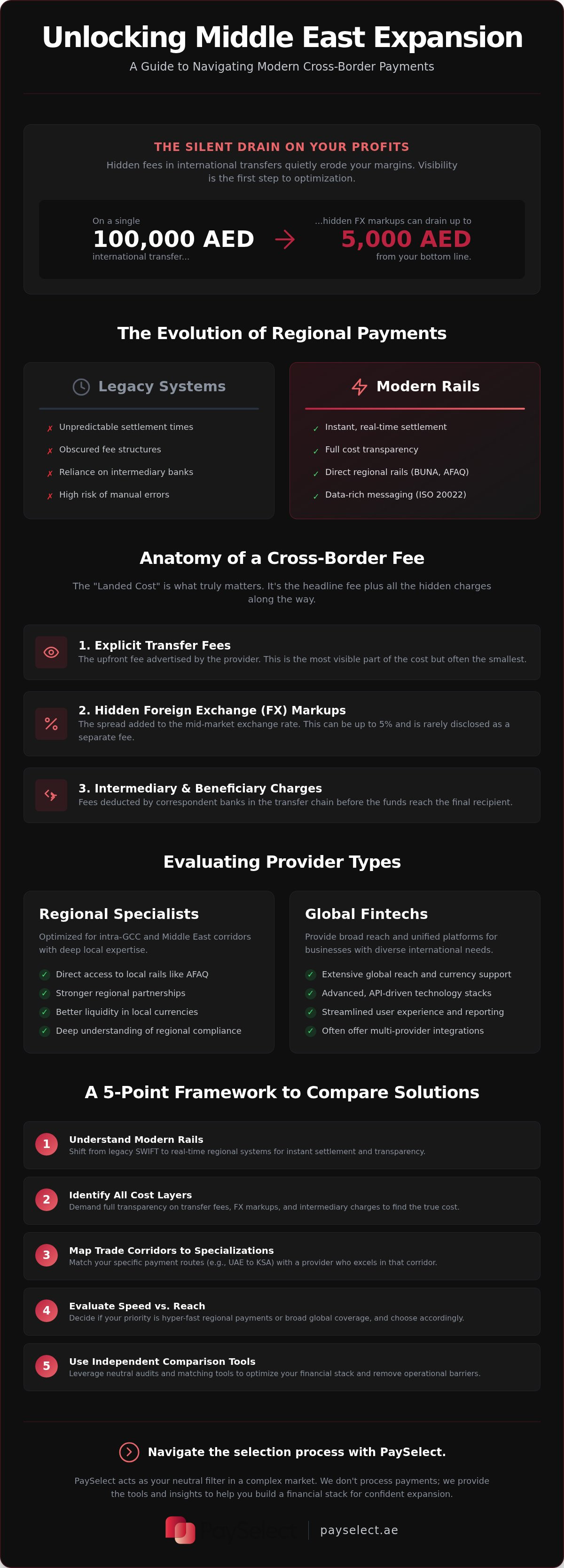
On a single 100,000 AED transfer, hidden FX markups can quietly drain 5,000 AED from your profit margins before the funds even arrive. It's not just a standard transaction fee; it's a structural leak that undermines your international ambition. You already understand that managing regional growth requires precision, speed, and absolute clarity. Yet, unpredictable settlement delays and the strict compliance requirements of Federal Decree-Law No. (6) of 2025 often make expansion feel like an unnecessary hurdle.
To scale with confidence, you must compare cross border payment solutions middle east by looking beyond headline rates to find true operational fluidity. This guide deconstructs hidden costs, evaluates regional rails, and identifies provider specialisations that integrate with your existing financial stack. You'll discover how to achieve real-time FX visibility, lower transaction costs, and prepare for the mandatory ISO 20022 transition. PaySelect acts as your neutral filter in this crowded market, using a specialised matching tool to simplify your selection process and remove the operational barriers to your expansion.
Key Takeaways
• Understand the shift from legacy SWIFT banking to modern, real-time regional payment rails that provide instant settlement and transparency across the GCC.
• Identify the three primary cost layers of international transfers, including hidden FX markups and intermediary charges that often drain profit margins.
• Use a structured 5-point framework to compare cross border payment solutions middle east by mapping your specific trade corridors to provider specialisations.
• Evaluate the distinct advantages of regional specialists versus global fintechs to find the right balance of speed and reach for your business.
• Discover how independent comparison tools and bespoke audits can help you optimise your financial stack and remove operational barriers to growth.
The Evolution of International Payments in the Middle East
The transition from legacy systems to modern infrastructure is reshaping how businesses move capital across the region. For decades, the correspondent banking model served as the primary bridge for international trade, but it often resulted in unpredictable settlement times, obscured fee structures, and manual reconciliation. By 2026, the shift toward instant, transparent rails has become a necessity for any merchant looking to compare cross border payment solutions middle east and maintain healthy profit margins. The Middle East has emerged as a sophisticated hub for outbound remittances, driven by a regulatory environment that prioritises speed and security.
The implementation of Federal Decree-Law No. (6) of 2025 has formalised this evolution, with a compliance deadline of September 16, 2026. This regulation expands oversight to include open finance and virtual asset payments, ensuring the UAE remains a leader in financial technology. This legal framework, coupled with the mandatory global transition to ISO 20022, allows for data-rich payment messaging that eliminates the opacity of the past. These advancements also provide a solid foundation for Central Bank Digital Currency (CBDC) developments, including the legal recognition of the Digital Dirham as a valid tool for settlement.
Modern Payment Rails: Understanding BUNA and AFAQ
Regional clearing and settlement systems are removing the friction historically associated with cross-border trade. BUNA acts as a multi-currency clearing house that allows financial institutions to settle payments in Arab and international currencies with high efficiency. Simultaneously, the AFAQ system simplifies GCC-wide transfers by connecting regional real-time gross settlement systems. These platforms reduce reliance on multiple intermediary banks, lower the risk of transaction errors, and ensure that funds are available to suppliers almost instantly. For businesses, this means better liquidity management and stronger regional partnerships.
The Rise of Fintech in the Regional Payment Landscape
Non-bank providers are challenging traditional correspondent banking by offering agile, API-driven solutions that connect directly to your existing financial stack. These fintech platforms focus on user experience, providing real-time FX tracking and transparent cost breakdowns that legacy banks often struggle to match. As businesses seek to avoid hidden markups, many are moving toward multi-provider payment stacks to optimise different trade corridors. PaySelect helps you navigate this complex market by acting as an independent filter. We don't process payments; instead, we provide the tools to evaluate provider specialisations, ensuring your infrastructure is built for expansion and operational fluidity.
Deconstructing the Total Cost of Cross-Border Transactions
When you compare cross border payment solutions middle east, the headline fee is rarely the final cost. Finance teams must focus on the "Landed Cost," which is the actual amount that reaches the recipient after every participant in the chain takes their share. This total cost is comprised of three primary layers: explicit transfer fees, Foreign Exchange (FX) markups, and intermediary charges. Opaque pricing structures can lead to unpredictable settlement amounts, which ultimately strain supplier relationships and complicate internal reconciliation.
Achieving real-time visibility into these layers is a strategic necessity for modern merchants. In the UAE, traditional methods often involve correspondent banking chains that "clip" funds as they move between jurisdictions. Without a clear breakdown of these costs, your business might be losing significant capital through structural leaks in your financial stack. Understanding these components allows you to move from a reactive stance to a proactive strategy focused on cost optimisation and operational fluidity.
Uncovering Hidden Foreign Exchange Markups
The FX markup is the hidden spread added to the interbank rate, representing the difference between the mid-market rate and the rate your provider actually gives you.
In the UAE market, these markups can reach as high as 5% above the mid-market rate. For a 100,000 AED transfer, this results in a 5,000 AED loss that is often not disclosed as a separate fee. To protect your margins, you should request a detailed fee schedule from your provider that includes explicit spread transparency. Providers generally offer two types of FX pricing:
Fixed Pricing
A set percentage markup regardless of the transaction size, providing predictability for smaller volumes.
Volume-Based Pricing
Tiered spreads that decrease as your total monthly transfer volume increases, which is essential for scaling businesses.
Intermediary Fees and Opaque Charges
It is a common frustration for finance departments when payments arrive for less than the amount sent. This shortfall occurs because correspondent banks involved in the transfer process deduct their own service fees before the funds reach the destination. According to a regional analysis of payment systems, these intermediary fees can be as high as 400 AED per transaction depending on the complexity of the trade corridor.
Modern solutions bypass these legacy correspondent chains by utilizing regional rails or local payout accounts, ensuring the full amount arrives as intended. This level of precision is vital for maintaining trust with international partners. If you are unsure whether your current setup is cost-effective, you can compare cross-border options through an independent audit to identify where your capital is being diverted. PaySelect helps you filter through these complex fee structures to find the most efficient infrastructure for your specific trade corridors.
Evaluating Provider Types: Regional Specialists vs. Global Fintechs
Selecting the right infrastructure requires a strategic alignment between your primary trade corridors and a provider's core strengths. To effectively compare cross border payment solutions middle east, you must evaluate whether your volume is concentrated within the GCC or dispersed across global markets. Each provider type offers distinct advantages in speed, compliance, and cost. While some excel at navigating local regulatory nuances, others provide the expansive reach needed for international scaling. This choice is increasingly influenced by a global perspective on cross-border payments that prioritises interoperability and reduced friction across diverse financial systems.
Regional Specialists: Excellence in GCC Corridors
Regional specialists offer deep integration with local payment rails like BUNA and AFAQ. These providers are specifically designed to handle the complexities of the Middle East and North Africa, providing lower latency for transfers between regional banks. Their support teams operate within local business hours and understand the specific documentation requirements of regional jurisdictions. For SMEs focusing on intra-GCC trade, these specialists often provide the most direct route for capital, minimising the need for correspondent banking chains that can delay settlement.
Global Fintechs: Scaling Beyond the Middle East
Global fintechs provide a different value proposition, focusing on vast currency support and sophisticated API connectivity. These partners are ideal for businesses paying suppliers in Western or Asian markets, where they hold local licenses that allow for near-instant payouts. Their technology is built for high-volume automation, allowing finance teams to integrate payment workflows directly into their ERP systems. You should prioritise global reach when your operations require fluidity across multiple continents rather than a deep focus on a single regional corridor.
Institutional transfers of high-value capital often remain the domain of bank-backed solutions. While these may lack the agility of fintechs, they offer a level of security and regulatory comfort required for enterprise-level movements. Large-scale organisations often adopt a hybrid approach, using banks for treasury management and fintechs for operational payouts. To find the right balance for your specific needs, you can compare cross border payment solutions middle east through an independent matching tool. This ensures your selection is based on data rather than brand familiarity, allowing your financial infrastructure to act as a catalyst for growth.
A 5-Point Framework to Compare Cross-Border Solutions
Selecting a financial partner requires a rigorous evaluation process that moves beyond marketing claims. To effectively compare cross border payment solutions middle east, you need a framework that prioritises operational performance over headline rates. A structured approach ensures your infrastructure is robust, cost-effective, and fully compliant with the evolving regulatory landscape. Use this 5-point framework to audit potential partners and secure your profit margins.
Step 1: Map your primary trade corridors.
Identify where your suppliers are located and match these to provider strengths.
Step 2: Audit for FX transparency.
Demand a breakdown of the spread against the mid-market rate to ensure you aren't paying hidden markups.
Step 3: Assess technical compatibility.
Verify that the solution integrates directly with your existing ERP and POS systems to avoid manual data entry.
Step 4: Verify settlement speed.
Test the predictability of fund arrival times for your most active markets to maintain healthy supplier relationships.
Step 5: Review compliance and licensing.
Ensure the provider meets the standards set by Federal Decree-Law No. (6) of 2025 before the September 16, 2026 deadline.
Corridor Mapping: Why Specialisation Matters
Specialisation is a critical differentiator in the payment industry. A provider might offer exceptional rates and instant settlement for European corridors but provide poor liquidity and high fees for South Asian routes. This discrepancy occurs because providers rely on different banking relationships and local licenses in each region. Matching your specific supplier locations to a provider's core strengths allows you to access corridor-specific pricing. This targeted approach reduces the number of intermediary banks involved, which directly lowers your total transaction cost and increases settlement predictability.
Technical Integration and Operational Fluidity
The value of modern cross-border solutions lies in their ability to remove manual barriers from your finance department. When evaluating a partner, you must scrutinise their API documentation and the ease of system connectivity. A solution that offers automated reconciliation can significantly reduce your team's workload by matching outgoing payments to invoices in real time. This technical utility transforms your payment setup from a simple utility into a strategic tool for business transformation. If your current system feels disconnected from your broader financial stack, it's time to take the PaySelect test to find a more efficient match for your business needs.
Navigating the Selection Process with PaySelect
The landscape of international finance is increasingly complex, making it difficult for businesses to identify the most efficient partners. When you attempt to compare cross border payment solutions middle east, you often encounter a wall of marketing jargon and opaque fee structures. PaySelect removes this friction by acting as an independent, data-driven filter. We don't process payments; we provide the clarity you need to select the providers that actually deliver on their promises of speed and transparency.
Our platform is built on the principle of absolute neutrality. In a referral-heavy industry where many advisors are incentivised to push specific vendors, our independence is our greatest asset. You can use our specialised tools to compare payment gateways alongside your international options, ensuring every component of your financial stack is optimised for performance. This holistic view allows you to identify structural leaks and remove the operational barriers that hinder your global ambition.
The Advantage of Unbiased Comparison
Independence is critical when your profit margins are on the line. Traditional advisors might favour certain providers due to existing partnerships, but PaySelect focuses purely on your business requirements. We provide access to transparent data that providers often keep opaque, such as the real-time spread on FX rates and the likelihood of intermediary bank deductions. This level of insight ensures that your decision is based on performance data rather than brand familiarity or aggressive sales tactics.
Optimising Your Infrastructure for 2026
For large-scale organisations, our bespoke advisory services go beyond simple matching. We offer a Payment Cost Optimisation Audit designed for CFOs who need to align their international payment strategy with aggressive growth goals. This process involves a deep dive into your current transaction volumes and trade corridors to find immediate savings. By deconstructing your "Landed Cost" and verifying settlement predictability, we ensure your infrastructure is ready for the mandatory shifts in regional regulations, including the September 16, 2026 compliance deadline for Federal Decree-Law No. (6).
The first step toward a more fluid financial future is data. Our "Take the Test" matching tool is designed to provide personalised recommendations based on your specific profile, evaluating factors such as:
• Technical compatibility with your existing ERP and POS systems
• Volume-based pricing eligibility for high-frequency corridors
• Compliance readiness for upcoming regional regulatory changes
• Real-time FX visibility and settlement speed requirements
This tool takes the guesswork out of the selection process, allowing you to compare cross border payment solutions middle east with confidence. Stop letting hidden markups and unpredictable settlement delays drain your margins. Start building a payment ecosystem that acts as a catalyst for your expansion and provides the rock-solid reliability your business deserves.
Securing Your Global Growth Strategy
Regional expansion depends on more than just vision; it requires a financial infrastructure that is both transparent and highly efficient. By deconstructing hidden FX markups and leveraging modern payment rails like BUNA, your business can eliminate the structural leaks that often drain profit margins. You now have the framework to evaluate providers based on corridor-specific performance rather than headline rates.
As the 2026 regulatory landscape evolves, the ability to effectively compare cross border payment solutions middle east becomes a significant competitive advantage. PaySelect provides the independent advisory and expert audits needed to optimise complex payment stacks. Our transparent comparison of Middle East payment infrastructure removes operational barriers, allowing you to focus on your core business objectives.
Ready to streamline your international capital movements? Take the matching test to find the best cross-border solution for your business and transform your payment setup into a catalyst for expansion. Your journey toward frictionless global commerce starts with a single, data-driven choice.
Frequently Asked Questions
How do I identify hidden fees in a cross-border payment contract?
You should request a comprehensive "Full Cost of Funds" breakdown before signing any agreement. Look specifically for the spread between the mid-market rate and the provider's offered rate, as this FX markup is often not listed as a separate fee. You must also check for "correspondent bank charges" or "processing surcharges" that can be deducted from the principal amount during transit.
What is the difference between SWIFT and regional rails like BUNA?
SWIFT is a global messaging network that typically relies on a chain of intermediary banks to move capital, which can lead to delays and extra costs. In contrast, BUNA is a regional clearing and settlement system designed specifically for Arab markets. BUNA allows for more direct transfers, providing faster settlement and significantly lower fees by removing unnecessary correspondent layers across the GCC.
Can I use multiple cross-border payment solutions simultaneously?
Yes, many sophisticated merchants maintain a multi-provider stack to ensure maximum operational fluidity. This strategy allows you to compare cross border payment solutions middle east based on specific trade corridors, using different partners for European, Asian, or regional transfers. Diversifying your payment infrastructure helps you access the best possible rates and settlement speeds for every unique market your business enters.
How long should a cross-border transfer take in 2026?
Settlement for regional transfers should now be near-instant or completed within the same business day. The traditional standard of waiting 2 to 4 business days for funds to arrive is considered a legacy bottleneck in the modern economy. By utilizing regional rails or API-driven fintech solutions, your business can achieve real-time visibility and immediate liquidity for your international suppliers.
Are fintech payment solutions as secure as traditional Middle Eastern banks?
Fintech providers in the UAE must adhere to the same rigorous security standards as traditional banks, especially under Federal Decree-Law No. (6) of 2025. This regulation ensures that all payment technology providers meet strict capital requirements and data protection protocols. Many modern platforms use advanced encryption and multi-factor authentication that match or even exceed the security frameworks of legacy institutional partners.
What is the mid-market rate and why does it matter for my business?
The mid-market rate is the real exchange rate used by global banks to trade currencies with each other. It matters because it serves as the only honest benchmark for transparency in international trade. Any deviation from this rate represents a hidden markup. Tracking this rate allows your finance team to calculate the true cost of every transaction and protect your profit margins.
How does PaySelect maintain its independence when recommending providers?
PaySelect does not process payments or accept commissions that could bias our comparisons. Our "Take the Test" matching tool uses objective data points, such as fee transparency, settlement speed, and technical compatibility, to provide neutral recommendations. We act as a strategic filter to help you compare cross border payment solutions middle east, ensuring your selection is based entirely on your specific business requirements.
Disclaimer
This content is for informational purposes only and should not be considered financial, legal, or regulatory advice. Payment provider availability, pricing, and approval processes vary depending on individual business circumstances. PaySelect does not guarantee provider acceptance or specific outcomes. Businesses should conduct their own due diligence before entering into any agreements.
Empowering businesses to achieve greater growth