Comparing Secure Payment Gateways for Ecommerce in the UAE: 2026 Merchant Guide

The UAE ecommerce sector is surging toward a projected USD 9.2 billion valuation by the end of 2026. This massive growth means that comparing secure payment gateways for ecommerce uae is no longer just a technical task; it's a strategic necessity. You've likely felt the sting of unpredictable transaction fees, complex integration hurdles, and settlement delays that stall your cash flow. These operational barriers shouldn't dictate your business trajectory or limit your international ambition.
We understand that you need absolute confidence in your financial infrastructure. This guide provides the framework you need to master provider evaluation, ensuring your systems remain compliant with UAE Central Bank regulations while actively reducing your merchant discount rates. We'll explore how to optimize your stack for fluidity, security, and a frictionless checkout experience. PaySelect simplifies this transition through our payment gateway comparison tool, pricing comparison data, and cost optimization audits. You'll learn how to transform technical utility into a strategic tool that accelerates your growth and removes every friction point from your digital storefront.
Key Takeaways
• Identify the non-negotiable security standards required to protect your revenue and maintain mandatory compliance with current UAE Central Bank regulations.
• Apply a structured framework for comparing secure payment gateways for ecommerce uae to ensure your chosen provider matches your specific operational scale.
• Look beyond basic transaction fees to calculate the total cost of ownership, accounting for settlement times and their impact on your business liquidity.
• Implement a five-step strategic selection process that aligns your technical payment stack with your existing ecommerce platform for a frictionless checkout experience.
• Discover how independent comparison tools and cost optimization audits eliminate choice paralysis and accelerate your path to regional expansion.
The UAE Ecommerce Landscape: Why Security is Non-Negotiable
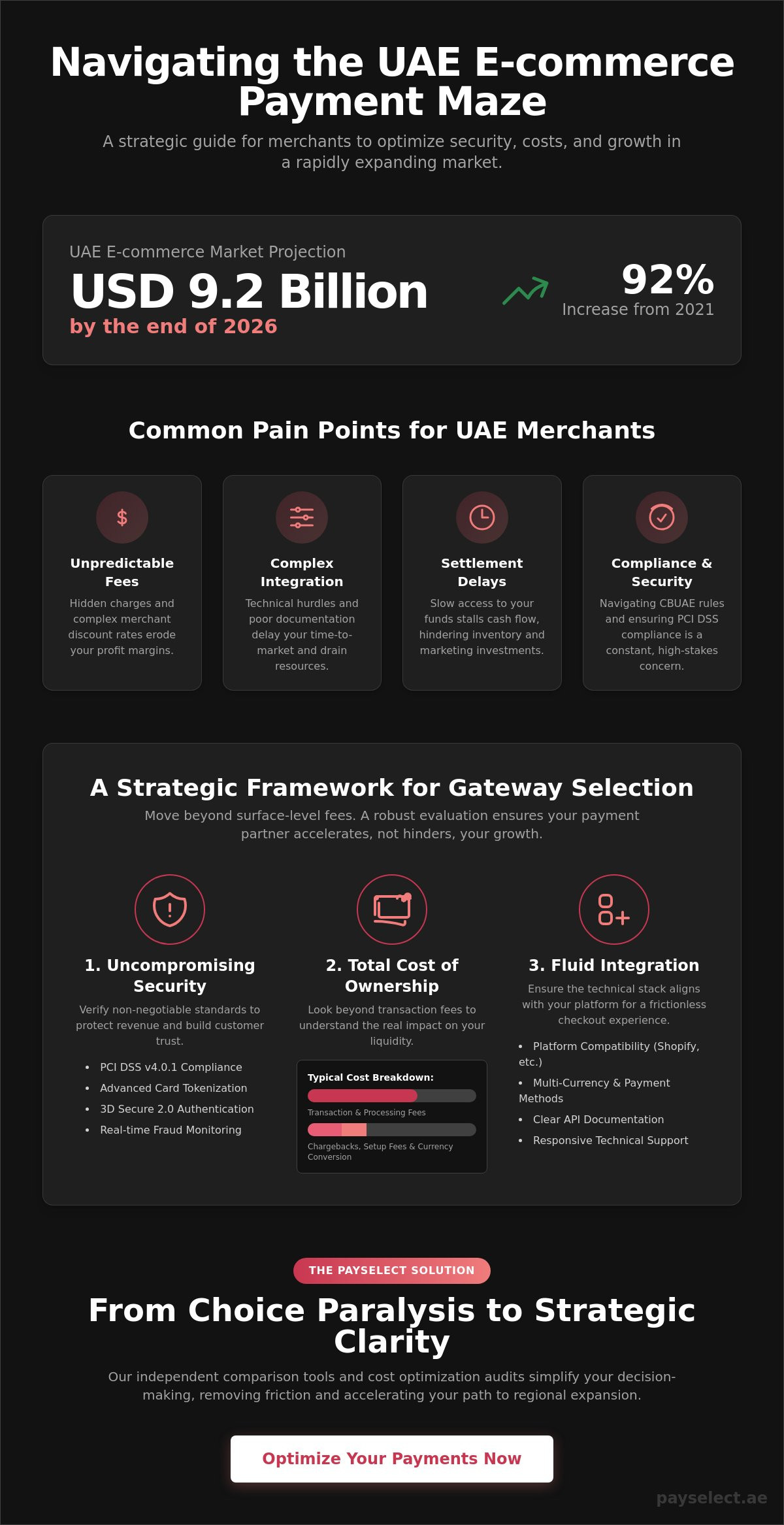
Digital commerce in the Emirates is moving at an unprecedented pace. The Dubai Chamber of Commerce projects the UAE ecommerce sector will reach USD 9.2 billion by 2026, marking a 92% increase from 2021 levels. This rapid expansion has transformed the payment gateway from a back-end utility into the critical infrastructure for digital growth. It's the digital bridge that connects your vision to your customer's wallet. When you begin comparing secure payment gateways for ecommerce uae, you're not just looking for a vendor. You're selecting a strategic partner that determines your operational fluidity and your ability to scale across borders.
UAE consumers have some of the highest digital expectations globally. They demand checkout experiences that are instant, intuitive, and, above all, secure. The Central Bank of the UAE (CBUAE) governs this landscape with a focus on stability and consumer protection. Their regulations ensure that every payment service provider operating in the region adheres to strict financial standards. This oversight has forced a shift in the industry. Payment processing is no longer just about moving money; it's about strategic business enablement. Your choice of gateway affects everything from your daily cash flow to your long-term regulatory standing.
The Role of Regulatory Compliance
Choosing a licensed provider is the only way to ensure long-term stability for your business. In the UAE, regulatory compliance involves more than just a checkbox. It includes adhering to local data residency requirements and specific financial frameworks set by federal authorities. These laws, such as Federal Decree-Law No. 45 of 2021 on Personal Data Protection, mandate how you collect and store customer information. A compliant gateway protects you from heavy liabilities and the rising threat of digital fraud. It ensures that your business remains operational even as the UAE government strengthens its oversight of the digital economy.
Security as a Growth Catalyst
Smart merchants don't view security as a cost. They see it as a tool for reducing cart abandonment. When a shopper sees familiar trust signals at checkout, their confidence increases. This confidence leads directly to higher conversion rates and repeat purchase intent. A secure shopper is a loyal shopper. By prioritizing robust encryption and multi-factor authentication, you remove the emotional barriers that prevent a sale. Security creates a frictionless path to purchase, turning technical utility into a competitive advantage.
At PaySelect, we help you master this complex landscape. Our payment gateway comparison tool and infrastructure consulting services help you identify the right balance of security and cost. We address common pain points like high transaction fees and complex integration processes by providing clear, independent insights. Instead of struggling with choice paralysis, you can use our platform to find a solution that matches your operational scale and supports your international ambition.
Evaluating Security Protocols: What Merchants Must Verify
Security jargon often complicates what should be a straightforward business decision. For a merchant, the goal is simple: protect revenue and maintain customer trust. When you're comparing secure payment gateways for ecommerce uae, you must look beyond marketing claims and verify three core technical pillars. These standards don't just protect data; they ensure your business remains compliant with the UAE eCommerce market overview and regulatory landscape. In 2026, the baseline for safety includes PCI DSS v4.0.1, tokenization, and 3D Secure 2.0.
Modern payment infrastructure has moved past static defense. Leading providers now utilize machine learning fraud monitoring to identify suspicious patterns in real time. This proactive approach balances rigorous security with a frictionless checkout flow. It prevents legitimate transactions from being blocked while stopping fraudulent ones before they impact your bottom line. Success in the digital economy requires a system that is both a fortress and a gateway.
PCI DSS and Tokenization Explained
PCI DSS v4.0.1 is the global gold standard for protecting sensitive cardholder data. As of March 2025, this version is mandatory for all merchants. Non-compliance isn't just a risk; it can lead to fines reaching $100,000 per month. Tokenization works alongside this standard by replacing sensitive card details with unique identifiers called tokens. If a breach occurs, the data stolen is useless to hackers. Tokenization ensures that even in the event of a breach, your customers’ actual card data remains inaccessible. This process eliminates the need for you to store raw financial data on your own servers, significantly reducing your liability and operational burden.
3D Secure 2.0: The New Standard for UAE
The original 3D Secure was known for clunky pop-ups that drove customers away. The updated 3DS2 standard solves this by facilitating better data sharing between merchants and banks behind the scenes. This allows for "frictionless authentication" where the bank can verify the shopper's identity without requiring extra steps. It's particularly effective for the mobile shopping experience, which now dominates the UAE market. By reducing false declines and streamlining the process, 3DS2 turns a security hurdle into a conversion tool. If your current setup still relies on outdated protocols, it's time to use a payment gateway comparison tool to find a provider that supports modern standards. Upgrading your security architecture is a direct investment in your customer's confidence and your business's long-term fluidity.
Comparing Costs: Beyond the Transaction Fee
Focusing solely on the headline transaction fee is a common mistake that can erode your profit margins. When comparing secure payment gateways for ecommerce uae, you must evaluate the Total Cost of Ownership (TCO). This comprehensive figure includes setup fees, monthly maintenance costs, and the often-overlooked expense of slow settlement times. A gateway with a lower percentage fee might actually be more expensive if it traps your capital for weeks or charges high premiums for currency conversion. True cost-efficiency comes from aligning a provider's fee structure with your specific business model and transaction volume.
Different business stages require different financial architectures. Small and medium enterprises (SMEs) often benefit from pay-as-you-go models that eliminate heavy upfront costs. In contrast, high-volume enterprise merchants should seek tiered pricing structures where the Merchant Discount Rate (MDR) decreases as sales grow. For instance, typical UAE market rates might start around 2.85% plus 1 AED per transaction, but can drop significantly once monthly volumes surpass 50,000 AED. Understanding these thresholds allows you to negotiate from a position of strength and ensures your payment stack remains a driver of growth rather than a drain on resources.
The Visible vs. Invisible Fee Structure
The fee landscape in the UAE is divided into visible costs and those hidden in the fine print. You'll encounter two primary models: fixed monthly fees and pure transaction-based pricing. Some providers charge a monthly subscription, such as 349 AED, to unlock lower transaction rates. You also need to account for:
Setup and Integration Costs
These vary based on whether you use a simple hosted page or a complex API integration.
Cross-Border Premiums
Many providers add an extra 1% for international cards, which is critical if you sell to customers outside the GCC.
Currency Conversion
Hidden markups on exchange rates can silently inflate your costs during international settlement.
Settlement Cycles and Operational Fluidity
Cash flow is the lifeblood of any ecommerce operation. Settlement cycles define how quickly your sales revenue moves from the gateway to your corporate bank account. While some legacy systems might hold funds for 7 to 14 days, modern UAE providers offer "Next Day" or "T+2" settlement options. Waiting a week for your money creates a liquidity gap that can prevent you from restocking inventory or funding marketing campaigns. By optimising payment infrastructure, you ensure that your capital remains fluid and ready for reinvestment. At PaySelect, we help you navigate these complexities through our payment pricing comparison tools and cost optimization audits. We identify the hidden friction points in your current setup, allowing you to choose a partner that supports both your security needs and your operational speed.
A Strategic Framework for Selecting Your Gateway
Selecting a payment provider is a decision that dictates your business's operational speed and customer satisfaction. While security and cost are essential, comparing secure payment gateways for ecommerce uae requires a structured methodology to ensure long-term compatibility. You need a partner that doesn't just process transactions but acts as a catalyst for your growth. A fragmented approach leads to integration delays and checkout friction; a strategic framework ensures your technical stack remains fluid and scalable.
Local expertise is a critical factor often overlooked by merchants. A provider with a deep understanding of the UAE's regulatory environment can resolve technical hurdles faster than a remote support team. They understand the nuances of the regional banking system and the specific requirements of the UAE Central Bank. This local insight ensures that your business stays compliant as laws evolve, allowing you to focus on expansion rather than administrative barriers.
Step 1: Audit Your Transaction Profile
Your first step is a deep dive into your current and projected sales data. Analyze your Average Transaction Value (ATV) and total monthly volume to determine which fee structure offers the most efficiency. If your business model involves international expansion, you must verify cross-border payment capabilities early in the process. Consider whether your revenue model requires specialized features like recurring billing for subscriptions or automated split payments for marketplaces. Identifying these needs now prevents costly migrations in the future.
Step 2: Technical and Platform Compatibility
Your gateway must integrate seamlessly with your existing ecommerce platform to maintain a professional user experience. You have two primary choices: a hosted checkout or an API-integrated solution. Hosted pages redirect customers to a secure third-party site, simplifying your PCI compliance burden. API integrations keep the shopper on your site, offering more control over the brand experience. For startups and social commerce entrepreneurs, "no-code" payment links provide an immediate way to accept funds without a complex website setup. Ensure the provider offers robust plugins for the major platforms used in the UAE to minimize development time.
The final stages of your framework should focus on security verification, support responsiveness, and future scalability. You need a system that grows with your international ambition without requiring a complete infrastructure overhaul. If you're feeling overwhelmed by the technical nuances, you can use our payment gateway comparison tool to filter providers based on your specific operational needs. Our platform eliminates choice paralysis by providing the independent data you need to make a confident, results-oriented decision.
Simplifying the Choice: How PaySelect Facilitates Expansion
The complexity of the MENA payment landscape often leads to choice paralysis. With dozens of providers offering varying fee structures and technical capabilities, making an informed decision requires more than just a surface-level search. PaySelect acts as an independent authority, bridging the gap between sophisticated global infrastructure and your specific business needs. We don't process payments; we provide the clarity you need to select the partners that will fuel your international ambition. When you are comparing secure payment gateways for ecommerce uae, our platform replaces guesswork with data-driven insights.
Our "Take the Test" tool serves as the antidote to operational friction. It's designed to analyze your unique business profile and match you with solutions that prioritize speed, security, and cost-efficiency. Instead of navigating biased marketing claims, you receive a transparent breakdown of how different providers handle your specific transaction volume and industry requirements. This results-oriented approach ensures that your payment stack becomes a strategic tool for transformation rather than an administrative burden.
Tailored Matching for Your Industry
Every industry faces unique payment hurdles. A high-volume retail store has different liquidity needs than a subscription-based SaaS platform. PaySelect filters providers based on these industry-specific pain points, such as high Merchant Discount Rates (MDR) or slow settlement cycles. By accessing transparent data before you commit, you avoid the hidden costs that often stall digital growth. We focus on removing operational barriers, providing expert guidance that allows you to focus on what matters most: scaling your brand. Our payment pricing comparison tools ensure you never overpay for the infrastructure that powers your sales.
Expert Advisory for Enterprise Scale
For large-scale organizations, a standard gateway isn't enough. You require a robust architecture that supports high-velocity commerce and complex cross-border flows. PaySelect offers specialized payment infrastructure consulting and cost optimization audits to identify inefficiencies in your existing stack. We look deep into your transaction data to find opportunities for reducing fees and improving operational fluidity. This high-end advisory service is built for businesses that view payments as a strategic competitive advantage. If you're ready to move beyond generic solutions and build a world-class financial foundation, you can compare payment gateways now. Let us help you find the perfect match to accelerate your expansion across the UAE and beyond.
Secure Your Growth with Data-Driven Decisions
The UAE digital economy is expanding at a record pace. Selecting your financial infrastructure is a defining factor for your success. You now have the framework to look beyond simple transaction percentages and evaluate the total cost of ownership. This includes understanding the impact of settlement cycles on your liquidity. By prioritizing modern standards like PCI DSS v4.0.1 and 3DS2, you ensure your business remains compliant while providing the frictionless experience your customers expect.
Comparing secure payment gateways for ecommerce uae requires a precise balance of technical rigor and operational efficiency. PaySelect provides an independent and unbiased digital platform to help you navigate these choices with confidence. We offer comprehensive data on UAE-licensed providers and expert advisory for high-volume enterprises looking to optimize their payment stacks. It's time to stop guessing and start scaling with precision.
Find your perfect payment gateway match with PaySelect’s comparison tool
Take control of your financial architecture today and build a foundation for limitless expansion.
Frequently Asked Questions
How do I know if a payment gateway is licensed in the UAE?
You can verify a provider's status by checking the official register of the Central Bank of the UAE for licensed Retail Payment Services. Licensed providers must adhere to strict federal standards regarding data residency and financial stability. Comparing secure payment gateways for ecommerce uae involves ensuring your partner is fully regulated to avoid legal liabilities or sudden operational shutdowns.
What is the average transaction fee for ecommerce in the UAE in 2026?
Standard transaction fees in 2026 typically range between 2.80% and 2.85% plus a flat fee of 1 AED per transaction. High-volume merchants with monthly sales exceeding 50,000 AED can often access lower rates around 2.49% plus 0.50 AED. These rates vary based on your industry and the specific plan you select, making a pricing comparison essential for cost efficiency.
Can I use one gateway for both my online store and physical POS machines?
Many providers offer unified omnichannel solutions that connect your digital storefront with physical POS machines. This integration creates a single view of your inventory and sales data across all channels. It simplifies your financial reporting and ensures a consistent experience for customers, whether they shop in-person or through your website.
How long does it typically take to integrate a gateway onto a website?
Integration timelines depend entirely on your technical architecture and the platform you use. If you're using pre-built plugins for major ecommerce platforms, setup can take just a few hours. Custom API integrations for complex enterprise websites often require two to four weeks for development and security testing to ensure a smooth, frictionless checkout flow.
What happens if a transaction is flagged as fraudulent?
Flagged transactions are typically held in a pending state for manual review or automatically blocked based on your risk settings. Modern gateways use machine learning and 3DS2 protocols to analyze data points like IP addresses and purchase history in real time. This proactive approach reduces chargebacks and protects your merchant account from the financial impact of digital fraud.
Are there specific gateways better suited for cross-border payments in the GCC?
Certain providers are better equipped for regional expansion because they support direct settlement in local currencies like SAR, KWD, and BHD. This removes the need for expensive currency conversion and reduces the total cost of ownership for your business. Identifying these providers through cross-border matching tools ensures your technical stack supports your international ambition from day one.
What documentation is required to open a merchant account in the UAE?
You'll need a valid UAE trade license, a Memorandum of Association (MOA), and identification for all owners, including passports and Emirates IDs. Most providers also request the last six months of your corporate bank statements. Having these documents organized and ready for submission can significantly reduce approval times and accelerate your path to market.
Is it possible to negotiate transaction rates as my business scales?
Negotiating your Merchant Discount Rate (MDR) is common practice once your business reaches higher transaction volumes. Most providers offer tiered pricing models where fees decrease as you hit specific monthly revenue milestones. Conducting a regular cost optimization audit helps you identify when you have enough leverage to request a more competitive rate structure from your provider.
Disclaimer
This content is for informational purposes only and should not be considered financial, legal, or regulatory advice. Payment provider availability, pricing, and approval processes vary depending on individual business circumstances. PaySelect does not guarantee provider acceptance or specific outcomes. Businesses should conduct their own due diligence before entering into any agreements.
Empowering businesses to achieve greater growth