Cross-Border Payment Fees in the Middle East: A 2026 Strategic Cost Guide

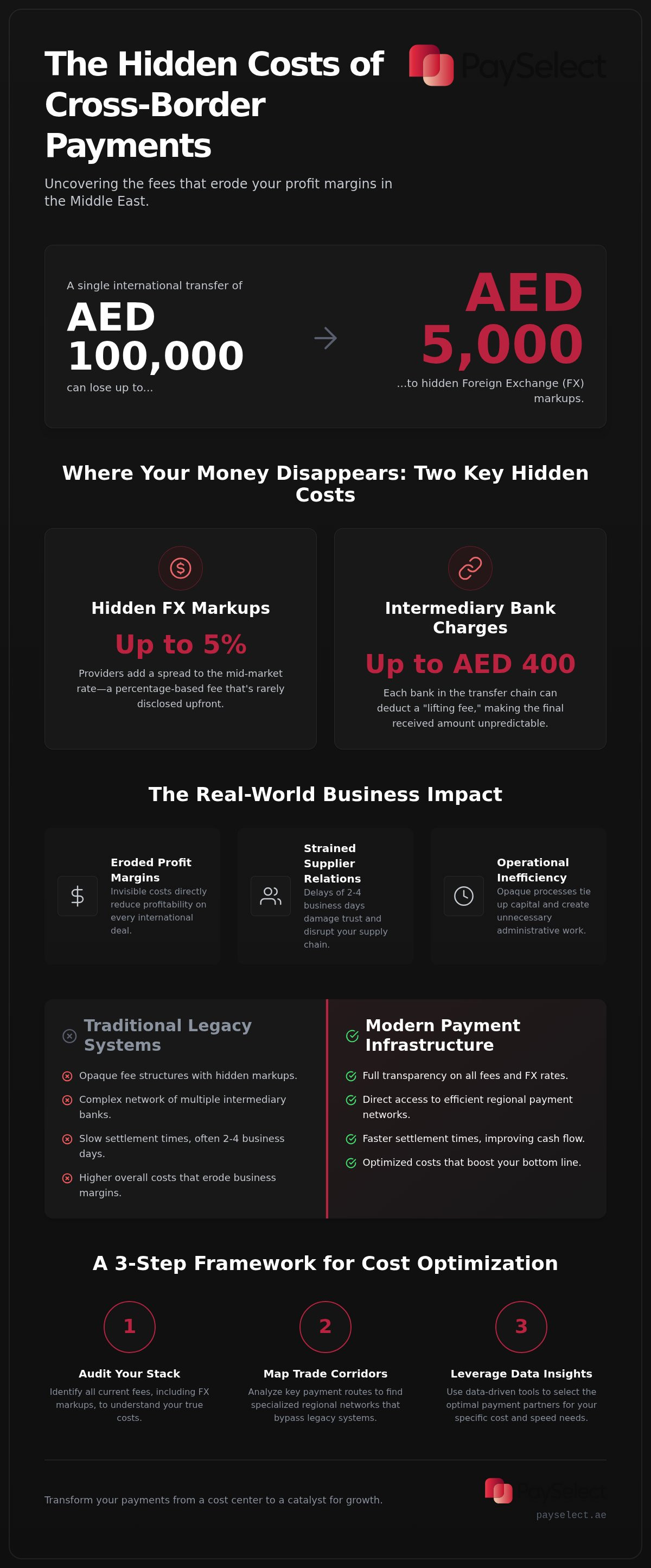
Did you know that a single AED 100,000 international transfer can lose AED 5,000 purely to hidden foreign exchange markups? In a landscape where cross border payment fees middle east are often shrouded in complexity, these invisible costs erode your margins before the capital even reaches its destination. You've likely felt the frustration of opaque intermediary bank charges that can reach AED 400 per transaction, or settlement delays that strain your vital supplier relationships. With the September 16, 2026, regulatory compliance deadline approaching, it's critical to ensure your payment infrastructure is both compliant and cost-effective.
This guide empowers you to master these complexities and transform your international transaction costs into a strategic advantage for maximum profitability. We'll provide a data-driven framework to achieve transparent fee structures, faster settlement times, and optimized performance. You'll learn how to audit your current stack by comparing solutions that prioritize fluidity and operational efficiency. By leveraging independent insights and cost optimization strategies, you can turn your payment infrastructure into a powerful catalyst for international growth.
Key Takeaways
• Uncover the hidden impact of foreign exchange markups and intermediary charges on your international margins.
• Evaluate the efficiency gains of emerging regional payment networks against traditional global banking rails.
• Implement a data-driven framework to map trade corridors and reduce cross border payment fees middle east.
• Secure transparent fee structures and faster settlement times through independent infrastructure audits.
• Use specialized matching tools and the "Take the Test" tool to select the ideal payment partners for your expansion goals.
Understanding Cross-Border Payment Fees in the Middle East
Cross-border payments are the engine of international trade. They facilitate the flow of goods across jurisdictions, yet they remain a significant operational hurdle for expanding enterprises. For many, managing cross border payment fees middle east is a strategic necessity rather than just an accounting task. Traditional banking legacy systems often result in higher costs because they rely on aging infrastructure. These systems lack the transparency and speed required for modern commerce, leading to friction that slows down your business growth. It's time to move beyond the limitations of traditional finance to reclaim your profit margins.
The Anatomy of an International Transaction
When you initiate a transfer, your capital embarks on a complex journey. It rarely moves directly from your bank to the recipient. Instead, it passes through a series of intermediary institutions within Global Payment Systems. Each bank in this chain performs specific clearing and settlement functions, often deducting their own "lifting fees" along the way. These intermediary charges can reach AED 400 per transaction. This fragmentation creates a lack of visibility, making it difficult to predict the exact amount that will arrive in your supplier's account. Understanding this path is essential for anyone looking to optimize their cross-border payments stack.
Why Middle Eastern Corridors Require Specific Attention
Regional trade corridors present unique challenges that demand specialized attention. Regulatory environments are evolving rapidly. Businesses are currently working toward the September 16, 2026, deadline to comply with Federal Decree-Law No. (6) of 2025. Rigorous Anti-Money Laundering (AML) and Counter-Financing of Terrorism (CFT) screenings are now standard, acting as necessary but significant cost drivers. Additionally, currency volatility in the region can lead to foreign exchange markups as high as 5% above mid-market rates. By analyzing your specific corridors, you can drastically reduce cross border payment fees middle east and improve your bottom line.
The operational impact extends beyond the balance sheet. Settlement delays of 2 to 4 business days are common with legacy networks. When capital is trapped in transit, it stalls supply chains and can damage vital supplier relationships. A predictable payment flow is vital for maintaining liquidity and operational agility. To overcome these hurdles, you must move away from opaque structures and toward a data-driven framework that prioritizes efficiency and cost-effectiveness.
Deconstructing the Total Cost of International Transactions
The total cost of moving money internationally is rarely found in a single line item. It's a combination of visible charges and hidden margins that can quietly erode your bottom line. For businesses looking to scale, mastering cross border payment fees middle east requires looking beneath the surface of the standard transaction receipt. Most providers operate on a mix of fixed transaction fees and percentage-based models, making it difficult to compare apples to apples without a structured audit.
Foreign exchange (FX) markups represent the most significant hidden cost. Most providers don't charge a flat fee for currency conversion; instead, they apply a spread. This is the difference between the mid-market rate and the retail rate they offer you. When a spread reaches 5% above the mid-market rate, an AED 100,000 transfer can lose AED 5,000 before it even leaves the system. The G20 Roadmap for Cross-border Payments highlights the global effort to reduce these frictions, specifically targeting transparency and cost reduction in emerging markets like the Middle East.
Identifying Hidden FX Markups
To identify these costs, compare your provider's rate against the real-time mid-market rate. Many businesses don't realize that rates are often negotiable. High-volume merchants can often secure tighter spreads by presenting clear data on their trade corridors. Transparency here is a competitive advantage. You should demand clear disclosure of the markup percentage to ensure you aren't overpaying for basic currency conversion. Understanding this difference is the first step toward optimizing your cross-border payments stack.
The Complexity of Intermediary Charges
Intermediary fees, often called "lifting fees," occur when multiple banks are involved in a single transfer. In a correspondent banking network, each bank that touches the payment takes a cut. These fees can reach AED 400 per transaction and are notoriously difficult to predict. Instruction codes determine who pays these fees:
OUR
The sender covers all transaction costs.
SHA
The sender pays their bank's fee, and the recipient pays the rest.
BEN
The recipient covers all transaction charges.
Using "OUR" provides the most certainty for your supplier relationships, but it requires you to account for unpredictable third-party deductions upfront. Even after the money reaches the destination country, the recipient bank may charge a landing fee to deposit the funds. This further reduces the final amount received by your partner. If you're unsure how these fees are impacting your margins, you can take a specialized test to match your business with more transparent infrastructure partners.
Regional Payment Rails vs. Global Legacy Systems
For decades, SWIFT has functioned as the backbone of international finance. While reliable, this correspondent banking model often involves multiple intermediaries, each adding to the total cross border payment fees middle east. The landscape is shifting rapidly. Modern enterprises are moving toward regional rails and fintech alternatives that offer direct connectivity. This bypasses the legacy "hop-to-hop" method, reducing both transaction time and operational costs. By leveraging direct links, you eliminate the middleman and reclaim control over your capital.
The full implementation of ISO 20022 in late 2025 revolutionized how data travels with your money. This global standard ensures richer, more structured information accompanies every transfer. It leads to fewer manual interventions, faster compliance checks, and significantly higher transparency. For the business owner, it means fewer "stuck" payments and more predictable outcomes. Structured data isn't just a technical upgrade; it's a strategic tool for reducing the administrative burden of international trade.
BUNA and AFAQ: Regional Efficiency
Regional clearing networks like BUNA and AFAQ are designed specifically for intra-GCC and Arab world transactions. BUNA facilitates multi-currency settlements across the region, while AFAQ connects GCC central banks for real-time gross settlement. These networks provide three core advantages:
• They reduce reliance on expensive international intermediary banks.
• They lower foreign exchange friction for regional currency pairs.
• They offer near-instant settlement for participating financial institutions.
Accessing these rails requires a payment partner deeply integrated into the regional financial ecosystem. These systems are essential for businesses looking to minimize cross border payment fees middle east while maintaining high-speed operations across borders.
The Shift Toward Real-Time Payments
Traditional settlement typically takes 2 to 4 business days. In a 2026 economy, this delay is an operational liability that stalls growth. Modern API-driven solutions now enable 24/7 payment processing, ensuring your capital is always productive. This shift toward real-time settlement improves business liquidity, strengthens supplier trust, and eliminates the "black hole" period where funds are in transit. It's about moving money at the speed of your digital operations.
Choosing between legacy banking and modern fintech solutions is a strategic decision that impacts your long-term profitability. Different providers offer varying levels of access to regional rails like BUNA. To determine which infrastructure fits your specific trade corridors, you can use specialized tools to compare performance and pricing. Finding a partner that leverages these modern rails is the most effective way to optimize your cross-border payments stack for the future.
A Strategic Framework for Reducing Transaction Costs
Managing cross border payment fees middle east requires more than a passive approach. It demands a structured, data-driven framework that treats payment infrastructure as a strategic asset. To reclaim your margins, you must move from reactive payment processing to proactive cost management. Follow these five steps to optimize your stack and ensure maximum profitability.
Step 1: Audit Current Data.
Collect 12 months of transaction logs. Look specifically for the variance between the exchange rate you were charged and the mid-market rate at that exact moment to uncover hidden spreads.
Step 2: Map Trade Corridors.
Identify where your capital flows most frequently. High-volume routes to specific regions often qualify for specialized pricing tiers that general providers cannot match.
Step 3: Evaluate Technical Criteria.
A low-cost provider is a liability if they lack reliable API connectivity or fail to integrate with your existing ERP system. Prioritize uptime, security, and speed.
Step 4: Diversify Your Stack.
Don't rely on a single institution for all global needs. Use regional specialists for corridors where legacy systems are traditionally slow or expensive.
Step 5: Review Quarterly.
The regulatory and technical landscape changes fast. Regular audits ensure your partners are still delivering the best possible value for your current scale.
Corridor Mapping for Maximum Efficiency
Efficiency is found at the intersection of geography and technology. Some providers excel in Western markets but struggle with the unique compliance requirements of regional trade. By mapping your corridors, you can balance cost against urgency. For example, non-urgent inventory payments can move through slower, cheaper rails, while critical service payments require real-time settlement. To find the right fit for your specific routes, you can explore specialized cross-border payment solutions that align with your trade patterns.
Selecting the Right Partner for Your Scale
Your choice of partner must evolve with your business. SME-focused providers often offer intuitive interfaces and simple flat fees, while enterprise-grade solutions provide the deep API connectivity and multi-currency account structures needed for high-volume operations. Consider the quality of dispute resolution and the availability of dedicated support. A partner that understands the nuances of the Middle Eastern regulatory environment will save you more in the long run than one that simply offers the lowest headline rate. If you're ready to stop overpaying, take the test to see how an independent cost optimization audit can refine your infrastructure.
Optimizing Your Payment Infrastructure with PaySelect
The global payment market is deeply fragmented. Most providers present marketing claims that highlight low headline rates while obscuring the true cost of their services. For businesses attempting to manage cross border payment fees middle east, this lack of transparency creates significant operational barriers. PaySelect functions as an independent, neutral bridge between complex global infrastructures and your specific merchant needs. We provide the clarity required to move from guesswork to data-driven decision-making, ensuring your payment stack is built for performance rather than just basic utility.
By leveraging unbiased data, you gain the power to negotiate better terms with financial partners. You no longer have to accept standard retail rates when your transaction volume justifies institutional pricing. Our platform identifies the specific friction points in your current setup, from hidden FX spreads to redundant intermediary charges. This structural clarity allows you to implement a payment strategy that prioritizes fluidity and long-term profitability. It's about transforming technical utility into a strategic tool for business transformation.
The Advantage of Unbiased Comparison
Successful expansion requires moving beyond surface-level comparisons. Different providers offer varying advantages depending on your trade corridors, currency requirements, and technical capabilities. PaySelect's specialized matching tool removes the bias from this selection process. Our "Take the Test" tool analyzes your specific business requirements to match you with the infrastructure that offers the most efficient path for your capital. You can compare payment gateways for your business using hard transaction data rather than relying on generic sales pitches. This ensures that every component of your payment stack is optimized for your unique scale and geographic reach.
Strategic Scaling Through Professional Advisory
Large-scale organizations and hotel groups face unique challenges that go beyond simple transaction fees. Managing high-volume, multi-currency flows across various jurisdictions requires a sophisticated approach to infrastructure. PaySelect offers bespoke advisory services and fixed-fee payment infrastructure audits designed to uncover hidden operational barriers. We help you develop a long-term strategy for global expansion, ensuring your systems are ready for the 2026 regulatory standards and the latest real-time settlement networks.
A professional audit provides a clear roadmap for cost reduction and performance enhancement. We analyze your entire payment lifecycle to identify where capital is being trapped or eroded. This proactive approach positions your business for a significant competitive advantage in international trade. By removing operational barriers and optimizing your cross border payment fees middle east, you create a frictionless environment that supports rapid growth and strengthens global partnerships. Expansion doesn't have to be complex when you have a rock-solid institutional partner to guide your infrastructure choices.
Future-Proof Your International Payment Strategy
The global economy moves at the speed of digital connectivity. By deconstructing the total cost of your transactions and leveraging regional networks like BUNA, you can reclaim significant profit margins. You've learned that cross border payment fees middle east are not fixed costs; they are variables you can control with the right data and infrastructure. Moving away from opaque legacy systems toward transparent, real-time settlement is no longer optional for businesses aiming for international expansion.
PaySelect stands as the leading MENA comparison platform, offering independent and unbiased advisory to bridge the gap between global infrastructure and your merchant needs. Whether you require expert cost optimization audits or bespoke advisory for large-scale operations, our platform provides the structural clarity needed for success. It's time to stop overpaying and start scaling with confidence. Take control of your financial fluidity today and position your business for a competitive advantage in the global landscape.
Take the Test to find your ideal cross-border payment partner and optimize your infrastructure for maximum profitability.
Frequently Asked Questions
What are the most common hidden fees in international business payments?
The most common hidden costs include foreign exchange markups, intermediary bank lifting fees, and recipient landing charges. While a flat fee might be visible, the spread between the mid-market rate and the retail rate often hides the largest expense. These cross border payment fees middle east can quietly drain capital. Identifying these costs requires a detailed audit of your transaction logs against real-time market data to ensure you aren't paying excessive margins.
How does the BUNA payment system benefit UAE businesses?
BUNA provides a centralized regional clearing and settlement system that reduces reliance on traditional global correspondent banking. For UAE businesses, it enables faster, more secure multi-currency transactions across the Arab world. By using direct settlement paths, it lowers the total cost of capital movement and enhances transparency. This regional infrastructure is a key tool for organizations looking to optimize their regional trade corridors and improve overall liquidity management.
Why is there a difference between the mid-market rate and the rate my bank gives me?
The difference represents the foreign exchange markup, which is the primary way many financial institutions generate revenue on international transfers. The mid-market rate is the real exchange rate used by banks to trade with each other, but businesses are usually offered a retail rate. This spread can reach up to 5% above the market average. Understanding this gap is essential for negotiating better terms and reducing your cross border payment fees middle east.
Can I use multiple cross-border payment providers at the same time?
Implementing a multi-provider strategy is a highly effective way to optimize your payment stack. No single provider excels in every geographic corridor or currency pair. By using different partners for specific regions, you can leverage the lowest rates and fastest settlement times for each trade route. PaySelect's specialized matching tool helps you identify which combinations of providers offer the best technical and cost advantages for your unique business scale.
What is the "OUR" payment instruction and when should I use it?
The "OUR" instruction means the sender accepts responsibility for all transaction charges, including those from intermediary banks. You should use this instruction when it's critical that the recipient receives the exact invoice amount without any deductions. While this provides clarity for your suppliers, it requires you to account for unpredictable lifting fees upfront. Choosing the right instruction code is a vital part of managing your international transaction costs effectively.
How long does a typical cross-border payment take to settle in 2026?
Settlement times vary significantly depending on the infrastructure used. While traditional correspondent banking networks still take 2 to 4 business days, modern API-driven solutions and regional networks now offer near-instant settlement. Some global initiatives enable settlements in about 60 seconds. In 2026, businesses should prioritize partners that offer 24/7 processing to eliminate the "black hole" period where funds are trapped in transit and unproductive, ensuring capital remains active.
How can an independent payment audit help my business save money?
An independent audit uncovers the hidden operational barriers and pricing spreads that standard bank statements often obscure. PaySelect provides bespoke infrastructure audits that analyze your transaction data to identify specific areas for cost reduction. This unbiased data empowers you to negotiate more favorable terms with your financial partners. By reviewing your technical stack and trade corridors, you can transform your payment infrastructure from a cost center into a strategic advantage.
What is the role of ISO 20022 in reducing transaction errors?
ISO 20022 introduces a global standard for rich, structured data that travels with every payment. This higher level of detail reduces the need for manual intervention and significantly lowers the risk of transaction errors. It facilitates faster compliance and AML screenings, which are major drivers of delay and cost. By adopting this standard, businesses ensure their payments move through modern systems with greater speed, transparency, and operational reliability across all international borders.
Disclaimer
This content is for informational purposes only and should not be considered financial, legal, or regulatory advice. Payment provider availability, pricing, and approval processes vary depending on individual business circumstances. PaySelect does not guarantee provider acceptance or specific outcomes. Businesses should conduct their own due diligence before entering into any agreements.
Empowering businesses to achieve greater growth