

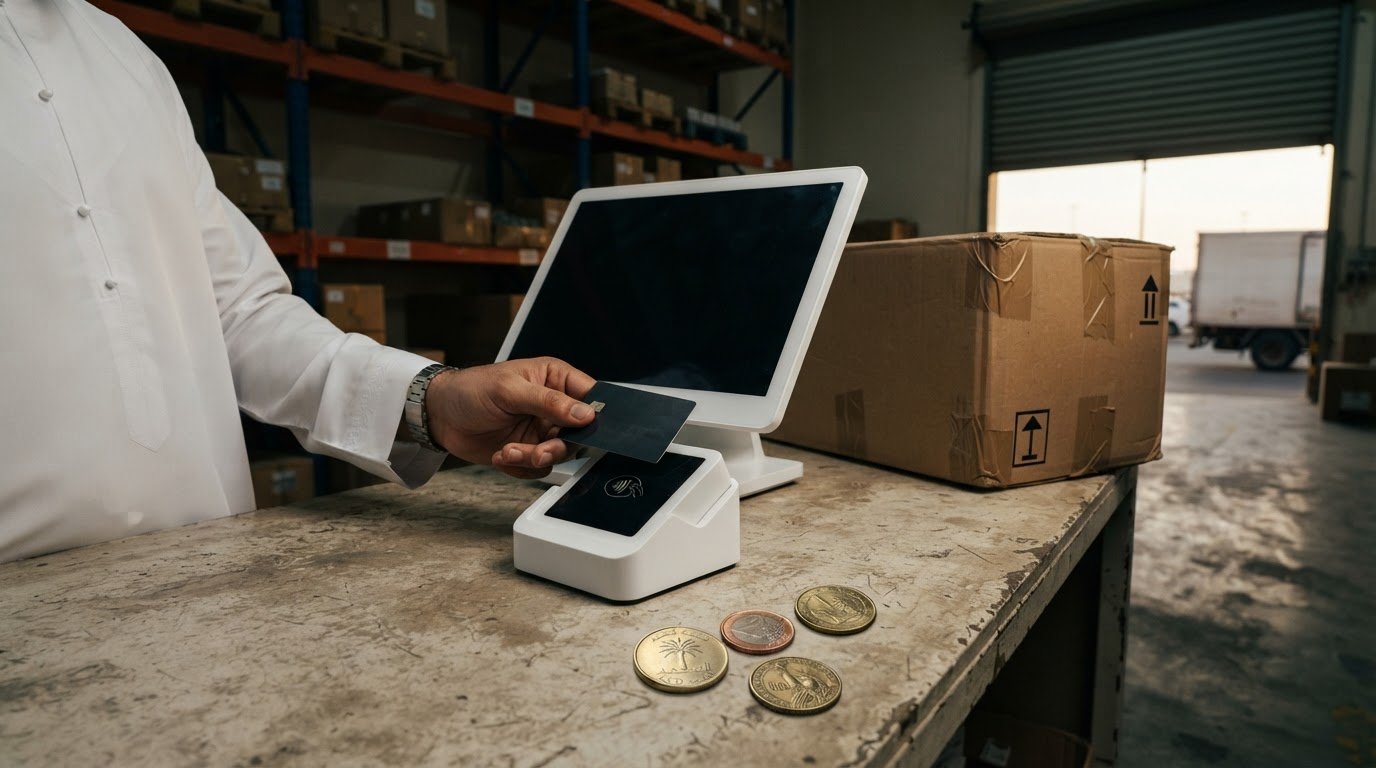
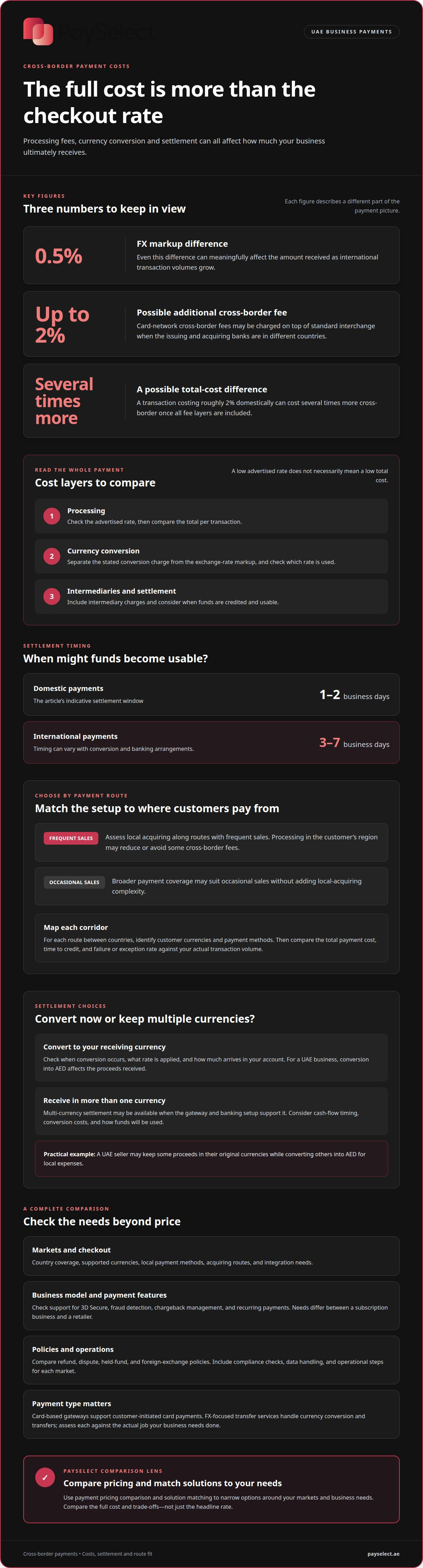
The lowest advertised rate may not mean the lowest cross-border payment cost. For UAE businesses, a cross border payment gateway comparison should account for processing fees, currency conversion and settlement, because each can affect the final amount received. Even a 0.5% difference in foreign-exchange markup can have a meaningful impact as international transaction volumes grow.
It’s easy to focus on the fee shown at checkout, but cross-border payments can involve several cost layers and extra steps. The right setup may reduce some fees. For example, local acquiring may lower or avoid certain cross-border charges when payments are processed in the customer’s region.
This guide explains how cross-border gateways work, what drives their fees, and how currency conversion, settlement choices, and exchange-rate risk affect costs. It also covers what to compare so you can assess the trade-offs for your markets and business model.
Key Takeaways
• Compare the full cost of accepting international payments, not just the advertised processing rate.
• Assess customer location and transaction volume to understand when local acquiring may help reduce cross-border charges.
• Weigh multi-currency settlement against conversion costs, cash-flow timing and exchange-rate exposure.
• Use payment pricing comparison and solution matching to narrow options around your markets and business needs.
What is a cross-border fee and how can I minimise it?
For UAE merchants, gateway currencies and country coverage vary by provider and payment route. No single gateway suits every e-commerce business, subscription service, marketplace, or small business. Customer locations, transaction volume, payment types, and checkout needs all shape the right fit.
Domestic and Cross-Border Transaction Costs
A cross-border fee is an added charge associated with processing a payment across countries. A transaction costing roughly 2% domestically can cost several times more cross-border once all fee layers are included. Visa and Mastercard may charge merchants cross-border fees of up to 2% on top of standard interchange when issuing and acquiring banks are in different countries. Compare the total per transaction, including conversion and intermediary charges, rather than relying only on a headline rate.
Gateway Selection by Customer Location and Volume
Choosing a gateway by customer location means matching payment coverage and acquiring routes to the countries your customers pay from. Map each corridor, the route between two countries, and identify the currencies and payment methods customers use. Then compare providers against your actual transaction volume. Frequent sales along a route may make local acquiring worth assessing, while occasional sales may suit broader coverage without extra complexity. Local acquiring can reduce or avoid some cross-border fees when transactions are processed in the customer’s region.
Cross-border processing can involve extra intermediaries, fees, foreign-exchange charges, compliance checks, operational steps, and processing time. For example, a UAE merchant selling to customers abroad should compare the checkout route and acquiring location, not just the gateway’s base rate. Review the total cost per payment, time to credit, and failure or exception rate to understand how each corridor performs.
FX-focused transfer fintechs handle currency conversion and transfers, while card-based gateways serve customer-initiated card payments with predictable transaction and settlement processes. They suit different needs. An online store taking card payments at checkout, for example, should assess card acceptance separately from a business transferring funds between countries, where platforms such as keybs.io support cross-border payments and multi-currency account management.
Include sanctions screening in your payment setup. Transactions involving individuals or entities on OFAC, EU, or UN sanctions lists must be blocked automatically. Monitoring should also flag unusual activity for review. Consider these checks across countries and payment routes, alongside fees and the checkout experience.
Currency conversion and multi-currency settlement
Currency conversion changes a payment from the customer’s currency into the currency your business receives. Multi-currency settlement lets a merchant receive funds in more than one currency when the gateway and banking setup support it. For a UAE business selling abroad, that choice affects conversion timing, cash flow, and how much arrives in each account.
Compare international payment providers by supported markets, currencies, settlement options, and integration needs. Suitability depends on the corridors your customers use and how your business handles funds, not on a universal ranking. A business serving several markets may need different capabilities from one focused on a smaller set of countries.
Check security and payment features against your business model. Support for 3D Secure, fraud detection, chargeback management, and recurring payments varies by gateway and configuration. An online subscription business, for example, needs recurring payment support, while a retailer may prioritise card security and dispute handling.
Refund, chargeback, reserve, and foreign-exchange policies also vary by provider. Compare how each handles refunds, disputes, held funds, and conversion rates. These terms affect reconciliation and the amount available for operating costs, so assess them alongside settlement arrangements.
Settlement speed affects working capital. Domestic payments might settle in one to two business days, while international payments can take three to seven business days. Currency conversion and banking arrangements influence when funds become usable, so track time to credit by corridor rather than treating every payment the same.
Local payment networks can make checkout more familiar to customers and connect payments with local banking infrastructure. Map the countries you serve, identify the payment methods used there, and compare settlement currencies with your accounting needs. A UAE seller may keep some proceeds in their original currencies while converting others into AED for local expenses.
Build compliance into the comparison. Review the payment flow, data handling, and operational steps for each market. For European merchants, the European Union identifies GDPR as the primary data protection framework. A cross-border payment route should fit the countries served, currencies accepted, and settlement process.
Currency-conversion costs and exchange-rate risk
For a UAE business, converting an overseas customer’s payment into AED affects the proceeds received. Separate the conversion charge from exchange-rate movements to understand each cost.
Currency Conversion Fees
A currency conversion fee is a charge or exchange-rate markup applied when payment funds change currency. Domestic transactions have zero FX spread, while an international sale may require conversion before funds reach the merchant’s accounts. Compare the rate used, any stated conversion charge, and the settlement currency. For example, an AED-based business accepting a foreign-currency payment should find out whether conversion happens at checkout or settlement.
The difference matters across multiple transactions. A merchant processing sales in several currencies can track conversion costs for each currency, then compare the total with the value received in AED. This makes costs visible as business expands across countries. Review transaction records alongside settlement statements so a conversion charge isn’t mistaken for an acquiring fee.
Dynamic Currency Conversion
Dynamic Currency Conversion (DCC) lets a cardholder choose whether to pay in their home currency or the merchant’s currency at checkout. Card scheme disclosure requirements call for a clear comparison of the two rates offered to the cardholder. The displayed choice matters because it determines which rate applies to the purchase.
A visitor paying a UAE merchant by card might see the amount in AED and their home currency. Present both rates clearly, and make the customer’s selection visible before payment. DCC can make the checkout amount easier for an international customer to understand, but it doesn’t remove the need to assess conversion costs. Compare the displayed rate with the merchant’s settlement arrangement.
Exchange-Rate Risk
Exchange-rate risk is the possibility that a currency’s value changes between a sale and its conversion or settlement. A UAE business that prices a sale in a foreign currency but reports revenue in AED may receive a different AED amount if conversion happens later. The risk depends on the currency, conversion timing, and how long funds remain unconverted.
Map the steps from customer payment to funds reaching your business accounts. Record the transaction currency, settlement currency, and conversion point for each route. If the business keeps foreign-currency balances, compare incoming funds with expenses in that currency before converting. This helps clarify whether conversion should happen at checkout, settlement, or when funds are needed. Track the AED value received alongside the original sale amount to see how exchange movements affect revenue.
What cross-border payment gateways are
A cross-border payment gateway connects an online checkout with payment processing for customers and businesses in different countries. It passes transaction details through the payment chain, helping a UAE merchant accept international payments and reconcile records. A cross border payment gateway comparison can help identify a setup suited to the countries and payment methods your business serves.
For example, a consumer abroad pays at a UAE retailer’s checkout. The gateway sends the payment for authorisation, then the acquiring bank and other parties handle processing and settlement. Funds move through reciprocal accounts rather than physically travelling overseas. The merchant can use payment records and settlement reports to reconcile the sale.
A gateway usually connects checkout to one acquiring bank. A payment orchestration platform can connect through one integration to a broader network of banks, payment methods, and currencies. As a business expands, a cross border payment gateway comparison helps weigh a focused connection against broader routing capabilities across different markets.
To open a UAE merchant account for cross-border payments, prepare legal business details, ownership information, bank settlement details, and an explanation of your products and international activity. Submit the application, complete business and identity checks, then configure accepted currencies, checkout, and settlement preferences.
Businesses in the UAE can access international card gateways and broader payment platforms. Availability depends on supported markets, currencies, and merchant needs. Compare country coverage, payment methods, integration approach, and settlement setup against the markets you serve.
Choose a provider that fits your business model. A card gateway can suit customer-initiated purchases, recurring digital services, and subscriptions. For example, international passenger transport providers such as Prague Airport Chauffeur rely on seamless card gateways so overseas travellers can book transfers without friction across different currencies. A marketplace may need support for different payment flows, while a small business may prioritise straightforward checkout and manageable operations. The right capabilities depend on your requirements, not a universal ranking.
Map your customer countries, preferred payment methods, and integration needs before selecting a route. Compare cross-border payment options against your expansion plans and checkout requirements.
PaySelect: Payment Gateway Comparison Tool
PaySelect helps UAE businesses compare payment options against their operating needs. Its Payment Gateway Comparison Tool matches merchants with providers based on industry, transaction volume, and international requirements, helping you focus on relevant differences instead of headline fees alone.
Use Cross-border Payment Solution Matching when assessing new markets, currencies, or payment routes. Payment pricing comparison can clarify how provider pricing fits your transaction profile. Together, these tools support an informed decision about gateway coverage, checkout requirements, and payment costs. PaySelect helps with comparison and selection, not payment processing.
Visit payselect.ae to compare payment gateways for your business.
Make your next payment decision with clarity
Your payment setup should support the markets you plan to enter, not just the transactions you process today. As your business grows, review whether its payment routes, settlement choices, and reporting still fit your operations. A cross border payment gateway comparison can turn that review into a practical decision grounded in your customers, transaction patterns, and expansion priorities.
PaySelect offers a Payment Gateway Comparison Tool, a POS System Selection Tool, and Cross-border Payment Solution Matching. These options help businesses assess payment infrastructure against their needs, whether refining checkout or preparing to serve customers in new markets.
Bring your priorities into focus and explore suitable options with PaySelect. Discuss payment options with PaySelect and take a considered next step toward supporting your business as it expands.
Frequently Asked Questions
Do I need separate merchant accounts for each country I sell into?
Not necessarily. Account needs depend on your acquiring setup, target markets, and settlement arrangements. A UAE business selling online abroad can start by mapping where customers pay from and where it wants funds deposited. Then compare whether one merchant account supports those markets or whether local acquiring arrangements are useful. Separate accounts can add administration, so weigh that against local payment acceptance and reconciliation needs.
What risk and compliance layers are important in global payment flows?
Key layers include identity checks, fraud controls, transaction monitoring, sanctions screening, and payment data security. For example, a transaction involving an individual or entity on OFAC, EU, or UN sanctions lists must be blocked automatically. PCI-DSS applies globally to payment processing. Map which parties handle customer data and payment details, and define how unusual activity, disputes, and account access are reviewed across each payment route.
What are the transaction fees, FX markups, and settlement charges for UAE payment gateways?
UAE gateway costs vary by provider, card type, transaction route, currency conversion, and settlement terms. Compare the complete pricing schedule, separating processing charges, scheme or cross-border fees, FX markup, refunds, and settlement-related charges. Ask how each item applies to your actual sales mix, including card origin and settlement currency. A headline rate alone won’t reveal the full cost of accepting payments internationally.
Disclaimer
This content is for informational purposes only and should not be considered financial, legal, or regulatory advice. Payment provider availability, pricing, and approval processes vary depending on individual business circumstances. PaySelect does not guarantee provider acceptance or specific outcomes. Businesses should conduct their own due diligence before entering into any agreements.
Empowering businesses to achieve greater growth
