
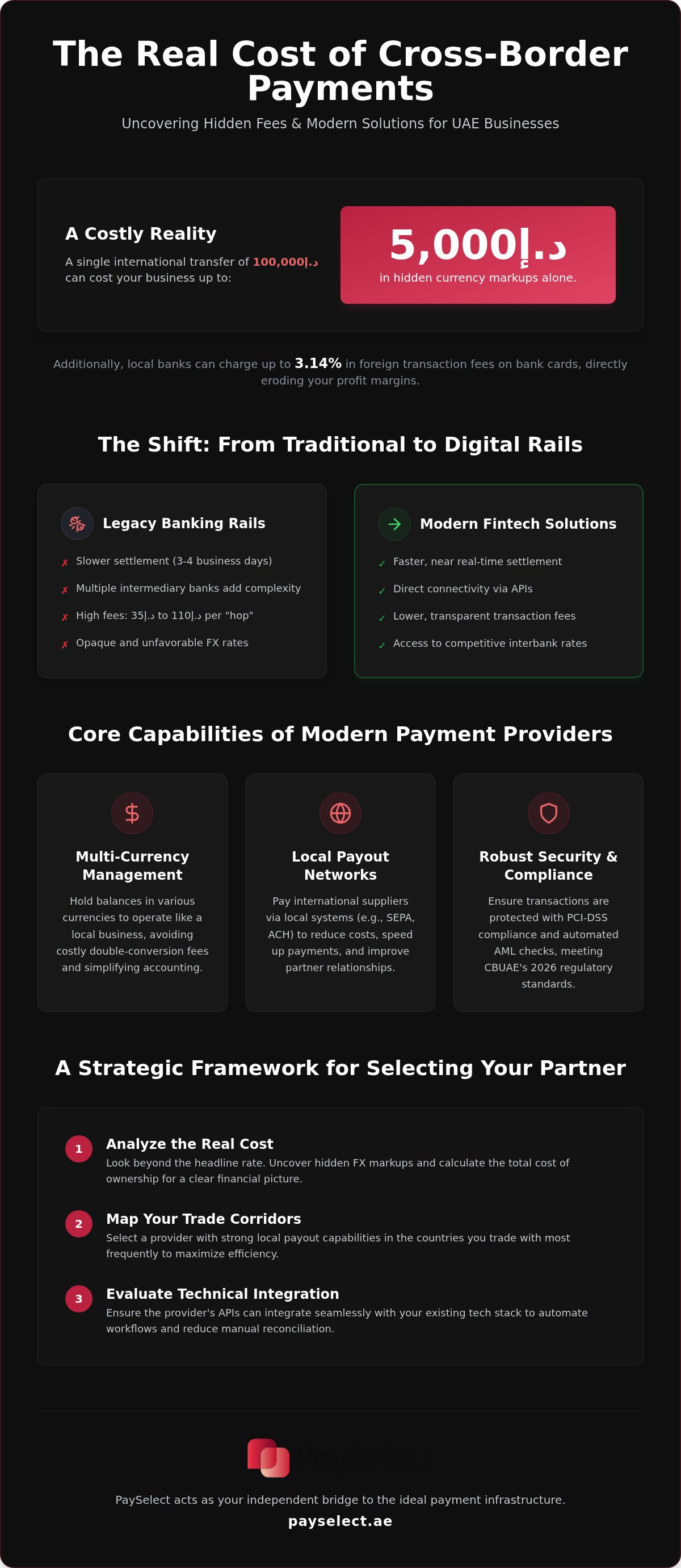
A single international transfer of د.إ100,000 can cost your business د.إ5,000 in hidden currency markups alone. It's a staggering figure that highlights why you must compare cross border payment fees uae options before committing your capital. While the UAE maintains a 0% withholding tax on international payments, local banks recently increased foreign transaction fees on bank cards to 3.14%. These costs, combined with slow settlement times, directly erode your profit margins and stall your global expansion.
You're likely tired of opaque FX rates and the complexity of managing multiple currencies. Your priority is growth, not deciphering technical jargon or chasing missing funds. This guide shows you how to evaluate international payment providers to build a high-performance transaction infrastructure. You'll learn to secure transparent rates, reduce operational barriers, and gain faster access to your funds. We'll break down the 2026 regulatory environment and the shift toward real-time payments. PaySelect acts as your independent bridge, helping you identify hidden costs and select the most efficient solutions to ensure your business remains agile, efficient, and ready for the global stage.
Key Takeaways
• Identify the shift from traditional banking rails to modern fintech to accelerate your global settlement times.
• Learn how to compare cross border payment fees uae by uncovering hidden FX markups and understanding the impact of interbank rates on your bottom line.
• Leverage multi-currency accounts to operate like a local business in international markets, reducing friction and conversion costs.
• Build a strategic framework for selecting partners based on your primary trade corridors and existing technical stack.
• Use PaySelect’s "Take the Test" tool to bypass technical complexity and find the ideal payment infrastructure for your specific business needs.
Understanding the Cross-Border Payment Landscape in 2026
Cross-border payments are the lifeblood of international trade, defined simply as the movement of funds across national borders. In 2026, the UAE has solidified its position as a premier global commerce hub, handling nearly د.إ143 billion in outbound remittances. For local merchants, achieving operational fluidity is no longer a luxury; it's a strategic necessity. When you compare cross border payment fees uae providers offer, you'll find that the difference between legacy systems and modern digital rails often determines your ability to scale. High fees and slow settlement times shouldn't be the price of doing business globally.
The Shift from Traditional Banking to Digital Rails
Traditional banking rails are often slower and more expensive than modern fintech alternatives. Legacy payment systems often rely on the SWIFT network, which can involve multiple intermediary banks. Each "hop" adds time and cost, with intermediary fees typically ranging from د.إ35 to د.إ110 per transaction. Modern fintech solutions bypass these hurdles using API-driven settlement. This direct connectivity reduces friction and enhances transparency. The Central Bank of the UAE (CBUAE) has accelerated this transition, requiring fintech providers to meet stringent compliance standards by September 16, 2026. These regulations ensure that while your money moves faster, it remains secure within a robust legal framework.
Why National Businesses are Expanding Globally
Digital services and e-commerce have erased geographical boundaries. To stay competitive, you must accept payments in multiple currencies without losing your margin to opaque conversion fees. Efficient cross-border payments act as a catalyst for this growth, allowing you to settle international sales quickly. You don't want your capital locked in transit for three to four business days. By selecting the right infrastructure, you gain faster access to international funds and reduce the administrative burden of manual reconciliation. It's about turning your payment setup from a cost center into a strategic tool for transformation. When you compare cross border payment fees uae market participants charge, focus on the total cost of ownership, not just the headline rate.
Core Capabilities of Modern International Payment Providers
Modern international payment providers offer more than simple fund transfers. They provide a sophisticated financial layer that integrates directly into your business operations. By utilizing advanced system connectivity, these platforms transform how you interact with global markets. The focus has shifted from merely moving money to optimizing every stage of the transaction lifecycle. This transition ensures that your global trade remains fluid and efficient.
Multi-Currency Management and Local Payouts
One of the most significant advantages of modern providers is the ability to open multi-currency accounts. These function like local accounts in foreign jurisdictions, allowing you to collect and hold balances in various currencies. This capability is a game-changer for UAE businesses. It lets you avoid the "double conversion" trap where funds are converted to Dirhams only to be converted back for a supplier payment later. Holding balances in the original currency preserves your margin and simplifies your accounting.
Payout networks are equally critical for performance enhancement. They allow you to pay international suppliers using local clearing systems like SEPA in Europe or ACH in the United States. This approach makes your business appear local to your partners, often resulting in faster delivery and lower costs. When you compare cross border payment fees uae, look for providers that offer these local payout capabilities to remove operational barriers and improve supplier relationships. You can match your specific trade corridors with the right provider using independent comparison tools.
Security Protocols and Regulatory Compliance
Security is the foundation of any international payment infrastructure. PCI-DSS compliance is a non-negotiable standard that ensures your transaction data remains protected against unauthorized access. Beyond technical security, robust Anti-Money Laundering (AML) protocols are essential for maintaining the integrity of your global trade. These automated checks run in the background, ensuring speed without compromising safety. Elite providers prioritize this rock-solid reliability to inspire absolute confidence in their partners.
Regulatory alignment is also evolving to meet modern demands. Fintech companies in the UAE must align with the updated Central Bank Law by September 16, 2026, to operate within a recognized regulatory safe harbor. This ensures that your chosen partner meets the highest institutional standards. Selecting a provider that balances these security needs with a seamless user experience is a strategic advantage. It allows you to focus on international ambition while your partner handles the complex global infrastructure.
Analyzing the Real Cost of International Transactions
Understanding the true cost of moving money requires looking beyond the headline transaction fee. Most providers present a simple flat rate, but the real expense is often buried in the currency conversion. When you compare cross border payment fees uae, you must evaluate three distinct pillars: the per-transaction charge, the foreign exchange (FX) markup, and any recurring subscription costs. These elements combine to form your total cost of ownership, directly affecting your operational margins and bottom line.
The Hidden Impact of FX Markups
The Interbank rate, also known as the mid-market rate, is the real-time exchange rate used by banks when they trade with each other. Most retail providers add a markup to this rate, which acts as a hidden fee. For example, a 5% markup on a د.إ100,000 transfer results in a د.إ5,000 loss before the money even arrives at its destination. High-volume merchants often find that even a 1% difference in the spread can save them tens of thousands of Dirhams annually. Comparing cross-border payment fees across different providers is the only way to ensure you're accessing rates close to the interbank level and protecting your profit margins.
Subscription Models vs. Pay-As-You-Go
Your choice of pricing model should align with your transaction volume and business stage. Pay-as-you-go models are ideal for SMEs that require flexibility without the burden of fixed overheads. Conversely, enterprise-scale organizations often prefer subscription models that offer lower per-transaction costs in exchange for a fixed monthly fee. These tiers provide predictability, scalability, and transparency. As your business grows, your ability to negotiate better pricing tiers increases. It's essential to audit your infrastructure regularly to ensure your current plan still serves your volume efficiently.
Many business owners hesitate to switch providers due to perceived technical complexity or potential downtime. However, the cost of staying with an inefficient partner often outweighs the effort of migration. Modern payment systems are designed for system connectivity, making transitions smoother and more manageable than in the past. By identifying these hidden drains on your capital, you can optimize your global transaction infrastructure to support long-term international ambition. PaySelect helps you bridge the gap between complex global infrastructure and your specific business needs, ensuring you never pay more than necessary for global trade.
A Strategic Framework for Selecting Your Payment Partner
Choosing a partner is a strategic decision that impacts your operational speed. You need to analyze your primary transaction corridors, such as the GCC, Europe, or Asia. A provider with deep roots in the Asian market might offer superior settlement times for those routes compared to a generalist. When you compare cross border payment fees uae market leaders charge, remember that regional specialization often beats a one-size-fits-all approach. Aligning your infrastructure with your target markets ensures your capital remains fluid and accessible.
Matching Infrastructure to Business Architecture
Your business model dictates your technical requirements. A high-volume retail business needs a robust Payment Gateway Selection that handles rapid, smaller transactions with minimal latency. In contrast, a SaaS platform might prioritize recurring billing and complex API documentation for deep system connectivity. If your team lacks extensive developer resources, look for providers offering no-code payment links. These allow you to send secure invoices and collect funds without touching a single line of code. This structural clarity ensures your technical solutions remain manageable and ready for implementation.
Service Level Agreements and Support
Technical utility is only half the equation; reliability is the other. Having access to customer support within the national time zone is a strategic advantage that prevents costly delays. For enterprise organizations, a dedicated account manager acts as a rock-solid institutional partner, helping you navigate complex global infrastructures. Before committing to a long-term contract, test the provider's responsiveness. Send a support ticket during peak hours to see how quickly they resolve issues. High-end providers understand that your time is as valuable as your security.
Finally, consider the breadth of the ecosystem. Do you need additional tools like corporate cards or expense management? Integrating these services into one platform creates a sense of completeness and momentum in your financial operations. It removes operational barriers, allowing your team to focus on international ambition rather than manual data entry. To find the right balance between technical capability and cost, you can take the test at PaySelect to match your business with the ideal solution and optimize your global transaction infrastructure.
Optimizing Your Payment Infrastructure with PaySelect
PaySelect stands as the independent authority for merchants refining their global transaction architecture. We serve as a sophisticated bridge between complex global infrastructures and your intuitive business needs. Our "Take the Test" tool removes the guesswork, offering the fastest path to clarity in a market often clouded by technical jargon. When you use our platform to compare cross border payment fees uae market participants offer, you gain an unbiased selection framework tailored to your specific trade corridors.
The Power of Independent Comparison
Unbiased data leads to better financial decisions. PaySelect identifies the fine print that merchants often miss, such as hidden FX markups, unexpected intermediary fees, and tiered subscription traps. We act as a rock-solid institutional partner, ensuring your payment setup is a strategic tool for transformation rather than a lingering cost center. Our platform provides the structural clarity needed to identify hidden drains on your capital, match your volume to the right pricing tier, and ensure absolute compliance with 2026 regulations. This approach ensures that your technical solutions are simple, manageable, and ready for implementation.
Next Steps for National Merchants
Start your payment infrastructure audit today to uncover immediate optimization opportunities. The current digital landscape moves quickly; staying agile is your primary competitive advantage. This process involves reviewing your primary transaction corridors, assessing your technical stack's connectivity, and verifying your regulatory alignment. PaySelect offers bespoke advisory services for enterprise-scale organizations, helping you navigate the complexities of international fund movements with calm assurance. We help you move from a traditional, stagnant setup to a dynamic, forward-thinking payment strategy.
Removing operational barriers is the first step toward achieving your international ambition. By optimizing your infrastructure, you gain faster access to funds, transparent FX rates, and reduced administrative friction. A fluid payment system acts as a catalyst for growth, allowing you to focus on expansion rather than reconciliation. Simplify your selection with PaySelect and build a foundation that supports elite global commerce.
Accelerate Your Global Commercial Ambition
Optimizing your international fund movements is no longer a back-office task; it's a strategic tool for business transformation. You've seen how legacy banking rails can erode margins through hidden FX markups and slow settlement times. By adopting modern digital infrastructure, you gain the fluidity needed to operate like a local business in any market. Whether you're leveraging multi-currency accounts or utilizing local payout networks, the goal remains the same: faster access to capital and absolute pricing transparency.
Success in the fast-moving 2026 digital landscape requires a partner that acts as a bridge between complex global infrastructures and your intuitive needs. It's essential to compare cross border payment fees uae providers offer to ensure your scale isn't penalized by inefficient pricing tiers. PaySelect provides the independent advisory and transparent comparison tools you need to stay ahead. From bespoke cost optimization audits to specialized MENA region insights, we empower you to make data-driven decisions with confidence. Match your business with the right cross-border provider today and turn your payment infrastructure into a catalyst for international growth. Your journey toward seamless global trade starts with a single, informed choice.
Frequently Asked Questions
What are the main differences between cross-border payment companies in the UAE?
Differences primarily lie in regional specialization, settlement speed, and pricing models. Some providers focus on the GCC while others prioritize Europe or Asia. You should evaluate FX markups versus flat transaction fees. Digital-first platforms often provide API connectivity that legacy banks lack. It's vital to compare cross border payment fees uae providers charge to see if they offer local payout networks like SEPA or ACH for performance enhancement.
How long does it typically take for an international payment to settle?
Settlement times vary based on the technology used. Traditional SWIFT transfers often take two to four business days due to intermediary bank involvement. Modern fintech solutions using direct API-driven settlement can achieve same-day or next-day delivery. Real-time payment systems in the UAE are projected to double their market share by 2028. Speed depends on your chosen provider's network and the specific trade corridor involved in the transaction.
Can I use a cross-border payment solution without a traditional bank account?
Yes, many modern fintech platforms allow you to collect and hold funds in multi-currency digital wallets. While you usually need a business bank account to withdraw funds to your local entity, you can pay international suppliers directly from these digital balances. This capability removes operational barriers and reduces conversion costs. It's a strategic tool for businesses that want to operate like a local entity in foreign markets without opening physical branches.
What is the "interbank rate" and why should businesses care?
The interbank rate is the real-time exchange rate banks use when trading with each other. It's the most accurate rate available. Businesses should care because most providers add a markup to this rate as a hidden fee. A single transfer of د.إ100,000 can cost د.إ5,000 in FX markups alone. Accessing rates close to the mid-market level is the most effective way to protect your profit margins during global expansion and international trade.
Are digital payment platforms as secure as traditional national banks?
Yes, elite digital platforms adhere to the same stringent security and regulatory standards as institutional banks. In the UAE, fintech providers must comply with the Central Bank Law by September 16, 2026. This includes maintaining PCI-DSS compliance and robust Anti-Money Laundering (AML) protocols. These platforms prioritize rock-solid reliability and data protection to inspire absolute confidence in their partners while facilitating rapid international commerce and secure fund movements.
How do I know if my business needs a multi-currency account?
You need a multi-currency account if you frequently receive or send funds in currencies other than Dirhams. These accounts allow you to hold balances in USD, EUR, or GBP, avoiding the "double conversion" trap. If your suppliers prefer local payments or you sell on international e-commerce platforms, these accounts are essential. They act as a catalyst for growth by reducing administrative friction and preserving your margins across different trade corridors.
What are the common hidden fees in international money transfers?
Hidden costs often include FX markups, intermediary bank fees, and landing fees. While a provider might advertise "zero commission," they often hide their profit in a spread above the interbank rate. Intermediary banks on the SWIFT network may also deduct fees ranging from د.إ35 to د.إ110 without prior notice. When you compare cross border payment fees uae, ensure you evaluate the total cost of ownership rather than just the visible transaction charge.
How does PaySelect help businesses reduce their transaction costs?
PaySelect acts as an independent bridge between complex global infrastructure and your business needs. We provide a "Take the Test" tool that matches your specific transaction volume and trade corridors with the most cost-effective providers. For enterprise-scale organizations, we offer bespoke infrastructure audits to identify hidden drains on capital. Our platform brings structural clarity to the selection process, ensuring you find a rock-solid partner that aligns with your international ambition.
Disclaimer
This content is for informational purposes only and should not be considered financial, legal, or regulatory advice. Payment provider availability, pricing, and approval processes vary depending on individual business circumstances. PaySelect does not guarantee provider acceptance or specific outcomes. Businesses should conduct their own due diligence before entering into any agreements.
Empowering businesses to achieve greater growth