


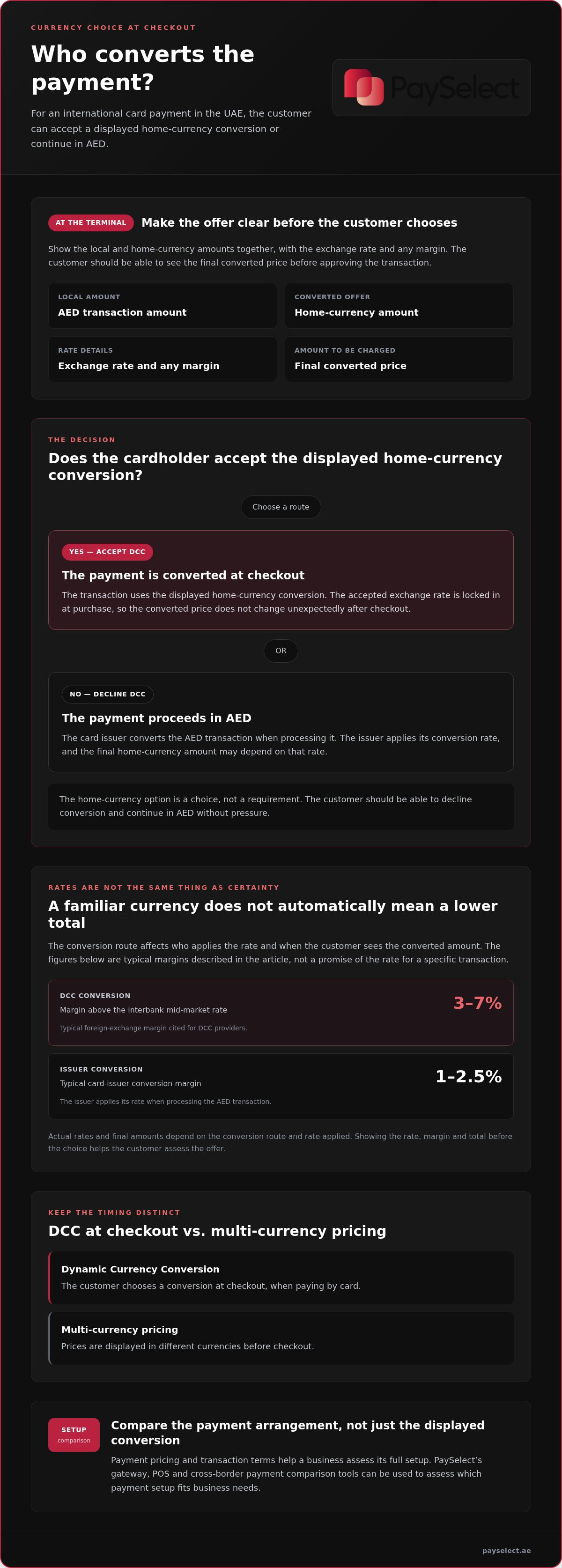
The checkout currency determines who converts an international card payment and what the customer sees. For a UAE business learning how to offer dynamic currency conversion, the core is to display the amount in AED and the cardholder’s home currency, alongside the exchange rate, any markup and the final price. Customers must be able to choose whether to accept the conversion or pay in AED.
That choice matters: showing a familiar currency can make a price easier to understand, but it does not automatically make the transaction cheaper. This guide explains how DCC works at checkout, what affects the rate and margin, and what customers need to know to choose clearly.
The key difference is timing. DCC converts the payment at checkout, while multi-currency pricing displays prices in different currencies before checkout. This guide explains how the two approaches shape the customer experience and what UAE businesses should consider when comparing payment options.
Key Takeaways
• Understand how the customer’s choice at checkout affects whether the transaction is converted at the point of sale or processed in AED.
• Make the conversion easy to assess by showing the exchange rate, any markup and the final amount before the customer decides.
• Recognize that an accepted DCC rate is locked in at purchase, while declining conversion means the payment proceeds in AED.
• Distinguish checkout conversion from multi-currency pricing, which presents prices in different currencies before checkout.
• Use PaySelect’s gateway, POS and cross-border payment comparison tools to assess which payment setup fits your business needs.
What is Dynamic Currency Conversion?
Dynamic Currency Conversion (DCC) lets an international cardholder choose whether to convert a transaction at checkout. In the UAE, the customer can choose to pay in AED or see the amount in their home currency.
DCC or Bank Conversion
DCC converts the transaction into the cardholder’s home currency at checkout, while bank conversion leaves the conversion to the card issuer. The difference is who applies the exchange rate and when the customer sees the converted amount. For a visitor paying an AED bill, accepting DCC means the terminal displays a home-currency price. Declining means the payment proceeds in AED for the issuer to convert.
The distinction matters because a familiar currency does not automatically mean a lower total. With DCC, the customer can see the offered exchange rate and any margin before choosing. With bank conversion, the card issuer applies its rate when processing the AED transaction. The final home-currency amount may therefore depend on the conversion route and rate.
For a UAE merchant, show the local-currency amount and converted home-currency amount together. For example, a visitor with a euro-denominated card can compare the AED price with the euro amount on the terminal. The customer can accept DCC or decline it and pay in AED. Displaying both amounts makes the choice clear at the decision point.
Cardholder Consent to Currency
Cardholder consent means the customer actively chooses whether to accept the displayed DCC conversion. They must also be able to decline and continue in AED, without pressure. A home-currency amount should be an option, not an assumed part of payment. Make both routes understandable on the screen and in any staff interaction before the cardholder approves the transaction.
A clear display separates the transaction amount from the conversion details. Before deciding, customers should be able to identify the AED amount, home-currency amount, exchange rate and any margin. If they decline conversion, the transaction is processed in AED. Do not present the home-currency option as mandatory or hide the local-currency choice among other checkout steps.
For context, according to the European Union, Regulation 2019/518 amended Regulation 924/2009. That identifier concerns European Union legislation; it does not establish a UAE requirement. In practice, UAE merchants should focus on making the currency choice and the amounts legible at the terminal, so the cardholder can understand what accepting or declining means.
At checkout, display both currency amounts and the rate and margin, then let the cardholder choose. If the customer accepts DCC, the payment uses the displayed home-currency conversion. If they decline, it proceeds in AED for the card issuer to convert. This gives international cardholders control over how their purchase is converted.
Displaying the exchange rate, margin and final price
Show the exchange rate, any margin and the converted total before the customer chooses. This makes the cost visible and clarifies which amount will be charged.
Exchange Rate and Price Transparency
Price transparency means displaying the local-currency amount, home-currency amount, exchange rate and any markup together before payment. Customers can compare the conversion with paying in AED and decide with the full price in view. Once they accept DCC, the exchange rate is locked in at purchase, so the converted price does not change unexpectedly after checkout.
Provider Markups and Exchange Rates
The DCC provider’s exchange rate can include a margin above a reference rate, while the card issuer may apply its own conversion rate if the customer pays in local currency. DCC providers typically apply a foreign-exchange margin of 3-7% above the interbank mid-market rate; card issuers typically apply 1-2.5%. These are typical margins, not a promise of the rate for a specific transaction. Make the card currency clear, then display the rate and final amount for that currency.
A practical display lists the original AED amount, the cardholder’s currency, the exchange rate, the margin as a percentage and the final converted amount. Transaction records should also capture the converted amount and rate. This helps customers understand the completed payment and gives merchants details to review if questions arise.
Customers may complain or dispute a DCC transaction if they were not told that conversion would occur or were not offered the choice to pay in the merchant’s local currency. Clear disclosure and an unpressured choice help prevent misunderstandings about the currency and amount charged.
To assess conversion and revenue impact, track DCC offers, accepted transactions and declined transactions, then compare the acceptance share over the same reporting period. Review any margin revenue separately: DCC providers share some conversion-margin revenue with acquirers and, under some arrangements, merchants.
The rate and margin affect the customer’s total, so merchants should understand how their payment setup calculates and displays them. Comparing payment pricing and transaction terms helps a business assess the full arrangement rather than focusing only on the displayed conversion.
DCC definition and point-of-sale operation
At a UAE point of sale, dynamic currency conversion (DCC) converts an international card payment into the cardholder’s home currency at checkout. The terminal presents the currency offer, records the customer’s choice and sends the payment for processing in the selected currency.
For merchants deciding how to offer dynamic currency conversion, setup begins with enabling the feature through their payment arrangement. Configure which currencies the system can display, and ensure customers can review the rate, markup and converted total. Test both choices to confirm payments follow the customer’s selection.
DCC at the Point of Sale
DCC is a point-of-sale conversion that presents an international cardholder with a choice between the local currency and home currency. This matters because the terminal shows the converted amount during payment, before the customer approves the purchase. A terminal can identify a card’s issuing country using the first 6 digits of its number, helping determine which currency offer to display.
For example, a UAE retailer starts with the purchase price in AED. If the terminal offers DCC, it displays a home-currency alternative for an eligible international card. The customer can review that option before paying. Make the choice clear on the terminal, rather than implying it through card insertion or tapping, so customers know which currency they are selecting.
The DCC Payment Flow
The DCC payment flow connects card recognition, customer choice and payment processing. After identifying the card’s issuing country, the terminal can show the AED amount beside an eligible home-currency amount. The customer reviews the offer and selects a currency. The payment system then sends the transaction for processing according to that choice.
If the cardholder accepts DCC, the payment is sent with the selected home-currency conversion. If they decline, the transaction is processed in AED and the card issuer handles conversion. The choice changes how the payment is processed, not the original price recorded by the UAE merchant. The receipt should match the completed transaction.
Configuring DCC on Payment Systems
Configuration connects the DCC offer to a POS terminal or payment gateway. The merchant needs to set which currencies can appear, how rates and markups are displayed, and how the customer’s choice is sent with the payment. The available setup depends on the payment system’s functions and the merchant’s payment agreement.
To plan how to offer dynamic currency conversion, map each checkout step before enabling it. Test whether the system recognizes an eligible card, displays both currency amounts and records the customer’s decision. Run separate tests for accepting and declining, then check that payment records and receipts reflect the customer’s choice.
Before accepting live payments from travellers, walk staff through both scenarios. They should know how to explain the available choices without steering customers toward either currency. This links the terminal setup to a clear, consistent checkout experience.
Information to expect when a merchant offers DCC
A DCC offer gives international cardholders a choice at checkout, while also creating transaction records and possible margin revenue. For a UAE merchant, the key is understanding how the service affects customer choice, payment reporting and the commercial arrangement.
DCC as an Optional Merchant Service
DCC is optional for merchants: they can offer it or let the cardholder’s issuing bank convert the payment. A business can decide whether a home-currency option suits its checkout experience and international customers. If offered, customers must be able to accept or decline the conversion. DCC should not replace the local-currency payment route.
Customers should recognize the offer as a choice, not an automatic conversion. For example, a UAE hotel can present a guest with an AED transaction and a home-currency alternative. The guest’s selection determines whether DCC applies. Clear records of the selected currency help staff explain the transaction if the guest later asks about the charge.
Merchant reporting can distinguish DCC transactions from payments processed in AED. Useful categories include offers presented, conversions accepted, conversions declined and completed transaction amounts. A hotel or retailer can compare these records across reporting periods to understand customer responses. Keep them separate from total card sales, since an offer does not mean the customer accepted DCC.
Customer feedback adds context to transaction records. If guests query a charge, review the transaction details and the currency choice recorded at checkout. A clear report can help staff establish whether the customer accepted conversion or paid in AED, separating questions about the selected currency from questions about the purchase itself.
Merchant Costs and Fee Revenue
DCC fee revenue depends on how conversion-margin revenue is shared under the payment arrangement. DCC providers share some of this revenue with the acquirer and, in some arrangements, with the merchant. A displayed customer margin does not automatically equal merchant income. The commercial terms determine whether the merchant receives a share and how it is calculated.
Before assessing the financial impact, separate potential revenue from the service’s costs and terms. Review how the payment arrangement describes margin sharing, which transactions qualify and how amounts appear in settlement reports. This helps a UAE business understand its actual position instead of assuming every accepted conversion generates a direct rebate.
Track accepted DCC transactions alongside any revenue recorded for them, then compare the figures with declined offers and customer feedback. This gives the merchant a balanced view of whether the service generates a share, how often customers choose it and whether checkout questions arise. DCC remains optional, so weigh the commercial terms against the customer experience and payment operations.
DCC compared with multi-currency pricing
DCC and multi-currency pricing both show foreign customers prices in familiar currencies, but they work at different stages. DCC converts an AED transaction at the point of sale; multi-currency pricing displays prices in different currencies before checkout for the customer to choose from.
Consider a UAE retailer displaying a product in AED. With DCC, the customer reaches checkout and can accept a converted home-currency amount or pay in AED. With multi-currency pricing, the retailer displays the product price in different currencies before checkout, and the customer selects a currency while shopping. The difference is timing: conversion at payment versus currency choice during price presentation.
That timing shapes the customer experience. A visitor browsing an online catalogue can see a selected currency before deciding to buy, making the listed price easier to compare with other purchases. At a physical UAE checkout, DCC presents the foreign-currency option when the customer pays. Their choice determines whether the transaction is converted at the point of sale or charged in AED.
The two approaches also affect how a business manages displayed prices. Multi-currency pricing requires the business to show prices in the currencies it chooses to support. Exchange rates and how converted prices are maintained influence what shoppers see before checkout. DCC instead calculates a home-currency amount for an eligible card transaction at payment. In either case, customers should be able to identify the currency and amount before committing to the purchase.
For example, a UAE hotel could display room prices in AED and selected foreign currencies during booking, then offer DCC if a guest pays in person with an eligible international card. The first feature helps the guest compare prices while considering a booking. The second offers a currency choice at the terminal. They serve different moments in one customer journey rather than functioning as identical alternatives.
To assess which approach fits, map the customer journey: where the price first appears, where the customer chooses a currency and when payment is charged. Then compare how each setup handles exchange rates, displayed amounts, price maintenance and payment reporting. A business focused on pre-purchase price visibility may value multi-currency pricing; one focused on checkout choice may consider DCC. The deciding factor is where currency clarity matters most to its customers.
Payment setup and pricing terms can affect how either feature works in practice. Compare payment gateway pricing and options to assess how transaction terms fit your business’s currency strategy.
PaySelect: Payment Gateway Comparison Tool
PaySelect helps businesses compare payment options when assessing the infrastructure behind international payments and checkout currency choices. Its Payment Gateway Comparison Tool matches merchants with providers based on factors such as industry, transaction volume and international requirements. Businesses reviewing in-person payments can also use the POS System Selection Tool, while Cross-border Payment Solution Matching helps assess international payment needs.
Use payment pricing comparison to understand how provider pricing fits your payment setup, alongside the features and requirements that matter to your business. This helps you compare options without treating DCC as a standalone decision: the gateway, POS environment and cross-border needs all shape the wider setup.
Visit payselect.ae to explore PaySelect’s comparison tools.
Plan your next payment decision
For UAE businesses deciding how to offer dynamic currency conversion, treat it as part of the wider payment experience, not an isolated terminal setting. Map where customers encounter currency decisions, who maintains rates and displays, and how staff can explain the options consistently. Then define what success means for your operation, such as clear checkout, manageable reconciliation and fewer avoidable customer queries.
Involve finance, operations and customer-facing teams before changing payment flows. Their perspectives can reveal practical friction, from how transactions appear in reports to how customers understand receipts. Assign an internal owner to review these details and keep checkout aligned as your business’s payment needs evolve.
A focused comparison can clarify whether your payment setup supports the customer journey and your cross-border requirements. PaySelect offers a Payment Gateway Comparison Tool, POS System Selection Tool and Cross-border Payment Solution Matching to help businesses assess their options. Contact PaySelect to discuss DCC and move forward with a payment setup suited to your next stage of growth.
Frequently Asked Questions
Is DCC mandatory for merchants?
No. DCC is optional for merchants, and a UAE business can accept international cards without offering it. If the business chooses not to provide DCC, the cardholder’s issuing bank can convert the AED transaction. A merchant considering the feature can weigh its checkout experience, customer needs and payment setup before deciding whether to offer a currency choice.
Is there a fee for merchants to enable DCC?
There is no standard merchant fee for every DCC arrangement. Commercial terms determine whether setup or transaction charges apply and how conversion-margin revenue is shared. Before enabling the feature, review the payment agreement and settlement reporting together. For example, confirm whether a reported merchant share is shown separately from transaction charges instead of assuming the displayed customer markup becomes merchant revenue.
What are the scheme rules around DCC disclosure?
Card scheme rules require DCC disclosures to show the exchange rate, markup, local-currency amount and home-currency amount, along with a clear option to decline. At a UAE checkout, customers should be able to distinguish the AED price from the converted total before approving payment. Keep the selected currency and displayed amounts clear in transaction records so staff can respond to later questions about a charge.
What happens if the customer chooses not to use DCC?
If the customer declines DCC at a UAE checkout, the transaction proceeds in AED. The cardholder’s issuer then handles any currency conversion when processing the payment. For example, a visitor who declines a home-currency offer still pays the merchant’s AED transaction amount; the amount later shown on their card statement may reflect the issuer’s conversion. Declining DCC should not prevent payment in local currency.
What is DCC and how does it work?
Dynamic Currency Conversion is a checkout option that lets an international cardholder see a transaction converted into their home currency. For a UAE purchase, the customer can compare the AED sale amount with the converted amount offered at the terminal. The offer applies to that payment decision: it does not change the merchant’s underlying AED price or require the customer to change their card account currency.
What is DCC?
DCC presents an international card payment in the cardholder’s home currency at checkout. The term describes when conversion is offered: during the purchase or cash withdrawal, rather than later through the card issuer. For a UAE business, the original sale can remain in AED while the international customer considers a converted alternative.
What is dynamic currency conversion (DCC) and how does it work?
Dynamic currency conversion lets a customer with an international card choose whether to accept a home-currency conversion during payment. The terminal presents the converted amount for that transaction, and the customer decides whether to proceed with that option. For instance, a visitor paying an AED bill can review the home-currency offer at checkout. The choice applies to that transaction, not future purchases.
How can a merchant enable DCC for card payments?
A merchant can start by discussing DCC capability with the payment provider or acquirer responsible for its card acceptance setup. Confirm how the system identifies eligible cards, presents currency options, records the selection and reports transactions. Test both acceptance and decline scenarios before using it at checkout. Train staff to explain the displayed choices without steering customers toward either option.
Disclaimer
This content is for informational purposes only and should not be considered financial, legal, or regulatory advice. Payment provider availability, pricing, and approval processes vary depending on individual business circumstances. PaySelect does not guarantee provider acceptance or specific outcomes. Businesses should conduct their own due diligence before entering into any agreements.
Empowering businesses to achieve greater growth
