Evaluating Cross Border Payments Companies: A Strategic Guide for UAE Businesses in 2026

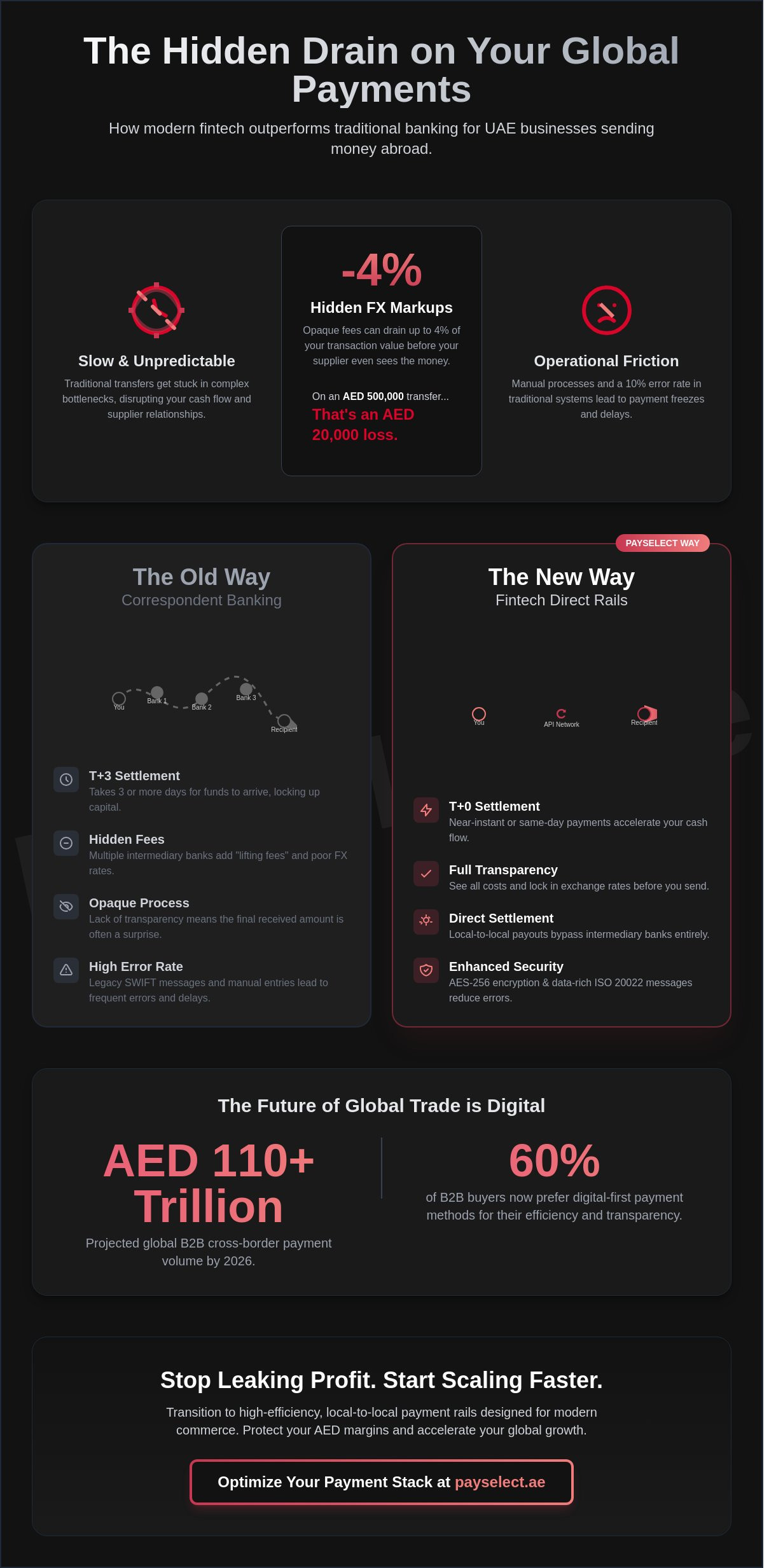
Did you know that hidden FX markups can drain up to 4% of your transaction value before your global supplier even receives their payment? For a UAE firm transferring AED 500,000, that translates to an AED 20,000 loss hidden in plain sight. You already feel the frustration of opaque fees and slow settlement times that disrupt your monthly cash flow. Selecting the right cross border payments companies isn't just a technical choice; it's a strategic move to protect your margins and maintain your competitive edge in the 2026 global market.
You deserve predictable transaction costs and faster payouts that don't get stuck in complex compliance bottlenecks. This guide provides the framework you need to master international transfer complexities and discover how to select a partner that offers seamless integration with your existing accounting tools. We'll explore how to streamline your operations, accelerate your global reach, and ensure every dirham you send works harder for your business expansion.
Key Takeaways
• Understand the shift from slow correspondent banking to API-driven networks that enable near-instant settlement for your international transactions.
• Learn to evaluate cross border payments companies by looking beyond marketing fluff to identify true FX transparency and specific corridor expertise.
• Discover how to overcome the operational friction of moving away from traditional banks to manage multi-currency accounts with minimal overhead.
• Protect your AED margins and accelerate global growth by transitioning to high-efficiency, local-to-local payment rails designed for modern commerce.
• Use a proven methodology to audit your current payment stack and match your business with a partner that aligns with your unique volume and destination needs.
The Evolution of International Commerce: Understanding Cross Border Payments Companies
Cross border payments companies are specialized fintech entities that facilitate multi-currency transfers through proprietary digital infrastructure. These platforms act as a bridge between different national financial systems, allowing businesses to send and receive funds without the friction of traditional banking. While legacy systems rely on a chain of correspondent banks, modern providers use direct integrations to settle transactions faster and with lower overhead.
The global financial landscape is moving away from the manual, SWIFT-based processes that have dominated for decades. We're seeing a decisive shift toward API-driven global networks. These networks automate the verification and settlement stages, ensuring that data moves as quickly as the capital itself. For UAE businesses, this transition is vital. The local market operates as a global logistics and trade hub, requiring financial tools that match the speed of physical supply chains. Relying on 40-year-old banking protocols often results in capital being locked in transit, which restricts cash flow and limits scaling potential.
A modern cross-border provider is a technology-first financial institution that utilizes integrated API networks to execute instant, multi-currency settlements while bypassing the traditional intermediary banking chain.
The Scale of Global B2B Transfers in 2026
The volume of international trade is reaching unprecedented heights. Industry forecasts from Juniper Research suggest that global B2B cross-border payment volumes will exceed AED 110 trillion by 2026. This growth is fueled by the rapid digitisation of the economy. Businesses now expect real-time visibility into their transaction status. When companies integrate advanced cross-border payments solutions, they gain the ability to manage high-volume transfers with the same ease as a local AED transaction. This level of efficiency isn't a luxury; it's a requirement for staying competitive in a market where 60% of B2B buyers now prefer digital-first payment methods.
Why Traditional Banking No Longer Suffers for Growth
Legacy financial institutions often struggle with the "intermediary bank" problem. When you send money through a standard bank, your funds frequently pass through multiple third-party institutions before reaching the recipient. Each stop adds a delay and a potential fee. This lack of transparency in legacy fee structures means the final amount received is often lower than expected due to hidden "lifting fees" and poor exchange rates. Modern cross border payments companies solve this by offering borderless financial operations. They provide:
• Direct settlement routes that eliminate unnecessary middle-men.
• Real-time exchange rate locking to protect against currency volatility.
• Full transparency on transaction costs before the transfer is initiated.
• Automated compliance checks that prevent unnecessary payment freezes.
Moving away from stagnant banking models allows UAE entrepreneurs to focus on expansion rather than administrative hurdles. It's about turning payment processing from a back-office cost into a strategic advantage for global growth.
Fintech Rails vs. Correspondent Banking: A Technical Comparison
Traditional banking relies on the correspondent model. Your transfer travels through a "multi-hop" route of intermediary banks. Each intermediary takes a fee and adds time. Modern cross border payments companies utilize a direct, local-to-local model instead. They maintain pre-funded accounts in key global markets. When you send AED from the UAE, the provider pays out the destination currency from their local account in that specific country. This removes the middleman. It cuts costs. It secures speed.
Security remains the foundation of these digital rails. Top-tier providers use AES-256 encryption and TLS 1.2 protocols to protect sensitive data. They implement ISO 20022 messaging standards. This format carries more data than traditional SWIFT messages, which reduces the 10% error rate often seen in manual bank entries. By using data-rich messaging, businesses ensure that compliance checks are faster and less prone to false flags.
The Mechanics of Modern Settlement
Settlement speed defines your cash flow. Traditional banks often settle in T+3, meaning three days after the transaction. Modern fintech rails achieve T+0 or T+1. This efficiency depends on liquidity management. Providers must hold sufficient AED reserves to facilitate immediate conversion without waiting for external markets. Netting is the process of offsetting the total value of multiple credit and debit positions to settle only the net difference, which optimizes global currency flows. Businesses can access these optimized cross-border payment rails to ensure funds arrive exactly when they're needed.
API Integration and Digital Ecosystems
Manual data entry is a growth bottleneck for UAE enterprises. Leading cross border payments companies offer direct API integrations. These connect your payment flow directly to ERP systems like Oracle or SAP. This link eliminates the need for manual file uploads. Webhooks provide real-time status notifications. You'll know the exact moment funds clear without refreshing a browser. This automation reduces reconciliation time by up to 80% compared to traditional methods. It lets your finance team focus on strategy rather than spreadsheets. Digital ecosystems empower you to scale without adding administrative headcount.
T+0 Settlement
Same-day delivery of funds to the recipient.
ISO 20022
High-quality data that streamlines regulatory reporting.
Automated Reconciliation
Direct syncing between payment platforms and accounting software.
Switching from legacy systems to modern fintech rails isn't just about speed. It's about control. You gain visibility into every step of the transaction. You avoid the "black box" of correspondent banking where fees and delays are often unpredictable. For a business in the UAE, this transparency is essential for maintaining strong relationships with international vendors.
5 Essential Criteria for Evaluating International Payment Providers
Selecting a partner to manage your global capital flow requires more than a surface-level price comparison. The landscape for cross border payments companies is diverse, and the wrong choice can lead to trapped liquidity or eroded margins. UAE businesses must look beyond marketing promises to find a partner that matches their specific scaling trajectory.
Decoding the True Cost of Foreign Exchange
Marketing often highlights "mid-market rates," but this is frequently a distraction. Most providers generate revenue through the FX spread, which is the difference between the wholesale price they pay and the retail price you receive. For a merchant moving 1,000,000 د.إ annually, a hidden 1% spread results in 10,000 د.إ in unnecessary costs. Transparency is found in clear breakdowns where the spread and the transaction fee are listed separately. Fixed-fee models offer predictability for high-value transfers, while percentage-based pricing often suits smaller, high-frequency transactions. To understand how these costs fit into your wider infrastructure, review a payment gateway comparison to see the intersection of processing and conversion fees.
Regulatory Compliance and Fund Security
Security in the UAE is governed by strict standards set by the Central Bank of the UAE (CBUAE). When vetting cross border payments companies, verify if they hold a direct license or operate under a "regulatory umbrella" through a partner. Direct licensing typically indicates a higher level of institutional maturity and oversight. A critical feature to look for is "safeguarding." This legal requirement ensures your business funds are kept in ring-fenced accounts, separate from the provider's operational cash. If the provider faces financial distress, your 50,000 د.إ or 500,000 د.إ settlement remains protected and accessible.
Corridor Specialization and Local Expertise
Payment efficiency isn't universal. A provider might offer 0.2% spreads on UAE to EU corridors but struggle with high failure rates or 3% spreads when sending funds to Southeast Asia. This happens because local banking relationships vary. You need a partner with deep liquidity in your specific target markets to avoid "correspondent banking" delays that can park your funds in limbo for days.
Scalability and Limits
Ensure the platform handles enterprise-level volumes. A provider that works for a startup might impose restrictive daily caps that stall a 2,000,000 د.إ expansion plan.
Compliance Rigor
Look for automated KYC and AML workflows that don't trigger false positives. Inefficient compliance checks are the leading cause of delayed settlements in 2024.
Human Support
Digital-only bots fail when a high-value transfer is flagged. Demand access to human experts who understand UAE regulations and can intervene immediately.
The right provider acts as a catalyst for growth rather than a bottleneck. By prioritizing transparency and local regulatory alignment, UAE entrepreneurs can build a borderless financial operation that scales at the speed of their ambition.
Overcoming Operational Friction in Global Payouts
Switching from a traditional bank doesn't require a total overhaul of your financial operations. Many UAE entrepreneurs feel tethered to legacy institutions, yet a 2023 industry survey revealed that 72% of regional CFOs find traditional banking infrastructure too slow for global expansion. Modern cross border payments companies bridge this gap by integrating with your existing workflows. You don't have to close your primary account; you simply add a more efficient layer for international reach.
Managing multi-currency accounts shouldn't create a massive administrative burden. The primary source of friction usually involves intermediary bank rejections and "broken" payments. When a transfer passes through multiple banks, fees are deducted at every stage. This often results in your recipient receiving less than the agreed amount. By using local payout capabilities, you can "pay like a local." This strategy bypasses the SWIFT network's complexity, ensuring a transfer of 50,000 د.إ arrives as the exact equivalent in the destination currency without unexpected deductions.
Reliable cross border payments companies provide the infrastructure to handle these complexities. They allow you to hold balances in multiple currencies, which simplifies reconciliations and reduces the need for constant, expensive conversions. This approach transforms global payouts from a technical hurdle into a competitive advantage.
Streamlining Supplier and Vendor Management
Efficiency scales when you stop processing individual invoices manually. Use batch payment features to settle accounts with 500 contractors or vendors in a single file upload. Self-service portals empower international payees to manage their own banking details, which shifts the burden of data entry away from your team. Automated validation systems check IBAN and SWIFT formats in real-time. This simple step can reduce payment rejection rates by up to 15%, saving hours of manual follow-up and investigation.
Mitigating Currency Risk
Currency volatility can wipe out a 10% profit margin in a matter of hours. Protect your bottom line by using forward contracts to lock in exchange rates for future obligations. A "hold and convert" strategy lets you keep funds in a specific currency until the market shifts in your favor. Real-time FX alerts keep you informed of market movements without requiring you to monitor screens all day. These tools provide the calm assurance needed to commit to large-scale international projects without fear of sudden AED fluctuations.
Ready to eliminate the barriers to your international growth? Explore seamless cross-border payment solutions that empower your business to scale globally.
Optimizing Your Payment Stack with PaySelect
The UAE payment landscape is increasingly fragmented. With over 400 fintech firms now licensed in the country, choosing between various cross border payments companies requires more than a cursory glance at transaction fees. PaySelect provides the independent comparison you need to cut through the marketing noise. We don't just list providers; we analyze how their specific strengths align with your unique business model. This clarity is essential for businesses that want to avoid the 1.5% to 3% hidden markup often found in standard currency conversions.
Our "Take the Test" methodology is the core of our approach. It evaluates your business based on three critical pillars:
Transaction Volume
Matching your monthly throughput to providers that offer tiered pricing.
Geographic Corridors
Identifying which companies have the strongest liquidity in your specific target markets.
Settlement Speed
Finding partners that offer T+0 or T+1 settlement in د.إ to keep your cash flow fluid.
For enterprises managing large-scale infrastructure, PaySelect offers unbiased advisory services. We conduct deep audits of your current payment stack to identify redundancies. We act as the bridge between your complex operational needs and the rapidly evolving capabilities of the fintech world. By optimizing these connections, we empower you to focus on growth while we handle the technical intricacies of global value exchange.
Moving from Comparison to Implementation
Data is your strongest leverage. Use the insights from PaySelect to negotiate better rates with your current providers. When you show a clear understanding of market benchmarks for د.إ transfers, providers often find room to reduce their margins. If a switch is necessary, our step-by-step process simplifies the transition. We guide you through API documentation, sandbox testing, and full integration. For businesses maintaining a physical presence in the Emirates, connecting your digital stack with modern POS systems ensures that your local and international revenue streams remain unified and transparent.
The Future of Borderless Commerce
The payment world is moving fast. By 2026, the Central Bank of the UAE's "Digital Dirham" and the expansion of the mBridge project will likely redefine how cross border payments companies handle liquidity. Stablecoins are also projected to capture a larger share of B2B settlement flows, offering near-instant transfers at a fraction of the cost. You shouldn't wait for these changes to happen. A proactive approach to your infrastructure today ensures you're ready for the innovations of tomorrow. Efficiency isn't just a goal; it's a competitive requirement.
Ready to streamline your global operations? Compare cross-border payment companies with PaySelect today.
Future-Proof Your Global Growth Strategy
Navigating the global trade landscape in 2026 requires more than just a standard bank account. UAE businesses must transition from legacy correspondent banking to modern fintech rails to eliminate unnecessary delays and high transaction costs. By focusing on settlement speed, API integration, and local compliance, you turn your payment infrastructure into a strategic competitive advantage. Selecting the right partner among the many available cross border payments companies determines how effectively you can scale into new markets without eroding your margins. Industry data suggests that optimizing these corridors can prevent thousands of د.إ from being lost to inefficient FX spreads and hidden fees.
PaySelect simplifies this complex selection process by offering an independent, unbiased comparison of 50+ providers. We ensure your choice is backed by hard data rather than guesswork. Our team provides expert advisory for enterprise-scale cost optimization, focusing specifically on your unique trade corridors to maximize efficiency. It's time to remove the friction from your international transactions and embrace a borderless future. Your global expansion is just one strategic decision away, and we're ready to help you lead the way with confidence and clarity.
Match your business with the ideal cross-border payment provider
Frequently Asked Questions
What are cross border payments companies and how do they differ from banks?
Cross border payments companies are specialized fintech firms that move money internationally using proprietary digital networks rather than traditional legacy banking systems. While banks rely on the aging SWIFT network and multiple intermediary institutions, these providers use local payout accounts to settle transactions faster. This structure reduces costs for UAE businesses by eliminating high wire fees and offering more competitive exchange rates than standard commercial banks.
How long does a typical international business transfer take in 2026?
Most international business transfers in 2026 settle within minutes or on the same business day, which is a massive improvement from the three-day wait times common in 2020. Advanced settlement technology and 24/7 liquidity pools allow UAE firms to move AED to major global markets almost instantly. While some exotic currency pairs still require 24 hours for finality, the majority of global trade corridors now operate at the speed of local transfers.
What are the hidden fees I should look for in cross-border payment contracts?
You should look for correspondent bank fees, landing fees, and FX markups that aren't clearly disclosed in the headline rate. Many traditional contracts hide a 2% to 5% margin within the exchange rate, which can cost a UAE business thousands of Dirhams on a single large transaction. It's essential to audit the total cost of ownership, including recipient bank charges and monthly account maintenance fees, to ensure full transparency in your global operations.
Is it safe for a UAE business to use a non-bank provider for large transfers?
It's highly secure for UAE businesses to use non-bank providers that are licensed by the Central Bank of the UAE or the Financial Services Regulatory Authority. These companies must adhere to strict capital requirements and keep client funds in segregated accounts, separate from their own corporate capital. Professional providers also implement multi-factor authentication and high-level encryption to protect every transaction, offering a level of security that matches or exceeds traditional banking standards.
Can I integrate these payment platforms with my existing accounting software?
Modern cross border payments companies offer direct API integrations that sync transaction data with popular accounting platforms like Xero, QuickBooks, and Oracle NetSuite. This automation eliminates manual data entry, reduces human error by 99%, and allows for real-time reconciliation of international invoices. By connecting your payment flow directly to your financial stack, you can streamline your back-office operations and maintain an accurate view of your global cash flow.
What is the "mid-market rate" and why does it matter for my business?
The mid-market rate is the real exchange rate at which banks buy and sell currency from each other on the global wholesale market. It represents the fairest possible price because it doesn't include the profit margins added by retail providers. For a UAE business, using the mid-market rate as a benchmark is vital because even a small 1% deviation can result in a loss of 10,000 د.إ for every 1,000,000 د.إ transferred.
How do cross-border payment companies handle local compliance in the UAE?
Providers handle local compliance by integrating automated Anti-Money Laundering and Know Your Customer protocols that align with UAE federal laws. They work closely with regulators to ensure every transaction meets the standards set by the Executive Office for Control and Non-Proliferation. This proactive approach protects your business from legal risks and ensures that your international transfers aren't flagged or frozen during the clearing process.
What happens if an international payment gets stuck or delayed?
If a payment is delayed, the provider uses digital tracking tools to identify exactly where the funds are held within the banking chain. Delays often occur due to missing recipient details or additional compliance checks by intermediary banks. A dedicated fintech partner will provide real-time updates and work directly with the receiving institution to resolve the issue, ensuring your capital is released and your global supply chain remains uninterrupted.
Disclaimer
This content is for informational purposes only and should not be considered financial, legal, or regulatory advice. Payment provider availability, pricing, and approval processes vary depending on individual business circumstances. PaySelect does not guarantee provider acceptance or specific outcomes. Businesses should conduct their own due diligence before entering into any agreements.
Empowering businesses to achieve greater growth