Evaluating Integrated Payment Solutions in the UAE: A Guide to Geidea and the Market

With transaction fees in the UAE reaching as high as 3.2%, the cost of choosing the wrong payment partner is a direct hit to your bottom line. You want a system that works without friction, yet you're likely facing complex fee structures, slow settlement cycles, and integration hurdles that stall your momentum. It's frustrating when your payment infrastructure feels like a barrier rather than a bridge to growth. Finding a provider like PaySelect that fits your specific needs requires a clear understanding of the local landscape and your own operational requirements.
This guide helps you navigate the market by evaluating leading providers against the broader fintech ecosystem in the Emirates. You'll discover how to find a partner that offers transparent pricing, seamless integration, and the scalability required to capture your share of a market valued at over AED 783.9 billion in 2026. We examine the impact of the new CBUAE compliance deadline on September 16, 2026; compare settlement efficiencies; and outline the steps to optimize your payment costs for long term success. You will gain the clarity needed to streamline your operations, accelerate your cash flow, and empower your business to scale across borders.
Key Takeaways
• Learn why merging your physical POS and digital gateway into a single ecosystem is essential for modern UAE commerce.
• Master a strategic framework to evaluate the total cost of ownership and settlement cycles to protect your business margins.
• Understand how to objectively compare providers like geidea against the wider market to ensure your infrastructure scales with your growth.
• Discover how to navigate complex KYC requirements and bridge the gap between legacy retail systems and modern fintech APIs.
• Find out how PaySelect's independent comparison tools and audits can optimize your payment costs and match you with the ideal partner.
The Rise of Integrated Payment Ecosystems in the UAE
The UAE’s digital economy is maturing at an unprecedented rate. Merchants across the nation are rapidly moving away from fragmented, multi-vendor payment setups that complicate reconciliation and inflate operational costs. Integrated payment solutions merge physical pos machines, online payment gateways, and back-end business management software into a single, high-performance ecosystem. This shift is driven by the need for operational speed and the Central Bank of the UAE’s push for a sophisticated, cashless society. Unified commerce in the UAE represents the seamless synchronization of every sales channel into a single source of truth to deliver a frictionless consumer experience aligned with the nation's Vision 2030 digital goals.
Fragmented systems often lead to hidden inefficiencies. When your physical store uses one provider and your e-commerce site uses another, you're forced to manually bridge the gap. This results in slow settlement cycles and data silos that hinder your ability to make quick decisions. Fintech innovators are now standardizing the digital economy by offering unified platforms that remove these barriers. This creates a level playing field where SMEs can access the same high-end infrastructure as global corporations, allowing them to compete on a larger scale.
The Shift from Simple Processing to Strategic Growth
Payments have evolved from a simple utility into a data-driven tool for business intelligence. Modern systems provide real-time insights into customer behavior, inventory turnover, and cash flow patterns. For UAE-based companies, borderless capabilities are no longer a luxury. Expanding internationally requires infrastructure that handles multi-currency transactions without friction or excessive fees. The current demand for agility is driving businesses toward more integrated, API-first solutions that replace the rigid, legacy frameworks of the past. This evolution allows you to accelerate your growth by focusing on your customers rather than your tech stack.
Understanding the Role of Providers like Geidea
The "all-in-one" model offered by providers such as geidea is becoming the preferred choice for modern entrepreneurs. By combining hardware, software, and payment processing, these platforms significantly reduce technical debt for small and medium enterprises. You don't need a specialized IT team to sync your physical retail outlet with your digital storefront. Integrated platforms like geidea ensure that every transaction, whether via a card tap or an online link, is recorded in one dashboard. Local support and strict regulatory alignment with the CBUAE are vital components of this model. It ensures your business remains compliant with the latest laws while providing the scalability to grow without limits.
Core Components of a Modern UAE Payment Infrastructure
Building a resilient business in the Emirates requires more than a simple card reader. It demands a unified architecture where every component communicates in real time. Modern payment gateways have transitioned from basic checkouts into sophisticated API hubs. They don't just process transactions; they sync your online sales with your ERP and accounting software instantly. This level of connectivity is essential to meet the Dubai Cashless Strategy goal of 90% digital transactions by the end of 2026. Security remains the bedrock of this infrastructure. Compliance with PCI-DSS and the latest Central Bank of the UAE regulations, specifically Federal Decree Law No. 6 of 2025, is non-negotiable for protecting your margins and customer trust.
Digital Gateways and Online Seamlessness
The checkout experience is the final hurdle in the customer journey. High-performance gateways now prioritize speed and security through "save-card" features and recurring billing. These tools are critical for modern subscription models and repeat buyers who expect a one-click experience. Integration flexibility is the priority here. Scalable businesses rely on open APIs to ensure their payment stack evolves as they do. If your gateway doesn't allow for easy optimization or third-party connections, you're likely losing revenue to checkout friction. Whether you're evaluating a solution from geidea or another regional leader, the ability to customize the API response is what separates a utility from a strategic asset.
Physical Terminals and Retail Innovation
Modern POS machines have moved far beyond the traditional "swipe and sign" model. Today's next-generation terminals are Android-based powerhouses that manage inventory, track staff performance, and handle complex tax calculations. The rise of tap-to-pay technology has seen contact-based payments decline sharply, replaced by facial recognition trials and mobile wallet dominance. Providers like geidea have been central to this transition, offering hardware that doubles as a business management tool. For the service and delivery sectors, mobile POS (mPOS) solutions empower staff to collect payments anywhere, reducing the reliance on cash on delivery, which still accounts for 20% to 25% of e-commerce orders in the region.
Payment links have emerged as a vital tool for social commerce and remote billing. They allow you to send a secure URL via SMS or email, bypassing the need for a full website setup. This is particularly effective for high-value services or personalized sales. However, with the CBUAE's April 2026 prohibition on using instant messaging for licensed transactions, ensuring your links are hosted on secure, compliant platforms is paramount. If you're unsure which setup fits your transaction volume, you can compare payment link providers to find a match that balances cost and capability.
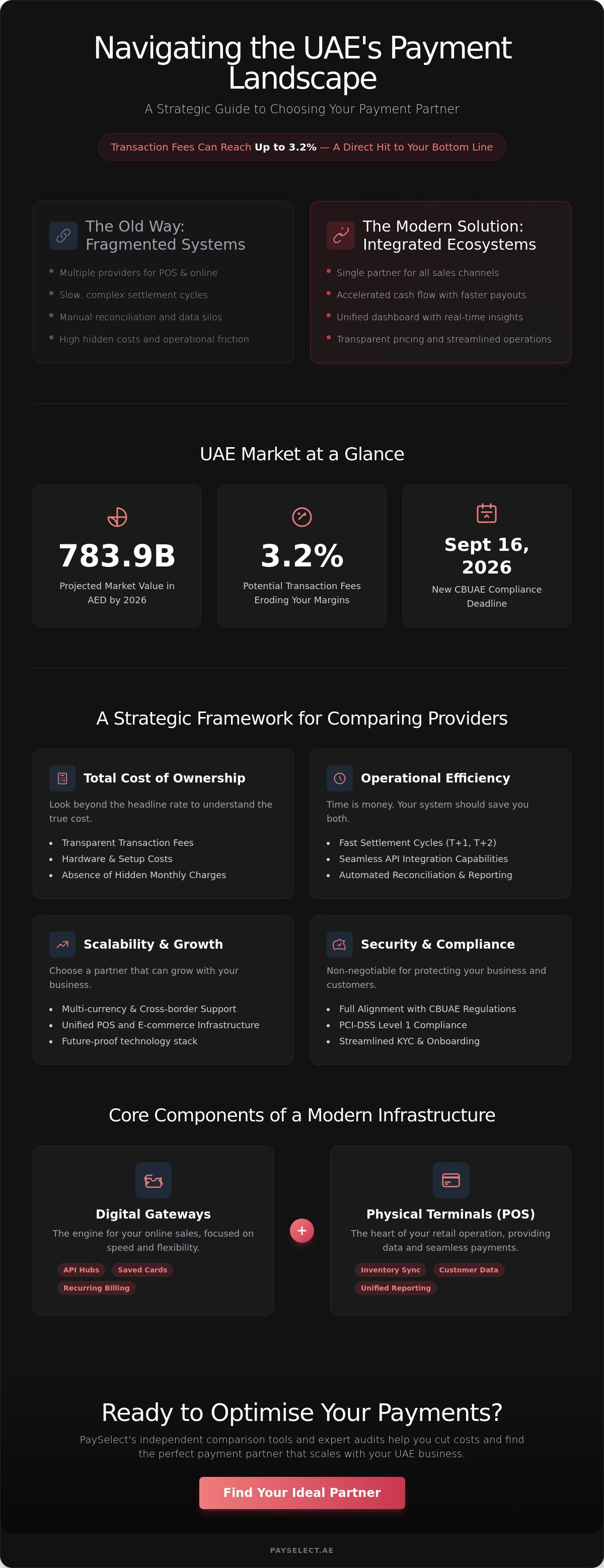
A Strategic Framework for Comparing UAE Payment Providers
Selecting a payment partner in the Emirates requires a structured methodology to avoid costly operational friction. You need a framework that moves beyond surface-level features to analyze long-term financial impact. Start by analyzing the total cost of ownership. This includes the Merchant Discount Rate (MDR), monthly service fees, and hardware rental costs for terminals. While headline rates are often the first thing merchants see, the cheapest headline rate often conceals high monthly minimums or terminal rental fees that erode your actual profit margins. Next, evaluate settlement timelines. Cash flow is the lifeblood of retail, and a shift from T+3 to T+1 settlement can significantly improve your working capital position.
Technical depth is the third pillar of your evaluation. You must test how well a provider’s API integrates with your existing e-commerce platform or ERP system. A provider like geidea is often benchmarked for its local integration capabilities, but you should verify if their specific tech stack aligns with your unique business logic. Finally, assess the quality of local technical support. In a market where digital transactions are projected to reach AED 783.9 billion by 2026, you cannot afford downtime. Ensure your partner offers on-the-ground account management and rapid hardware replacement within the UAE.
Pricing Transparency and Hidden Costs
Decoding the Merchant Discount Rate (MDR) is essential for cost optimization. In the UAE, transaction fees for merchants can reach as high as 3.2%, depending on the card type and industry. You must look past the base rate to identify interchange fees and scheme charges that might be passed on to you. Be wary of "hidden" costs such as setup fees, minimum monthly volume requirements, and restrictive exit clauses. A transparent partner provides a clear breakdown of every fils charged, allowing you to forecast your expenses with absolute precision. This clarity ensures your payment infrastructure remains a strategic asset rather than an unpredictable expense.
Scalability and International Reach
Your payment infrastructure must empower your expansion into the wider GCC and global markets. Verify the provider’s ability to handle cross-border payments and support multiple currencies without excessive FX conversion losses. Multi-currency settlement allows you to receive funds in the currency of the transaction, which is vital for maintaining margins during international growth. Robust reporting tools are also non-negotiable for managing high-volume transactions across different jurisdictions. As you scale, the ability to centralize data from various regions into a single dashboard will streamline your financial operations and accelerate your global ambition. Using a provider like geidea can provide a strong regional foundation, but your long-term partner must be able to bridge the gap between local reliability and global reach.
Overcoming Common Pain Points in Payment Setup
Setting up a payment ecosystem in the UAE involves more than just selecting a terminal. It's a rigorous process of regulatory alignment and technical synchronization. Many merchants find that the initial onboarding phase is where they encounter the most friction. Navigating the KYC (Know Your Customer) requirements can take days or even weeks if your documentation isn't perfect. You must provide a valid Trade License, Emirates ID copies for all shareholders, and recent bank statements. While a provider like geidea strives to streamline this, the reality of Central Bank of the UAE (CBUAE) oversight means there's no shortcut to compliance. Missing the September 16, 2026, deadline for the latest financial regulations could result in significant operational disruptions.
Bridging the gap between legacy retail systems and modern digital gateways is another significant hurdle. If you're running an older ERP or a custom-built e-commerce site, you might find that your existing software doesn't communicate well with new APIs. This technical debt leads to duplicate entries, reconciliation errors, and slow settlement cycles. Managing high-risk industry classifications is equally challenging. Certain sectors, such as travel or high-value electronics, face stricter scrutiny and higher reserve requirements. Securing a stable processing environment requires a partner that understands these nuances and provides clear paths to approval.
Integration Hurdles and Technical Support
Developers often struggle with poorly documented payment APIs that lack clear error codes or sandboxes for testing. This leads to integration delays that push back your launch date. The value of a dedicated local support team cannot be overstated. Relying on a global ticketing system often results in generic responses that don't account for UAE-specific banking hours or local clearing cycles. If you're planning a migration, a "seamless" transition requires a parallel run where both systems operate briefly to ensure no data is lost during the switch.
Compliance and Risk Management
Staying ahead of evolving UAE financial regulations and Anti-Money Laundering (AML) laws is a constant responsibility. Your infrastructure must include robust fraud prevention tools that balance security with high conversion rates. If your security settings are too aggressive, you'll lose legitimate sales; if they're too lax, you'll face chargebacks that eat into your margins. Ultimately, you're responsible for maintaining a secure environment, which includes PCI-DSS compliance and regular audits. To avoid these common pitfalls, you should compare payment gateway providers to see which ones offer the most robust support for your specific industry.
Ensuring 99.9% uptime is critical when your business processes thousands of Dirhams every hour. If the system goes down during a peak shopping period, the loss of revenue and customer trust is devastating. You need a contingency plan that includes offline processing or a secondary gateway to maintain continuity. A provider like geidea offers various hardware and software redundancies, but you must verify how these perform under high-stress conditions before committing to a long-term contract.
Optimising Your Choice with PaySelect Advisory
Selecting a payment partner is a high-stakes decision that dictates your business's long-term agility. While prominent providers like geidea offer powerful, all-in-one ecosystems, the sheer variety of options in the UAE market can lead to analysis paralysis. PaySelect provides an independent lens, cutting through the marketing noise to deliver objective, data-driven insights. We don't process your payments; we optimize how you choose those who do. This ensures you find the perfect infrastructure to scale your UAE business without being locked into inefficient contracts or hidden fee structures.
Why Independence Matters in Fintech
Direct sales teams are naturally incentivized to sell their own products, which sometimes overlooks your specific technical requirements or cost constraints. PaySelect acts as a neutral facilitator, serving as a bridge between complex global financial infrastructures and the intuitive needs of modern entrepreneurs. We stay updated on every shift in the MENA payments landscape, from the Jaywan card scheme to the CBUAE’s Open Finance framework. This independence allows us to provide a rock-solid financial strategy that prioritizes your growth over a provider's commission.
Matching your unique business profile with the right provider is simplified through our "Take the Test" tool. We analyze your transaction volume, industry risk, and integration needs to recommend a tailored fit, whether that involves geidea or another leading regional competitor. For high-volume organizations and hotel groups, we offer bespoke enterprise-level advisory services and payment cost optimization audits. These deep-dive assessments identify hidden fees and streamline settlement cycles to reclaim lost margins. In a market where transaction fees can reach 3.2%, even a small optimization translates into thousands of AED in annual savings.
Next Steps for Your Business
Take control of your financial infrastructure by using PaySelect to audit your current payment costs. This process uncovers where complex fee structures are eating into your margins and provides a roadmap to a more efficient, integrated, and borderless payment future. Whether you need a payment gateway comparison or a pos system selection, we provide the data you need to act with confidence. Empower your business with a strategy that removes every barrier to expansion and accelerates your cash flow.
Simplify your search and find the perfect payment partner today with PaySelect.
Future-Proof Your UAE Payment Strategy
The landscape of UAE commerce is shifting toward a unified, data-driven future. By moving away from fragmented vendors and adopting integrated ecosystems, you streamline your operations and protect your margins from transaction fees that reach as high as 3.2%. Whether you're evaluating the all-in-one capabilities of geidea or comparing other regional players, your choice must align with the September 16, 2026, CBUAE compliance deadline. Success requires a strategic balance of transparent pricing, technical flexibility, and rapid settlement cycles to maintain liquid cash flow.
PaySelect empowers you with the independent, unbiased advisory needed to make this choice with absolute confidence. Our deep expertise in the MENA payments landscape ensures you receive customized matching based on your specific industry and transaction volume. We remove the barriers to growth by identifying hidden costs and technical hurdles before they stall your momentum. This clarity allows you to focus on expansion rather than infrastructure troubleshooting.
Find the best payment gateway for your business with PaySelect’s comparison tool and start scaling your borderless operations today. Your business deserves a foundation built for global ambition and rock-solid local reliability.
Frequently Asked Questions
Is Geidea a bank or a payment service provider?
geidea
is a licensed fintech company and payment service provider (PSP) authorized by the Central Bank of the UAE, not a traditional bank. It focuses on providing the technology infrastructure for transactions, including POS terminals and digital gateways. This distinction is vital for business owners who need specialized merchant services rather than traditional deposit-taking or lending facilities.
What are the typical fees for integrated payment solutions in the UAE?
Transaction fees for merchants in the Emirates can reach as high as 3.2% per transaction depending on the industry and card type. These costs usually consist of the Merchant Discount Rate (MDR), interchange fees, and international scheme charges. You should also account for fixed monthly service fees or terminal rentals that can impact your actual profit margins.
How long does the onboarding process take for a new payment gateway?
The onboarding process typically takes between 3 and 10 business days if your documentation is complete and accurate. You'll need to submit a valid UAE Trade License, Emirates ID copies for all shareholders, and recent corporate bank statements. Delays usually happen during the KYC verification stage if the provider requires more details about your specific business activities.
Can I use one provider for both my physical shop and my online store?
Yes, utilizing a single provider for both physical and digital channels is the core of a unified commerce strategy. This approach allows you to centralize your inventory management, sales reporting, and customer data within one dashboard. Providers like geidea specialize in these integrated ecosystems to help you avoid the inefficiencies of managing multiple vendors.
Do UAE payment providers support international credit cards and digital wallets?
Most UAE providers support all major international card schemes, including Visa and Mastercard, along with digital wallets like Apple Pay and Google Pay. Many are also integrating the Jaywan domestic card scheme to help merchants reduce processing costs. This broad support is essential for capturing sales from both local residents and the high volume of international tourists.
What is the benefit of using an independent comparison tool like PaySelect?
PaySelect offers an unbiased, data-driven perspective that direct sales teams can't provide. We help you identify hidden costs and technical integration hurdles before you sign a restrictive contract. Our comparison tools ensure you find a partner that matches your specific transaction volume and industry requirements, protecting your margins as you scale.
How do settlement cycles work for merchants in the UAE?
Settlement cycles in the UAE generally range from T+1 to T+3 business days for most standard merchants. This means your funds reach your bank account within one to three days after the transaction is processed. New platforms like Aani are starting to offer real-time settlements, which significantly improves cash flow and working capital for high-volume businesses.
Is it possible to integrate my POS system with my accounting software?
Modern Android-based POS systems are built to integrate directly with accounting software and ERP systems through open APIs. This automation removes the need for manual data entry and ensures your financial records are updated in real time. It's a critical feature for reducing reconciliation errors and providing your finance team with accurate, up-to-the-minute business intelligence.
Disclaimer
This content is for informational purposes only and should not be considered financial, legal, or regulatory advice. Payment provider availability, pricing, and approval processes vary depending on individual business circumstances. PaySelect does not guarantee provider acceptance or specific outcomes. Businesses should conduct their own due diligence before entering into any agreements.
Empowering businesses to achieve greater growth