
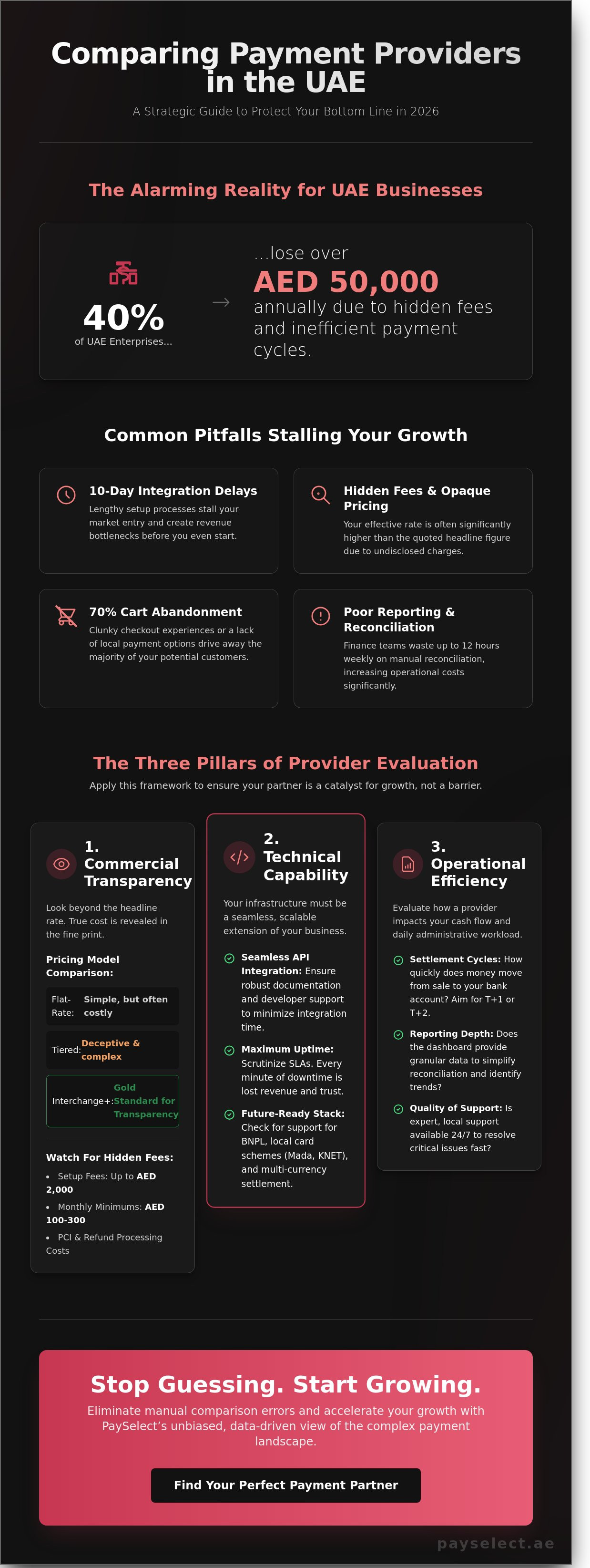
Did you know that 40% of UAE enterprises lose over 50,000 AED annually to hidden transaction fees and inefficient settlement cycles? You likely understand that selecting a financial partner is one of the most critical decisions for your business's scalability in the Emirates. It's easy to feel overwhelmed by complex fee structures, yet applying expert Tips for Comparing Payment Providers is essential to protect your bottom line. Many founders face 10-day integration delays or discover that their effective rate is significantly higher than the quoted headline figure. These bottlenecks don't just hurt your cash flow; they stall your global ambition.
Our authoritative framework empowers you to evaluate payment infrastructure with absolute precision. You'll learn how to strip away hidden costs, streamline your customer checkout experience, and ensure your technical support is as rock-solid as your ambitions. PaySelect addresses these challenges by removing technical barriers and providing the transparent, high-speed settlement cycles modern entrepreneurs require. This guide previews the strategic shifts needed for 2026 to ensure your business remains borderless, efficient, and ready to scale without friction.
Key Takeaways
• Transition from a "one-size-fits-all" approach to a strategic payment infrastructure that enhances customer conversion and scales with your global ambitions.
• Evaluate the "Three Pillars" of provider success by auditing total commercial transparency and ensuring technical APIs offer seamless integration and maximum uptime.
• Apply professional Tips for Comparing Payment Providers to analyze how settlement cycles and reporting depth directly impact your cash flow and operational efficiency.
• Implement a standardized RFP framework and data-driven audit process to ensure every dirham spent on processing contributes to your bottom line.
• Discover how to eliminate manual comparison errors and accelerate your growth by leveraging PaySelect’s unbiased view of the complex payment landscape.
Why a Strategic Comparison of Payment Providers Matters in 2026
In the UAE's maturing digital economy, selecting a merchant partner is a high-stakes strategic decision. The era of rigid, one-size-fits-all solutions ended years ago. By 2026, businesses that treat payments as a mere utility face stagnant growth. Modern e-commerce payment systems must be dynamic, borderless, and built for speed. Your payment infrastructure directly influences customer conversion. If a checkout process feels clunky or lacks local payment options, 70% of shoppers will abandon their carts without hesitation. A sophisticated stack builds brand trust by ensuring every transaction is secure and instantaneous.
When researching Tips for Comparing Payment Providers, you must look beyond the Merchant Discount Rate (MDR). While a low percentage fee looks attractive on a spreadsheet, it's often a distraction from the total cost of ownership. A cheap provider can become expensive if it lacks the tools to streamline cross-border payments or fails to provide robust technical support. An optimized payment setup acts as a catalyst for scaling. It allows you to enter new markets, accept diverse currencies, and manage high-velocity traffic during peak shopping seasons like White Friday.
Strategic comparison empowers your business to:
• Maximize authorization rates through intelligent transaction routing.
• Reduce the time between a sale and a settlement in your bank account.
• Eliminate technical barriers that prevent expansion into the wider GCC region.
The True Cost of Inefficient Payments
Inefficiency drains your bottom line through leaky revenue. High decline rates often stem from poor routing or outdated fraud filters that flag legitimate customers as risks. If your system triggers false positives, you lose sales and damage customer loyalty in one stroke. There's also a heavy administrative burden to consider. If your finance team spends 12 hours every week on manual reconciliation because of poor reporting, your operational costs are too high. Outdated systems also limit your agility. They make it difficult to adopt new methods like Buy Now, Pay Later (BNPL) which are now essential for capturing the UAE's younger demographic.
Defining Your Business Requirements
You must categorize your needs before signing any contract. Are you focused on pure e-commerce, physical retail, or a hybrid omnichannel model? Your transaction volume and average order value (AOV) dictate your leverage during negotiations. High-volume businesses can often secure better terms, but only if they understand their data. Assess the specific geographic needs of your customers. If you're targeting shoppers in Saudi Arabia or Kuwait, you need a partner that supports local card schemes and settles in multiple currencies without excessive conversion fees. Identifying these Tips for Comparing Payment Providers early ensures your infrastructure supports your long-term ambition.
The Three Pillars of Payment Provider Evaluation
Selecting a partner isn't just about the lowest rate. It's about building a foundation for growth. To master your strategy, you need to look at three critical areas: commercial transparency, technical capability, and compliance. Balancing these ensures your business stays agile while protecting your margins. Here are the essential tips for comparing payment providers to keep your operations stable through 2026.
Decoding Commercial Structures
Price transparency is the first hurdle. Most providers in the UAE offer three main models. Flat-rate pricing is simple but often expensive for high-volume merchants. Tiered pricing can be deceptive, as transactions often fall into "non-qualified" buckets with higher costs. Interchange-plus is the gold standard for transparency, showing you exactly what the card schemes charge versus the provider's margin. This model prevents the common pain point of seeing unexpected deductions on your monthly settlement.
Setup Fees
Some legacy providers in the region charge up to AED 2,000 just to open an account.
Monthly Minimums
You might pay AED 100 to AED 300 even if you process zero transactions during a slow month.
Hidden Extras
Watch out for statement fees, PCI non-compliance penalties, and refund processing costs that eat into your profit.
Technical Integration and Scalability
Your tech stack determines your speed to market. High-quality API documentation allows your developers to deploy solutions in days, not months. Look for providers that offer native plugins for platforms like Magento or Shopify. This reduces manual work and prevents checkout friction. In a digital economy, uptime is non-negotiable. A 0.1% difference in reliability can mean thousands of Dirhams in lost revenue during peak shopping seasons like White Friday.
Future-proofing is equally vital. As you scale beyond Dubai or Abu Dhabi, you'll need borderless payment capabilities to accept international currencies without heavy conversion hits. If your provider can't handle multi-currency settlements or local payment methods in new markets, they'll eventually become a bottleneck for your expansion.
Security isn't an optional add-on. Every provider must be PCI DSS Level 1 compliant. In the UAE, they must also adhere to the Retail Payment Services and Card Schemes Regulation (2021) set by the Central Bank. Compliance protects your brand reputation and prevents heavy fines. When you apply these tips for comparing payment providers, you move from a utility-based mindset to a strategic one. This alignment between cost, tech, and security creates the seamlessness required for modern global commerce.
Advanced Comparison: Operational Nuances and Cash Flow
Transaction fees often dominate the conversation during a provider search, but operational efficiency is what sustains a business long-term. A low processing rate loses its value if your capital remains locked in a lengthy settlement cycle or if your finance team spends 15 hours every week on manual reconciliation. When researching Tips for Comparing Payment Providers, you must prioritize how a partner integrates into your daily workflow. Efficiency isn't just a buzzword; it's the difference between a liquid business and one struggling to meet its immediate obligations.
The robustness of a provider's reporting dashboard is a critical factor. You need a centralized view that tracks every dirham in real-time. Without automated reporting, your internal reconciliation processes become prone to human error and delays. PaySelect solves this by offering intuitive dashboards that simplify complex data. Another vital element is the support structure. Automated bots might handle basic queries, but high-growth businesses require dedicated account management to resolve technical hurdles instantly. Look for a partner that offers human expertise rather than just scripted responses.
Settlement Cycles and Liquidity
Liquidity is the lifeblood of your operations. Standard settlement times usually follow a T+1 or T+2 format. A T+2 cycle means funds from a Monday sale hit your account on Wednesday. In the UAE, weekends can extend this wait to four or five days, which can stall inventory restocking or payroll. As your volume scales, you gain the leverage to negotiate faster terms. Some innovative providers now offer instant or accelerated settlement options. These tools ensure that your cash flow remains consistent regardless of the day of the week.
Omnichannel and POS Integration
Fragmented data creates blind spots in your business strategy. Unifying online and in-store data provides a 360-degree view of customer behavior. When you evaluate POS machines, look for hardware durability and software that syncs perfectly with your digital storefront. PaySelect helps businesses bridge this gap, ensuring that inventory and sales data remain consistent across every touchpoint. This synergy prevents overselling and provides a frictionless experience for your customers, whether they shop on a mobile device or at a physical counter.
Optimising Cross-Border Success
Expanding beyond the UAE requires a sophisticated approach to currency. One of the most effective Tips for Comparing Payment Providers is to scrutinize foreign exchange (FX) rates and multi-currency capabilities. High FX markups can silently erode your margins by 3% to 5% per transaction. Streamlining cross-border payments allows you to accept local payment methods in target markets, which increases checkout conversion rates. By reducing international transfer fees and settling in AED, you protect your bottom line while reaching a global audience.
Execution: A Step-by-Step Comparison Framework
Selecting the right partner requires more than a casual glance at a pricing page. You need a structured approach to filter out noise and identify the most efficient solution for your business. Use these five tips for comparing payment providers to build a robust selection framework that ensures long-term scalability.
Step 1: Standardize the RFP.
Send the same list of technical and commercial requirements to every candidate. This forces providers to answer on your terms, making it easier to spot discrepancies in service levels or settlement times.
Step 2: Audit with real data.
Use your last three months of transaction history to run a side-by-side cost analysis. If your monthly volume is 750,000 AED, a 0.25% difference in processing fees saves you 1,875 AED every month. Don't rely on hypothetical scenarios.
Step 3: Test technical responsiveness.
Request access to a sandbox environment to evaluate API documentation. Measure how long their support team takes to answer a technical query. A 24-hour delay during a test period often signals a 48-hour delay during a live system failure.
Step 4: Inspect the exit strategy.
Review contracts for exclusivity clauses or hidden exit fees. High-growth businesses in the UAE often outgrow their first provider within 18 months, so flexibility is a strategic asset.
Step 5: Use a weighted scorecard.
Assign a percentage value to each priority, such as security, cost, or local integration. The highest total score wins, removing emotional bias from the final decision.
Avoiding Common Pitfalls in the Selection Process
Don't let low introductory rates distract you. Many providers offer "teaser" rates for the first six months that jump significantly after the initial period ends. You should also scrutinize the fine print regarding chargebacks. In the UAE market, dispute fees can range from 120 AED to 300 AED per instance. If your provider doesn't offer automated dispute management, these costs will erode your margins quickly. Be wary of "free" hardware offers. These often hide long-term software commitments that cost 25% more over three years than purchasing the equipment upfront.
Transitioning Without Downtime
Switching systems shouldn't halt your revenue. Implement a phased migration where you move 15% of your traffic to the new provider first. This validates the integration before a full rollout. Ensure your new partner supports secure token migration to maintain your recurring billing data without asking customers to re-enter card details. Running parallel systems for the first 30 days provides a safety net if the primary link fails. This redundancy ensures your customers enjoy a seamless checkout experience regardless of back-end changes. Using these tips for comparing payment providers will help you maintain continuity during the shift.
Ready to upgrade your infrastructure? Discover how to optimize your checkout with advanced payment gateways designed for the UAE market.
Simplify Your Decision with PaySelect
Manual comparison is a high-risk strategy for busy executives. It's time-intensive and frequently leads to errors that impact your bottom line. Many leaders spend over 40 hours trying to decode complex fee structures and fine print across different platforms. This manual approach often misses hidden costs like monthly minimums, tiered pricing traps, or obscure processing markups. PaySelect replaces this friction with a streamlined, authoritative platform. We offer a clear, data-driven view of the market so you can focus on scaling your operations. By applying expert tips for comparing payment providers, you move from guesswork to strategic certainty.
Miscalculating interchange pricing or missing a 0.5% difference in settlement fees can cost a high-volume business tens of thousands of AED every year. Manual spreadsheets simply can't keep up with the fast-moving fintech sector in the UAE. PaySelect solves this by providing a single source of truth. We analyze the technical and financial variables that matter most to your specific business model, ensuring you don't overpay for features you don't use.
Our Independent Approach
Our independent model ensures you receive facts, not marketing. We don't process payments ourselves; we empower you to choose the best processor for your unique needs. This allows us to present unbiased data on payment gateways without the pressure of a sales pitch. We help you uncover the best fit for your specific sector, whether you're in high-growth retail, hospitality, or specialized B2B services. Our team understands the nuances of the UAE regulatory environment, ensuring your choice is compliant and optimized for local success.
• Access transparent data sets that compare apples to apples.
• Leverage expert industry knowledge to bypass marketing fluff.
• Identify providers with the most reliable AED settlement cycles.
Take the Next Step for Your Business
Efficiency is the foundation of a successful business. Our 'Take the Test' tool is a high-impact starting point for any leader looking to optimize. It takes only five minutes and can save your business thousands of AED in annual transaction costs by identifying more efficient fee structures. For established enterprises with complex requirements, our bespoke advisory services provide deep-dive infrastructure optimization. We analyze your entire payment flow to find where fees are leaking and where transaction speed can be improved.
We don't just look at basic fees. Our audits examine API stability, settlement speeds, and fraud prevention layers. This comprehensive approach ensures your infrastructure is robust enough to handle global expansion and borderless commerce. Join the thousands of UAE businesses that have already transitioned to a more efficient payment strategy. Using professional tips for comparing payment providers is the fastest way to turn your payment setup into a strategic tool for business transformation.
Ready to scale with confidence? Request your payment cost optimization audit today and see how much your business can save.
Future-Proof Your UAE Payment Strategy
The payment landscape in 2026 demands more than just a functional checkout; it requires a strategic engine that drives growth. Selecting the right partner means looking beyond basic transaction fees to examine settlement cycles and local integration capabilities within the UAE. Applying these Tips for Comparing Payment Providers ensures you avoid the common pitfalls of hidden operational costs and rigid contract terms. You need a setup that handles the nuances of the MENA market while keeping your cash flow agile and your operations lean.
PaySelect acts as your independent and unbiased comparison platform. We provide specialized MENA region expertise to help you navigate complex regulations and find the right fit for your specific business model. Our platform helps you optimize costs and scale seamlessly by removing the friction often found in traditional financial setups. We don't just find a provider; we empower your global ambition.
Take the PaySelect test today and find your perfect payment partner.
Your journey toward a borderless and efficient financial future starts with a single, informed decision.
Frequently Asked Questions
What is the most important factor when comparing payment providers?
Total cost of ownership and integration flexibility are the most critical factors for any business. You shouldn't just look at the base transaction fee; consider setup costs, monthly maintenance, and settlement speeds. A seamless API integration ensures your platform remains scalable as you expand. PaySelect helps businesses overcome technical hurdles by providing a unified interface that simplifies these complex comparisons and empowers your growth.
How do I know if I'm paying too much for my current payment gateway?
You're likely overpaying if your effective rate exceeds the standard 2.2% to 2.9% range for local UAE transactions. Audit your statements for hidden costs like PCI compliance fees, statement charges, or high refund penalties. High fees often stem from outdated legacy systems that lack modern optimization. PaySelect identifies these inefficiencies to help you streamline costs, recover lost margins, and accelerate your financial performance.
Can I use multiple payment providers at the same time?
You can absolutely use multiple payment providers simultaneously to ensure redundancy and optimize transaction routing. This strategy prevents downtime and allows you to choose the best provider for specific regions or payment methods. It's a key part of our Tips for Comparing Payment Providers to look for platforms that support multi-provider setups. PaySelect removes the barrier of managing several integrations by consolidating your global reach into one dashboard.
What is a Merchant Discount Rate (MDR) and how is it calculated?
Merchant Discount Rate (MDR) is the percentage fee a bank charges a merchant for processing debit and credit card transactions. It's typically calculated by adding the interchange fee, assessment fee, and the provider's markup. In the UAE, MDR rates vary based on whether the card is local or international. Understanding this breakdown is essential for accurate financial forecasting and helps you scale your operations without unexpected overhead or friction.
How long does it typically take to switch to a new payment provider?
Switching to a new payment provider typically takes 14 to 30 days depending on your technical requirements and KYC approval speed. This timeline includes API integration, sandbox testing, and final compliance checks by UAE regulatory bodies. Delays often happen during the documentation phase for local merchant accounts. PaySelect accelerates this transition by offering pre-built integrations and expert guidance to ensure your business remains operational throughout the move.
Are there specific payment providers better suited for startups versus enterprises?
Startups usually prioritize quick setup and low monthly fees, while enterprises require deep customization and volume-based pricing. Recent 2024 industry data shows that 65% of enterprises seek providers with robust reporting and multi-currency settlement capabilities. Startups benefit more from plug-and-play solutions that don't require heavy engineering resources. PaySelect bridges this gap by offering a scalable infrastructure that grows alongside your business from its first transaction to global expansion.
What security certifications should I look for in a payment provider?
You must look for PCI DSS Level 1 certification and compliance with UAE Central Bank regulations to ensure maximum security. These standards protect sensitive cardholder data and reduce your liability in case of a breach. Security is a major pain point for businesses moving into digital commerce. PaySelect prioritizes this by maintaining elite security protocols, allowing you to focus on expansion while we handle the complex task of protecting your borderless payments.
How do cross-border payment fees differ from local transaction fees?
Cross-border fees are significantly higher than local UAE fees because they include currency conversion markups and international interchange rates. A local transaction might cost 2.0% in AED, whereas an international payment could reach 3.5% or more. These extra costs are a common hurdle for businesses with global ambition. Utilizing these Tips for Comparing Payment Providers helps you identify partners that offer local acquiring in multiple regions to reduce these unnecessary expenses.
Disclaimer
This content is for informational purposes only and should not be considered financial, legal, or regulatory advice. Payment provider availability, pricing, and approval processes vary depending on individual business circumstances. PaySelect does not guarantee provider acceptance or specific outcomes. Businesses should conduct their own due diligence before entering into any agreements.
Empowering businesses to achieve greater growth