
What if the most established name in banking isn't the most efficient partner for your digital growth? Choosing the right payment infrastructure in the UAE often feels like a trade-off between institutional security and the agility of modern technology. You want a system that works as hard as you do, but high transaction fees and complex onboarding processes often create unnecessary friction in your daily operations.
This FAB merchant services review offers an independent analysis of how traditional bank-led solutions compare to the latest fintech innovations. Our goal is to help you optimize your payment setup for 2026 by identifying the specific trade-offs in settlement cycles, technical support, and fee structures. You'll learn how to navigate the differences between various providers to secure lower transaction costs and more transparent reporting for your business.
We provide a clear look at the landscape, focusing on how to achieve seamless POS integration and reliable national support. By the end of this guide, you'll understand how to leverage comparison tools to transform your payment gateway into a strategic tool for expansion rather than just a cost of doing business. It's about finding the balance that drives performance and removes operational barriers to your success.
Key Takeaways
• Balance the rock-solid stability of traditional institutional providers with the rapid innovation and agility of modern fintech payment gateways.
• Navigate the evolving 2026 landscape with an independent FAB merchant services review that evaluates how bank-led solutions compare to digital-first alternatives.
• Identify and remove common operational barriers such as high transaction fees, document-intensive onboarding, and delayed settlement cycles.
• Utilize specialized comparison tools to match your business with the ideal POS or online gateway provider based on your specific technical infrastructure.
• Optimize your payment ecosystem to achieve lower transaction costs, seamless system connectivity, and more transparent financial reporting.
Evaluating Institutional Merchant Services in the UAE
Tier-1 financial institutions like First Abu Dhabi Bank (FAB) form the bedrock of the national payment ecosystem. These banks provide the necessary stability and regulatory alignment required by the Central Bank of the UAE. For many entrepreneurs, defaulting to an institutional provider is a matter of perceived safety. You want to know your funds are secure and your processing remains compliant with national standards. This sense of security is why institutional providers remain the primary choice for businesses establishing their initial footprint.
A comprehensive FAB merchant services review reveals that while institutional backing offers peace of mind, it often comes with a layer of complexity. Traditional processing is currently shifting toward integrated digital ecosystems. This means your payment gateway is no longer just a tool for accepting money; it's a data engine that should drive your business growth. Choosing a partner solely based on their size can lead to operational bottlenecks if their technology doesn't match your specific needs.
Core Capabilities of Bank-Led Solutions
Institutional providers excel in areas where scale and physical presence matter. They offer direct integration with your corporate bank accounts, which can simplify the reconciliation process. Their security protocols are often at the highest level, featuring advanced fraud prevention and strict adherence to industry standards. For retail operations, these banks provide reliable physical POS hardware supported by a national service network. This ensures your storefront stays operational without the technical hurdles sometimes found in smaller, less established setups. This infrastructure is particularly beneficial for high-volume businesses that prioritize uptime above all else.
The Evolution of Merchant Expectations in 2026
The landscape has moved beyond simple card swiping. Modern businesses now demand real-time data access and instant settlement cycles to maintain healthy cash flow. In 2026, the transition to omnichannel payments is no longer optional. Your customers expect to pay via mobile wallets, online gateways, and physical terminals with the same level of ease. When analyzing your options through a FAB merchant services review, you must consider how these institutional benefits weigh against the agility of newer market entrants.
Standard banking packages are becoming obsolete because they fail to address the specific needs of different industries. High transaction commissions, which can range from 1.8% to 3.8% depending on the channel, often eat into margins if not properly optimized. PaySelect helps you navigate these complexities by providing a payment gateway comparison tool. This allows you to audit potential costs and infrastructure requirements before committing to a long-term contract. We simplify the setup process by matching your specific business needs with the right institutional or fintech partner through a neutral, data-driven approach.
Analyzing Performance: Reliability and Integration
Performance isn't just about successful card swipes. It's about the invisible backend stability that keeps your business running during peak hours. While consumer-facing apps often receive high praise for their interface, merchant services demand a higher level of technical endurance. A professional FAB merchant services review must prioritize whether the system handles peak transaction volumes without slowing down your operations. Reliability is the foundation of customer trust and operational efficiency.
Integration remains a primary pain point for many UAE businesses. You need a gateway that connects effortlessly to your e-commerce platform through well-documented APIs. Some institutional providers still rely on legacy integration methods, which can frustrate your development team and delay your launch. Seek out solutions that offer clear, accessible technical guides to ensure a smooth transition from setup to sales. Access to dedicated account management can also bridge the gap between complex banking protocols and your daily business needs.
Technical Infrastructure and Scalability
Scalability is essential when your business experiences rapid growth or seasonal spikes. You need an infrastructure that manages thousands of concurrent transactions without latency or timeouts. Maintaining 99.9% uptime is the baseline requirement for any merchant who values customer trust and consistent revenue generation. If you're looking for hardware that matches this reliability, comparing POS machines through a neutral platform ensures you don't settle for outdated technology. High-volume periods shouldn't be a source of stress for your technical team.
The Onboarding and Compliance Experience
Navigating the UAE's regulatory landscape is often the most time-consuming part of your setup. Strict Anti-Money Laundering (AML) and Know Your Customer (KYC) procedures mean that onboarding can take anywhere from four to eight weeks at traditional institutions. It's a document-intensive process that requires absolute precision to avoid repetitive requests and delays. Institutional partners often provide dedicated support to guide you through these requirements, but the speed of activation still depends on your initial document readiness. Reducing friction during this phase is vital for getting your hardware deployed and your gateway active.
If you're feeling overwhelmed by these technical requirements, it's helpful to audit your infrastructure with an independent consultant to find the most efficient path forward. Selecting the right partner early prevents costly migrations later as your business expands.
Traditional Banks vs. Fintech Gateways: A Comparison
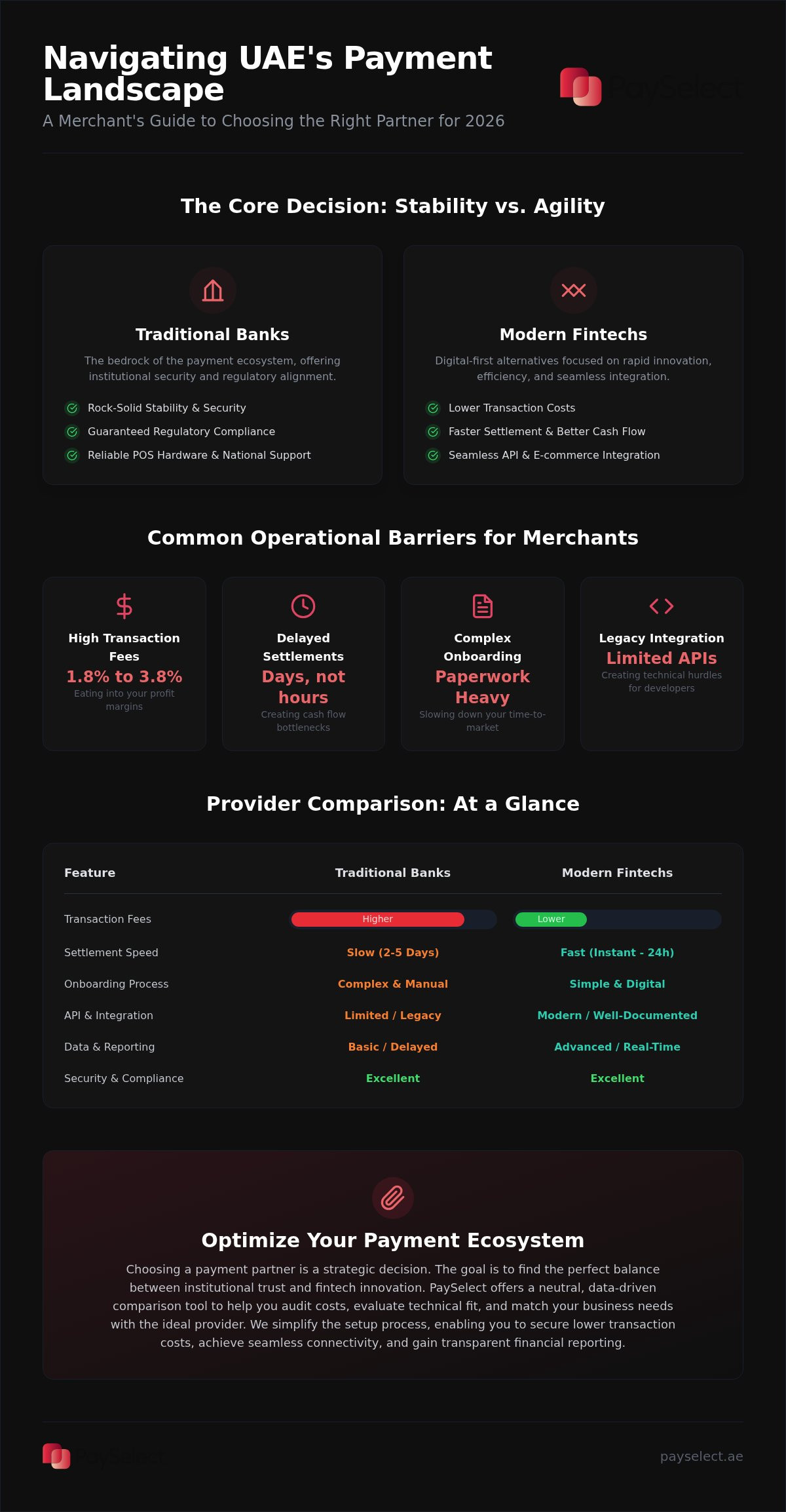
The choice between a traditional institutional provider and a modern fintech gateway often defines your operational speed. While banks offer a rock-solid foundation and integrated financial ecosystems, fintechs bring the technical innovation required to compete in a digital-first economy. A comprehensive FAB merchant services review shows that your decision should hinge on whether you prioritize integrated banking services or rapid feature deployment. Institutional providers offer the advantage of a one-stop-shop for loans and accounts, but their onboarding processes can be document-intensive and slow.
Agility is the primary differentiator for fintech startups. They release features faster and offer developer-friendly APIs that integrate smoothly with custom builds. However, these providers still require you to maintain a separate business bank account for fund settlement. Selecting the right model requires an honest assessment of your technical capabilities and your tolerance for traditional banking procedures. High-volume merchants often find that the stability of a bank-led service outweighs the initial complexity of the setup.
Fee Structures and Transparency
Transparency remains a critical differentiator in the UAE market. Traditional bank contracts often include multiple layers of costs, including setup fees that range from AED 1,500 to AED 6,000. Merchant Discount Rates (MDR) typically range from 1.8% for card-present transactions to 3.8% for online payments. High-volume merchants processing over 10,000 transactions monthly can often negotiate rates as low as 1.5%. Fintech providers frequently counter this with subscription-based models or more transparent percentage-based fees, helping SMEs avoid the sting of high monthly gateway costs that can reach AED 2,500. Using a payment gateway comparison tool is the most efficient way to identify these hidden costs before signing a contract.
Support and Service Response Times
Support structures differ vastly between these two models. Institutional providers offer reliable national coverage for physical POS machines, ensuring that hardware issues don't halt your retail operations. Conversely, fintech teams are usually more adept at resolving complex API integration hurdles and e-commerce gateway glitches. Handling chargebacks is another critical area; with fees ranging from AED 60 to AED 175 per dispute, you need a partner that offers a streamlined resolution process. Banks provide the security of an established institutional relationship, while fintechs provide the speed of a dedicated tech partner. Balancing these factors is essential for maintaining a frictionless payment infrastructure.
Common Pain Points in UAE Merchant Setup
Setting up a merchant account in the UAE is rarely a linear process. Businesses often encounter friction when attempting to bridge the gap between legacy banking systems and agile modern tech stacks. While an institutional FAB merchant services review might highlight stability, it's the operational hurdles like multi-currency settlement that often cause delays. Integrating older banking protocols with modern e-commerce plugins requires technical precision that many traditional setups lack. You need a system that doesn't just process payments but also manages the complexity of global expansion without increasing your administrative burden.
Local support is another critical factor often overlooked during the initial selection phase. When a physical terminal fails or a gateway integration glitch occurs, waiting for international support queues is not an option for national businesses. You require immediate, expert intervention to maintain continuity. Many providers struggle with this level of responsiveness, leading to extended downtime that directly impacts your bottom line. Understanding these root causes helps you select a partner that prioritizes operational uptime over simple service delivery.
Optimizing Cross-Border Transactions
Expanding your reach across the GCC requires a payment infrastructure that handles regional nuances effortlessly. Managing foreign exchange (FX) spreads on international sales can quietly erode your profit margins if your provider uses unfavorable rates. It's essential to select cross-border payment solutions that offer transparent FX handling and regional compatibility. This ensures your customers experience a smooth checkout regardless of their location or currency. Fluidity in cross-border movement is a competitive advantage that removes barriers to international growth.
Reducing High Transaction Costs
High Merchant Discount Rates (MDR) are a persistent challenge for UAE entrepreneurs. Negotiating these rates based on your transaction volume is a strategic necessity, yet many businesses accept standard terms without a second look. Regular payment audits play a vital role in identifying cost-saving opportunities and optimizing your financial infrastructure. A seemingly minor 0.5% difference in transaction fees can result in thousands of dirhams in lost annual revenue for a growing business. By reviewing your setup periodically, you ensure your costs remain aligned with your current scale and industry standards.
To ensure you aren't overpaying for your infrastructure, start a payment cost optimization audit today to identify exactly where your setup can be improved.
Selecting Your Optimal Payment Partner
Choosing the right partner requires a precise understanding of your operational volume and technical maturity. While this FAB merchant services review has analyzed the institutional strengths of bank-led solutions, the final decision rests on your specific business model. Retailers prioritizing physical presence need robust hardware, whereas e-commerce brands require high-performance digital connectivity. Filtering providers by industry ensures you don't overpay for features you don't use. It is about matching your infrastructure to your ambition.
For enterprise-scale shifts, independent advisory becomes essential. Transitioning your entire payment infrastructure is complex and carries significant operational risk. A final checklist for any merchant agreement should include a review of settlement cycles, technical support response times, and a clear breakdown of all variable fees. This structural clarity ensures that your chosen solution is ready for immediate implementation. Transparency at this stage prevents operational friction as your transaction volume grows.
The PaySelect Advantage
We simplify the selection process by acting as a neutral catalyst for your business growth. Our comparison tools allow you to evaluate various payment gateways based on real-time performance data and integration ease. If your focus is on-ground retail, we help you identify the most reliable POS machines that offer national support and seamless connectivity. Expert guidance ensures you navigate the MENA region's unique regulatory frameworks without the typical onboarding delays. This approach removes operational barriers and leads you toward a clear decision point.
Next Steps for UAE Merchants
Preparation is the key to a smooth transition. Start by organizing your financial documents, including bank statements and trade licenses, to expedite the KYC process. Conduct a final cost-benefit analysis to ensure the long-term value of the provider aligns with your expansion goals. This step confirms that your chosen infrastructure supports both current operations and future international ambition. A well-prepared application reduces the activation timeline and gets your systems online faster.
Ready to optimize your setup? Position your business for success by taking the PaySelect test. This tool matches your specific requirements with the ideal provider, removing the guesswork from your decision-making process. It's time to transform your payment infrastructure from a back-office necessity into a strategic tool for business transformation. Secure your margins, enhance your performance, and expand your reach today.
Future-Proofing Your Payment Infrastructure
Navigating the UAE's payment landscape requires a precise balance between the rock-solid stability of traditional institutions and the rapid innovation of fintech gateways. This FAB merchant services review has highlighted that success in 2026 depends on removing operational friction, whether through faster settlement cycles or seamless API integrations. By auditing your current setup and identifying hidden transaction costs, you transform your payment gateway from a back-office necessity into a strategic engine for expansion. It's about ensuring your technology scales as fast as your ambition.
Trusted by SMEs across the UAE, PaySelect provides independent and unbiased data to simplify these complex institutional decisions. Our expert payment infrastructure consulting helps you identify the ideal mix of security and speed for your specific industry requirements. Don't let legacy systems or opaque fee structures hold back your international growth. Match your business with the best UAE payment provider today and take control of your digital performance. Your next phase of expansion starts with a reliable, optimized foundation.
Frequently Asked Questions
What are the typical merchant discount rates (MDR) in the UAE for 2026?
Typical Merchant Discount Rates (MDR) in the UAE for 2026 range from 1.8% to 3.8% per transaction. Card-present transactions usually sit at the lower end, while online payments attract higher commissions. High-volume merchants processing over 10,000 transactions monthly can often negotiate rates as low as 1.5%. This FAB merchant services review emphasizes that these rates vary significantly between traditional banks and agile fintech providers, making independent comparison essential for cost optimization.
How long does it take to get a merchant account approved by a UAE bank?
Approval timelines for a merchant account at a traditional UAE bank typically range from four to eight weeks. This duration is largely due to strict Anti-Money Laundering (AML) and Know Your Customer (KYC) procedures required by national regulators. Fintech providers often offer faster onboarding, but they still require a verified business bank account for fund settlement. Ensuring your documentation is precise and complete from the start is the most effective way to reduce activation delays.
Can I use a fintech gateway while keeping my existing corporate bank account?
Yes, you can use a fintech gateway while maintaining your existing corporate bank account. Fintech providers focus on the digital processing layer but don't offer direct banking services; they require a separate account to settle your funds. This hybrid approach allows you to benefit from modern technical features without moving your entire financial ecosystem. PaySelect's comparison tools help you identify which gateways offer the smoothest connectivity with your current institutional bank account.
What is the difference between a payment gateway and a merchant account?
A payment gateway is the technical bridge that captures and encrypts transaction data, while a merchant account is a specialized financial account where funds are held after processing. Think of the gateway as the digital terminal and the merchant account as the temporary vault. Once the transaction is cleared, funds move from the merchant account to your corporate bank account. Understanding this distinction is vital when evaluating the total cost and infrastructure requirements of different providers.
Are there specific POS systems recommended for high-volume retail in the UAE?
High-volume retail operations in the UAE generally require institutional-grade POS hardware that offers national support and 99.9% uptime. Traditional bank-led services excel here, providing reliable physical terminals backed by extensive service networks. However, the best system for your business depends on your specific industry and integration needs. You can use PaySelect's POS system selection tool to filter hardware options that handle high transaction spikes without latency or technical failure.
What should I do if my merchant service application is rejected?
If your merchant service application is rejected, it's often due to strict compliance standards or high-risk industry classifications. You should first request a clear explanation for the rejection to identify specific document or eligibility gaps. In many cases, an independent payment infrastructure audit can uncover alternative providers with different risk appetites. Using a neutral comparison platform allows you to find partners that specialize in your sector, ensuring your business remains operational.
How do I integrate a UAE payment gateway with my international website?
Integrating a UAE payment gateway with an international website requires utilizing developer-friendly APIs and ensuring multi-currency settlement capabilities. Most modern gateways offer plugins for major e-commerce platforms, though custom builds may require more technical documentation. It's essential to choose a partner that supports GCC-wide compatibility to ensure a frictionless checkout experience for your global customers. This connectivity allows you to expand your reach while maintaining a rock-solid national financial foundation.
What are the security requirements for accepting online payments in the UAE?
Security requirements for online payments in the UAE include mandatory compliance with PCI DSS standards and the implementation of 3D Secure 2.0. These protocols protect sensitive customer data and reduce the risk of fraudulent transactions. Additionally, all providers must adhere to the Central Bank of the UAE's regulatory framework for merchant safety. Prioritizing institutional-grade security ensures your business remains compliant and inspires absolute confidence in your customers during every digital transaction.
Disclaimer
This content is for informational purposes only and should not be considered financial, legal, or regulatory advice. Payment provider availability, pricing, and approval processes vary depending on individual business circumstances. PaySelect does not guarantee provider acceptance or specific outcomes. Businesses should conduct their own due diligence before entering into any agreements.
Empowering businesses to achieve greater growth