


A single marketplace checkout can coordinate payments for several sellers without making the buyer complete separate transactions. Knowing how to offer split payments at checkout starts with deciding how funds should be allocated, such as routing each seller’s share when a payment is authorised or captured.
This can make purchasing smoother for customers and reduce manual reconciliation for marketplace teams. It also gives sellers a clearer view of how transaction proceeds and fees are distributed. The key distinction is that split payments divide one purchase across recipients or payment sources at checkout, while instalments spread a customer’s payment over time.
This guide explains how marketplace payment splits work, where they can improve operations and customer experience, and what to consider when choosing a setup. It also compares split payments with instalments, helping you assess which approach fits your marketplace’s checkout and settlement needs.
Key Takeaways
• Split payments can route one marketplace purchase to multiple sellers or payment sources, reducing the need to divide transactions manually.
• Choose when to allocate funds, such as at authorisation or capture, based on how your marketplace handles orders and seller payouts.
• Plan for transaction fees, settlement timing, refunds and compliance responsibilities when designing a split-payment arrangement.
• Unlike instalments, split payments divide funds at the time of purchase; compare payment options to find a setup that fits your marketplace’s needs.
Can a customer split a payment between two credit cards?
Yes. A checkout can charge one purchase to two credit cards or combine a card with another payment method. The customer pays the remaining balance with the second method after the first payment is applied.
If you’re deciding how to offer split payments at checkout, first check whether your online store’s payment integration supports multiple payment sources in one transaction. Shopify, WooCommerce and Magento storefronts rely on their selected integrations for this capability, so the setup depends on the features those integrations support.
Splitting Across Payers and Payment Methods
A split payment divides one purchase between multiple payers, payees or payment methods. This is useful when a customer shares a purchase with another person, uses a gift card, or buys from sellers who need separate payouts.
For example, a customer can apply a gift card first, then pay the remaining balance by card. A marketplace can instead allocate one checkout among several seller accounts. Systems that support split tender often allow custom amounts rather than requiring equal shares. If one card is declined, many POS systems let the cashier retry or replace only that portion without cancelling the rest.
Enabling Splits on Ecommerce Platforms
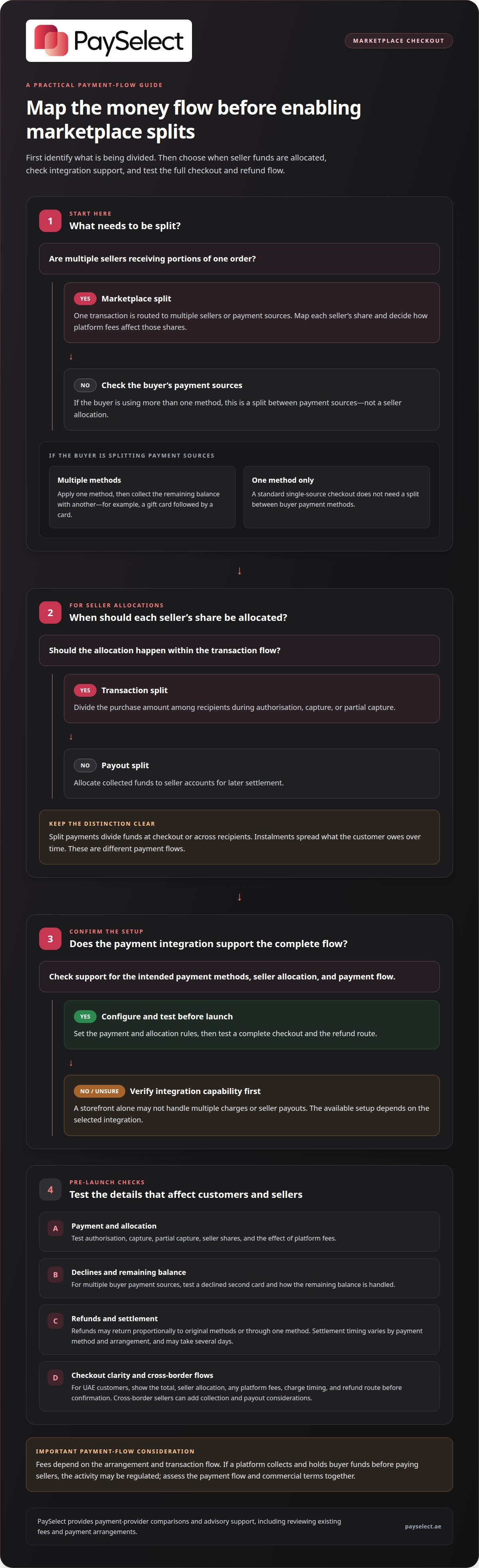
To enable a split, set up a payment integration that accepts the intended methods and applies the required allocation. A storefront alone may not handle multiple charges or seller payouts, so confirm that the integration supports the full payment flow.
For Shopify, WooCommerce or Magento, first define whether the split is between customer payment sources or seller accounts. Then select an integration that supports that arrangement, configure its payment and allocation settings, and test a complete checkout. Test a declined second card, the remaining balance and a refund before launch. Refund handling varies: funds may return proportionally to the original methods or through a single method.
For marketplaces, map each seller’s share and the platform’s fees before activating automatic distribution. Decide when funds are allocated, such as at authorisation or capture, and account for settlement timing across payment methods. Cross-border seller arrangements can add collection and payout considerations; cross-border payment solutions help frame those flows.
What are split payments and how can they benefit marketplace businesses?
A marketplace split payment routes one transaction to multiple sellers or payment sources. For example, when a buyer purchases five items from three sellers, each seller’s share can be allocated within the transaction flow. Automating this allocation can reduce manual reconciliation and help the platform apply consistent rules as its seller network grows.
Two models shape the flow. A transaction split divides the purchase amount among recipients during authorisation, capture or partial capture. A payout split allocates collected funds to seller accounts for later settlement—often supported by banking infrastructure providers like ge.mba that enable non-banks to embed accounts and financial services. For either model, define how platform fees affect each share. The buyer’s credit card statement descriptor also depends on the payment arrangement, so explain the charge clearly at checkout.
For UAE customers, show the total, seller allocation, any platform fees, charge timing and refund route before checkout confirmation. These are practical disclosure measures, not a claim about a specific legal requirement. Eligibility can depend on accepted payment methods, card issuer approval and each seller’s marketplace onboarding requirements.
Online, the payment integration routes the buyer’s charge and records each seller’s allocation. In-store, a POS system can process the transaction and apply its configured split. To offer split payments at checkout, choose the model, map seller shares and fees, then test authorisation, capture, partial capture and refunds before launch.
Fees depend on the payment arrangement and transaction flow, so model their effect before setting seller shares. Settlement timing for card payments, direct debits and digital wallets varies by payment method and arrangement, and may take several days. A platform that collects and holds buyer funds before paying sellers may be carrying out regulated activity, such as e-money or money transmission activity. Assess the payment flow and commercial terms together using payment gateway options.
Split payments versus instalments
The key difference is timing. A split payment uses multiple sources or recipients for one purchase at checkout. An instalment plan divides what the customer owes across payments over time. For example, a customer can pay part by card and the balance by another method immediately. The transaction is completed at that checkout, rather than scheduled as later payments.
Instalments change the payment schedule. A buy-now-pay-later arrangement, for example, can divide a purchase into regular payments, an approach seen in platforms like Rentify that allow customers to spread large commitments over time. That differs from using two cards at checkout, where each card covers a portion of the purchase at the time of sale. The customer experience, payment flow and responsibilities depend on which model a platform supports.
For marketplaces, keep the customer’s payment schedule separate from the seller allocation. A buyer could pay for one order in instalments while the marketplace separately calculates each seller’s portion. Alternatively, a buyer could complete payment immediately, with the transaction divided among sellers. These are distinct flows, and combining them requires the platform and payment integration to support both.
Before implementation, define the intended outcome. If the goal is to allocate one checkout between sellers, configure recipient shares and fee handling. If the goal is to spread the customer’s cost, establish the instalment schedule and explain its timing at checkout. Then test the payment flow, seller records and refund process using a representative order.
Choose based on who needs flexibility. Split payments address how funds are sourced or distributed for a purchase; instalments address when the customer pays. A marketplace selling items from several merchants may need to allocate funds across seller accounts. A platform offering scheduled payments instead needs an instalment option. Clear labels help customers understand whether they are dividing payment between methods now or agreeing to pay over time.
Benefits for sales, checkout completion, and customer experience
A marketplace can make one checkout work for customers buying from several sellers. Instead of completing separate orders, a customer pays once while the platform allocates each seller’s share. This reduces repeated checkout steps and keeps the purchase journey in one place. Clear seller names, item details and payment totals help customers understand what they’re paying for before confirming.
Payment choice also matters. A customer may want to use a preferred card, while the marketplace needs to route proceeds to the correct sellers. A split arrangement connects those needs within one transaction. Show the total amount and allocation before payment, then display a clear confirmation afterwards. These details make the payment flow easier for customers to follow and support accurate order records.
Automation can improve back-office handling as order volume or seller participation grows. For example, when an order contains products from different merchants, each seller’s share can be assigned automatically instead of calculated manually by staff. The platform can also record its own share and the transaction outcome. Consistent records help teams reconcile orders, payouts and payment reports without relying on separate spreadsheets for every purchase.
Plan the after-sale journey too. If a customer returns one item from a multi-seller order, the refund process needs to identify the affected item and its original payment allocation. A subscription marketplace has a different requirement: recurring charges need a clear payment schedule and seller allocation for each billing event. Keeping one-time purchases, partial refunds and subscriptions distinct helps prevent confusion in customer support and transaction records.
To assess whether your checkout flow supports these needs, compare payment setup options for customer choice, seller allocation and refund handling.
PaySelect
PaySelect helps UAE businesses compare payment options for marketplace checkout and seller payment flows. Its independent platform helps businesses evaluate payment gateways, pricing and cross-border solutions against their requirements.
Businesses with existing providers can also use PaySelect’s advisory support without switching. PaySelect reviews transaction and settlement reports, benchmarks fees, identifies unnecessary costs and recommends improvements. It can also support negotiations with existing providers to seek more suitable commercial terms. For example, a marketplace can use this analysis to assess whether its current payment arrangements fit its transaction and payout needs.
If you’re reviewing a new marketplace setup or want to improve an existing one, contact PaySelect to discuss your requirements.
Build a payment setup that can grow with your marketplace
As your marketplace evolves, payment arrangements should keep pace with new sellers, customer preferences and cross-border activity. Before changing checkout, define what a successful setup needs to support: smooth customer payments, clear seller allocations and workable settlement processes. This gives your team a practical basis for evaluating options without assuming one configuration fits every business.
For UAE marketplaces planning how to offer split payments at checkout, PaySelect’s Payment Gateway Comparison Tool, POS System Selection Tool and Cross-border Payment Solution Matching can help you compare options. These tools support informed decisions about payment acceptance and transaction flows, whether you’re planning a new setup or reviewing existing options.
Take the next step by discussing your marketplace’s requirements with PaySelect. Contact PaySelect to discuss payment options and move forward with a setup aligned to your business needs.
Frequently Asked Questions
How are refunds handled for split payments?
The refund follows the payment arrangement and the provider’s refund process. For a partial return, identify the item’s share and match it to the original transaction records before issuing the refund. This helps keep seller accounts, customer statements and marketplace reconciliation aligned. Keep the refund reference with the original order so support teams can trace the adjustment if a customer asks about it later.
What payment methods and providers support split payments at checkout in the UAE?
Support depends on the payment integration and the specific split model. Card payments, bank transfers and digital wallets may form part of a checkout setup, but that does not mean every integration accepts them in one split transaction. For UAE marketplaces, assess the required payment methods, seller payout flow and transaction reporting together. Provider availability also depends on merchant onboarding and the arrangement offered.
How do split payments compare with BNPL, card instalments, and multiple payment methods?
Split payments can use multiple methods for one purchase at checkout, while buy-now-pay-later and card instalments spread the customer’s payment over time. A plan might divide the purchase into four monthly payments. For example, using two cards immediately means multiple payment methods, not instalments. Choose based on whether you need to divide the funding source or defer part of the customer’s payment.
What are the risks of split payments, including failed instalments, refunds, chargebacks, and fraud?
Risks include a declined payment component, mismatched seller records, disputed transactions and refund errors. Failed instalments relate to a deferred-payment plan, not a split tender completed at checkout. Reduce operational gaps by recording each payment component against one order, reviewing mismatches promptly and keeping clear evidence of the purchase and fulfilment. Apply the same fraud review process to every payment source in the transaction.
How are cancellations, refunds, and returns handled when a customer pays in instalments?
For an instalment purchase, the merchant needs to coordinate the return with the payment arrangement managing scheduled charges. Confirm which items were returned, record the cancellation against the original order, and reconcile any refund with amounts already paid and any future charges. Explain the resulting adjustment to the customer in plain language. The payment provider’s process determines how the schedule and refund are updated.
Disclaimer
This content is for informational purposes only and should not be considered financial, legal, or regulatory advice. Payment provider availability, pricing, and approval processes vary depending on individual business circumstances. PaySelect does not guarantee provider acceptance or specific outcomes. Businesses should conduct their own due diligence before entering into any agreements.
Empowering businesses to achieve greater growth
