With 68% of UAE consumers now classified as non-cash users, your business cannot afford to ignore digital wallets. You likely recognize that a fast, frictionless checkout is a strategic necessity for growth in a market aiming for a 90% cashless economy by the end of 2026. However, determining how to accept google pay for business uae often creates more questions than answers. You might feel uncertain about Merchant Discount Rates (MDR), technical integration hurdles, or the upcoming regulatory deadlines mandated by the Central Bank.
We understand that navigating payment providers feels like a complex maze of varying fees and hardware requirements. This guide provides a clear roadmap to integrate Google Pay into your operations without the fear of hidden costs. You'll master the technical setup, understand the transition to modern 3D Secure authentication, and discover how to optimize your transaction expenses. We will break down the implementation steps for both POS and online systems to ensure your business remains compliant, efficient, and ready for the future of Emirati commerce.
Key Takeaways
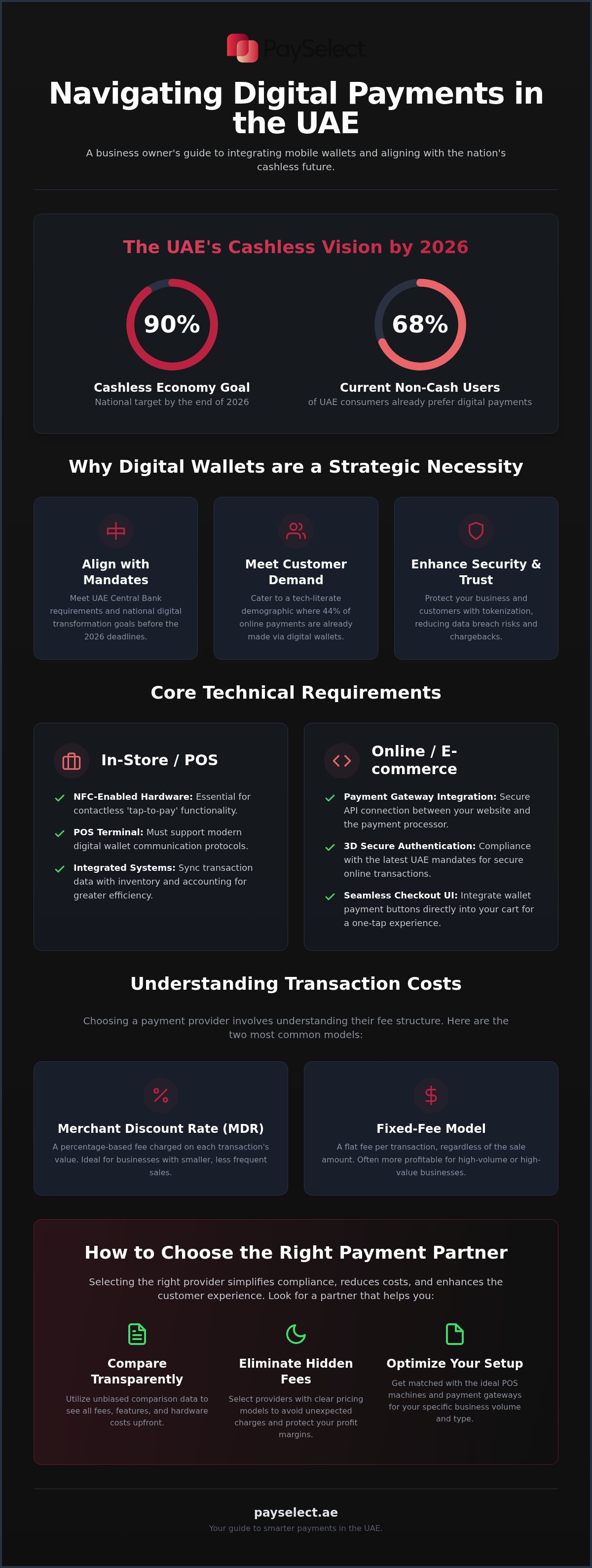
• Align your operations with the UAE's national drive toward a 90% cashless economy by the end of 2026 to meet rising consumer demand.
• Master the technical requirements on how to accept google pay for business uae by optimizing NFC-enabled hardware and secure online API integrations.
• Identify the most profitable fee structure for your specific transaction volume by decoding Merchant Discount Rates and fixed-fee models.
• Ensure seamless regulatory compliance with the latest UAE Central Bank mandates regarding 3D Secure authentication and data protection laws.
• Utilize unbiased comparison data and matching tools to select a payment partner that eliminates hidden fees and improves checkout speed.
The Strategic Role of Google Pay in the UAE Digital Economy
The UAE’s financial landscape is undergoing a rapid, state-led transformation. By the end of 2026, the national government aims to achieve a 90% cashless economy. This shift has moved digital payments from a luxury for tech-savvy startups to a core requirement for every merchant. For entrepreneurs asking how to accept google pay for business uae, the answer lies in understanding that mobile wallets are now the primary tool for consumer engagement. In a market where speed and security are paramount, providing a one-tap payment solution is no longer optional.
Meeting National Digital Transformation Goals
The push toward a cashless society is fueled by aggressive government initiatives and the Central Bank’s Federal Decree-Law No. 6 of 2025. This regulation mandates that merchants modernize their payment infrastructure by September 2026. Currently, 68% of UAE consumers are classified as non-cash users, creating a market where digital-first commerce is the standard. Accepting Google Pay allows your business to:
• Align with national regulatory frameworks and digital mandates.
• Meet the expectations of a high-income, tech-literate demographic.
• Capture market share as physical cash usage continues to decline across all emirates.
Digital wallets command nearly 44% of the market share for online payments in the UAE. This high penetration rate means that failing to support these methods creates immediate friction during the customer journey. By integrating mobile-first solutions, you transform your payment setup from a back-office function into a strategic tool for business expansion.
Security and Consumer Trust in 2026
Digital wallets provide a layer of security that traditional plastic cards cannot match. By understanding how Google Pay technology works, merchants can appreciate the power of tokenization. This process replaces sensitive card details with a unique digital identifier, ensuring that actual account numbers never touch your servers. This architecture significantly reduces the risk of data breaches and protects your business from the rising costs of fraudulent chargebacks.
Offering globally recognized payment brands also provides a psychological benefit. Customers feel more confident completing high-value transactions when they can use biometric authentication, such as fingerprint or facial recognition. This confidence directly translates to your bottom line by increasing checkout speed and reducing abandoned cart rates in digital environments. When you provide a frictionless payment experience, you remove the final barrier to a sale.
Selecting the right partner is the next step in this journey. Whether you need to compare payment gateways for your e-commerce store or find the right POS machines for a retail outlet, the infrastructure you choose must support these advanced wallet features natively. PaySelect helps you bridge the gap between complex global standards and local operational needs by providing transparent comparison tools to find the ideal provider for your volume.
Technical Requirements: Online vs. In-Store Acceptance
Establishing a modern payment infrastructure requires a dual focus on physical hardware and digital connectivity. To understand how to accept google pay for business uae, you must first distinguish between the needs of a brick-and-mortar shop and an e-commerce platform. While the end goal is a frictionless one-tap payment, the technical bridge between the customer's smartphone and your bank account differs significantly across these environments.
Hardware Standards for Physical Establishments
For physical retail locations, the primary requirement is a Point of Sale (POS) terminal equipped with Near Field Communication (NFC) technology. This allows the terminal to communicate with the customer's digital wallet through radio waves when the device is held within a few centimeters. In the UAE, where the contactless payment limit is AED 500, having NFC-compliant hardware is essential for high-volume environments like cafes, pharmacies, and supermarkets.
You should consider whether a standalone terminal or an integrated system suits your operational flow. Standalone units are quick to deploy, but integrated POS systems offer superior fluidity by syncing transaction data directly with your inventory and accounting software. This connectivity reduces manual entry errors and speeds up daily reconciliation. If your current equipment is outdated, it's a strategic move to compare POS systems for national business needs to ensure full compatibility with modern wallet standards.
Software Integration for E-commerce Platforms
Online acceptance shifts the technical burden from hardware to API integration. Your website or mobile app must connect with a payment gateway that supports the Google Pay API. This integration allows you to display a "Buy with Google Pay" button, which pulls encrypted payment data directly from the user's Google account. This eliminates the need for customers to manually type in long card numbers, a process that often leads to cart abandonment on mobile devices.
A seamless mobile-first user interface is critical. Because digital wallets are predominantly used on smartphones, the checkout flow must be responsive and fast. Your gateway partner should handle the complex task of decrypting payment tokens while ensuring compliance with UAE data protection laws, such as Federal Decree-Law No. 45 of 2021. To find a partner that simplifies this process, you can evaluate compatible payment gateways using unbiased comparison data.
Modernizing your setup doesn't have to be a technical hurdle. By selecting a provider that offers robust documentation and native support for mobile wallets, you can remove operational barriers and focus on scaling your business. Using a comparison tool like PaySelect helps you identify which providers offer the best technical support for your specific industry volume.
Evaluating Costs: Merchant Discount Rates and Fee Models
Understanding the financial implications of mobile wallet integration is essential for maintaining healthy margins. While Google does not charge merchants direct fees for using their service, the payment gateway or processor you choose will apply a Merchant Discount Rate (MDR). For those determining how to accept google pay for business uae, it's vital to recognize that the cost structure often mirrors standard contactless card transactions. In physical retail environments, these fees typically range from 1.9% to 2.9% plus a fixed fee. Online transactions usually carry a higher risk profile, with rates between 2.8% and 3% plus a fixed fee of AED 1 per sale.
Beyond the headline percentage, you must account for secondary costs that impact your bottom line. These can include monthly maintenance charges, setup fees, and specific settlement costs. If your business attracts international tourists, be aware that currency conversion fees between 1% and 3% may apply when customers use foreign-issued cards within their Google Pay wallet. Managing these variables requires a clear understanding of your transaction volume and average ticket size.
Comparing Provider Pricing Structures
Providers generally offer two main pricing models: flat-rate and interchange-plus. Flat-rate models provide simplicity with a single percentage for all transactions, making them ideal for smaller businesses with unpredictable volumes. Interchange-plus models are more transparent, separating the card network's cost from the provider's markup. This structure often benefits high-volume merchants who can leverage their scale to negotiate better terms.
The lowest percentage rate isn't always the cheapest option if it's accompanied by high fixed per-transaction fees or hidden monthly maintenance charges. As your business scales, your bargaining power increases. Providers are often willing to customize fee structures for merchants processing significant volumes, which can lead to substantial long-term savings. Utilizing a payment pricing comparison tool allows you to see through the marketing and find the most cost-effective partner for your specific needs.
Settlement Cycles and Cash Flow Management
Liquidity is the lifeblood of any UAE business. Settlement cycles for mobile wallet payments vary between providers, typically ranging from T+1 to T+3 business days. While some partners offer instant or same-day settlement, these services often come with premium fees that can erode your profits. Most providers require a local AED bank account to facilitate these transfers efficiently.
Balancing the need for immediate cash with the desire for lower service fees is a strategic decision. You must ensure your payment infrastructure supports your operational requirements without creating unnecessary bottlenecks. By auditing your current setup, you can identify where settlement delays or high fees are hindering your growth. If you're unsure where your costs stand, a payment cost optimization audit can reveal hidden inefficiencies in your current provider agreement.
Step-by-Step Guide to Enabling Google Pay for Your Business
Transitioning from strategic planning to active implementation requires a structured approach. To successfully master how to accept google pay for business uae, you must move beyond simply activating a feature on your terminal. You need a deployment plan that ensures technical stability, regulatory compliance, and staff readiness. Following these five steps will help you remove operational barriers and create a frictionless checkout experience for your customers.
Conducting an Infrastructure Audit
Before contacting a provider, you must identify potential bottlenecks in your current payment flow. Check if your existing hardware supports Near Field Communication (NFC) or if your digital storefront's gateway is compatible with tokenized payments. Many legacy systems in the UAE require firmware updates to handle the latest security protocols mandated by the Central Bank. You should also determine if your business requires multi-currency support to serve the high volume of international tourists visiting the Emirates. If your current setup lacks these capabilities, it's time to find a partner that can support your expansion.
Training and Customer Experience
Technical readiness is only half the battle; your front-line team must be prepared for the shift. Staff should be able to troubleshoot common mobile wallet failures, such as NFC connection issues or biometric authentication errors, without delaying the queue. Clear signage at the counter or on your website's footer signals to customers that you accept modern payment methods, which can significantly speed up peak-hour transactions. To ensure you are capturing every opportunity, explore cross-border payment solutions for regional growth that cater to both local and international wallet users.
Execution follows a logical path to minimize downtime:
Step 1: Audit infrastructure.
Verify NFC hardware and gateway API compatibility for tokenization.
Step 2: Select a partner.
Use a payment gateway comparison tool to find a provider with transparent fees for Google Pay.
Step 3: Technical integration.
Configure API keys for online stores or deploy updated POS terminals for physical retail.
Step 4: Staff training.
Educate your team on mobile wallet usage and place customer-facing signage.
Step 5: Rigorous testing.
Conduct small-value transaction verifications to ensure funds settle correctly in your AED bank account.
Once your systems are live, continuous monitoring is essential. Check your transaction reports regularly to ensure that the Merchant Discount Rates (MDR) align with your agreement and that settlement times remain consistent with your cash flow needs. If you find that your current provider is no longer the most cost-effective option as your volume grows, use PaySelect to re-evaluate the market and optimize your costs.
How PaySelect Simplifies Your Mobile Payment Strategy
Navigating the UAE’s evolving payment landscape requires more than just technical knowledge; it demands strategic clarity. While earlier sections detailed the requirements and steps for mobile wallet integration, finding the specific partner to execute that vision remains a primary challenge for merchants. PaySelect serves as an independent digital platform designed to remove these operational barriers. By providing transparent, data-driven comparisons, we ensure that your decision on how to accept google pay for business uae is based on performance rather than marketing promises.
Our proprietary "Take the Test" tool simplifies the selection process by matching your unique transaction volume and industry requirements with the ideal provider. This matching eliminates the guesswork that often leads to overpaying on Merchant Discount Rates or being locked into inflexible settlement cycles. We act as the bridge between complex global infrastructure and your local operational needs, allowing you to focus on scaling your enterprise with absolute confidence.
Unbiased Comparison for Better Decisions
Independence is our greatest asset in the UAE market. Unlike direct processors, PaySelect does not favor any single payment provider, allowing us to offer a payment pricing comparison that reveals the true cost of acceptance across the industry. We focus on business outcomes, such as reduced transaction costs, improved checkout speed, and system reliability, rather than technical fluff. This structural clarity ensures that even the most complex technical solutions are presented as simple, manageable, and ready for implementation.
Accessing transparent data on gateway and POS performance empowers you to negotiate from a position of strength. Whether you are a small boutique or a large-scale distributor, understanding the differences in provider service levels ensures your payment stack remains a strategic advantage. Our platform provides a centralized hub to compare pricing, evaluate performance, and optimize infrastructure without the pressure of a traditional sales environment.
Strategic Facilitation of Commerce
PaySelect functions as a catalyst for business expansion by optimizing the foundation of your commerce. In a fast-moving economy aiming for a 90% cashless status by 2026, the efficiency of your payment system directly impacts your competitiveness. We provide the tools for a payment cost optimization audit, identifying where hidden fees might be eroding your margins or where outdated hardware is slowing down your growth.
As a sophisticated facilitator, we help you transition from legacy systems to cutting-edge digital wallets with calm assurance. By removing the confusion surrounding technical requirements and fee models, we pave the way for international ambition and local success. Find your ideal payment partner today with PaySelect and secure your place in the future of the UAE’s digital economy.
Accelerate Your Commerce in the UAE’s Digital Future
Mastering how to accept google pay for business uae is no longer just a technical upgrade; it's a strategic move to align with the national 90% cashless economy goal for 2026. You've learned the importance of NFC-compliant hardware, the nuances of online API integration, and the critical need to audit your fee structures to protect your margins. These elements form the foundation of a modern, efficient payment stack that drives customer loyalty and operational speed.
PaySelect provides the clarity you need to navigate these choices through independent and unbiased comparisons. We offer tailored recommendations based on industry data and expert advisory for large-scale organizations, ensuring your infrastructure is built for expansion. Find the best payment gateway for your business today to remove operational barriers and optimize your transaction costs. The transition to a frictionless economy is moving fast, and your business is now equipped to lead the way with confidence.
Frequently Asked Questions
Is Google Pay secure for businesses in the UAE?
Google Pay is exceptionally secure due to tokenization, which replaces sensitive card details with a unique digital identifier. In the UAE, biometric authentication like fingerprint or facial recognition adds another layer of protection for every transaction. This architecture ensures that actual account data never touches your servers, significantly reducing your liability and the risk of fraudulent chargebacks.
How much does it cost to accept Google Pay?
Google does not charge merchants direct fees; your costs are determined by your payment gateway’s Merchant Discount Rate (MDR). In the UAE, in-store contactless transactions typically range from 1.9% to 2.9%. Online transactions usually cost between 2.8% and 3% plus a fixed fee of AED 1 per sale. These rates cover the processing and security infrastructure provided by your chosen partner.
Do I need a special POS machine to accept Google Pay in-store?
You need a Point of Sale (POS) terminal that supports Near Field Communication (NFC) technology. Most modern terminals issued by UAE banks and providers are NFC-compliant by default. If your current hardware is outdated, upgrading is essential to handle the tap-to-pay functionality that Android users expect. Comparing different systems can help you identify the most cost-effective NFC-enabled hardware for your volume.
Can I accept Google Pay on my e-commerce website?
Yes, you can integrate Google Pay into your digital storefront using the Google Pay API. This allows customers to complete purchases with a single tap, bypassing manual data entry. To enable this, your payment gateway must support the API natively. Implementing this feature is a proven way to reduce cart abandonment and streamline the mobile checkout experience for your tech-savvy UAE customers.
How long does it take to set up Google Pay for my business?
The timeline for how to accept google pay for business uae depends on your current infrastructure and chosen provider. If you already have an NFC-enabled POS or a compatible gateway, activation can be nearly instantaneous. For new setups, the onboarding process, which includes KYC verification and technical configuration, typically takes between 24 hours and five business days.
What happens if a Google Pay transaction fails at checkout?
If a transaction fails, your terminal or gateway will provide a specific error code indicating the cause. Common reasons include insufficient funds, expired cards within the customer's wallet, or a connection timeout. Training your staff to recognize these codes allows them to guide the customer effectively, whether that means suggesting an alternative payment method or re-attempting the tap to ensure a successful sale.
Are there any specific UAE regulations for mobile wallet payments?
Merchants must comply with the UAE Central Bank’s Federal Decree-Law No. 6 of 2025 by September 2026. Additionally, all transactions must adhere to stringent Anti-Money Laundering (AML) and Know Your Customer (KYC) regulations. Ensuring your payment partner is fully licensed by the Central Bank is the most efficient way to maintain compliance with these evolving regulatory frameworks.
Does Google Pay work with all UAE banks?
Most major UAE banks support Google Pay for their cardholders, but as a merchant, your ability to accept it depends on your payment processor. Not all gateways offer the same level of wallet support or settlement speed. Comparing different providers ensures you select a partner that integrates seamlessly with your local AED bank account and offers the most reliable performance for mobile wallet transactions.
Disclaimer
This content is for informational purposes only and should not be considered financial, legal, or regulatory advice. Payment provider availability, pricing, and approval processes vary depending on individual business circumstances. PaySelect does not guarantee provider acceptance or specific outcomes. Businesses should conduct their own due diligence before entering into any agreements.
Empowering businesses to achieve greater growth