Setting up online payments in the UAE sounds straightforward until you're three weeks into bank onboarding, facing fees you didn't budget for, and still unsure whether your setup is fully compliant. For many business owners, figuring out how to accept online payments in the UAE turns into a far more complex project than expected, and the stakes are high. Choose the wrong structure and you'll pay for it, literally, through elevated transaction costs and operational friction that compounds every month.
That frustration is real, and it's common. The UAE payment landscape sits at the intersection of strict regulatory oversight, a rapidly evolving fintech ecosystem, and a wide range of providers who all claim to be the best fit for your business. Cutting through that noise requires more than a quick comparison of headline rates.
This guide gives you exactly that clarity. You'll walk away with a practical understanding of the legal requirements every UAE business must meet, a framework for evaluating and comparing payment solutions on your own terms, and concrete strategies to reduce what you're paying in processing costs. Consider this your professional roadmap from confusion to confident, compliant operation.
Key Takeaways
• Understanding how to accept online payments in the UAE requires navigating both regulatory requirements and a crowded provider landscape — this guide gives you a clear, structured path through both.
• Every UAE business accepting digital payments must meet specific licensing and compliance obligations set by the Central Bank of the UAE, and getting this wrong has real commercial consequences.
• The true cost of a payment solution goes far beyond headline transaction rates — setup fees, monthly charges, and onboarding timelines all affect your bottom line in ways that are easy to overlook.
• Different payment methods suit different business models, and choosing the wrong setup creates friction for your customers and operational drag for your team.
• Independent comparison tools and payment infrastructure audits can cut through provider bias, helping you identify the right solution for your specific business needs rather than the one that's most aggressively marketed.
The Evolution of Digital Commerce and Online Payments in the UAE
The UAE's relationship with cash has changed dramatically. Not long ago, cash-on-delivery dominated e-commerce transactions across the region, driven by consumer hesitation around online security and limited digital infrastructure. That era is effectively over. The UAE now ranks among the most digitally connected economies in the world, and consumer payment expectations have shifted to match. Businesses that haven't adapted aren't just missing a convenience feature; they're losing sales at the checkout stage to competitors who have.
Smartphone penetration is a core driver of this shift. With mobile device usage among the highest globally, UAE consumers increasingly expect to complete purchases, transfers, and subscriptions directly from their phones, without friction, without delays, and without being redirected through clunky payment portals. That expectation doesn't disappear when a consumer interacts with a B2B vendor or a service-based business. It follows them everywhere.
The national digital infrastructure has kept pace. Initiatives supporting real-time payment rails, digital identity verification, and interoperable financial systems have created an environment where seamless transaction flows aren't just possible; they're expected. For businesses figuring out how to accept online payments in the UAE, this infrastructure is both an opportunity and a benchmark. The technical capability exists. The question is whether your payment setup is configured to take advantage of it.
The Shift Toward Frictionless Commerce
Frictionless isn't a buzzword in the UAE market. It's a commercial requirement. Digital wallets are now embedded in the daily consumer journey, from grocery runs to high-value retail purchases, and their adoption continues to expand across demographics. Consumers expect payment experiences that require minimal steps, support multiple methods, and work seamlessly across devices. Businesses that introduce unnecessary friction at checkout, whether through limited payment options, slow processing, or poor mobile optimisation, see it reflected in their conversion rates.
Regional accessibility matters too. The UAE's diverse population includes residents and customers from across the globe, which means payment solutions need to support a range of currencies, cards, and digital wallet formats to capture the full addressable market.
Digital-First Business Strategies
Online payments aren't just a transactional tool; they're a growth mechanism. A well-structured payment setup allows businesses to scale nationally without the operational overhead of physical infrastructure. It also builds brand trust. Consumers and corporate buyers alike interpret a smooth, secure checkout experience as a signal of business credibility.
This applies equally to B2B and B2C models. Enterprise buyers making high-value purchases online apply the same scrutiny to payment security as retail consumers. Understanding how to accept online payments in the UAE means designing a payment strategy that serves both audiences without compromise. That's where independent comparison tools and payment gateway analysis become genuinely useful; they cut through provider marketing to surface solutions that match your actual business model, not just the most visible option in the market.
Legal Framework and Compliance for UAE Online Merchants
Before a single dirham moves through your payment setup, there's a compliance layer that every UAE merchant must navigate. Getting this right isn't optional, and it directly affects which payment providers will work with you, how quickly you can go live, and whether your settlement process runs cleanly. Understanding how to accept online payments in the UAE means understanding the regulatory environment first, not as an afterthought.
The Central Bank of the UAE (CBUAE) is the primary authority governing payment services in the country. It licenses and supervises payment service providers, sets conduct standards, and enforces the rules that every merchant's chosen gateway must operate within. If a provider isn't licensed by the CBUAE, it cannot legally process payments in the UAE. That's your first filter when evaluating any solution.
The Retail Payment Services and Card Schemes Regulation (RPSCS) is the regulatory framework that governs how payment services are structured and delivered across the UAE. It defines the categories of payment activity that require licensing, establishes consumer protection obligations, and sets the compliance standards that licensed providers must meet. For merchants, the practical impact is significant: the providers you can work with are shaped by this regulation, and their compliance posture directly affects your own risk exposure.
Licensing and Jurisdiction Considerations
Your business structure determines which payment gateways you're eligible to use, and this is where many businesses hit unexpected friction. Mainland-licensed companies generally have broader access to UAE-based merchant accounts and local acquiring banks. Free zone entities face more variation; some free zones have strong banking relationships that support e-commerce merchant accounts, while others create complications that slow onboarding or limit provider choice.
Your trade license must include the specific commercial activities that cover your payment processing operations. A license that doesn't explicitly list your business activity can trigger compliance flags during merchant account onboarding, even if everything else is in order. This is a detail that's easy to overlook and expensive to fix mid-process.
When you're ready to apply for a merchant account, most providers and acquiring banks will require a standard set of documents. Preparing these in advance significantly reduces onboarding delays:
Valid trade license
with relevant commercial activities listed
Certificate of incorporation
or equivalent company registration document
Memorandum and Articles of Association
Passport copies and Emirates IDs
for all directors and Ultimate Beneficial Owners (UBOs)
Corporate bank account details
for settlement
Proof of business address
(utility bill or tenancy contract)
Website URL
with active product or service pages, terms and conditions, and a privacy policy
Processing history
(if applicable) or projected monthly transaction volumes
One point that catches businesses off guard: most payment gateways require a corporate bank account in the UAE before they'll approve your merchant application. Personal accounts don't qualify. If your banking setup isn't in place, your payment onboarding stalls regardless of how strong the rest of your application is.
Regulatory Compliance and Data Security
PCI DSS (Payment Card Industry Data Security Standard) compliance is the internationally recognised security framework that any business handling card data must adhere to, and in the UAE it's a non-negotiable requirement enforced through both card scheme rules and CBUAE oversight.
The CBUAE's "Safeguarding of Funds" rule requires licensed payment service providers to hold client funds in segregated accounts, separate from their own operational capital. For merchants, this matters because it protects your settlement funds if a provider faces financial difficulty. When evaluating providers, it's worth confirming how they handle fund safeguarding as part of your due diligence.
KYC and AML obligations apply to both payment providers and the merchants they onboard. Providers are required to verify the identity of every merchant, understand the nature of their business, and monitor transaction patterns for suspicious activity. This is why onboarding involves detailed documentation and why businesses in higher-risk categories, such as certain cross-border or subscription models, often face more intensive scrutiny and longer approval timelines.
Navigating these requirements across multiple providers is genuinely complex. An independent payment gateway comparison that accounts for compliance compatibility, not just pricing, gives you a clearer picture of which solutions are actually viable for your specific business structure before you invest time in onboarding.
Strategic Methods for Accepting Payments Online
Once your compliance foundation is in place, the next decision is structural: how do you actually want payments to flow into your business? This isn't a one-size-fits-all answer. The right method depends on your business model, your technical resources, and how your customers prefer to pay. Understanding how to accept online payments in the UAE means matching the right payment architecture to your specific operational reality, not simply defaulting to whatever your platform recommends.
The core choice most businesses face is between an integrated gateway embedded directly into their website and a hosted checkout page managed by a third-party provider. Integrated gateways keep customers on your domain throughout the transaction, creating a seamless brand experience and giving you greater control over the checkout flow. Hosted pages redirect customers to an external environment to complete payment, then return them to your site. The tradeoff is straightforward: integrated setups require more technical effort but deliver a higher-quality user experience, while hosted pages are faster to deploy but introduce a moment of friction that can affect conversion rates, particularly for first-time customers who don't immediately recognise the external environment.
Payment Gateways and API Integrations
A payment gateway is the connective layer between your website and the financial network that authorises and processes transactions. When a customer enters card details, the gateway encrypts that data, routes it to the relevant acquiring bank, receives an approval or decline, and returns the result, all within seconds. For businesses operating at scale or with complex checkout requirements, a custom API integration unlocks granular control over this entire flow. You can define exactly how payment data is captured, how errors are handled, how retry logic works, and how transaction data feeds into your wider systems. That level of control matters for enterprise operations where checkout performance directly affects revenue. For businesses evaluating their options, an independent comparison of payment gateways is the most efficient way to identify which providers offer the API depth your integration actually requires, without spending weeks in separate sales conversations.
Alternative Payment Methods: Links and Wallets
Not every business needs a full website checkout. Payment links have become a genuinely powerful tool for service-based businesses, consultants, and social commerce operators. A shareable link routes the customer directly to a secure payment page without requiring any website infrastructure. It's deployable via WhatsApp, email, or Instagram in minutes, which makes it particularly effective for businesses that close deals conversationally rather than through a traditional product catalogue.
Digital wallets add another dimension. Apple Pay and Samsung Pay are deeply embedded in UAE consumer behaviour, and supporting them removes a meaningful point of checkout friction. Customers don't re-enter card details; they authenticate with a device they already trust. For businesses with regional ambitions, this matters beyond the UAE too. Cross-border trade across the GCC involves customers with varied wallet preferences and currency expectations, and a payment setup that can't accommodate that range leaves revenue on the table.
For hybrid businesses operating both online and in-person, NFC and tap-to-pay technology bridges the two environments. A customer who discovers your brand online and then visits a physical location expects the same payment fluency in both contexts. Building that consistency into your payment infrastructure from the start is far more efficient than retrofitting it later.
Multi-currency support follows the same logic. If your customer base extends beyond the UAE, pricing and settling in local currencies reduces friction for buyers and signals commercial sophistication. It's a growth lever, not just a convenience feature, and it's one of the clearest ways a well-configured payment setup translates directly into expanded market reach.
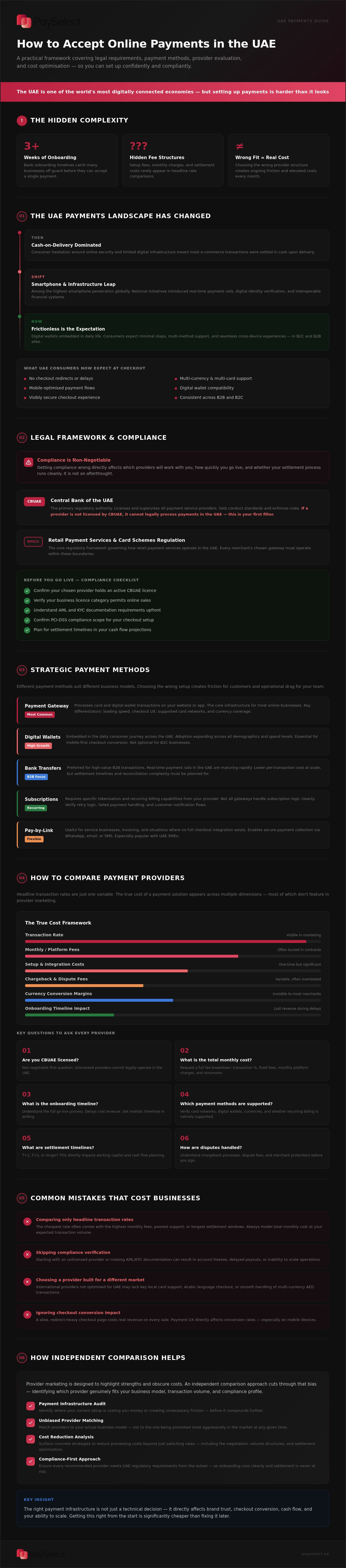
Key Criteria for Comparing Payment Service Providers
Choosing a payment provider based on headline rates alone is one of the most common and costly mistakes UAE businesses make. The provider with the lowest advertised transaction fee can easily become the most expensive option once you account for setup charges, monthly minimums, chargeback fees, and settlement delays that quietly erode your margins. Knowing how to accept online payments in the UAE means knowing how to evaluate the full picture, not just the number on the brochure.
Most provider comparison content you'll find online is written by the providers themselves. That's a structural conflict of interest. What follows is an independent framework for assessing any payment solution on criteria that actually affect your business performance.
Cost Structure and Fee Optimization
Merchant Discount Rates vary significantly by industry, with sectors like travel, forex, and digital goods typically attracting higher rates than standard retail due to elevated chargeback risk profiles. Understanding where your business sits in that risk spectrum is the starting point for any fee negotiation.
The pricing model matters as much as the rate itself. Flat-rate pricing bundles all card types into a single percentage, which is simple to forecast but often means you're subsidising higher-cost card transactions that don't apply to your customer base. Interchange-plus models pass through the actual card scheme cost and add a fixed margin on top, which is more transparent and frequently more cost-effective for businesses with higher volumes or a predictable card mix. Neither model is universally superior; the right choice depends on your transaction profile.
Beyond the headline rate, audit the fine print carefully. Common hidden costs include:
PCI compliance fees
charged annually or monthly
Chargeback handling fees
applied per dispute regardless of outcome
Refund processing fees
that aren't always reversed when the original transaction is
Currency conversion margins
on cross-border transactions
Early termination fees
if you switch providers before a contract period ends
Settlement cycles deserve equal scrutiny. A provider settling funds every seven days versus every two days creates a meaningful working capital difference for businesses managing tight cash flow. This is an operational cost that doesn't appear in any fee schedule but compounds every week you're trading.
Technical Capabilities and Support
A unified dashboard that consolidates payment acceptance, payout management, and transaction reporting into a single interface isn't a luxury feature. It's an operational efficiency tool. Businesses managing multiple channels, online checkout, payment links, and in-person terminals, without centralised visibility spend disproportionate time reconciling data across disconnected systems. That time has a cost.
Local support quality is a criterion that gets underweighted until something goes wrong. When a payment failure occurs during a high-traffic period, response time measured in hours rather than minutes translates directly into lost revenue. A provider's global reputation means very little if their UAE support infrastructure can't resolve a critical issue within your trading window. For businesses building omni-channel payment capability, evaluating selecting POS systems alongside your gateway choice ensures both environments are technically compatible and supported by the same accountability structure.
Fraud detection tooling rounds out the technical evaluation. Rule-based filters, velocity checks, and 3D Secure authentication aren't differentiators anymore; they're baseline expectations. The real distinction between providers lies in how configurable those tools are and how well they balance fraud prevention against false decline rates, because declining a legitimate customer is a revenue loss that never appears in your fraud statistics.
Running this evaluation across multiple providers simultaneously is where independent tools deliver genuine value. A payment gateway comparison built on unbiased criteria cuts weeks from your assessment process and surfaces trade-offs that provider sales teams have little incentive to highlight.
Optimizing Your Payment Infrastructure with PaySelect Advisory
Most businesses reach a point where the payment setup that got them started becomes the bottleneck holding them back. Transaction costs creep upward, reconciliation takes longer than it should, and the provider that seemed like a good fit at launch no longer matches the operational complexity of a growing business. That's the infrastructure gap that PaySelect is built to close.
PaySelect operates as an independent comparison platform, which means no provider relationships skewing the results and no commercial incentive to steer you toward a particular solution. In a market where most guidance comes from the providers themselves, that independence is genuinely rare. It's also the foundation of every tool and advisory service PaySelect offers.
Data-Driven Selection for SMEs and Enterprises
PaySelect's proprietary "Take the Test" tool cuts through the complexity of figuring out how to accept online payments in the UAE by matching your specific business profile to the providers that fit your actual requirements. You answer structured questions about your business model, transaction volumes, currency needs, and technical setup. The tool surfaces compatible solutions based on that profile, not on which providers pay for prominence.
That transparency has a direct commercial application. When you understand the full landscape of what's available at your volume and risk profile, you're in a far stronger position to negotiate. Providers compete on more than rate when they know you've done the comparison work. The data becomes leverage.
For enterprises managing complex payment flows across multiple channels or geographies, PaySelect offers bespoke payment infrastructure audits. These go beyond rate comparison. An audit examines your entire payment stack: gateway configuration, settlement cycles, fraud tooling, and integration architecture. The output is a clear picture of where your current setup is costing you money and where it's creating operational drag.
Maximizing Efficiency and Reducing Costs
High-volume organisations carry the most to gain from a structured audit. Small inefficiencies in fee structures, settlement timing, or currency conversion compound at scale in ways that are invisible until someone maps them out systematically. A payment infrastructure review identifies those compounding costs and provides a prioritised path to reducing them.
Cross-border complexity is one of the clearest examples. Businesses trading across the GCC or beyond often carry unnecessary costs in their international payment flows, whether through unfavourable conversion margins, mismatched payment methods, or providers not optimised for regional settlement. Optimizing cross-border payments through the right provider match removes friction from those flows and recovers margin that's currently being absorbed silently.
The goal isn't to add another layer to an already complex process. It's to simplify it. PaySelect connects the technical reality of how to accept online payments in the UAE with the commercial outcome every business owner actually cares about: lower costs, faster settlement, and a payment setup that scales without breaking. Take the PaySelect test to find your ideal payment partner today.
Your Next Step Toward Smarter Payment Infrastructure
Figuring out how to accept online payments in the UAE involves more moving parts than most business owners anticipate: regulatory compliance, provider selection, fee structures, technical integration, and ongoing cost management all demand attention simultaneously. Get any one of them wrong and you're paying for it every month.
The clearest takeaways from this guide are straightforward. Compliance isn't optional and it shapes which providers you can actually work with. The true cost of any payment solution only becomes visible when you look beyond headline rates. And the right setup for your business depends entirely on your specific model, not on which provider markets itself most aggressively.
That's precisely where PaySelect delivers. As an independent platform with deep MENA market expertise, PaySelect gives you unbiased comparison tools and bespoke enterprise consulting built around your actual requirements, not a provider's commercial agenda.
Don't let the wrong payment setup quietly drain your margins. Compare UAE payment gateways and optimize your costs today and build a payment infrastructure that works as hard as your business does.
Frequently Asked Questions
Do I need a local UAE bank account to accept online payments?
Yes, a UAE corporate bank account is a firm requirement for almost every payment gateway and acquiring bank operating in the country. Personal accounts don't qualify, and attempting to use one will stall your merchant application before it progresses. This is one of the most common onboarding delays businesses encounter, so securing your corporate account should be an early priority, not something you address after choosing a provider.
How long does it typically take to set up a payment gateway in the UAE?
Timelines vary considerably depending on your business structure, documentation readiness, and the provider's internal processes. A straightforward application with complete documentation can move through in one to three weeks. Businesses in higher-risk categories, those with free zone licenses, or those missing required documents often face four to eight weeks or longer. Starting your documentation preparation before you've finalised your provider choice is the single most effective way to compress that timeline.
What are the average transaction fees for UAE online payments?
Transaction fees vary across providers, business types, and pricing models, so publishing a single "average" would be misleading. The rate you're offered depends on your industry risk profile, monthly transaction volumes, card mix, and whether you're on flat-rate or interchange-plus pricing. What's consistent is that the headline rate rarely tells the full story. Settlement fees, chargeback costs, and currency conversion margins all contribute to your real effective cost, which is why comparing the full fee structure matters more than comparing headline percentages.
Can I accept international payments in different currencies?
Most UAE payment gateways support multi-currency acceptance, but the depth of that support varies significantly between providers. Some settle everything in AED regardless of the customer's currency, applying a conversion margin in the process. Others offer dynamic currency conversion or the ability to settle in multiple currencies directly. If your customer base extends across the GCC or beyond, confirming exactly how a provider handles currency conversion and settlement is essential before you commit to an integration.
What is the difference between a payment gateway and a merchant account?
A payment gateway is the technology layer that encrypts and transmits transaction data between your website and the financial network. A merchant account is the actual bank account that holds funds after a transaction is authorised, before they're settled into your business account. Some providers bundle both into a single service, while others require you to establish them separately. Understanding this distinction matters when you're comparing how to accept online payments in the UAE, because bundled solutions trade convenience for less flexibility, while separate setups offer more control over costs and provider choice.
Is it possible to accept online payments without a website?
Yes. Payment links are a practical solution for businesses that operate through social media, messaging apps, or direct client relationships rather than a traditional e-commerce site. A shareable link routes the customer to a secure hosted payment page without requiring any website infrastructure on your end. It's particularly effective for service-based businesses, consultants, and social commerce operators who close transactions conversationally. Many UAE payment providers offer this capability, and comparing the fee structures across those options is straightforward using an independent payment comparison tool.
How do I ensure my online payment setup is legally compliant?
Compliance starts with confirming that any provider you work with holds a valid licence from the Central Bank of the UAE. Beyond that, your trade licence must list the commercial activities that cover your payment operations, your website needs active terms and conditions and a privacy policy, and your business must meet PCI DSS requirements for handling card data. If your setup involves cross-border transactions or subscription billing, additional scrutiny during merchant onboarding is common. Working through an independent comparison platform that filters for compliance compatibility, not just pricing, removes much of the guesswork from this process.
What happens if a transaction is flagged as fraudulent?
When a transaction is flagged, the payment gateway's fraud detection system either declines it automatically or routes it for manual review, depending on how the rules are configured. If a customer disputes a completed transaction, it enters the chargeback process, where the acquiring bank investigates and may reverse the funds. Merchants typically incur a fee per chargeback regardless of the outcome. This makes fraud tooling configuration a meaningful operational decision, not just a technical one. Providers differ considerably in how configurable their fraud rules are and how well they balance security against false declines, which is a key criterion when comparing providers.
Disclaimer
This content is for informational purposes only and should not be considered financial, legal, or regulatory advice. Payment provider availability, pricing, and approval processes vary depending on individual business circumstances. PaySelect does not guarantee provider acceptance or specific outcomes. Businesses should conduct their own due diligence before entering into any agreements.
Empowering businesses to achieve greater growth