

How to avoid long-term payment provider contracts through careful term review

A low headline rate doesn’t make a payment provider agreement flexible. To understand how to avoid long-term payment provider contracts, review the full commitment before signing: the initial term, renewal rules, notice period, exit charges, volume thresholds, exclusivity, and rights to change pricing or services. A short stated term can still renew automatically or make an early exit costly, so assess how the clauses work together, not just the contract duration.
It makes sense to want room to adapt as your business grows or its payment needs change. This article explains how provider commitments, contract clauses, and payment terms affect that flexibility, and what to look for in a UAE business agreement. Learn how to distinguish the contract’s overall length from its payment schedule, spot clauses that can extend your commitment, and assess whether the terms support your operations without creating avoidable lock-in.
Key Takeaways
• Assess how transaction commitments, processing expectations and flexibility fit together before agreeing to a payment-provider contract.
• Review renewal, exit, pricing-change and payment-trigger clauses as a connected set, not in isolation.
• Understand how settlement terms, such as settlement timing and reserves, affect cash flow and operational planning.
• Compare provider terms against your business requirements so the agreement supports your payment setup without unnecessary lock-in.
1. Consider supplier relations and mutual commitments
A payment adviser maps the provider relationship, purchasing cycle, transaction volume, and cash-flow needs. This helps determine whether a longer commitment brings a useful benefit, such as more suitable payment terms, or limits future choices without clear value. The adviser also compares the provider’s due date with expected receivable timing. If customer funds arrive after an invoice falls due, working capital can come under pressure.
For cross-border purchases, the adviser reviews the payment trigger, invoice currency, transfer charges and exchange-rate basis. Deferred terms should align with relevant Incoterms and local rules. The agreement should show who bears bank or intermediary charges and how each delivery connects to its invoice. These checks help keep payment records clear across borders. Businesses reviewing international payment routes can also assess cross-border payment options alongside their supplier commitments.
For transactions involving the United States, the adviser flags the Robinson-Patman Act, enacted in 1936, for jurisdiction-specific legal review. It concerns certain discriminatory prices between purchasers of commodities of like grade and quality when competition may be harmed; it is not a UAE payment rule. The adviser avoids applying it to a UAE supplier relationship without a relevant US connection.
For VAT and regulatory considerations, the adviser checks invoice practices against applicable UAE rules and relevant guidance from the Federal Tax Authority. The review clarifies invoice submission details and the event that starts the payment period. A phrase such as “30 days after receipt of a valid invoice” gives accounts teams a clearer due-date reference than an undefined deadline. Any penalties should also be documented and reviewed against applicable requirements.
Businesses can use multiple payment providers to reduce reliance on a single supplier. An adviser weighs that flexibility against the work of managing separate agreements, reconciliation practices, settlement flows, and integrations.
A provider with no fixed contract term can still present operational risks. An adviser considers how pricing changes, service interruptions, settlement terms, support arrangements, and exit procedures may affect the business. Flexible duration does not remove the need to understand these commitments before accepting the service.
2. Review existing contract clauses and legal implications
A payment adviser reviews the entire agreement, not only its headline term. The review maps the initial period, automatic renewal, notice deadline, termination rights, pricing changes, minimum processing commitments, and any penalties. It also checks how the clauses interact. For example, a short initial term may still create a lengthy commitment if notice is required well before the end date.
There is no single notice period that applies to every UAE payment provider contract. The adviser identifies the notice period written in the agreement, how notice must be delivered, and when it takes effect. If the contract requires 60 days’ notice, the review clarifies the relevant end date and whether notice must arrive in a particular form.
Early termination fees and minimum processing commitments depend on the contract’s stated conditions. A fee may apply if a merchant exits before a defined term ends; a volume clause may require agreed processing activity during that period. The adviser assesses how these obligations could affect working capital and accounts, then helps the business negotiate clearer terms before signing or renewing.
The review also traces the invoice process: what event starts the payment period, which records support each charge, and how disputes affect the due date. Payment clauses may include late-payment interest, suspension rights, or other remedies, subject to local law. A vague phrase such as “payment on completion” needs a clear definition of completion and acceptance.
For data continuity, the adviser checks contract language on transaction-history access, export options, account access after termination, and record formats. A practical exit plan identifies who requests the export, which accounts need access, and how reconciliation continues after switching. Changes to payment terms should be recorded in a written amendment agreed by both parties.
Commercial review helps identify negotiation points; legal advice addresses interpretation and legal implications. For a gateway agreement, a payment gateway comparison can help assess provider fit alongside contract terms, rather than treating the lowest headline rate as the only decision factor.
There is no single notice period for UAE payment provider contracts; the required period is the one stated in the agreement. For example, a contract may require 60 days’ notice.
3. Common payment term types and durations
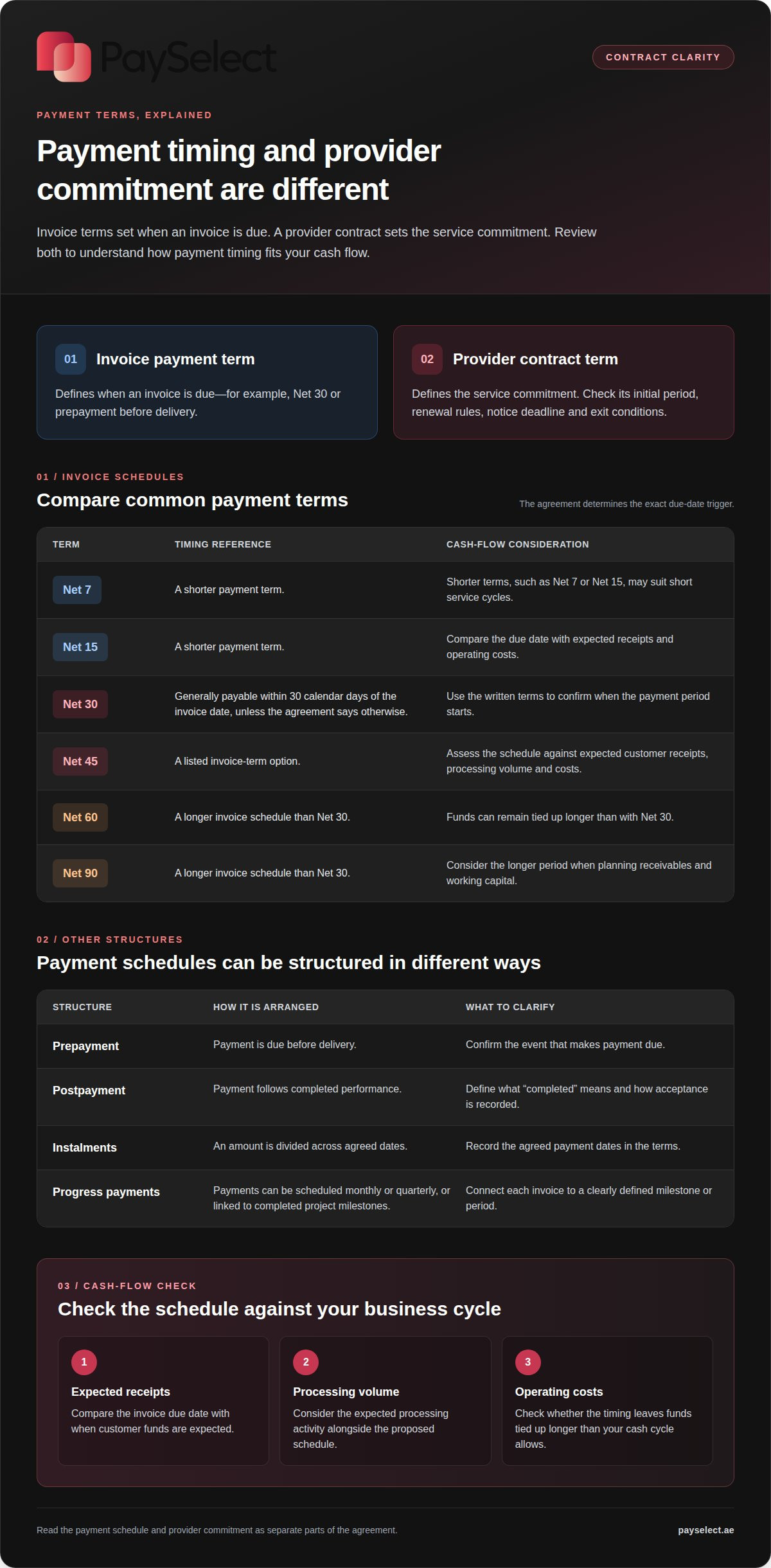
Payment terms set when an invoice is due, while a provider contract sets the service commitment. UAE businesses may use Net 15, Net 30, Net 45, Net 60 or Net 90. Net 30 generally means the invoice is payable within 30 calendar days of its date, unless the agreement says otherwise. Prepayment is due before delivery; postpayment follows completed performance.
Instalments divide an amount across agreed dates, while progress payments can be scheduled monthly or quarterly. A service business might connect each invoice to a completed milestone instead of waiting until the entire project ends. Shorter terms, such as Net 7 or Net 15, may suit short service cycles. Each structure affects cash flow, receivables and the timing of collection.
To assess a proposed term, an adviser compares the due date with expected customer receipts, processing volume and operating costs. A Net 60 or Net 90 schedule can leave funds tied up longer than Net 30. This comparison helps businesses understand how to avoid long-term payment provider contracts while choosing payment timing that fits their cash cycle.
UAE payment gateway setup, monthly, and transaction fees don’t follow a standard schedule. Charges depend on the provider’s pricing model, transaction volume, accepted payment methods, and included services. An adviser separates setup, recurring, and per-transaction charges, then explains how each applies to the business’s expected use.
For a month-to-month processing arrangement, an adviser can use transaction and settlement information to support negotiations. The discussion may cover pricing, review periods, renewal wording, and conditions that could extend the commitment. It can also clarify how changes in volume or service needs affect the proposed terms, without treating monthly billing as proof of a flexible contract.
There is no single reliable list of every UAE provider offering contracts without a long-term commitment. Contract options can vary by service and merchant agreement. An adviser compares the written commitment and payment structure rather than assuming that a particular provider, or monthly billing, means there is no fixed-term obligation.
Average payment terms for UAE B2B sales are 47 days. A UAE business may request a 50% advance payment before starting a marketing campaign, with the remaining 50% due on project completion.
4. What contract terms should businesses check before choosing a payment provider?
A payment adviser assesses whether the agreement matches the business’s actual payment setup. The review identifies included and optional services, and whether separate terms apply to different channels. For example, a merchant accepting online and in-person payments needs the agreement to distinguish gateway services from acquiring or terminal arrangements. Clear scope can prevent complications when changing services later.
The adviser also examines how the pricing schedule works in practice. It should explain the basis for transaction charges, any additional service charges, and how changes to the pricing structure are communicated. If a business accepts international cards, the agreement should describe how currency conversion and related charges are calculated. These details help finance teams reconcile statements and assess the full commercial arrangement.
Settlement terms deserve a separate review. The adviser checks the stated settlement schedule, how weekends or public holidays are treated, and whether the agreement allows reserves or deductions. The review also clarifies how disputed transactions, refunds, and chargebacks affect settlement records. These clauses can influence cash planning, so the agreement should explain the process and what information is available to the merchant.
Operational clauses matter too. An adviser reviews integration responsibilities, support channels, service changes, transaction-data access, and the process for resolving service issues. If the business changes its checkout or accounting workflow, unclear responsibilities can cause disruption. The agreement should identify the process for updates and explain how merchants can retrieve records needed for reconciliation. For businesses managing specialized online retail platforms, industry resources like Jewelry eCommerce explore how checkout technologies and operational workflows intersect with digital commerce strategies.
Finally, the adviser checks that the contracting entity, service description, and amendment process are consistent across the agreement and its schedules. The review maps each commercial commitment to the clause that governs it and highlights points for negotiation before signing. For a business comparing providers, this creates a clearer basis for assessing not just headline pricing, but also operational fit and obligations that continue after onboarding.
PaySelect
PaySelect helps UAE businesses compare payment options and assess how provider terms fit their operating needs. Its independent comparison service helps merchants evaluate provider fit based on requirements such as payment model, business activity, and international needs, alongside contract duration, renewal conditions, and pricing structure.
When reviewing a new setup, PaySelect can help make provider costs easier to assess. Merchants can compare payment options for different needs without favouring an individual provider. This helps decision-makers consider the overall agreement, not just the headline transaction rate.
If you’re weighing provider options or reviewing the terms that shape your payment setup, contact PaySelect to discuss your business requirements.
Keep payment options aligned with your next stage
Payment needs can shift as your business adds sales channels, enters new markets, or changes how it collects from customers. Make contract flexibility part of your operating strategy, not just a point to consider at signing. A scheduled review before renewal can help decision-makers assess whether the agreement still fits the business’s direction.
A practical way to avoid long-term payment provider contracts is to compare each commitment with your expected needs and keep future changes visible to the people responsible for payment decisions. PaySelect’s comparison service can help businesses assess options across different payment requirements. Contact PaySelect to discuss options that fit your business.
Use that perspective to move forward with a payment arrangement that supports growth without adding unnecessary constraints. Contact PaySelect to discuss your options, and take the next step with greater clarity.
Disclaimer
This content is for informational purposes only and should not be considered financial, legal, or regulatory advice. Payment provider availability, pricing, and approval processes vary depending on individual business circumstances. PaySelect does not guarantee provider acceptance or specific outcomes. Businesses should conduct their own due diligence before entering into any agreements.
Empowering businesses to achieve greater growth
