
What if the strongest case for a new payment system isn’t a lower fee, but a clearer view of what payment friction costs your business? Knowing how to build a business case for a new payment system starts with evidence from your own operations, not assumptions about what a new setup might deliver.
Payment costs can be difficult to compare, and time spent on manual processes can be easy to overlook. Needs may also differ across online, in-person, and international sales. Stakeholders need more than a feature list: they need a consistent comparison that connects business requirements to potential financial and operational impact.
This guide explains how to build that case step by step. You’ll learn how to document current performance, define requirements, assess options fairly, and present the investment and implementation priorities clearly. PaySelect helps UAE businesses compare payment solutions based on factors such as industry, transaction volume, and international requirements. For complex or enterprise-scale decisions, its advisory services support structured reviews of payment infrastructure and costs.
Key Takeaways
• Identify the underlying payment problem, not just visible symptoms such as manual work or delays.
• Use transaction, workflow, and support records to establish a reliable picture of current performance.
• Connect measured needs to expected business value when building a case for a new payment system.
• Compare options against the same requirements, including channels, integrations, reporting, international needs, and commercial terms.
• Weigh potential gains against transition effort, then present a clear recommendation, trade-offs, and next steps.
How to Build a Business Case for a New Payment System: Start with the Problem
A business case explains why an organization should invest, make a change, or keep its current system. It connects a business need to evidence, possible outcomes, and the decision required. In plain language: A payment-system business case explains what isn’t working, who it affects, and why a particular course of action makes sense.
Start with the payment process, not a preferred solution. A team may say reconciliation takes too long, for example. That’s a symptom. The underlying problem might be that payment records from different channels don’t flow into the same workflow, so staff have to match transactions manually. Identifying the cause helps you judge whether a new system would solve the problem or a process change could be enough.
Map the affected teams, channels, and customer journeys before comparing options. Consider how customers pay online or in person, how staff handle exceptions, and how finance records completed transactions. A payment system includes more than the point where a customer pays; its components and processes shape how transactions move through the business. Requirements can also vary with transaction volume, industry, and international needs. PaySelect’s payment gateway comparison helps organize those requirements for a structured evaluation.
Which payment problems justify evaluating a new system?
Look for recurring friction: manual work, processing delays, repeated support requests, difficult reconciliation, or inconsistent payment experiences across channels. For each issue, record when it occurs, how often it appears in available records, and which team or customer journey it affects.
Separate evidence from assumptions. A recurring issue in transaction records or staff workflows is different from a single complaint or a general belief that a system is outdated. Capture both, but label them clearly. Then connect each confirmed problem to a business process, customer experience, or priority, such as smoother operations or support for international transactions.
Who needs to contribute to the business case?
Involve finance, operations, technology, and customer-facing teams. Finance can explain reporting and reconciliation needs; operations can identify manual steps; technology can assess integration requirements; and customer-facing staff can describe problems in the payment journey. Include decision-makers and approvers, along with the people who will use and maintain the system.
Early alignment reduces the risk of conflicting requirements later. A shared view of the problem gives teams a stronger basis for deciding what the future setup must support. This is the first practical step in how to build a business case for a new payment system: establish the need before evaluating solutions.
Measure the Current Payment System Before Estimating Business Value
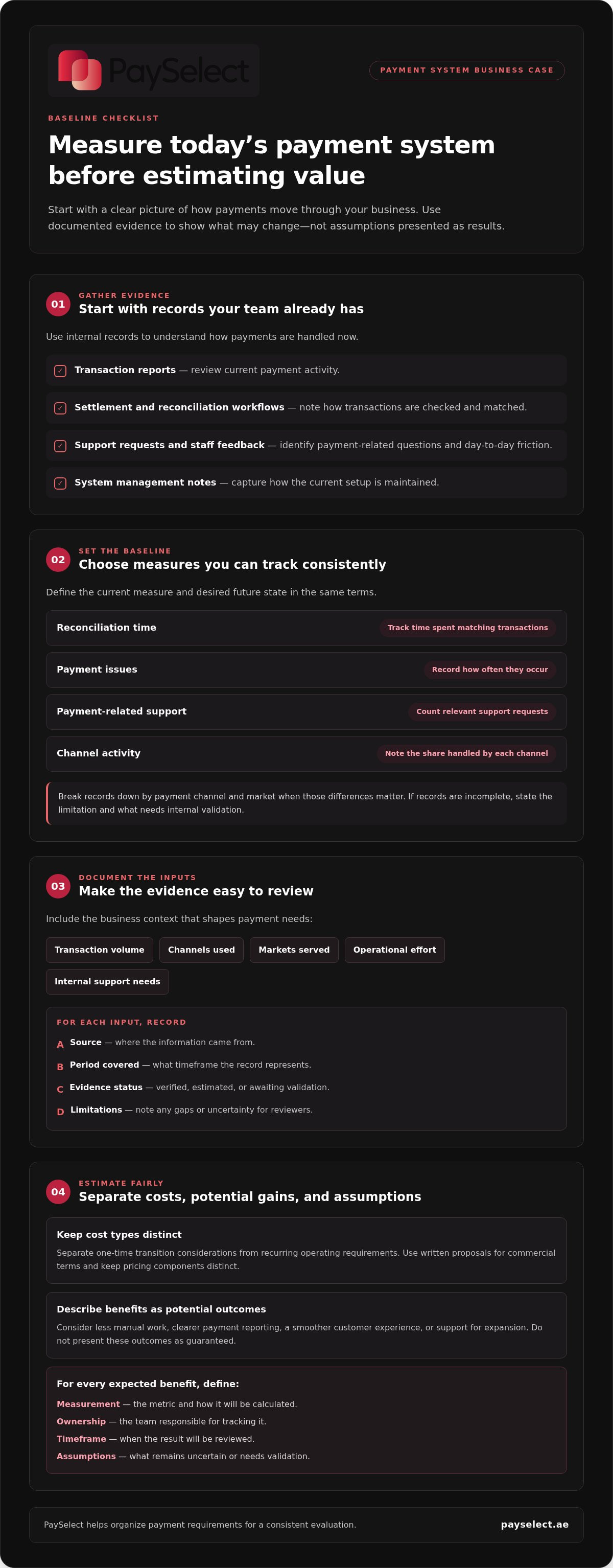
A credible estimate starts with a clear baseline. Gather records showing how payments move through the business today, then compare that picture with the outcome you want. Measure every expected benefit against a documented baseline, so the case shows what may change rather than presenting a guess as a result.
Use internal records wherever possible: transaction reports, settlement and reconciliation workflows, support requests, staff feedback, and notes on how the current system is managed. Break information down by payment channel and market when those differences matter. For example, record how much staff time goes into matching transactions, where payment-related queries arise, and which steps require manual follow-up.
Choose measures your team can track consistently. These could include reconciliation time, frequency of payment issues, support requests linked to payments, or the share of transactions handled through each channel. Define the current measure and desired future state in the same terms. If records are incomplete, state the limitation and identify what needs internal validation before it supports a decision.
Which inputs belong in a payment-system business case?
Include transaction volume, channels used, markets served, operational effort, and internal support needs. Use your records for current activity and financial inputs, and written proposals for the commercial terms of options under review. Keep pricing components distinct so the comparison reflects your transaction profile rather than a generic assumption. PaySelect’s payment gateway comparison helps organize requirements for a consistent evaluation.
Build a simple evidence table with the input, its source, the period it covers, and any limitation. Mark each entry as verified, estimated, or awaiting validation. This makes uncertainty visible and gives reviewers a clear way to check the figures.
How can teams estimate costs and benefits fairly?
Separate one-time transition considerations from recurring operating requirements. Then assess potential benefits such as less manual work, clearer payment reporting, a smoother customer experience, or support for expansion. Treat these as potential outcomes, not guaranteed results. Explain what would need to happen for each benefit to be achieved and how the team will measure progress.
Measurement
State the metric and how it will be calculated.
Ownership
Name the team responsible for tracking it.
Timeframe
Set when the result will be reviewed.
Assumptions
Record what remains uncertain or needs validation.
This evidence-led approach strengthens how to build a business case for a new payment system: it helps stakeholders distinguish documented performance from projected value and compare options fairly.
Compare Payment System Options Against the Same Business Requirements
Once your needs are documented, use the same comparison framework for every option. A feature list can look impressive without showing whether a system solves a real workflow problem. Turn each requirement into a practical question: does the option support your sales channels, provide the reporting finance needs, or accommodate the international activity the business has identified?
Create a weighted matrix with three categories: must-haves, useful capabilities, and acceptable trade-offs. Give more weight to requirements that directly address confirmed problems or business priorities. Score each option against the same criteria and evidence standard. For example, compare integration needs, reporting, channels, support arrangements, international requirements, and commercial terms. Record the evidence behind each score, along with any gaps or exclusions.
This makes the shortlist easier to explain. An option shouldn’t score highly simply because it offers more features if those features don’t matter to your business. Independent guidance can help turn requirements such as industry, transaction volume, and international needs into a structured comparison. For online acceptance, explore payment gateway comparison options.
How do you compare payment systems without relying on feature lists?
Link every feature to a business need. If an option offers consolidated reporting, for instance, assess whether it addresses a documented reporting gap and how your team would use the information. Apply the same criteria and evidence standards to every option. Note why each was shortlisted or excluded, and record trade-offs, such as a strong fit in one area alongside a limitation in another.
How do channels and international requirements change the comparison?
Match the system type to how customers pay. If in-person sales are part of the business, include point-of-sale requirements in the matrix and compare POS system options against the workflows identified earlier. If the business serves customers or markets internationally, include those needs and review cross-border payment solutions as a relevant category. Don’t add channels or capabilities without a defined business requirement.
A consistent comparison helps stakeholders see which option fits and why. That is central to how to build a business case for a new payment system: connect each score to a need, each trade-off to an impact, and the shortlist to the evidence already gathered.
Address Transition Risk, Implementation Readiness, and the Case Against Change
A proposed system may address real problems, but projected gains must be weighed against the effort and disruption of changing how payments are handled. Compare expected outcomes with the work involved in moving to a new setup, preparing staff, updating connected processes, and maintaining continuity. Then compare that case with keeping the current setup, including the operational impact of problems that would remain unresolved.
Make implementation readiness part of the decision, not an afterthought. Map the teams, systems, information, and workflows a change could affect. Clarify who owns each task, who supports staff using the system, and how teams will maintain essential payment reporting and customer processes during the transition. A phased approach may help limit disruption when the work can be divided into manageable stages, but it should suit the business’s needs and capacity.
What risks should a payment-system proposal address?
Consider integration dependencies, data handling, staff adoption, reporting continuity, and ongoing support ownership. For each material risk, record its likely business impact, an owner, a mitigation approach, and a review point. For example, if a connected system depends on payment data arriving in a particular format, assign responsibility for assessing that dependency before recommending a change.
Separate known risks from assumptions. A confirmed workflow dependency is different from an untested concern about staff adoption. Label gaps clearly and identify what must be assessed before approval. For larger or more complex reviews, PaySelect’s payment infrastructure advisory helps structure the evaluation while keeping the comparison independent.
When is replacing the current payment system not the right decision?
Test whether a process change could address the problem first. If reconciliation delays stem from unclear staff responsibilities rather than a system limitation, for instance, improving the workflow may be more proportionate. A new system is harder to justify when the problem is anecdotal, the baseline is incomplete, or the expected benefit depends on assumptions that haven’t been validated.
Keeping the current setup is also a decision, so record what it means: which problems continue, which teams remain affected, and what would prompt a future review. Set clear conditions for revisiting the case, such as a change in channels, transaction volume, or international requirements. This balanced assessment is central to how to build a business case for a new payment system: compare the cost and risk of action with the consequences of doing nothing.
PaySelect’s payment gateway comparison helps businesses assess payment options against their requirements.
Present a Decision-Ready Payment System Case and Define the Next Steps
A strong recommendation makes the decision clear. Summarize the business problem, evidence, options considered, key trade-offs, expected outcomes, and the approval or action you’re requesting. Keep supporting detail available, but make the main argument easy for decision-makers to assess.
Show how the preferred option meets the requirements established earlier. Explain where it fits, where compromises remain, and which assumptions still need validation. Don’t rely on a provider name or feature list to make the case. The recommendation should stand on its alignment with business needs and the evidence behind it.
What should the final business case include?
Begin with an executive summary that states the problem and the decision required. Follow with a concise comparison of options, criteria, evidence, assumptions, and trade-offs. Close with implementation responsibilities and a measurement plan, including who will track each outcome and when stakeholders will review progress.
Carry baseline measures into the post-launch plan. If the case expects to reduce manual reconciliation effort, for example, assign an owner to track the same measure after implementation. Set review points so the business can compare actual results with the starting position, investigate gaps, and adjust processes where needed.
Problem and evidence
State the issue and the records that support it.
Recommendation and trade-offs
Explain the preferred fit and what the business accepts in return.
Delivery and review
Assign implementation responsibilities, measurement owners, and review points.
These elements turn how to build a business case for a new payment system into a decision process, not just a proposal. Stakeholders can see what they’re approving, how progress will be assessed, and who is accountable for follow-through.
How can PaySelect support a structured payment decision?
PaySelect’s matching tool uses business requirements such as industry, transaction volume, and international needs to help organize a comparison across payment options. Its independent guidance helps teams understand differences without favouring a provider. For complex or enterprise-scale decisions, PaySelect’s advisory services support payment infrastructure reviews and cost optimization, helping teams assess requirements and priorities in a structured way.
A clear recommendation, named owners, and measurable review points give the business a shared understanding of the intended outcomes as it moves from approval to implementation.
Turn Payment Evidence Into a Confident Decision
A strong payment-system business case connects a verified problem to measurable value and a practical plan. Start with your own records, compare options against the same business requirements, and weigh expected gains against transition effort and the cost of leaving unresolved issues in place. That is how to build a business case for a new payment system stakeholders can assess and act on.
Keep the recommendation decision-ready: state the evidence, trade-offs, owners, and measures you’ll review after implementation. The preferred option should fit your business needs, not simply offer the longest list of features.
PaySelect provides independent comparison and matching based on requirements such as industry, transaction volume, and international needs. For complex payment infrastructure reviews or cost optimization, its fixed-fee advisory supports enterprise teams in structuring their assessment.
Compare payment solutions against your business requirements with PaySelect and move forward with a clearer view of your options. A well-supported case grounds your next payment decision in evidence and aligns it with the way your business plans to grow.
Frequently Asked Questions
How do you build a business case for a new payment system?
Start with a documented payment problem, then show who it affects and how it affects operations or customers. Gather internal records to establish current performance, define the requirements a solution must meet, and compare options using consistent criteria. Include expected benefits, transition effort, risks, and the consequences of keeping the existing setup. Finish with a clear recommendation, a decision request, and measures to review after implementation.
What should a payment-system business case include?
Include an executive summary, the problem and supporting evidence, current performance measures, business requirements, and a comparison of options. State key assumptions and trade-offs, then explain expected outcomes and implementation responsibilities. Identify who will measure results, which baseline metrics they’ll use, and when progress will be reviewed. Keep the recommendation concise, with supporting detail available for stakeholders who need to examine the evidence.
How do you calculate the ROI of a new payment system?
Estimate ROI by comparing the value of expected benefits with the full costs over the same period. A common calculation is: (benefits minus costs) divided by costs, multiplied by 100. Use your own records and documented commercial proposals for inputs, expressed consistently in AED. Separate one-time transition considerations from recurring requirements. Label estimates clearly, and don’t treat possible gains, such as reduced manual work, as guaranteed savings.
What data do you need to compare payment systems?
Gather records on transaction volume, payment channels, markets served, current commercial terms, reconciliation work, support needs, and relevant system processes. Add documented requirements for integrations, reporting, customer journeys, and international activity where these apply. Use the same criteria and evidence standard for each option. PaySelect’s independent matching considers factors such as industry, transaction volume, and international requirements, helping businesses organize a comparison around their needs.
When should a business replace its payment system?
Consider replacement when documented problems persist and the current setup cannot meet important business requirements, such as supporting required channels or workflows. Compare the expected value of a change with transition effort and the impact of leaving issues unresolved. First assess whether a process improvement could address the problem. If evidence is incomplete or expected benefits rely on untested assumptions, gather more information before recommending an investment.
How do you justify payment-system implementation costs to stakeholders?
Show how implementation costs relate to a verified business problem and expected outcomes. Present one-time transition needs separately from ongoing operating requirements, using documented proposals and internal estimates in AED. Explain assumptions, risks, responsibilities, and how benefits will be measured against a baseline. A balanced case also describes the cost and operational effect of keeping the current setup, so stakeholders can compare action with inaction.
Can a business case include more than one payment channel?
Yes. Include each channel relevant to the business, such as online and in-person payments, and assess its requirements separately within one shared comparison framework. Show how customers move between channels and where teams need consistent reporting or workflows. Include international payment requirements if the business serves customers or markets across borders. This helps decision-makers understand channel-specific needs without losing sight of the overall payment setup.
Disclaimer
This content is for informational purposes only and should not be considered financial, legal, or regulatory advice. Payment provider availability, pricing, and approval processes vary depending on individual business circumstances. PaySelect does not guarantee provider acceptance or specific outcomes. Businesses should conduct their own due diligence before entering into any agreements.
Empowering businesses to achieve greater growth