
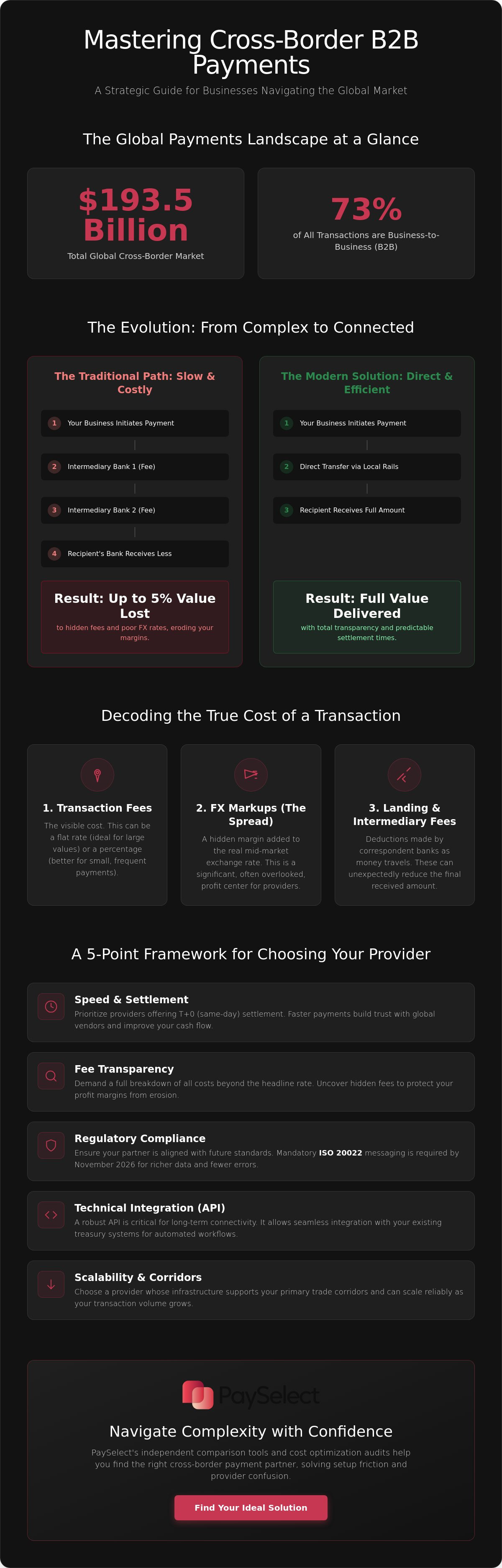
Did you know that B2B transactions now account for nearly 73% of the $193.5 billion global cross-border market? As international trade reaches record volumes, the margin for error in your treasury operations has never been thinner. You likely already know that hidden FX markups and unpredictable settlement times can quietly erode your profit margins. Understanding how to choose a cross-border payment provider is no longer just a back-office task. It's a core strategic decision for any business aiming for frictionless expansion.
This guide provides a professional framework to master the complexities of international transactions. You'll learn to evaluate providers based on real-time speed, transparent fee structures, and the strict ISO 20022 messaging standards that became mandatory on November 14, 2026. We'll explore the critical differences between various infrastructures without favoring a specific brand. Instead of guessing which service fits your trade corridors, PaySelect provides comparison tools and cost optimization audits to solve setup friction. We'll break down the G20's latest speed targets and show you how to navigate regulatory shifts like the EU's MiCA framework with absolute confidence.
Key Takeaways
• Identify hidden intermediary fees that can erode up to 5% of transaction value beyond the headline exchange rates.
• Learn how to choose a cross-border payment provider by mapping your primary trade corridors and auditing your current payment failure rates.
• Evaluate the operational impact of T+0 settlement speeds and API robustness on your long-term cash flow and system connectivity.
• Navigate the strict 2026 regulatory landscape by aligning your infrastructure with ISO 20022 messaging and MiCA compliance requirements.
• Utilize independent comparison tools and cost optimization audits to secure a reliable partner that scales with your transaction volume.
Understanding the Role of Cross-Border Payment Providers in 2026
Cross-border payment providers are the architects of modern international trade. They act as the essential bridge connecting fragmented global payment systems, allowing capital to move across borders without the friction of traditional banking delays. In the UAE's high-growth digital economy, this connectivity isn't just a convenience; it's a strategic necessity. When business owners evaluate how to choose a cross-border payment provider, they're looking for more than a transaction tool. They're seeking a partner that can bypass the slow, expensive corridors of legacy finance to ensure operational fluidity.
The industry has reached a turning point. B2B transactions now represent 72.8% of the cross-border market, and businesses are demanding the same speed they experience with domestic transfers. This demand is driving a massive shift from stagnant institutional models to agile, technology-first solutions that prioritize transparency and performance.
The Evolution of International Business Payments
International business payments have moved past the era of "wait and see." Traditional correspondent banking models often involve multiple intermediary banks, each adding fees and settlement time. Modern providers have replaced this with local payment rail integration. This allows for the use of multi-currency accounts, where you can manage liquidity in real-time. It removes the need for constant, manual currency conversions and provides a direct path to your international partners. With the ISO 20022 migration deadline on November 14, 2026, the industry is now fully committed to richer, more structured data, which reduces the errors that used to plague international wires.
Why Your Choice Directly Impacts Operational Fluidity
The market is crowded with competing claims and complex fee structures. PaySelect simplifies this by offering cross-border payment solution matching and pricing comparison tools. We help you identify which provider's infrastructure fits your specific trade corridors and transaction volumes. This independent approach ensures you find a reliable partner without the bias of traditional sales pitches, solving the common pain point of provider confusion.
Decoding the Cost Structure: Beyond Headline Transaction Fees
Choosing a partner based solely on a low transaction fee is a common mistake. Most business owners focus on the visible price tag but ignore the secondary layers that actually determine the total cost of doing business. To understand how to choose a cross-border payment provider effectively, you must look at the three primary cost components: transaction fees, FX markups, and landing fees. Fixed-fee models are typically best for high-value transactions, where a flat rate prevents the cost from scaling with the payment size. Conversely, percentage-based pricing might suit smaller, more frequent transfers. Your choice depends entirely on your average transaction value and monthly volume.
Hidden intermediary bank fees are the most significant threat to your margins. In a traditional transfer, your money often travels through several correspondent banks before reaching the recipient. Each "hop" can trigger a deduction, sometimes eroding up to 5% of the transaction's total value. This is why a $10,000 payment might arrive as $9,500 without any clear explanation from your primary bank. Understanding your federal rights protecting your money and demanding full fee transparency is essential for maintaining healthy cash flow.
The Reality of Foreign Exchange (FX) Markups
The mid-market rate is the real exchange rate you see on search engines. Financial institutions rarely offer this rate to businesses. Instead, they add a "spread," which is a markup on top of the mid-market rate. Some providers are transparent about this, while others hide it within a "zero-fee" promise. High-volume businesses should look for providers that allow them to lock in rates through forward contracts. This strategy protects your budget from sudden currency volatility and ensures your profit margins remain predictable even in unstable markets.
Intermediary and Receiving Bank Charges
Legacy banking relies on a correspondent network where multiple institutions handle your funds. Each one takes a cut. Modern providers often avoid this by using local payout capabilities. By holding local currency reserves in target markets, they can process your international transfer as a domestic one. This eliminates the extra hops and the associated fees. CFOs often prefer "fee-on-top" models because they show the exact cost upfront rather than deducting it from the principal amount during transit.
Finding the right balance between these costs requires a deep dive into your specific trade corridors. At PaySelect, we provide a payment pricing comparison tool that helps you see through the marketing noise. By conducting a payment cost optimization audit, you can identify where your current setup is leaking value and switch to a more efficient structure.
Technical Capabilities, Speed, and Security Standards
Settlement speed dictates your operational pace. In the current landscape, the gap between T+0 and T+3 settlement can be the difference between a fluid supply chain and a cash flow bottleneck. While traditional systems often leave capital in transit for days, modern infrastructures aim for near-instant execution. The G20 roadmap for enhancing cross-border payments targets having 75% of payments credited within one hour by the end of 2027. Understanding these technical performance benchmarks is vital when deciding how to choose a cross-border payment provider that supports your growth. Real-time visibility and rapid settlement ensure that your liquidity remains exactly where it's needed: in your accounts.
Security is the foundation of every international transaction. A provider must demonstrate rigorous adherence to global standards, including PCI-DSS compliance and advanced fraud detection algorithms. These systems don't just protect your funds; they protect your reputation. Beyond technical encryption, local regulatory licensing is a non-negotiable requirement. A provider with multiple international licenses offers a layer of institutional security that unlicensed "grey market" alternatives cannot match. Robust security protocols act as a competitive advantage, signaling to your global partners that your financial operations are professional, secure, and resilient.
Integration and System Connectivity
Connectivity should be seamless. A "plug-and-play" infrastructure allows you to scale rapidly without rebuilding your entire financial stack. When evaluating providers, prioritize those with robust APIs that integrate directly with your existing ERP systems. This connectivity reduces the burden on your accounting teams by automating manual reconciliation processes. It ensures that data flows smoothly between your sales platforms and your treasury management tools. High-quality developer documentation and responsive technical support are clear indicators of a provider's commitment to your operational success. If the integration is clunky, your expansion will be too.
Regulatory Compliance and Fund Protection
Compliance is a complex but necessary hurdle. Your partner must manage Anti-Money Laundering (AML) and Know Your Customer (KYC) requirements with precision. By 2026, regulatory frameworks like the EU's MiCA and updated FATF "Travel Rule" mandates require more structured data for every transaction over USD/EUR 1,000. Choosing a provider that stays ahead of these shifts prevents your payments from being flagged or rejected. At PaySelect, we help businesses navigate this complexity through cross-border payment solution matching and infrastructure consulting. We identify partners that meet your specific regulatory needs, ensuring your international expansion remains compliant and frictionless.
A 5-Point Framework for Comparing International Providers
Selecting the right partner requires more than a cursory glance at a marketing brochure. It demands a structured approach that prioritizes your specific business objectives. When you're determining how to choose a cross-border payment provider, you must move beyond generic features and look at operational compatibility. This 5-point framework ensures your infrastructure remains resilient as you scale.
Step 1: Map your primary trade corridors.
Identify your high-volume currency pairs and target regions. A provider that's excellent for US-UK routes might lack the necessary local rails for the GCC or Asia-Pacific.
Step 2: Audit your current performance.
Review your existing payment failure rates and settlement delays. High friction in these areas suggests your current provider's infrastructure isn't optimized for your specific routes.
Step 3: Compare total cost of ownership (TCO).
Look past transaction fees. Include monthly maintenance, API access costs, and the hidden FX spreads we decoded in section two.
Step 4: Test the experience.
Evaluate the interface for your team and the checkout process for your customers. Friction at either end leads to operational inefficiency or lost sales.
Step 5: Assess future scalability.
Project your growth over the next five years. Your partner must be able to handle a 10x increase in volume without a drop in performance.
Matching Corridors to Provider Strengths
Not all providers are created equal across all geographies. Some have built deep, direct integrations within the GCC, offering superior speed and lower costs for regional trade. Others dominate the EU and US markets through established correspondent networks. You must also prioritize Local Payment Method (LPM) support. If your customers in Europe prefer specific digital wallets or bank transfer systems, your provider must support them to ensure high conversion rates. You can Explore corridor-specific cross-border payment solutions to see which providers align with your expansion targets.
Evaluating Scalability and Future-Proofing
The global cross-border market is projected to reach USD 193.5 billion in 2026. To capture this growth, your infrastructure must be flexible. This includes multi-entity management capabilities for businesses with international subsidiaries. You need a dashboard that consolidates global data while allowing for local operational autonomy. Flexibility in contract terms is equally important; you don't want to be locked into a rigid structure that penalizes you as your volume increases. Use PaySelect’s cross-border payment solution matching tool to find a partner that evolves alongside your enterprise.
Navigating the Complex Payments Landscape with PaySelect
Finding clarity in a market projected to reach $193.5 billion by the end of 2026 is a significant challenge. When you're deciding how to choose a cross-border payment provider, the noise of biased sales pitches can be overwhelming. PaySelect's 'Take the Test' tool serves as the antidote to this confusion. It provides a structured path through the noise. Instead of relying on marketing promises, you gain access to independent data that matches your business model with the most efficient infrastructure. This ensures your expansion is built on a foundation of facts rather than guesswork. Decisions should be data-driven. Marketing shouldn't dictate your treasury strategy.
PaySelect acts as your strategic partner for removing operational barriers. We simplify the audit process for enterprise-scale organizations, identifying exactly where your current setup is underperforming. Whether it's high failure rates in specific trade corridors or slow settlement times that delay your cash flow, our platform highlights the gaps. We don't process your payments; we empower you to find the partner that does it best. This independent position allows us to focus entirely on your ultimate business outcome: frictionless international growth.
The Power of Independent Comparison
Transparency is the cornerstone of a healthy financial stack. By providing a clear, side-by-side analysis of various providers, we allow you to see the reality of FX markups and settlement speeds before you commit to a contract. You can compare features, technical capabilities, and regional strengths without jumping between dozen of different websites. This unified view saves you time and prevents the costly mistake of choosing a provider that cannot scale with your needs. You can Compare international payment gateways today to see how different infrastructures stack up against your requirements.
Bespoke Advisory for Large-Scale Organizations
Large-scale organizations, such as international hotel groups and B2B enterprises, often face unique challenges. Their payment infrastructure is frequently a patchwork of legacy systems and newer fintech tools. This creates fragmentation. Our payment infrastructure consulting and cost optimization audits help these organizations consolidate their global cost stack. We identify redundancies and suggest more efficient cross-border solutions that align with the 2026 regulatory environment, such as ISO 20022 compliance. If your current setup feels like a barrier to your international ambition, it's time for a professional review. Start your payment optimization journey with PaySelect and secure a partner that facilitates your long-term success.
Master Your Global Expansion Strategy
The 2026 landscape for international trade demands more than just basic connectivity. It requires a deep understanding of cost structures, settlement speeds, and evolving regulatory standards. By auditing your intermediary fees and prioritizing local payment rails, you transform your treasury from a cost center into a competitive advantage. Mastering how to choose a cross-border payment provider ensures that your business remains fluid, secure, and ready to scale across new borders. The global cross-border market is projected to reach $193.5 billion this year; ensuring your infrastructure is ready is no longer optional.
PaySelect provides the independent and unbiased comparison data you need to make these critical decisions. With comprehensive coverage of the MENA payments landscape and expert-led advisory for enterprise cost optimization, we help you eliminate operational friction. Don't let biased sales pitches dictate your financial future. Use our tools to find a partner that matches your specific transaction volume and trade corridors with absolute precision.
Take the Test: Find your ideal cross-border payment provider in 2 minutes
Your international ambition deserves a reliable foundation. Start optimizing your payment stack today and lead your industry with confidence.
Frequently Asked Questions
What is the difference between a payment gateway and a cross-border provider?
A payment gateway serves as the digital interface at checkout, while a cross-border provider manages the technical movement of funds across international rails. Gateways focus on capturing the transaction; cross-border specialists optimize the currency conversion and settlement between different banking systems. While some platforms offer both, businesses often separate these functions to achieve better rates and faster liquidity in specific trade corridors.
How long does a typical cross-border transaction take to settle in 2026?
Settlement times have improved significantly, with many providers offering T+0 or same-day processing for major currency pairs. By the end of 2027, the G20 aims for 75% of cross-border payments to settle within one hour. However, less common routes may still take up to three business days. Your choice of provider directly influences whether your capital stays in transit or arrives in your account immediately.
Are cross-border payment providers safer than traditional banks?
Modern providers are as secure as traditional banks because they must adhere to rigorous global standards, including PCI-DSS and the EU's MiCA regulation. Licensed providers use safeguarding accounts to keep business funds separate from their own operational capital. This ensures your money is protected even if the provider faces financial difficulty. Security is a core competitive advantage for any top-tier facilitator of international commerce.
What are hidden FX markups and how can I avoid them?
Hidden FX markups are the difference between the mid-market exchange rate and the price a provider charges you. These spreads can quietly inflate your costs by several percentage points. To avoid them, request a full breakdown of the exchange rate versus the interbank rate. Using independent comparison tools like PaySelect helps you audit these costs and identify which providers offer the most transparent pricing structures.
Do I need a local business license in every country I sell to?
You don't always need a local license in every jurisdiction. Many cross-border providers use their own local entities and payment rails to facilitate your sales, acting as the merchant of record in some cases. This allows you to enter new markets without the legal burden of local incorporation. However, you should always check the specific regulatory requirements for your industry and target region before launching. For those looking to establish a formal entity in the Middle East, you can explore Business Setup and Company Formation Consultancy to navigate the local landscape efficiently.
How can I integrate a new international payment solution without disrupting my website?
Integration is typically handled through robust APIs that connect directly to your existing ERP or e-commerce platform. Using a plug-and-play infrastructure allows you to add international capabilities without rebuilding your site from scratch. This technical flexibility is a major factor in how to choose a cross-border payment provider that scales with your volume. Always test integrations in a sandbox environment to ensure zero downtime for your customers.
What is the 'mid-market rate' and why does it matter for my business?
The mid-market rate is the real-time midpoint between the global buy and sell prices for a currency. It's the benchmark that professional traders use. For your business, it serves as the ultimate yardstick for transparency. Any rate offered by a provider that deviates from this is a markup. Knowing this rate allows you to calculate the exact cost of your currency conversion and negotiate better terms.
Can a single provider handle all my global payment needs?
One provider can handle many needs, but a multi-provider strategy is often more efficient for global enterprises. Different providers have varying strengths; one might dominate the GCC while another offers better rates for the US or Asia-Pacific. Using PaySelect's comparison tools allows you to see these differences side-by-side. This helps you build a diversified payment stack that optimizes speed and cost across every trade corridor.
Disclaimer
This content is for informational purposes only and should not be considered financial, legal, or regulatory advice. Payment provider availability, pricing, and approval processes vary depending on individual business circumstances. PaySelect does not guarantee provider acceptance or specific outcomes. Businesses should conduct their own due diligence before entering into any agreements.
Empowering businesses to achieve greater growth