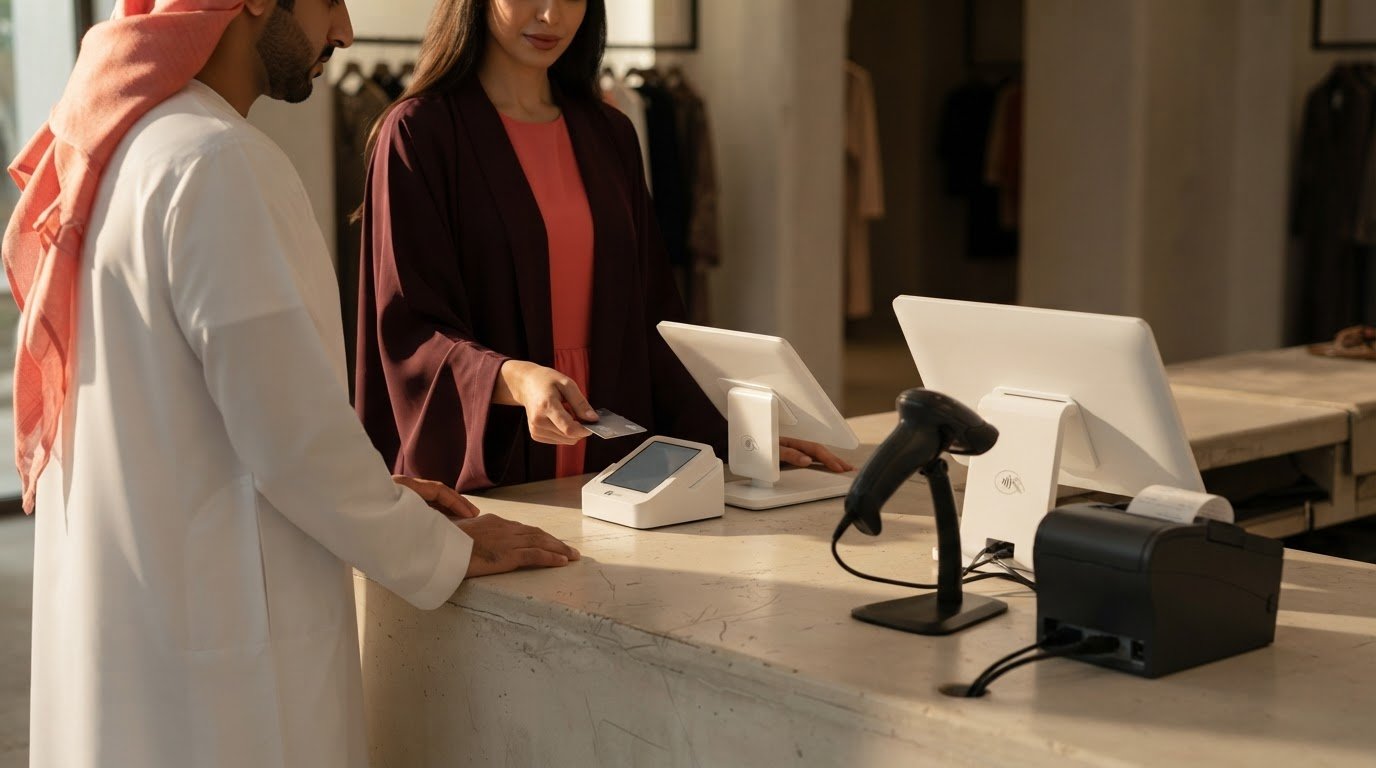
A future-proof payment solution adapts as your business changes its sales channels, operations and customer needs. The right choice is not simply the system with the longest feature list. It should meet your current requirements while leaving room for new markets, sales models and payment expectations.
For UAE businesses, payment choices affect more than checkout. Payment technology also connects with internal workflows, financial planning and risk management. A setup that suits one sales channel may not fit when you add online sales or serve customers in other markets. Assessing these needs together helps you focus on long-term fit, not just one feature or the initial setup.
This guide explains how to assess a retail payment stack, compare capital expenditure (CapEx), operating expenditure (OpEx) and service-based models, and evaluate security and industry standards. It also covers practical questions to help determine whether a system can adapt without unnecessary disruption. Use these considerations to shape your selection, whether you are choosing a new setup or reviewing an existing one.
Key Takeaways
• Assess whether the payment stack can scale and adapt through modular components, useful data and automation.
• Compare upfront investment, ongoing operating costs and service-based models against your business needs.
• Consider security measures such as tokenization and fraud prevention alongside applicable compliance requirements.
• Use PaySelect’s comparison and advisory tools to explore gateway, POS, cross-border and pricing options.
1. What does a future-proof retail payment stack include?
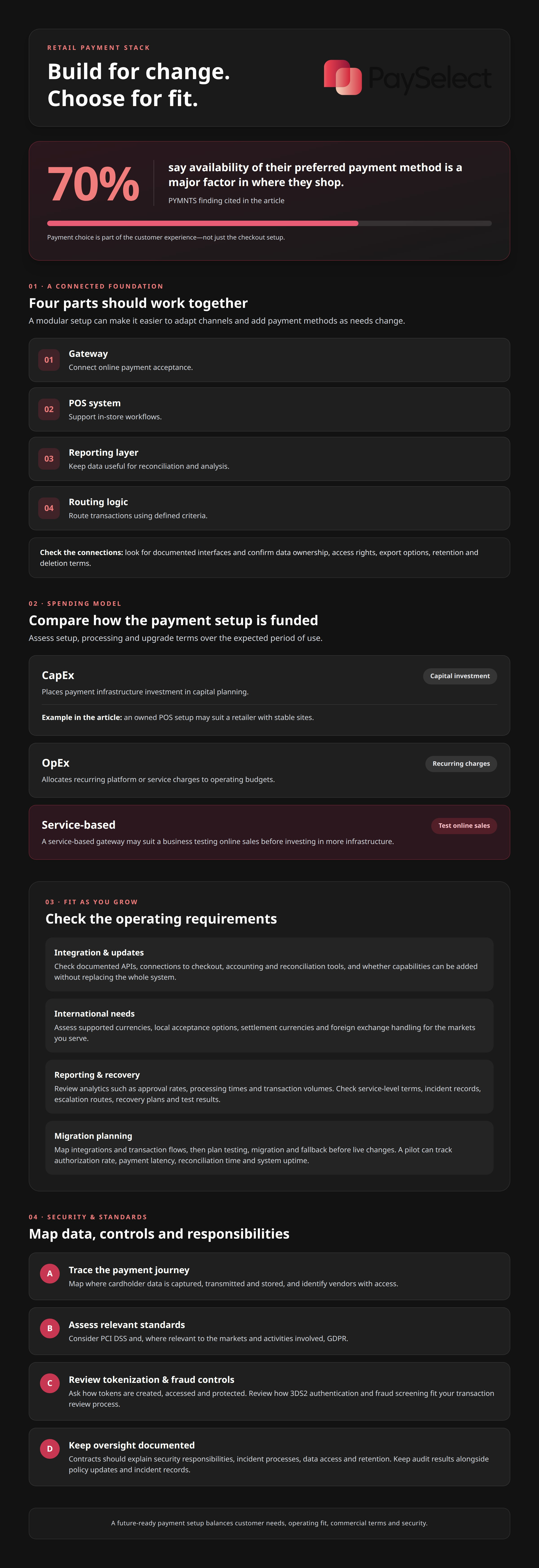
For a UAE retailer, how to choose a future-proof payment solution starts with assessing how its components fit together, rather than choosing a fixed bundle. A gateway, POS system, reporting layer and routing logic should connect through documented interfaces. This can make it easier to add online acceptance in new markets without replacing in-store workflows. Modular design can also help you introduce payment methods as sales channels change.
A provider-neutral orchestration platform can route transactions among providers according to defined criteria. Analytics can show approval rates, processing times and transaction volumes. Before selecting a platform, clarify data ownership, access rights and export options so reports remain useful for reconciliation, compliance work and future analysis. These choices help ensure the payment setup can adapt to changing transaction needs.
Interpret data-storage claims carefully. A data-reduction claim, such as compression or deduplication, concerns storage efficiency. It does not explain how long records remain available or who can retrieve them. Contracts should address retention, deletion, export and access. If AI tools use locally hosted customer data, assess data flows, permissions and model access. On-premise hosting can support a data-residency strategy, but location alone does not settle governance.
Assess uptime, support and disaster recovery by reviewing service-level terms, incident records, escalation routes, recovery plans and test results. Recovery objectives should reflect your trading and reconciliation needs.
To decide how to choose a future-proof payment solution and manage a switch, a professional maps integrations and transaction flows, compares provider fit and pricing, then plans testing, migration and fallback before live changes. A pilot can track authorization rate, payment latency, reconciliation time and system uptime. For online sales, compatible payment gateways can preserve checkout and reporting workflows.
2. Flexible CapEx, OpEx and as-a-Service payment models
CapEx places payment infrastructure investment in capital planning, while OpEx allocates recurring platform or service charges to operating budgets. An owned POS setup may suit a retailer with stable sites; a service-based gateway may suit a business testing online sales before investing in more infrastructure. Compare setup, processing and upgrade terms over the expected period of use.
When assessing APIs, integrations and scalability, look for payment gateways and orchestration platforms with documented interfaces. Your payment setup should connect payment processing with checkout, accounting and reconciliation tools. A payment adviser can compare integration requirements alongside contract terms, helping you assess technical fit and the commercial model together.
Flexibility also means adapting internal workflows. A finance team can start with scheduled settlement reporting, then add automated reconciliation as transaction flows grow. PYMNTS found that 70% of consumers say their preferred payment method’s availability is a major factor in where they shop, making payment choice relevant to customer experience. For modern direct-to-consumer brands like oceanmotionwear.com, providing versatile checkout options helps capture customer demand and maintain a smooth shopping journey.
For international growth, assess supported currencies, local acceptance options, settlement currencies and foreign exchange handling. A business expanding from the UAE into GCC markets may need different collection and payout arrangements. Compare these requirements through cross-border payment solutions.
A payment adviser can review processing fees, setup costs and contract terms using transaction and settlement reports. The review can identify pricing components, recurring charges, exit provisions and volume conditions, then assess the overall arrangement against your business needs.
Technology that becomes outdated can leave a business with rigid integrations, manual work and limited payment-method options. Assess update processes, API access and whether you can add capabilities without replacing the whole system.
3. PCI compliance, tokenization, and fraud prevention
Assess security across the full payment journey, from checkout to settlement. Map where cardholder data is captured, transmitted and stored, then identify every vendor with access. This shows which systems affect compliance and where controls need to apply.
PCI DSS is an industry standard to consider when selecting payment infrastructure. Tokenization replaces sensitive card details with a token for later payment activity, reducing exposure of the original data. Ask how tokens are created, accessed and protected, and how tokenization fits your checkout and reporting workflows.
Fraud prevention should combine policy, technology and review. A gateway’s 3DS2 feature can apply authentication based on transaction context, while fraud screening can consider customer behaviour and history. Set clear rules for reviewing flagged transactions, handling disputes and adjusting controls when fraud patterns change.
Compliance can also cross borders. If your UAE business serves customers in other jurisdictions, map where transactions and personal data flow, then consider applicable frameworks such as PCI DSS and GDPR. Requirements depend on the markets and activities involved, so account for each operating region rather than assuming one control covers them all.
Include legal compliance in vendor selection and ongoing oversight. Payment contracts should explain each party’s security responsibilities, incident processes, data access and retention. Regular system audits can review vendor performance, operational efficiency and alignment with industry standards. Keep audit results alongside policy updates and incident records to maintain a traceable record of changes across your payment setup.
4. Choosing technology that follows industry standards
Industry standards can help payment technology work across vendors and markets. Their value is especially clear at integration points, where a gateway connects with a website, POS system or finance platform. For example, documented interfaces can let a retailer update reporting without rebuilding checkout. Shared data formats can also simplify handoffs between sales and finance teams.
To understand how to choose a future-proof payment solution, assess interfaces, formats and update practices against your actual workflows. A UAE retailer entering another market, for example, may need a new acquiring connection while keeping existing finance tools. Clear technical documentation shows which records pass between systems and what mapping implementation requires, making vendor claims easier to evaluate.
Use a pilot to test real tasks before a wider rollout. Run a card payment, refund and reconciliation file through the planned integration. Confirm that transaction details appear in the right fields across checkout and finance systems. This practical review can uncover mismatched formats or manual steps that a feature list may miss.
Expansion can introduce new providers, channels and reporting needs. Choose technology with documented update processes and interfaces that let you change individual components. For example, a retailer might add an online sales channel while retaining its existing POS workflow. This gives the implementation a clearer path to adapting to new requirements.
When deciding how to choose a future-proof payment solution, weigh working integrations and clear documentation more heavily than broad compatibility claims. Test results, portable data and defined update procedures give you practical evidence for comparing long-term technical fit.
How PaySelect can help you compare payment solutions
PaySelect is an independent payment comparison platform and advisory service for UAE businesses. It can help you compare payment providers and understand how their offerings relate to your business requirements. This may be useful when launching a new sales channel, expanding across borders or reviewing an established setup.
For online sales, you can compare payment gateway options. Retailers can explore POS payment solutions, while businesses collecting payments from overseas customers or paying international suppliers can compare cross-border payment options. The available solutions and their suitability depend on each business’s requirements.
Pricing comparison adds a commercial perspective. Instead of focusing only on a headline transaction rate, assess pricing components alongside processing needs and service requirements. Existing merchants can use PaySelect’s advisory services to review transaction and settlement reports, understand charges and consider whether changing providers makes sense. An advisory review can consider your current arrangement and potential alternatives.
Before comparing options, prepare an overview of your sales channels, expected transaction activity, markets served and operational priorities. If you already accept payments, include relevant payment and settlement reports. These details help focus the comparison on real requirements, such as online acceptance, POS coverage, cross-border collections or pricing structure, rather than a generic feature list.
PaySelect helps businesses compare and assess payment options, but cannot promise a particular approval, saving or settlement result. The right next step depends on whether you are selecting a new setup or reviewing your current one. Contact PaySelect to discuss your payment requirements.
Frequently Asked Questions
What does a future-proof retail payment stack include?
A payment setup should connect acceptance with sales and finance systems. For example, a retailer selling in-store and online needs transaction records that can be reconciled across both channels. A flexible setup can also make it easier to add a payment method or provider without redesigning every workflow. Map the customer journey and back-office handoffs to identify which components need to connect.
What features make a payment solution future-proof?
Look for modular components, documented APIs, useful reporting and the ability to add capabilities as your business changes. A growing retailer, for example, may need a new online checkout while keeping existing store processes. Check whether you can introduce updates without replacing the full setup, and whether transaction data supports reporting and operational decisions as volumes and channels evolve.
How do payment providers support new payment methods and digital wallets?
Providers may make payment methods available through gateway integrations, checkout options or connections to other payment services. The business should assess how a wallet appears at checkout, how its transactions are recorded, and whether refunds and reconciliation fit existing processes. Test the customer flow on relevant devices and sales channels, then confirm that finance teams can identify each method in transaction reports.
How do payment providers handle PCI DSS compliance and data security?
Payment providers describe how they handle card data and the controls supporting their PCI DSS compliance. Map which systems collect or transmit card details, what data is retained and which vendors can access it. For example, hosted checkout may change how card data moves through your systems. Review responsibilities, token handling and data access as part of vendor oversight.
What fraud prevention and chargeback tools should businesses compare?
Compare contextual fraud screening, configurable review rules, transaction monitoring and dispute-management workflows. A gateway may use 3DS2 authentication or customer behaviour to inform risk decisions. Also assess how teams receive flagged transactions, gather evidence and track dispute outcomes. The right tools should fit the business’s risk policy and customer journey, rather than relying only on blanket rules that can disrupt legitimate purchases.
Which payment solutions offer APIs, integrations, and scalable architecture?
Payment gateways and orchestration platforms with documented interfaces can connect payment processing to checkout, accounting and reconciliation tools. Modular components can help businesses add capabilities as their needs grow, while fintech infrastructure providers such as Gemba enable non-banks to embed and scale branded financial services.
Disclaimer
This content is for informational purposes only and should not be considered financial, legal, or regulatory advice. Payment provider availability, pricing, and approval processes vary depending on individual business circumstances. PaySelect does not guarantee provider acceptance or specific outcomes. Businesses should conduct their own due diligence before entering into any agreements.
Empowering businesses to achieve greater growth