How to Choose a Secure Payment Gateway for E-commerce in the UAE: 2026 Merchant Guide

Is your payment gateway a silent partner in your growth or a hidden drain on your margins? With UAE e-commerce projected to reach AED 48.8 billion by 2028, the stakes for your digital infrastructure have never been higher. Learning how to choose a secure payment gateway for ecommerce is no longer just a technical checkbox; it's a strategic move to safeguard your reputation. You likely feel the pressure of rising transaction fees and the complexity of local regulations, but you don't have to manage this fragmented landscape alone.
We'll show you how to master the technical, regulatory, and operational criteria to select a solution that protects your revenue. You'll gain a clear framework for evaluating security, ensuring compliance with the UAE PDPL and PCI DSS v4.0.1, and creating a frictionless checkout experience. PaySelect helps by simplifying this process through payment gateway comparison tools and infrastructure consulting, ensuring you find a partner that drives expansion. This guide provides the insights you need to balance protection with profit and build a more resilient business.
Key Takeaways
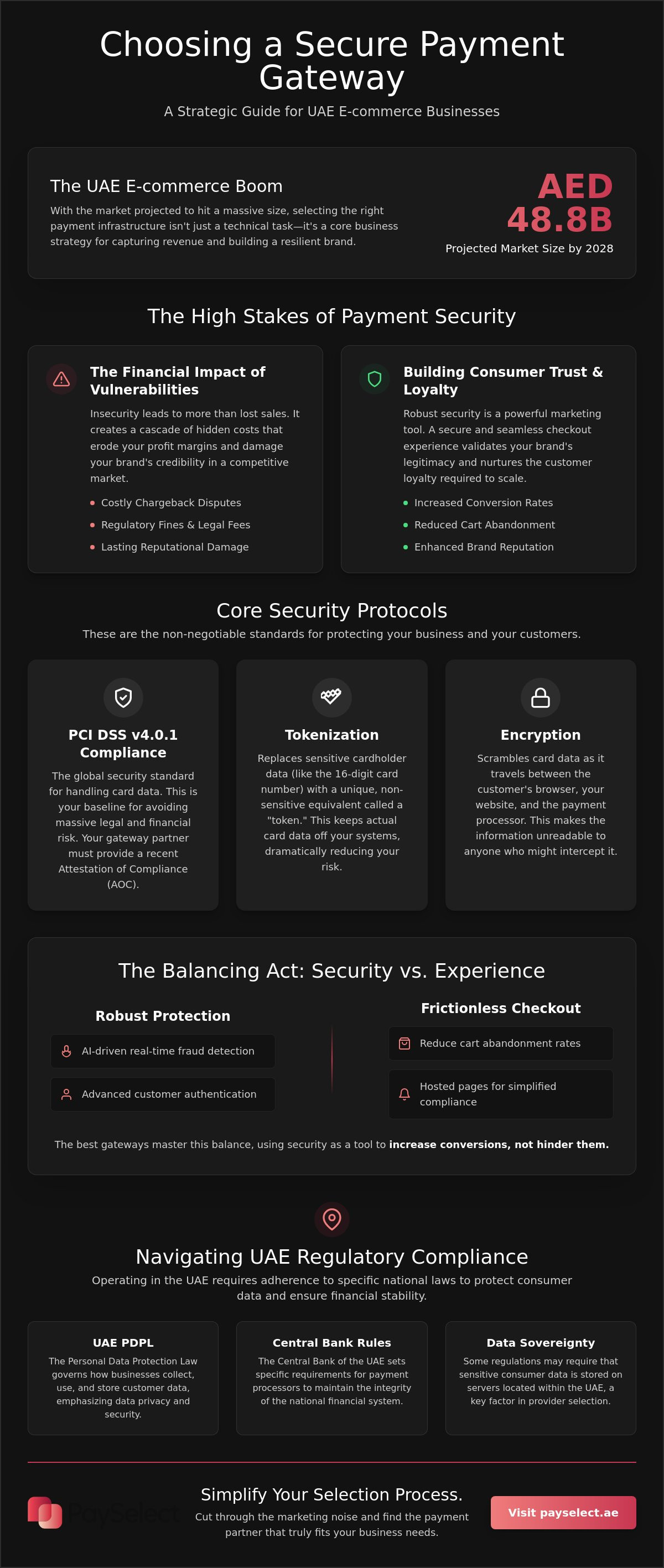
• Understand how protocols like tokenization shield your revenue and build the customer trust necessary for scaling in the UAE market.
• Learn how to choose a secure payment gateway for ecommerce by auditing providers against the latest PCI DSS v4.0.1 standards and national data residency laws.
• Master the balance between robust protection and a frictionless checkout to prevent security checks from driving away legitimate customers.
• Navigate the UAE regulatory landscape with confidence by identifying the specific compliance requirements set by the Central Bank and local data protection authorities.
• Streamline your decision making process using independent comparison tools that cut through marketing noise to reveal the true operational impact of each provider.
The Strategic Importance of Payment Security for UAE E-commerce
A secure payment gateway acts as the digital bridge between your online store and the global financial network. It's the critical infrastructure that ensures funds move from your customer's account to yours without interception or compromise. In the 2026 digital economy, security has evolved into the primary driver of conversion. If a customer senses even a slight vulnerability during the checkout process, the transaction fails. Understanding how to choose a secure payment gateway for ecommerce is no longer a back-office task; it's a front-line business strategy to capture revenue in a competitive market.
The cost of insecurity extends far beyond the immediate loss of a single transaction. Merchants must account for the long-term impact of chargebacks, administrative fees, and lasting reputational damage. We've seen a decisive shift from reactive security measures toward proactive, AI-driven threat prevention. Modern gateways now utilize machine learning to identify suspicious patterns in real-time, stopping fraudulent attempts before they can impact your bottom line. These systems rely on standardized Core Security Protocols to maintain a fortress around sensitive cardholder data, ensuring your business remains a trusted destination for digital shoppers.
Building Consumer Trust in a High-Growth Market
UAE consumers are among the most tech-savvy in the world, and their expectations for data protection are exceptionally high. Visible security markers, such as recognized trust badges and secure URL indicators, are essential for reducing cart abandonment rates. For first-time buyers, a polished and secure checkout experience serves as a psychological handshake that validates your brand's legitimacy. When you prioritize robust security, you aren't just protecting data; you're actively nurturing the customer loyalty required to scale. PaySelect helps businesses navigate these choices by providing clear insights into how different payment gateways handle the delicate balance of protection and user experience.
The Financial Impact of Payment Vulnerabilities
A single data breach can result in catastrophic direct costs, including regulatory fines, legal fees, and the potential loss of your merchant account. Beyond these "headline" risks, secure gateways play a vital role in reducing the frequency of expensive chargeback disputes that eat into your profit margins. One of the most important concepts for any merchant is the "fraud liability shift," which is the transfer of financial responsibility for unauthorized transactions from the merchant to the card issuer when advanced authentication protocols are correctly implemented. By selecting a gateway that automates these protections, you effectively insulate your business from the financial fallout of external fraud. PaySelect simplifies this evaluation, allowing you to compare the security performance of various providers without getting lost in technical jargon.
Core Security Protocols: The Non-Negotiable Standards
Choosing the right tech stack is about more than just speed. It's about resilience. When you evaluate how to choose a secure payment gateway for ecommerce, you must look for Level 1 PCI DSS compliance as your absolute baseline. This isn't just a recommendation; it's a requirement for any business that wants to handle card data without assuming massive legal risk. Mastering how to choose a secure payment gateway for ecommerce involves verifying these non-negotiable standards early in your search.
The PCI Security Standards Council (PCI SSC) manages these global benchmarks, and as of 2026, all merchants must adhere to the full PCI DSS v4.0.1 standard. This version emphasizes continuous security monitoring rather than annual checks. Selecting a provider that automates these requirements will save your team hundreds of hours in manual auditing and documentation.
Understanding PCI DSS and Your Liability
Compliance can feel like a maze of technical jargon. For most small to medium businesses, the easiest way to reduce liability is by using a hosted payment page. This setup means the customer enters their details on the provider's secure server, not yours. It keeps sensitive data off your network entirely. Always verify a gateway's current certification status before signing any contract. If they can't provide a recent Attestation of Compliance (AOC), walk away.
The Power of Tokenization and Encryption
Security relies on two distinct methods: encryption and tokenization. Encryption is reversible and uses a key to protect data during transmission. Tokenization is non-reversible; it replaces sensitive card numbers with a unique digital identifier called a "token." This token has no value to hackers if stolen. It also enables secure "one-click" checkouts for returning customers, as you can store the token instead of the card number. To secure the initial data transmission, ensure your provider uses high-grade SSL/TLS certificates.
Modern gateways also implement 3D Secure 2.0 (3DS2) and Point-to-Point Encryption (P2PE). 3DS2 uses rich data to authenticate customers behind the scenes, only requiring a password or biometric check for high-risk transactions. P2PE ensures card data is unreadable from the very moment it's entered until it reaches the secure decryption environment. If you're unsure which provider offers the most streamlined compliance path, using a payment gateway comparison tool can clarify your options.
Balancing Robust Protection with a Seamless Checkout Experience
Security should never be a barrier to a sale. It should be the foundation that makes the sale possible. If you are researching how to choose a secure payment gateway for ecommerce, you must confront the "friction paradox." This occurs when excessive security layers, such as multiple password prompts or redundant redirects, frustrate legitimate customers. In the fast-paced UAE market, a delay of even a few seconds can lead to abandoned carts. Your objective is to implement a system that is invisible to honest buyers but impenetrable to fraudsters.
Modern technology allows businesses to achieve this balance through smart routing and risk-based authentication. These systems evaluate transactions in real-time, only triggering additional security checks when a high-risk pattern is detected. This ensures that your most loyal customers enjoy a smooth, uninterrupted path to purchase. According to a recent UAE e-commerce market report, consumer trust in gateway security remains a decisive factor for both domestic and cross-border shopping success. When you prioritize a seamless experience, you aren't just improving usability; you're actively protecting your conversion rate.
Reducing Friction with Risk-Based Authentication
Modern gateways utilize machine learning to assess transaction risk in milliseconds. By analyzing variables like device fingerprints, IP locations, and historical buying behavior, the system can distinguish between a regular customer and a potential threat. Low-risk transactions move through a "frictionless flow," while suspicious ones are challenged with multi-factor authentication. To ensure your mobile experience is optimized, use this quick checklist:
• Does the gateway support native biometric authentication like FaceID or TouchID?
• Are payment fields optimized for mobile keyboards?
• Does the system offer "one-click" checkout for returning users via secure tokens?
Integration Methods and Security Ownership
Your choice of integration dictates how much security responsibility falls on your shoulders. Direct API integrations allow you to keep customers on your own website, providing a premium, branded experience. However, this method requires your servers to meet more rigorous security standards. Alternatively, redirected or hosted payment pages transfer the entire security burden to the provider. This is often the most efficient route for SMEs that want to minimize their compliance footprint.
A major pain point for many UAE merchants is the technical complexity of setting up these systems. Navigating the fragmented payments landscape can lead to integration delays and unexpected costs. PaySelect helps by offering a payment gateway comparison tool and expert infrastructure consulting. This independent advice ensures you select an integration style that matches your technical capabilities while maintaining elite security standards. Understanding how to choose a secure payment gateway for ecommerce involves weighing these trade-offs to find the perfect fit for your specific business model.
Compliance and Data Sovereignty in the UAE Market
Operating in the UAE requires more than just technical security; it demands strict adherence to a specific regulatory framework. For entrepreneurs establishing their legal foundations, Fast Zone Business offers expert guidance on company setup to ensure you meet all local requirements. The Central Bank of the UAE (CBUAE) serves as the primary authority, regulating Retail Payment Services to ensure financial stability and consumer protection. When you evaluate how to choose a secure payment gateway for ecommerce, you must prioritize providers that hold the necessary licenses to operate within this jurisdiction. Using a non-regulated or "offshore" gateway for local transactions can expose your business to significant legal risks and potential service disruptions.
Compliance also involves robust Anti-Money Laundering (AML) and Know Your Customer (KYC) protocols. These are not merely administrative hurdles. They are essential safeguards that prevent your platform from being used for illicit activities. A secure gateway will have these checks integrated into their onboarding and transaction monitoring processes. This proactive stance protects your merchant account and ensures your business remains in good standing with national financial authorities.
Navigating National Financial Regulations
Merchants must ensure their provider is fully authorized by the CBUAE to handle digital payments. This authorization is your guarantee that the provider meets the highest standards of capital adequacy and operational integrity. Local support is equally vital. Having a team on the ground that understands the nuances of UAE financial law allows you to resolve regulatory queries quickly. If your growth strategy involves selling to the wider GCC or international markets, you'll need specialized cross-border payment solutions that manage multiple regulatory environments simultaneously.
Data Sovereignty and Merchant Responsibility
The UAE Federal Decree-Law No. 45 of 2021 on the Protection of Personal Data (PDPL) places clear responsibilities on merchants. You're legally required to protect the personal and financial data of your residents. Data residency is a critical factor here. Choosing a gateway that processes and stores data within the UAE can simplify your compliance with sovereignty requirements. It also often results in faster settlement times and better connectivity with local banks. Under the PDPL, organizations must notify the UAE Data Office of any data breach within 72 hours of discovery, making the real-time monitoring capabilities of your gateway a legal necessity. For comprehensive protection that extends beyond the payment page, OAD Technologies provides specialized enterprise solutions like Managed Detection and Response to help businesses maintain continuous compliance.
Don't leave your regulatory compliance to chance. You can instantly filter providers based on their regional capabilities and licensing status using our payment gateway comparison tool.
Simplifying Your Selection Process with Independent Advisory
Direct sales pitches from providers often obscure the critical details you need most. While marketing headlines focus on ease of use, they frequently bury complex fee structures and security limitations in the fine print. When you're determining how to choose a secure payment gateway for ecommerce, relying solely on a provider's own documentation can lead to expensive oversights. Independent advisory provides the objective lens necessary to see past the sales talk and focus on technical performance, system connectivity, and long-term reliability.
Many merchants report that it's too hard to compare security features across different platforms. This confusion is often by design, as providers use proprietary jargon to make their solutions seem unique. We remove these operational barriers by providing transparent, unbiased data that standardizes these comparisons. By using an independent comparison tool, you can evaluate gateways based on their actual performance in the UAE market rather than their marketing budget. This clarity ensures that your infrastructure is built on facts, not promises.
Pain Points in Payment Setup: How to Overcome Them
How to Use PaySelect to Find Your Secure Gateway
Mastering how to choose a secure payment gateway for ecommerce is simpler when you follow a structured, logical flow. Our platform is designed to lead you toward a clear decision point without hesitation:
Step 1
Use the "Take the Test" tool to define your specific business requirements, volume, and target markets.
Step 2
Compare providers based on verified security certifications, the quality of their localized support, and transparent pricing models.
Step 3
Consult with an independent expert through our Payment Infrastructure Consulting for enterprise-scale audits and custom matching.
The right gateway is a catalyst for your growth, not just a service. It should remove operational barriers and act as a strategic tool for business transformation. Don't let technical complexity hold your business back. Compare secure payment gateways for your business today and secure your path to international commerce.
Secure Your Strategic Advantage in UAE Commerce
Selecting the right payment partner is one of the most critical decisions for your 2026 growth strategy. You've seen how elite security protocols like PCI DSS v4.0.1 and tokenization form the foundation of customer trust. By balancing these robust protections with a frictionless checkout experience, you ensure that security supports your conversion goals rather than hindering them. Mastering how to choose a secure payment gateway for ecommerce allows you to navigate the UAE's specific regulatory landscape with absolute confidence and clarity.
PaySelect provides the independent and unbiased comparison data you need to cut through marketing noise and identify the best fit for your industry. Whether you require expert advisory for complex payment infrastructure or specialized insights into the MENA regulatory environment, we remove the operational barriers to your expansion. It's time to transform your technical utility into a strategic tool for business transformation and international reach. Match with the right payment gateway for your business today and build a more resilient, profitable future for your brand.
Frequently Asked Questions
What is the most secure payment gateway for a small e-commerce business in the UAE?
The most secure option is any provider that holds Level 1 PCI DSS v4.0.1 certification and a valid license from the Central Bank of the UAE. Small businesses should prioritize hosted payment pages to minimize their own data handling. This setup transfers the security burden to the provider, ensuring elite protection without high technical overhead. It's about finding a partner that balances high-end security with operational simplicity.
Does my business need to be PCI compliant if I use a payment gateway?
Yes, every merchant handling card data must maintain PCI compliance. However, using a secure gateway significantly reduces your workload. If you use a hosted redirect or iframe, you only need to complete a simplified Self-Assessment Questionnaire (SAQ). This prevents sensitive data from ever touching your servers, which is a key factor in how to choose a secure payment gateway for ecommerce. It keeps your business safe and compliant.
How does tokenization protect my customers credit card information?
Tokenization replaces sensitive card numbers with unique, non-reversible digital identifiers called tokens. If a breach occurs, the stolen tokens are useless to hackers because they can't be converted back into original card data. This technology also enables secure one-click checkouts, allowing you to offer convenience without storing actual card details on your platform. It's a rock-solid method for protecting customer information during every transaction.
What are the Central Bank of the UAE regulations for online payments?
The Central Bank of the UAE regulates all retail payment services to ensure financial stability and consumer safety. Providers must obtain specific licenses to operate, and merchants are required to use authorized entities for local transactions. These regulations also mandate strict adherence to AML and KYC protocols. This protects the integrity of the national financial system and your business reputation in a fast-moving digital landscape.
Can I use an international payment gateway for my UAE-based store?
You can use international providers, but you must ensure they comply with UAE Federal Decree-Law No. 45 of 2021 regarding personal data protection. Some international gateways lack direct connectivity to local payment networks, which can increase transaction costs. It's often more efficient to select a provider with a strong regional presence to ensure faster settlements and better local support. This approach helps you avoid unnecessary operational barriers.
How much does a secure payment gateway typically cost in terms of fees?
Costs generally consist of a percentage per transaction plus a fixed fee. Some providers offer a pay-as-you-go model with no setup or monthly costs, while others charge a monthly subscription in exchange for lower transaction rates. High-volume businesses can often negotiate custom pricing, so it's vital to audit your projected sales before making a final decision. This ensures your margins remain protected as you scale.
What is the difference between a payment gateway and a payment processor?
A payment gateway is the digital interface that captures and encrypts data at the point of sale. The payment processor is the backend engine that communicates between the gateway, the card networks, and the banks to authorize the transaction. Most modern providers in the UAE offer an all-in-one solution that combines both functions. This structural clarity ensures your payment infrastructure is simple, manageable, and ready for implementation.
How long does it take to integrate a secure payment gateway onto my website?
Integration timelines vary based on the provider's technology and your technical requirements. Modern, developer-friendly gateways can be integrated in just a few days using standardized APIs or pre-built plugins for popular e-commerce platforms. Traditional bank-backed solutions may take several weeks due to more rigorous manual onboarding and documentation checks. Understanding these differences is essential when learning how to choose a secure payment gateway for ecommerce.
Disclaimer
This content is for informational purposes only and should not be considered financial, legal, or regulatory advice. Payment provider availability, pricing, and approval processes vary depending on individual business circumstances. PaySelect does not guarantee provider acceptance or specific outcomes. Businesses should conduct their own due diligence before entering into any agreements.
Empowering businesses to achieve greater growth