How to Compare Business Money Transfer Exchange Rates in the UAE: 2026 Guide

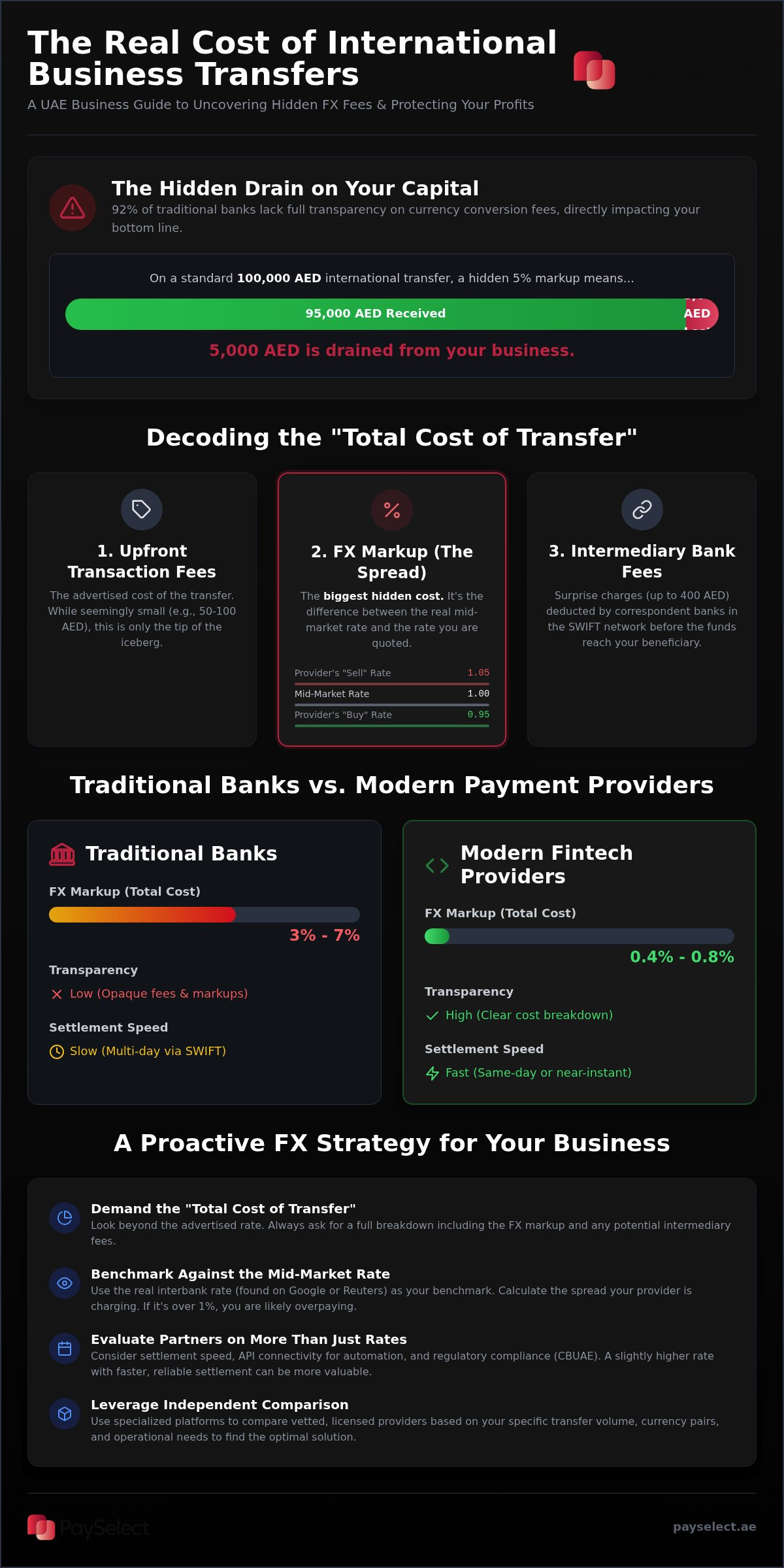
Did you know that 92% of traditional banks fail to provide full transparency on their currency conversion fees? For a standard 100,000 AED transfer, a hidden 5% markup can instantly drain 5,000 AED from your bottom line. It's a common frustration for leaders who need to compare business money transfer exchange rates uae to protect their profit margins. You likely feel that high transaction fees and opaque markups are simply an unavoidable cost of doing global business, but that's a misconception that limits your growth.
We agree that your capital should be used for expansion, not lost to inefficient banking legacy systems. This 2026 guide promises to help you master the art of comparing corporate exchange rates while uncovering the hidden costs of international business transfers in the UAE. You'll learn how to achieve predictable FX costs and faster settlement times for your cross-border operations. We'll preview the impact of the latest CBUAE regulatory updates, the shift toward digital remittance licenses, and how to identify the most efficient payment infrastructure for your specific needs.
Key Takeaways
• Identify the "Total Cost of Transfer" by looking beyond the advertised rate to uncover hidden markups and intermediary bank fees.
• Master the process to compare business money transfer exchange rates uae by understanding the spread between mid-market rates and provider quotes.
• Shift to a proactive FX strategy using multi-currency accounts to eliminate unnecessary conversion steps and protect your profit margins.
• Evaluate potential partners based on settlement speed and API connectivity rather than just the headline exchange rate to enhance supply chain efficiency.
• Leverage PaySelect's independent comparison tools and "Take the Test" to find a cross-border solution that matches your specific operational volume.
Navigating Business Exchange Rates in the UAE Market
The UAE serves as a critical global hub for cross-border trade. This central position creates a high-volume environment where foreign exchange (FX) complexity is the norm. While personal remittances focus on small amounts, corporate FX involves high-value transactions where even minor rate fluctuations impact the bottom line. Relying on a "set and forget" approach with your provider is a strategic error. Currency volatility remains a constant risk. A 1% shift during a slow settlement cycle on a 500,000 AED transfer can lead to a 5,000 AED loss. To protect your margins, you must actively compare business money transfer exchange rates uae to ensure your provider aligns with your volume.
Why Headline Rates Often Mislead Businesses
Marketing often highlights "zero fees," but this is frequently a trap. Providers hide their primary profit in the spread. To understand this, you first need to know what is an exchange rate and how the mid-market rate differs from what you're quoted. The rate you see on Google is the interbank rate; it's rarely accessible to businesses. Providers offer a "sell" rate when you buy currency and a "buy" rate when you sell it. The difference is their markup. In the corporate context, traditional banks often charge between 3% and 7% when hidden markups are included. Modern fintech providers might offer total costs between 0.4% and 0.8% of the transfer value.
The Role of the UAE Central Bank in FX Transparency
The Central Bank of the UAE (CBUAE) has significantly increased oversight to protect businesses. Financial institutions must fully comply with Federal Decree-Law No. (6) of 2025 by September 16, 2026. This law expands oversight to include open finance and virtual assets to ensure higher transparency. For any international wire transfer exceeding AED 3,500, institutions must include full sender and beneficiary details. These regulations aim to standardize the industry, but they also impact speed and documentation requirements. PaySelect helps businesses navigate these hurdles by matching them with providers that meet these strict compliance standards while maintaining operational fluidity. Using our specialized cross-border payment solution matching tool allows you to filter for licensed partners that prioritize both security and settlement speed.
Decoding the Real Cost of International Business Transfers
The real cost of moving capital across borders is rarely the figure highlighted on your bank's dashboard. For a UAE enterprise, the "Total Cost of Transfer" is the sum of three distinct layers: the upfront transaction fee, the foreign exchange markup, and potential third-party charges. The spread is the difference between the mid-market rate and the provider rate. This hidden margin is where most businesses lose significant capital without realizing it. While World Bank remittance data for the UAE illustrates the massive scale of capital flowing out of the country, it also highlights the necessity for businesses to audit their liquidity costs. High-volume transfers often unlock better tiers, but you must actively negotiate or compare business money transfer exchange rates uae to ensure you aren't stuck on a retail-grade pricing schedule.
The Mid-Market Rate vs. Currency Markups
The mid-market rate is the halfway point between the "buy" and "sell" prices on global markets. It's the only fair benchmark for your business. Providers rarely offer this rate; instead, they add a percentage markup that fluctuates based on the currency pair. For instance, the AED to USD pair is typically more stable due to the currency peg, leading to tighter spreads. However, sending funds to emerging markets often results in wider markups due to higher volatility and lower liquidity. You can calculate the markup by comparing your quoted rate against a live interbank feed. If the difference is greater than 1%, your business is likely subsidizing the provider's operational inefficiencies.
Understanding Fixed Fees and Intermediary Bank Charges
Transaction fees are only the beginning. Most international transfers move through the SWIFT network, which often involves "correspondent" banks. These intermediary institutions can levy additional charges as high as 400 AED per transaction, often deducted from the final amount your beneficiary receives. Standard SWIFT fees from traditional UAE banks usually range from 50 to 100 AED, but these don't account for the recipient bank's "landing fees." For businesses with high transaction frequency, a flat-fee model is usually superior to percentage-based fees. To optimize your setup, consider a payment pricing comparison to see how different providers handle these third-party costs. Settlement speed also plays a role. While instant payment platforms like "Aani" are transforming domestic transfers, international speed still carries a premium. Choosing a provider that uses local banking rails instead of the traditional correspondent network can often bypass these hidden landing fees entirely.
A Framework for Comparing Cross-Border Payment Providers
Selecting a partner requires a multidimensional approach. While the math behind the spread is vital, operational fluidity determines long-term success. You must compare business money transfer exchange rates uae alongside technical reliability and compliance rigor. For a growing UAE firm, a provider that offers a slightly better rate but lacks an API for automated reconciliation might actually increase your overhead costs through manual labor. High-end providers now offer dedicated account managers who understand CBUAE reporting requirements for large corporate transfers. This ensures your funds aren't flagged or delayed by avoidable compliance checks. You should also evaluate the breadth of currency coverage. A provider might be competitive for USD but lack the liquidity needed for emerging markets in Africa or Southeast Asia, where your supply chain might be expanding.
Speed vs. Cost: Finding the Right Balance
Speed is a strategic asset. Choosing a provider that leverages local payout networks instead of the standard SWIFT correspondent bank system can reduce your total transaction cost while simultaneously accelerating settlement times. While traditional banks often rely on the SWIFT network, which can take 3 to 5 days, modern fintech solutions often achieve T+0 or T+1 settlement. You should only pay a premium for "Instant" transfers when urgent liquidity is required for inventory or payroll. Otherwise, opting for a T+2 settlement can often secure a more favorable exchange rate. Don't forget to account for local banking hours and time zones in your destination markets. A transfer sent at 4:00 PM in Dubai might miss the processing window for a beneficiary in Singapore.
Integration with Business Payment Gateways
Efficiency thrives on connectivity. Your cross-border payment solution should sync directly with your existing payment gateway to streamline reconciliation. This is particularly critical for e-commerce businesses that collect revenue in multiple currencies and need to repatriate funds to the UAE. Manually tracking international sales against domestic accounts is a recipe for error. Modern providers offer multi-currency "wallets" that allow you to hold funds in various denominations, letting you choose the optimal moment to convert. This level of control removes operational barriers and transforms your FX management from a reactive chore into a strategic advantage. PaySelect provides the independent data you need to identify which providers offer the best technical integration for your specific infrastructure.
Strategic Cost Optimization for UAE Corporate FX
High-growth companies in the UAE can't afford a reactive stance toward foreign exchange. Moving from one-off spot transfers to a proactive FX strategy transforms a cost center into a strategic advantage. Holding multi-currency accounts within the UAE allows your business to receive and hold funds in major denominations like USD, EUR, or GBP without immediate conversion. This fluidity lets you wait for favorable market conditions before moving capital back into AED. Risk management is equally vital. Utilizing forward contracts enables you to lock in today's exchange rate for payments due in 90 or 180 days, providing absolute budget certainty. Automated batch payments reduce administrative overhead and errors by processing hundreds of international transfers in a single secure file upload.
Leveraging Volume for Better Negotiated Rates
Corporate providers operate on a tiered pricing model. If your annual transfer volume exceeds a specific threshold, you shouldn't accept the standard rates displayed on a public dashboard. Approach providers with your historical data to negotiate "preferred" corporate rates that reflect your scale. Consolidating your global payments through a single, efficient partner increases your bargaining power and often unlocks lower percentage-based markups. In the Middle East, custom FX pricing typically becomes accessible once your monthly cross-border volume crosses the six-figure mark in AED.
Auditing Your Existing Payment Infrastructure
Operational leakage is a silent profit killer. It occurs when your current international payment flow involves unnecessary intermediary banks or poorly timed conversions. Engaging in independent payment infrastructure consulting helps identify these inefficiencies before they impact your annual reports. You should perform a comprehensive audit of your rates every six months to ensure your provider hasn't quietly widened their spreads. When you compare business money transfer exchange rates uae during these audits, use a live interbank benchmark to see the true percentage you're paying. This regular benchmarking ensures your cross-border operations remain lean and competitive.
Ready to eliminate hidden FX costs? Take our cross-border payment test to discover the most cost-effective infrastructure for your business volume.
Simplifying Your Global Payments with PaySelect
Most platforms you encounter online are providers attempting to sell their own specific services. PaySelect operates differently. We act as an independent bridge, offering the neutral data you need to compare business money transfer exchange rates uae without the influence of marketing bias. Our platform removes operational barriers by providing a clear, data-driven path to the most efficient providers in the market. We don't process your payments; we ensure you choose the infrastructure that keeps your capital working for you. This unbiased perspective is essential in a landscape where 92% of traditional banks fail to provide full transparency on their markups.
Central to this process is our "Take the Test" tool. It's a specialized match-making engine designed to analyze your transaction volume, destination markets, and technical requirements. Within minutes, you receive a tailored selection of cross-border partners that align with your specific operational needs. This approach replaces the guesswork of manual research with a structured, logical flow toward a clear decision point. By using data to drive your selection, you ensure that your business isn't just getting a "good" rate, but the optimal rate for your specific liquidity needs.
Finding the Right Cross-Border Partner via Independent Comparison
Every industry has unique payment requirements. A logistics firm moving high-value freight requires different liquidity than an e-commerce startup managing thousands of micro-transactions. Our comparison tool evaluates providers based on these nuances, helping you transition from traditional banking to specialized fintech solutions that offer superior performance. We focus on long-term growth strategy. This means matching you with partners whose API capabilities and tiered pricing schedules scale as your international footprint expands. You avoid the friction of switching providers later by choosing a partner that fits your five-year expansion plan today.
Advisory Services for Large-Scale Payment Infrastructure
For hotel groups and enterprise-scale organizations, the complexity of global commerce requires more than just a software tool. PaySelect offers bespoke audits and payment infrastructure consulting to refine your entire technical stack. We identify hidden leakage in multi-entity settlements and streamline your connectivity to global banking rails. Our consultants work to ensure your infrastructure supports seamless international expansion while maintaining absolute regulatory compliance. You gain the calm assurance that your FX strategy is optimized for both speed and security. Optimize your cross-border costs today and transform your international payment setup into a strategic competitive advantage.
Accelerate Your International Growth
Operational fluidity in cross-border commerce requires a shift from passive acceptance to data-driven selection. You've seen that the true cost of liquidity involves more than just a headline rate; it's the sum of the spread, transaction fees, and intermediary charges. By adopting proactive FX strategies such as forward contracts and multi-currency accounts, your business gains budget predictability and protects margins from volatility. Mastering the process to compare business money transfer exchange rates uae ensures your capital remains focused on expansion rather than being lost to opaque markups.
PaySelect provides the independent and unbiased comparison platform you need to navigate this landscape. From comprehensive data on UAE payment gateways to expert advisory for enterprise-scale payment optimization, our tools remove the barriers to your success. We act as your neutral facilitator, matching you with the ideal cross-border partner through specialized match-making tools. Take the Test: Find the Best Cross-Border Solution for Your Business and start optimizing your international infrastructure today. Your path to frictionless global trade starts with a single, informed decision.
Frequently Asked Questions
How do I find the best business exchange rate in the UAE?
The most efficient way to compare business money transfer exchange rates uae is to use an independent comparison tool that benchmarks quotes against the live mid-market rate. You shouldn't rely on the headline rate alone; instead, evaluate the all-in cost including hidden markups and transaction fees. PaySelect provides a specialized match-making engine that analyzes your specific volume to find the most cost-effective provider for your international expansion.
What are the hidden fees in international business money transfers?
Hidden fees primarily exist within the exchange rate markup and third-party correspondent bank charges. Many traditional banks hide margins between 3% and 7% within the spread, which is the difference between the interbank rate and the rate you're quoted. Intermediary banks in the SWIFT network can also deduct up to 400 AED from the final amount without prior notice, affecting your supply chain relationships.
Is it better to use a bank or an exchange house for corporate transfers?
The choice depends on your specific operational needs and technical requirements. Traditional banks offer institutional stability but often include higher hidden markups in their spreads. Specialized exchange houses or modern fintech providers typically offer tighter margins and more intuitive digital interfaces for automated reconciliation. It's essential to compare business money transfer exchange rates uae across both categories to find a partner that balances competitive pricing with fast settlement.
How long does a cross-border business payment typically take from the UAE?
Settlement times range from instant to five business days depending on the network used. While domestic transfers via the "Aani" platform are real-time, international SWIFT transfers usually take 3 to 5 days. Modern fintech solutions that utilize local banking rails can often settle within 24 hours. You should choose your provider based on whether your priority is immediate liquidity or the lowest possible transaction cost.
What is the mid-market exchange rate and why does it matter for my business?
The mid-market rate is the real-time halfway point between global "buy" and "sell" prices for any currency pair. It serves as the only unbiased benchmark for transparency in the FX market. Comparing your provider's quote against this rate reveals the exact percentage markup you're being charged. Understanding this benchmark allows your finance team to create more accurate budgets and identify when a provider's spread is widening.
Can I negotiate exchange rates with UAE providers for high-volume transfers?
Yes, most providers offer tiered pricing models specifically for corporate clients with significant transaction volumes. Once your monthly volume reaches a consistent threshold, usually in the six-figure AED range, you can request custom spreads. Consolidating your global payments through a single partner often increases your bargaining power. Don't settle for retail rates if your business moves capital frequently across borders.
Are digital money transfer platforms safe for large corporate transactions?
Regulated digital platforms are highly secure and must comply with strict CBUAE standards. They follow the same Anti-Money Laundering (AML) and Countering the Financing of Terrorism (CFT) protocols as traditional banks. Many modern platforms use ISO 20022 messaging standards to ensure high data quality and transaction security. These providers often offer enhanced user permissions and multi-factor authentication to protect your corporate treasury operations.
What documents are required for a UAE business to send money abroad?
To comply with CBUAE regulations, you must provide a valid trade license, a memorandum of association, and identification for all beneficial owners. You'll also need supporting documentation for the transaction itself, such as a commercial invoice or contract. These requirements ensure your business remains compliant with Federal Decree-Law No. (6) of 2025, which enhances transparency and security for all corporate capital movements from the UAE.
Disclaimer
This content is for informational purposes only and should not be considered financial, legal, or regulatory advice. Payment provider availability, pricing, and approval processes vary depending on individual business circumstances. PaySelect does not guarantee provider acceptance or specific outcomes. Businesses should conduct their own due diligence before entering into any agreements.
Empowering businesses to achieve greater growth