
The most expensive POS system isn't the one with the highest monthly fee; it's the one that hides its true cost in inefficient transaction rates and rigid infrastructure. You've likely felt the friction of high merchant discount rates or the complexity of ensuring every receipt meets the 5% VAT requirements set by the Federal Tax Authority. Managing disparate fee structures while trying to avoid system downtime is a heavy burden for any growing business. It's a common struggle to align modern payment needs with your bottom line without losing focus on your customers.
You can gain absolute control over your operational expenses when you accurately compare pos systems uae. This guide delivers an expert-backed framework to help you find a frictionless payment setup that scales with your ambition. We'll explore how to evaluate cloud-based connectivity, integrate domestic payment schemes like Jaywan, and utilize the PaySelect "Take the Test" tool to strip away bias. By the end of this guide, you'll have the confidence to optimize your payment infrastructure for speed, compliance, and significant cost reduction.
Key Takeaways
• Identify how modern POS systems have evolved into central business hubs that drive digital transformation and operational efficiency.
• Master a structured framework to compare pos systems uae based on technical compatibility and 2026 regulatory compliance.
• Uncover the true cost of ownership by decoding complex Merchant Discount Rates and identifying hidden transaction fees that impact your margins.
• Determine industry-specific requirements to ensure your payment infrastructure supports your unique business logic, whether you are an SME or an enterprise.
• Leverage independent matching tools to remove vendor bias and find a frictionless payment fit that scales with your international ambitions.
The Evolution of POS Systems in the UAE Market
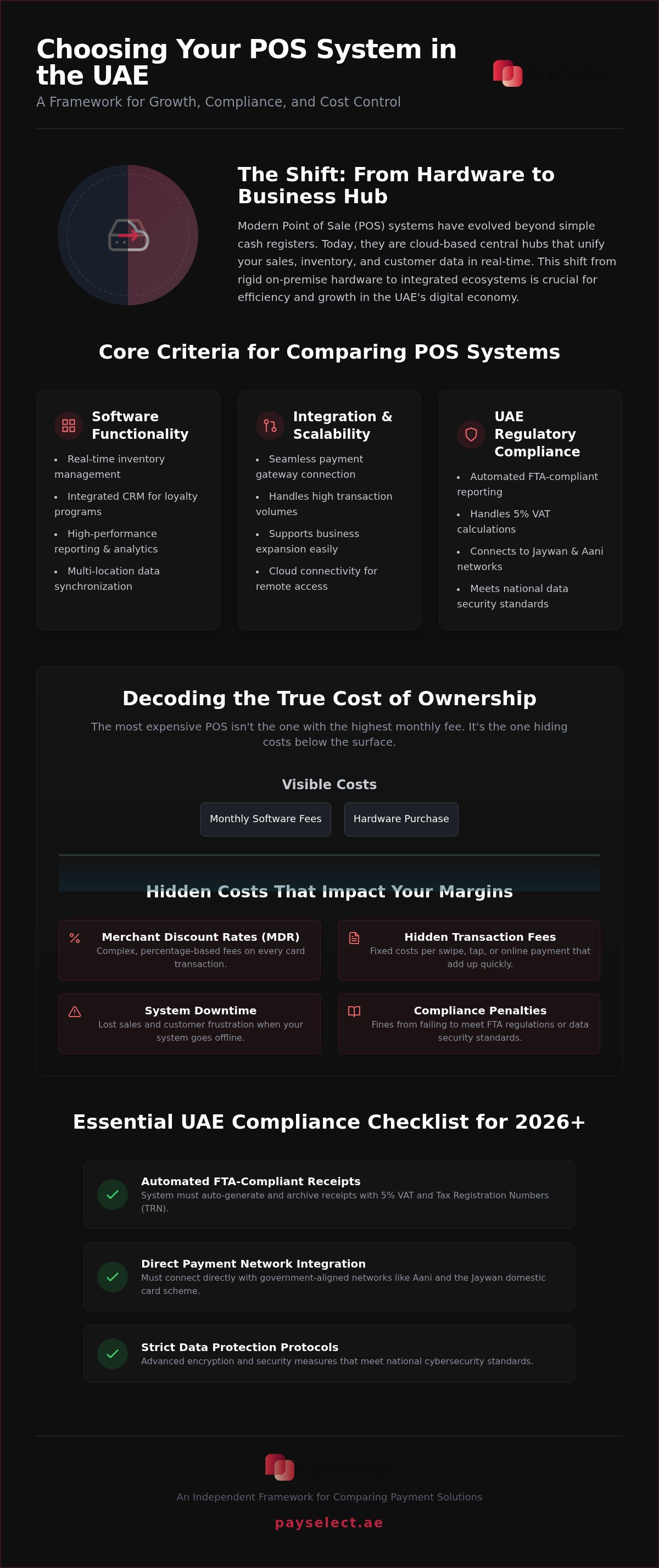
The modern Point of Sale (POS) system has transcended its origins as a simple cash drawer. In the UAE's rapidly advancing digital economy, it functions as a central business hub that synchronises sales, inventory, and customer data in real time. This shift aligns with the national digital transformation strategy, moving away from fragmented operations toward unified commerce. To effectively compare pos systems uae in 2026, you must look beyond basic transaction processing. You need a system that acts as an engine for growth, expansion, and operational fluidity. Standing still means falling behind as competitors adopt AI-powered forecasting and seamless integrations that redefine the customer experience.
The Shift from Hardware to Integrated Ecosystems
Legacy on-premise installations are becoming obsolete as cloud-based ecosystems take center stage. These modern platforms remove the physical barriers of traditional hardware, allowing you to manage your entire business from any device with an internet connection. Real-time data synchronisation ensures that your inventory levels, sales reports, and employee performance metrics are always accurate across all locations. For dynamic environments like pop-up shops or high-traffic retail, wireless and mobile pos machines provide the agility needed to serve customers anywhere on the floor. This mobility reduces wait times, enhances the user experience, and drives higher conversion rates. Cloud connectivity bridges the gap between your physical storefront and your digital back office, creating a sense of completeness in your operational strategy.
Compliance and Regulatory Standards in 2026
The regulatory landscape has matured significantly, making compliance a cornerstone of any technical evaluation. Maintaining strict adherence to UAE Central Bank regulations is a fundamental requirement for business continuity. While basic VAT compliance was the focus in previous years, 2026 standards demand automated tax reporting that integrates directly with Federal Tax Authority (FTA) protocols. Your system must handle 5% VAT calculations for every line item and track tax registration numbers (TRN) without manual intervention. Security is equally critical, requiring advanced encryption to protect merchant transactions and customer data. High-end systems now integrate with official channels like the Aani instant payment platform and the Jaywan domestic card scheme. When you compare pos systems uae, prioritize platforms that offer the following compliance features:
• Automated FTA-compliant receipt generation and digital archiving.
• Direct integration with Aani and Jaywan networks for government-aligned payments.
• Real-time TRN verification to ensure B2B transaction accuracy.
• Strict data protection protocols that meet national cybersecurity standards.
The complexity of this evolving market often leads to decision fatigue. PaySelect removes this operational barrier by offering an independent platform to evaluate these sophisticated ecosystems without vendor bias. By focusing on performance enhancement and system connectivity, you can transform your payment infrastructure from a cost center into a strategic tool for business transformation.
Core Criteria for Comparing POS Systems
Selecting a platform requires a clinical focus on operational logic over aesthetic appeal. When you compare pos systems uae, the goal is to find a solution that removes friction from your daily workflow while supporting your long-term expansion. Scalability is essential; your system must handle increased transaction volumes and additional locations without requiring a total infrastructure overhaul. A structured framework to compare pos systems uae ensures that you prioritise system connectivity and performance over surface-level features. Seamless integration with your payment gateway is equally critical to ensure that funds flow efficiently from the customer to your merchant account. A fragmented system leads to reconciliation errors and lost revenue.
Step 1: Assessing Software Functionality
Software is the central nervous system of your business. It should offer robust inventory management that supports multi-location synchronisation in real time. Look for integrated Customer Relationship Management (CRM) modules that allow you to launch loyalty programmes and track customer preferences across your entire network. High-performance reporting and analytics are non-negotiable. You need actionable business intelligence to forecast demand, manage staff shifts, and optimise your product mix. This level of connectivity transforms a simple terminal into a strategic asset for growth.
Step 2: Evaluating Hardware Reliability
Hardware must be durable enough to withstand high-volume environments without compromising on performance. Modern pos machines should support a wide range of peripherals, including biometric scanners and various card readers. As part of the tech revolution in the retail scene, businesses are increasingly adopting contactless and biometric payment methods to speed up checkout. For premium hospitality and retail sectors, the physical design of the hardware should reflect your brand's elite positioning while remaining functionally rock-solid. Reliability is the foundation of a positive customer experience.
Step 3: Support and Service Level Agreements (SLAs)
Technical downtime is a direct threat to your revenue. You need a Service Level Agreement (SLA) that guarantees 24/7 technical support to ensure business continuity. Evaluate whether the provider offers on-site assistance or relies solely on remote troubleshooting. Remote support is often faster for software glitches, but physical hardware failures require a rapid on-site response. Future-proofing is also vital; check the frequency of software updates and how the system adapts to new regulatory frameworks. You can use the PaySelect POS selection tool to identify providers that offer the most reliable support structures for your specific industry.
Decoding the Cost: Transaction Fees and Hidden Charges
The true cost of a POS system is rarely found on the initial invoice. To effectively compare pos systems uae, you must look deep into the Merchant Discount Rate (MDR) and its long-term impact on your margins. While a low hardware price might seem attractive, high transaction fees can quickly erode your profitability. Many merchants find themselves trapped in rigid, long-term contracts with steep exit fees that stifle their ability to pivot as the market evolves. PaySelect acts as an independent facilitator, providing a payment pricing comparison that reveals these financial pitfalls before you commit to a provider. Accuracy saves money. Efficiency drives growth. Clarity ensures confidence.
Understanding Fee Structures in the UAE
Fee structures in the national market are increasingly diverse, making it difficult to find a direct comparison. You'll encounter flat-rate fees, percentage-based models, or hybrid structures that combine both. For example, international card transactions often carry higher fees, with some B2B platforms listing rates of 2.9% plus VAT as of June 2026. If your business serves a global clientele, these cross-border costs are a significant factor in your total expenditure. Additionally, many UAE banks increased foreign transaction fees to 3.14% in late 2025, which affects how you manage overseas purchases and withdrawals. The shift toward SaaS models means ongoing monthly subscriptions are replacing one-time licensing fees, creating a recurring operational expense that you must balance against the system's performance.
Identifying Hidden Operational Barriers
Hidden barriers often lurk in the integration phase, turning a simple software switch into a complex project. Connecting your POS to existing accounting or ERP software can incur unexpected development or API costs that aren't mentioned in the sales brochure. Hardware isn't a one-time purchase either; you must account for maintenance and replacement cycles to avoid system downtime that affects the customer experience. Finally, don't overlook the cost of staff training. A system that is too complex will lead to slower service and increased errors during the onboarding phase. When you compare pos systems uae, consider these secondary costs:
• API and third-party integration fees for accounting software.
• Hardware maintenance contracts and out-of-warranty repair costs.
• Staff downtime during system transitions and training sessions.
• Potential exit fees for terminating a contract early.
PaySelect simplifies this journey through a specialized Payment Cost Optimization Audit. By removing the bias from traditional vendor-led guides, we help you identify the most cost-effective infrastructure for your specific business model. This independent approach ensures that your technical fit is as solid as your financial strategy.
Matching POS Features to Your Industry Requirements
Industry logic is not a luxury; it's an operational necessity. A generic terminal that works for a boutique retail shop will struggle with the technical demands of a multi-unit hotel group or a high-volume restaurant. When you compare pos systems uae, you must evaluate how the software logic aligns with your specific sector's unique workflows. SMEs often prioritize rapid setup and intuitive interfaces, while enterprise organizations require deep system connectivity and data sovereignty. PaySelect bridges this gap by providing unbiased insights into which platforms align with your specific industry vertical, ensuring your technical fit supports your growth strategy.
Retail and E-commerce Integration
Modern retail requires a unified commerce approach to meet the expectations of a sophisticated national audience. Your POS must act as the bridge between your physical storefront and your digital presence. Omnichannel capabilities allow you to merge sales data, customer profiles, and loyalty points regardless of where the transaction occurs. This fluidity removes operational barriers and enhances the user experience. To maintain efficiency, your system should offer:
• Real-time stock tracking across national warehouse networks to prevent overselling.
• Automated click-and-collect processing for a frictionless customer journey.
• Integrated returns management that updates inventory levels and financial reports instantly.
• Synchronised pricing and promotions across all digital and physical touchpoints.
Food, Beverage, and Hospitality Excellence
The hospitality sector demands high-frequency performance and rock-solid technical stability. For large-scale hotel groups and restaurant chains, a POS must do more than process bills. It needs to handle complex split billing for corporate guests and integrate seamlessly with kitchen workflows. Managing seasonal demand requires a system that maintains speed during peak hours without compromising data integrity. High-end hospitality systems focus on performance enhancement by automating background tasks, allowing your staff to focus on service rather than software troubleshooting.
• Kitchen Display System (KDS) integration to reduce order latency and improve accuracy.
• Advanced table management to optimise seating capacity and turnover rates.
• Automated gratuity and service charge calculations that meet national regulatory standards.
• Handheld mobile terminals for tableside ordering and faster payment processing.
Finding the right balance between these specialised features and your operational budget is the ultimate challenge for modern entrepreneurs. You can compare pos systems uae effectively by focusing on these industry-aligned functional advantages rather than generic feature lists. PaySelect removes the complexity of this search by matching you with the ideal provider based on your specific operational needs. Find your industry-aligned POS solution with our independent matching tool.
How PaySelect Simplifies Your POS Selection Journey
The UAE market is flooded with conflicting claims and vendor-led guides that often mask underlying biases. Finding a technical fit shouldn't depend on who has the largest marketing budget. PaySelect operates as an independent digital platform, stripping away these operational barriers to provide a clear, objective framework. We act as a catalyst for growth, helping you compare pos systems uae without the pressure of a sales pitch. Our mission is to lead you toward a clear decision point through structural clarity and data-driven insights. Accuracy saves time; transparency builds trust.
The "Take the Test" Methodology
Manual research is often a source of significant friction and research fatigue for business owners. Our specialised POS selection tool, known as "Take the Test," simplifies this journey into a manageable process. By analysing your specific industry requirements, monthly transaction volumes, and technical integration needs, we match you with the ideal provider in minutes. This methodology ensures that your decision is based on performance enhancement rather than aesthetic features. You'll receive a transparent comparison that highlights system connectivity, true transaction costs, and industry-specific functional advantages. This structured flow leading to a clear matching result saves you time and ensures your infrastructure is ready for implementation.
Enterprise Advisory and Cost Optimization
For large-scale organisations and hotel groups, the payments landscape presents even deeper complexities. A simple terminal isn't enough; you need a sophisticated architecture that supports international ambition and removes hidden operational barriers. PaySelect provides bespoke payment infrastructure consulting to audit your existing systems and identify cost-saving opportunities. We focus on reducing merchant discount rates and streamlining your reconciliation processes. Our advisory services act as a strategic tool for business transformation, ensuring your payment setup is an asset rather than a cost centre. By removing bias and focusing on ultimate business outcomes, we help you build a frictionless payment infrastructure that scales with your success.
You don't have to navigate these complex global infrastructures alone. When you compare pos systems uae through an independent lens, you gain the confidence to implement solutions that drive speed and operational efficiency. PaySelect is the elite facilitator you need to bridge the gap between technical utility and strategic growth.
Optimise Your Payment Infrastructure for 2026
The transition from legacy hardware to integrated cloud ecosystems represents a fundamental shift in the national business landscape. By moving beyond basic VAT compliance and focusing on system connectivity, you transform your payment setup into a strategic tool for expansion. Whether you manage a boutique SME or a large-scale hotel group, the ability to accurately compare pos systems uae is the difference between operational friction and fluid growth. You now have the framework to evaluate technical reliability, decode hidden transaction fees, and align software with your industry's unique workflows.
PaySelect provides the independent and unbiased guidance you need to navigate this complex landscape with absolute confidence. As a specialist in UAE payment infrastructure, we remove the operational barriers that stall progress. It's time to replace research fatigue with expert-backed precision. Take the Test and find your perfect POS match today. Your journey toward a frictionless payment infrastructure starts with a single, informed decision.
Frequently Asked Questions
How do I choose the best POS system for my business in the UAE?
You choose the best system by aligning software logic with your specific operational needs. Start by identifying whether you require SME-level agility or enterprise-scale infrastructure. Evaluate the system's ability to handle high-frequency transactions and its compatibility with domestic card schemes. When you compare pos systems uae, prioritise platforms that offer seamless system connectivity and robust reporting. This ensures your technical utility acts as a strategic tool for business transformation rather than just a terminal.
What are the typical transaction fees for POS systems in the UAE?
Transaction fees typically include a percentage-based Merchant Discount Rate (MDR) and a fixed per-transaction fee. As of August 2026, some B2B platforms list international card fees at 2.9% plus VAT. Additionally, many banks increased foreign transaction fees to 3.14% in late 2025. These costs vary significantly between payment providers. Understanding these disparate fee structures is essential for maintaining healthy margins and reducing long-term operational costs across your national network.
Is VAT compliance automatic in modern UAE POS software?
Most modern systems feature automated VAT reporting, but you must verify that the software meets Federal Tax Authority (FTA) standards. A compliant system must calculate the 5% VAT rate for every line item and generate tax-compliant receipts that display your Tax Registration Number (TRN). Automated digital archiving of these records is a non-negotiable feature for 2026. This removes the operational barrier of manual tax reconciliation and ensures your business remains audit-ready at all times.
Can I integrate my POS system with my existing online payment gateway?
You can integrate your POS with an online gateway to create a unified commerce environment. This integration allows for real-time stock tracking and synchronised customer profiles across both physical and digital storefronts. It removes the friction of managing separate inventories and financial reports. When looking to compare pos systems uae, check for open API capabilities that facilitate smooth transitions between your web-based sales and on-site transactions for a frictionless customer journey.
Do I need different POS systems for multiple locations across the UAE?
You don't need different systems; instead, you should implement a single cloud-based platform that supports multi-location synchronisation. This setup allows you to manage inventory, staff performance, and sales data across all national branches from a central dashboard. It provides structural clarity and ensures that your business logic remains consistent. Centralised management reduces training costs and simplifies the expansion process as you scale your operations into new territories without technical barriers.
What is the difference between a cloud-based and an on-premise POS?
Cloud-based systems store data on secure remote servers, allowing you to access real-time business intelligence from any device with an internet connection. They offer lower upfront costs and automatic software updates. On-premise systems rely on local servers and often require manual updates and higher maintenance. Modern entrepreneurs prefer cloud connectivity because it facilitates speed and operational efficiency. This shift away from standalone hardware creates a more fluid and responsive business infrastructure.
How does PaySelect help me save money on my POS system?
PaySelect helps you save money by providing an independent platform to evaluate payment solutions without vendor bias. We offer a Payment Cost Optimization Audit to identify hidden fees and high merchant discount rates in your current setup. Our specialised matching tool connects you with providers that offer the most competitive pricing for your specific transaction volume. This objective approach removes the complexity of comparing disparate fee structures and ensures you find the perfect technical fit.
Are there specific POS requirements for the hospitality industry in the UAE?
Hospitality systems require specialised features like kitchen display system (KDS) integration, table management, and complex split billing. These platforms must handle high-frequency transactions during peak hours without system downtime. For large-scale hotel groups, the ability to manage seasonal demand and integrate with property management systems is essential. Industry-specific logic ensures that your technical utility supports the fast-paced nature of service and enhances the overall customer experience through performance enhancement.
Disclaimer
This content is for informational purposes only and should not be considered financial, legal, or regulatory advice. Payment provider availability, pricing, and approval processes vary depending on individual business circumstances. PaySelect does not guarantee provider acceptance or specific outcomes. Businesses should conduct their own due diligence before entering into any agreements.
Empowering businesses to achieve greater growth