How to Effectively Compare Payment Gateways in the UAE: 2026 Merchant Guide

The difference between a high-growth merchant and a struggling one often comes down to the efficiency of their financial infrastructure. With the UAE payments market now processing AED 1.6 trillion annually, your choice of provider is a strategic pivot point. You've likely faced the friction of slow settlement cycles, complex integrations, and fee structures that feel intentionally confusing. It's exhausting to manage international currencies when your gateway creates more barriers than it removes. Reliable connectivity should be a given, yet many businesses find themselves trapped by hidden costs that stifle their momentum.
This guide ensures you master the complexities of the 2026 market so you can compare payment gateways uae providers offer with absolute precision. You'll gain a clear framework for reducing transaction fees, accelerating cash flow, and delivering a secure checkout experience that builds trust. We'll break down the latest licensing requirements and technical benchmarks to help you select a partner that facilitates expansion. PaySelect simplifies this journey by offering independent advisory and proprietary matching tools that remove provider bias. By the end of this guide, you'll have the tools to transform your payment setup into a strategic asset for the future.
Key Takeaways
• Understand the rapid shift toward a national cashless economy and why selecting a gateway based on future scalability is more critical than finding the lowest entry price.
• Learn how to compare payment gateways uae providers offer by evaluating the full Merchant Discount Rate and ensuring technical compatibility with your current e-commerce plugins.
• Identify the hidden components of the "Total Cost of Ownership," specifically how settlement cycles ranging from T+1 to T+7 directly impact your business cash flow.
• Follow a structured framework to map your specific transaction volumes and technical stack before engaging with potential infrastructure partners.
• Discover how using an independent comparison platform and proprietary matching tools can remove provider bias and optimize your payment costs in minutes.
The Complexity of the UAE Payment Landscape in 2026
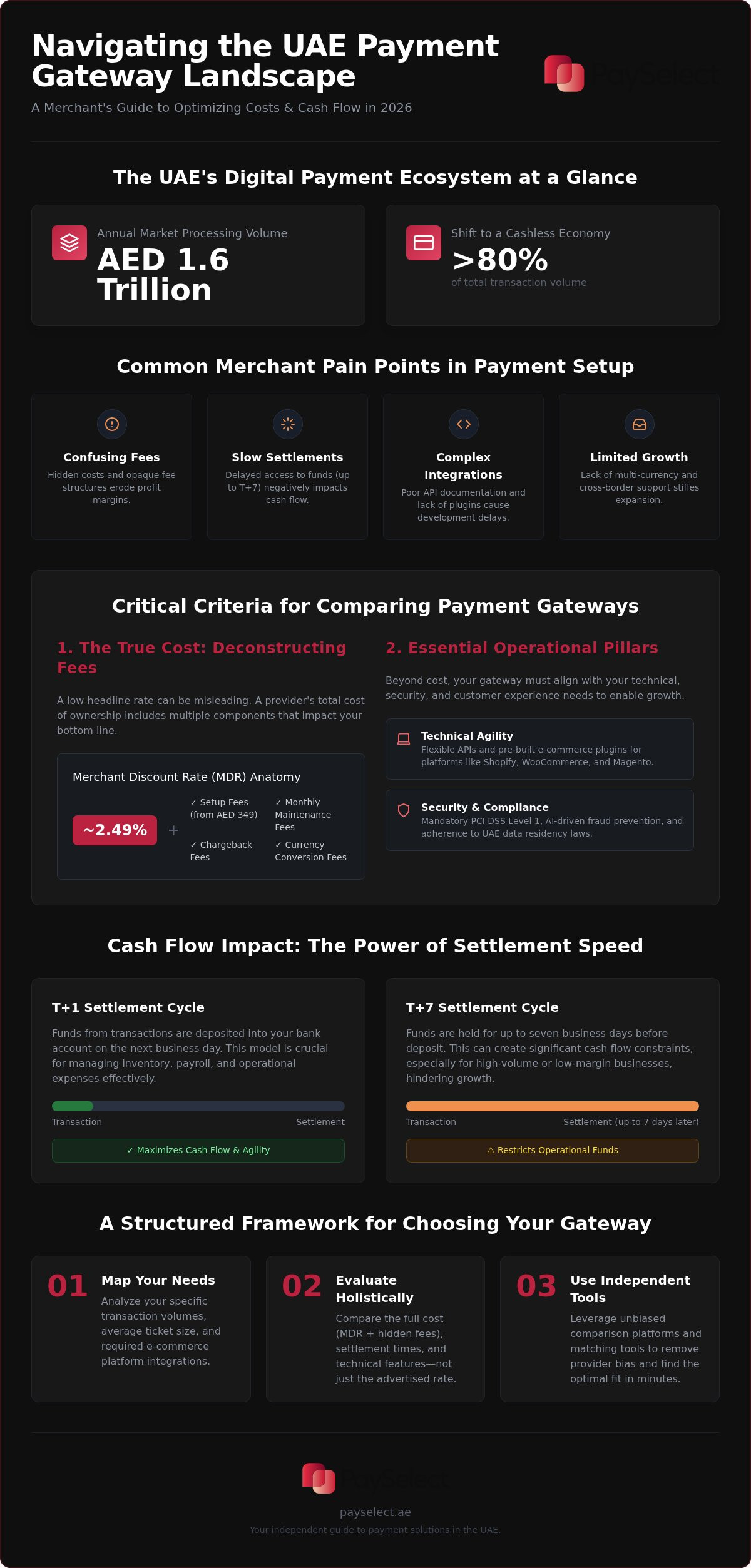
The UAE's financial ecosystem has reached a critical maturity level. Cashless transactions now account for over 80% of total volume, representing an annual market of AED 1.6 trillion. This rapid digital migration means businesses can no longer rely on legacy systems or basic setups. To effectively compare payment gateways uae merchants must look past simple transaction processing and evaluate how a provider fits their specific tech stack. A one-size-fits-all approach often leads to operational friction, especially when businesses attempt to scale across different sectors or consumer demographics.
The Central Bank of the UAE (CBUAE) provides the rigid framework that ensures national financial stability. Their tiered licensing system, which ranges from Category A for high-volume leaders to Category C for smaller startups, dictates the operational limits and capital requirements of every provider. Understanding What is a Payment Gateway? in this specific regulatory context is essential for avoiding service interruptions. You'll generally choose between local aggregators, who offer rapid onboarding for smaller volumes, and global processors that handle complex, multi-currency flows for international expansion. When you compare payment gateways uae options, the distinction between these two types of providers becomes a primary factor in your long-term success.
Regulatory Standards and Compliance Requirements
Security isn't optional; it's a foundation for trust. Every gateway must maintain PCI DSS Level 1 requirements to protect sensitive financial data. In 2026, regulations place a heavy emphasis on local data residency, requiring transaction information to be stored within the country. These updated KYC and onboarding protocols can become a significant pain point, leading to delays that affect your go-to-market speed. PaySelect helps by identifying which providers offer the most efficient compliance paths for your specific trade license, ensuring you don't get stuck in a loop of administrative requests or opaque setup requirements.
Market Dynamics and Regional Expansion
The UAE serves as the primary digital gateway to the wider GCC market. Your choice of infrastructure determines how easily you can enter neighboring territories without rebuilding your entire checkout flow. Modern gateways have shifted from being simple tools to integrated financial ecosystems that manage everything from digital wallets to AI-driven fraud prevention. If your gateway lacks cross-border fluidity or multi-currency support, your growth will hit a ceiling. By using a comparison tool, you can filter providers based on their regional reach and technical agility, turning your payment system into a strategic asset for international commerce.
Critical Criteria for Comparing Payment Gateways
Selecting a partner based solely on a headline percentage rate is a common pitfall for merchants. To effectively compare payment gateways uae providers offer, you must dissect the Merchant Discount Rate (MDR) into its core components. A competitive rate of 2.49% often hides high fixed costs or restrictive minimum commitments that impact your bottom line. Beyond pricing, your infrastructure must demonstrate technical agility through robust API flexibility and ready-to-use plugins for major platforms. Security remains a non-negotiable pillar; ensure any provider utilizes AI-driven fraud prevention and maintains strict PCI DSS Level 1 compliance to safeguard your revenue.
Consumer behavior in the region favors specific local payment methods and digital wallets. Data on eCommerce trends in the UAE shows that frictionless checkout flows are the primary driver of conversion. If your gateway doesn't support local schemes or the latest "Buy Now, Pay Later" options, you're leaving growth on the table. Finding the right balance requires a deep dive into how each provider handles these diverse requirements.
Fee Structures and Hidden Operational Costs
Opaque pricing can erode your margins quickly. While you compare payment gateways uae, look specifically for setup fees and monthly maintenance costs, which can start from AED 349 with certain providers. Pay close attention to chargeback fees and currency conversion markups. If your business handles international transactions, a high FX markup can be more expensive than the transaction fee itself. Transparency in these layers is what separates a vendor from a partner.
Technical Integration and User Experience
The choice between a hosted and non-hosted checkout involves balancing security with brand control. A hosted page simplifies compliance, while an API-integrated solution keeps the experience on your site. Given that mobile transactions dominate the market, prioritize mobile-first payment flows that offer speed and operational efficiency. Always evaluate developer documentation and support response times before committing; slow technical support can lead to days of lost revenue. To navigate these choices without bias, you can compare payment gateways using our independent tool to find your ideal match.
The Hidden Costs of Payment Processing: A Merchant Audit
A thorough merchant audit looks past the headline rate. While transaction fees typically range from 2.49% to 3.5% plus a fixed fee of up to AED 1.75, the "Total Cost of Ownership" framework reveals the true impact on your margins. This includes setup fees, monthly maintenance that can reach AED 349, and the hidden price of failed transactions. High authorization rates are a silent revenue driver. A gateway that fails 5% more transactions than its competitor is effectively 5% more expensive. When you compare payment gateways uae options, these discrepancies become clear.
Pricing models generally fall into two categories: tiered pricing and interchange-plus. Tiered pricing simplifies costs into "qualified" and "non-qualified" buckets but often lacks transparency. Interchange-plus is usually more favorable for growing businesses. It separates the card network cost from the provider's markup, allowing for clearer cost optimization. Understanding these differences is the first step toward reclaiming lost margin.
Settlement Speed and Liquidity Management
Cash flow is the lifeblood of any business. Settlement cycles vary significantly, typically ranging from T+1 to T+7. A faster settlement cycle ensures you have the liquidity to restock inventory or pay operational expenses without delay. For many, a slightly higher transaction fee is a fair trade for receiving funds within 24 hours rather than waiting a full week. New or high-risk businesses should also prepare for reserve requirements, where a provider holds a percentage of funds to mitigate risk. For businesses operating internationally, understanding cross-border payments is essential to avoid excessive delays in global fund transfers.
Volume-Based Negotiating Strategies
As your business scales, flat-rate pricing becomes a liability. Once you hit significant monthly volumes, it's time to move toward bespoke enterprise contracts. Use your transaction data as leverage. If your average order value is high or your chargeback rate is low, you represent a lower risk to the provider. This data allows you to negotiate reduced markups or waived monthly fees. Independent audits are a powerful tool here, helping you identify cost leakage that isn't apparent in standard monthly statements. PaySelect assists by providing an unbiased payment gateway comparison, ensuring your infrastructure costs align with your actual processing volume.
Step-by-Step Guide to Selecting Your UAE Gateway
Precision in selection prevents expensive migrations later. Start by defining your specific business requirements and anticipated transaction volume. This baseline dictates which licensing tier your provider must hold to ensure stability under national regulations. Next, map your technical stack by listing every e-commerce platform, CRM, and ERP system you currently use. Your gateway must offer native connectivity to these tools to maintain operational efficiency. When you compare payment gateways uae options, the technical fit is just as vital as the financial one. Shortlist candidates that specialize in your industry and conduct a technical and financial stress test. Simulate peak transaction periods to check for latency and calculate the total cost of ownership against your actual sales data. Finalize the contract only when the terms support long-term scalability and offer clear paths for expansion.
Assessing Business Model Alignment
Your specific sector dictates your feature requirements. Subscription-based models require robust recurring billing engines and automated card updating services to prevent churn. Conversely, high-volume retail often demands integrated POS machines to manage omni-channel inventory and unified reporting across physical and digital storefronts. Industry sectors like hospitality or high-growth tech have unique risk profiles that influence which providers will accept your application. Don't settle for a generic solution that doesn't account for these nuances. To effectively compare payment gateways uae providers for your specific niche, you need a targeted approach. Take the Test on PaySelect to match with the right provider in minutes.
Exit Strategies and Provider Lock-in
Scalability requires the freedom to move. Always prioritize data portability and tokenization during your selection process. If your provider owns the credit card tokens, switching becomes a customer experience nightmare because you'll have to ask every subscriber to re-enter their details. Look for non-exclusive contracts that allow you to route volume through multiple gateways as you grow. This strategy provides redundancy and prevents a single point of failure in your payment infrastructure. Finalize your contract with a clear understanding of exit terms and notice periods. This ensures you can pivot your infrastructure without operational barriers or financial penalties as your business evolves.
Simplifying the Selection with PaySelect
Most merchants feel overwhelmed by the sheer volume of technical and financial choices in the current market. PaySelect operates as an independent digital platform, bridging the gap between complex global infrastructures and your specific business needs. We eliminate the noise. Our goal is to ensure you achieve absolute operational fluidity by identifying and removing the barriers that slow your transactions down. By providing a transparent landscape, we empower you to compare payment gateways uae providers offer without the pressure of a biased sales pitch. This clarity transforms your payment setup from a simple utility into a strategic tool for business transformation.
Our personality is that of an elite facilitator. We don't sound like a traditional, stagnant institution; instead, we act as a dynamic tech partner deeply embedded in the modern economy. We focus on the ultimate business outcome, ensuring that your connectivity is smooth and your performance is enhanced. By removing operational barriers, we act as a catalyst for your growth, allowing you to focus on expansion while we handle the complexities of infrastructure matching.
The Independent Advisory Advantage
Independence is our greatest asset. In a market where many consultants are incentivized to push specific brands, we remain strictly neutral. Our methodology involves a deep audit of every solution's technical agility, fee transparency, and regulatory compliance. We don't just look at the surface; we rank solutions based on how they perform for your specific volume and industry. This precision reduces the typical time-to-onboard from several weeks to just a few days. For enterprises with intricate payment needs, our bespoke advisory services provide a rock-solid foundation for expansion, ensuring your systems are ready for implementation from day one.
Take the Next Step for Your Business
The logical starting point for any merchant is our proprietary "Take the Test" tool. In minutes, this matching system filters through the noise to present providers that align with your technical stack and transaction volume. You can use our payment gateway comparison tool to filter by specific features, such as recurring billing or multi-currency support. If you're managing a large-scale organization, requesting a professional infrastructure audit is the most effective way to identify cost leakage and optimize your margins. Joining the community of UAE merchants who prioritize efficiency means you're no longer guessing; you're making data-driven decisions that scale. It's time to compare payment gateways uae with a partner that values your time and security as much as you do.
Secure Your Strategic Advantage in the UAE Market
The landscape of digital commerce in the UAE is no longer just about processing transactions; it's about building a scalable financial foundation. You've seen how the rapid shift to a cashless economy and the complexities of tiered licensing require a precise, data-driven approach. Navigating opaque fee structures and settlement delays is a significant operational burden that stunts growth. To truly compare payment gateways uae providers offer, you must look beyond headline rates and evaluate technical agility, data residency, and long-term exit flexibility.
PaySelect exists to remove these operational barriers. As an independent and unbiased digital platform, we provide a transparent comparison of both national and global providers. Whether you're a startup seeking rapid onboarding or a large corporation requiring expert advisory for enterprise-scale organizations, we ensure your infrastructure is optimized for performance. Don't let technical friction or hidden costs hold your business back from its international ambitions.
Take the test and find your perfect payment gateway match in minutes. Your journey toward a more efficient, secure, and profitable checkout experience starts here.
Frequently Asked Questions
What is the average payment gateway fee in the UAE for 2026?
Transaction fees typically range between 2.49% and 3.5% per sale, usually accompanied by a fixed fee of AED 1.00 to AED 1.75. Some providers charge monthly maintenance fees starting from AED 349. When you compare payment gateways uae merchants often find that high-volume businesses can negotiate dynamic pricing or custom rates. It's essential to look at the total cost of ownership rather than just the headline percentage.
How long does it take to integrate a payment gateway for a UAE business?
Integration timelines vary based on your technical stack and the provider's onboarding efficiency. Most modern gateways offer plugins for major platforms that allow for setup within a few days. However, the regulatory KYC process and bank approvals can extend this to several weeks. PaySelect helps reduce this time-to-onboard by matching you with providers whose compliance requirements align with your existing trade license and corporate documentation.
Can I use a global payment gateway in the UAE?
Yes, several major global processors operate within the national market alongside local aggregators. These global entities often offer superior multi-currency support and seamless international connectivity for businesses with global ambitions. Local providers might offer deeper integration with regional payment schemes. The choice depends on your primary customer base and technical requirements. Using an independent comparison tool helps you evaluate the technical agility and regional reach of different provider types.
What documents are required to open a merchant account in the UAE?
You must provide a valid UAE trade license from either a mainland or free zone authority. Additionally, a corporate bank account in a local institution is required for fund settlements. Providers will also request the Passport, Visa, and Emirates ID copies of all shareholders and ultimate beneficial owners. Meeting these Central Bank of the UAE KYC requirements is a fundamental step in securing your digital payment infrastructure.
What is the difference between a payment gateway and a merchant account?
A payment gateway is the technical bridge that captures and encrypts credit card data during a transaction. It sends this information to the processor. A merchant account is a specialized bank account where funds are held before they are settled into your corporate account. Most modern providers in the UAE offer an integrated solution that combines both components, simplifying the operational flow and reducing the number of technical barriers you face.
How does a payment gateway handle multi-currency transactions for GCC markets?
Advanced gateways utilize dynamic currency conversion to allow customers to pay in their local currency while you receive funds in AED. This is particularly important for expansion across the GCC. When you compare payment gateways uae, check for competitive foreign exchange markups and the ability to settle in multiple currencies. High FX fees can significantly erode your margins on international sales, making transparency in currency handling a top priority.
Is it possible to negotiate transaction rates with UAE providers?
Negotiation is common for businesses with high transaction volumes or high average order values. Providers are often willing to move from flat-rate pricing to bespoke interchange-plus models once you demonstrate consistent processing history. You can leverage your transaction data to secure lower markups or waived monthly fees. Independent advisory services can help you conduct a cost optimization audit to identify where your current provider has room for negotiation.
What happens if my payment gateway goes down during peak sales?
System downtime can result in immediate revenue loss and damaged customer trust. To mitigate this risk, many enterprises implement a multi-gateway strategy for redundancy. This ensures that if one provider experiences latency or failure, transactions are automatically routed through a secondary channel. Always evaluate a provider's historical uptime and technical support response times. A reliable infrastructure partner should provide absolute confidence during high-traffic events like national shopping festivals.
Disclaimer
This content is for informational purposes only and should not be considered financial, legal, or regulatory advice. Payment provider availability, pricing, and approval processes vary depending on individual business circumstances. PaySelect does not guarantee provider acceptance or specific outcomes. Businesses should conduct their own due diligence before entering into any agreements.
Empowering businesses to achieve greater growth