How to Ensure Payment Data Security for Customers: A 2026 Guide for UAE Businesses

With 80% of all UAE payments now processed digitally, your business's reputation hinges on every single click. As phishing incidents rose by 32% in early 2026, the stakes for protecting financial information have never been higher. You likely feel the pressure of navigating PCI DSS v4.0 requirements while trying to maintain a frictionless checkout experience. It's a difficult balance; you want to expand rapidly, yet the fear of a data breach or a confusing array of gateway features can stall your momentum. Discovering how to ensure payment data security for customers is no longer just a technical necessity. It's a strategic advantage that builds lasting trust.
We know that choosing the right infrastructure is often the biggest hurdle for modern entrepreneurs. This guide provides a clear roadmap to safeguard your revenue and build a rock-solid foundation for growth. We'll explore the essential security features to look for in a provider and show you how to maintain high conversion rates while ensuring absolute safety. By simplifying the complex regulatory landscape and helping you compare the best solutions for your specific needs, we empower you to scale with confidence in a fast-moving digital economy.
Key Takeaways
• Understand why robust security is the primary driver of customer loyalty and brand reputation in the UAE's digital-first economy.
• Learn how to ensure payment data security for customers by leveraging advanced encryption and tokenization to protect sensitive financial identifiers.
• Navigate the complexities of current PCI DSS v4.0 standards and Central Bank of UAE regulations with a clear, manageable compliance roadmap.
• Strengthen your infrastructure immediately by auditing your payment stack and implementing secure checkout protocols to eliminate operational vulnerabilities.
• Simplify your decision-making process by using independent comparison tools to evaluate security features across various payment gateways and POS systems.
Why Payment Data Security is the Foundation of Modern Commerce
Payment data security is the technical and operational framework designed to shield financial transactions from unauthorized access. In the UAE's rapidly evolving economy, where 80% of transactions are now digital, this security is the bedrock of every successful commercial interaction. Businesses that understand how to ensure payment data security for customers don't just avoid risks; they build a foundation for long-term loyalty and expansion. By shifting the perspective from a mandatory cost to a core competitive advantage, you position your brand as a reliable institutional partner in a fast-moving landscape.
The High Stakes of Data Protection
A single breach can dismantle years of brand building in an afternoon. For 75% of UAE banking leaders, the reputational damage from fraud is considered as important as the direct financial impact. Modern customers are becoming increasingly sophisticated; 96% of UAE residents now take active steps to verify an offer's legitimacy before committing. They prioritize the assurance of a safe transaction over the mere speed of the checkout process. This shift means that your security protocols directly influence your customer lifetime value.
Adhering to the Payment Card Industry Data Security Standard (PCI DSS) is the starting point for any serious enterprise. Payment security is a strategic tool for business transformation. It's no longer enough to simply process payments; you must demonstrate an elite level of protection that inspires absolute confidence. When your infrastructure is rock-solid, you remove the psychological barriers that often prevent high-value customers from completing a purchase.
Security as a Growth Facilitator
Robust security protocols act as a catalyst for international growth. When you remove operational barriers and potential points of failure, customer transitions become fluid and frictionless. A secure infrastructure ensures system connectivity, performance enhancement, and total data integrity. This structural clarity allows you to enter new GCC markets with absolute confidence, knowing your systems can handle cross-border complexities. Aligning your infrastructure with national financial stability goals, such as the "We the UAE 2031" vision, demonstrates a commitment to excellence that attracts sophisticated partners.
Selecting the right payment gateways is a vital step in this journey. Different providers offer varying levels of protection, from advanced AI-driven threat detection to localized compliance features. Understanding how to ensure payment data security for customers involves evaluating these technical differences to find a solution that supports your specific scale. PaySelect helps bridge this gap by offering independent comparisons, ensuring you choose a partner that facilitates expansion rather than hindering it with complex setup hurdles or hidden vulnerabilities.
Essential Technologies: How to Ensure Payment Data Security for Customers
Securing digital transactions requires a multi-layered technological approach that functions silently in the background. For UAE businesses, the goal is to protect sensitive information without introducing friction that could damage conversion rates. By implementing a combination of encryption, tokenization, and multi-factor authentication, you create a robust environment that inspires absolute confidence. Understanding how to ensure payment data security for customers involves selecting the right mix of these tools to suit your specific business model and transaction volume.
Encryption: The First Line of Defence
Encryption is the process of scrambling sensitive data into an unreadable format that only authorized parties can decipher. In the modern payment landscape, you must protect data in two states: at rest and in transit. Data "in transit" refers to information moving from the customer's browser to your server, while data "at rest" is the information stored in your databases. The official PCI Security Standards mandate high-level encryption to ensure that even if a data packet is intercepted, it remains useless to unauthorized actors. End-to-end encryption protects customer privacy instantly without adding any noticeable delay to the transaction speed. This ensures a fluid experience while maintaining a rock-solid security posture.
Tokenization and Its Strategic Benefits
While encryption hides data, tokenization replaces it entirely. This technology swaps sensitive card details for a non-sensitive digital identifier called a "token." This token has no intrinsic value and cannot be reversed to reveal the original card number if stolen. This is a vital strategy for UAE merchants because it significantly reduces the scope of your security responsibilities. If you don't store actual card numbers on your servers, the risk of a catastrophic data breach is virtually eliminated.
Tokenization also facilitates "vaulting," which allows you to securely store payment information for recurring customers. This creates a smoother transition for returning buyers, as they don't need to re-enter their details for every purchase. If you're looking to optimize your infrastructure, you can compare payment gateways to see which providers offer the most advanced vaulting and tokenization features for your specific industry.
The Role of Multi-Factor Authentication
Technology alone isn't always enough; identity verification adds a necessary layer of certainty. Multi-factor authentication (MFA) requires users to provide two or more verification factors to complete a transaction. In 2026, this often includes biometric data or digital ID wallets, aligning with the UAE's push toward a secure digital identity framework. These technologies work together to create a secure ecosystem where how to ensure payment data security for customers becomes a built-in feature of your growth strategy. By choosing a partner that integrates these tools seamlessly, you remove operational barriers and focus on scaling your international reach.
Navigating Compliance: PCI DSS and National Standards
Compliance is often viewed as a hurdle, but for elite UAE businesses, it's a foundational baseline. While technical tools provide the protection, regulatory frameworks ensure that your operations align with international institutional standards. Understanding how to ensure payment data security for customers requires a firm grasp of both global mandates and local circulars issued by national authorities. In 2026, the regulatory environment is more proactive than ever, aiming to position the Emirates as a global leader in secure fintech innovation.
The PCI Security Standards Council manages the global requirements that every merchant must follow. Since March 31, 2025, PCI DSS v4.0 has been the mandatory standard, introducing stricter controls on how data is handled and verified. For businesses aiming to scale, the goal is to choose a partner that manages the bulk of this technical heavy-lifting. This structural clarity allows you to focus on expansion while your provider ensures every transaction meets the highest possible safety markers.
PCI DSS Levels and Your Business
Your compliance requirements depend on your annual transaction volume. Most SMEs fall into Level 3 or 4, which typically involves completing a Self-Assessment Questionnaire (SAQ). This process helps you identify potential vulnerabilities in your current payment stack. By comparing payment gateways, you can find partners that offer pre-certified environments. This significantly reduces your own compliance burden, ensuring that complex technical solutions remain simple and manageable.
Local Regulatory Alignment
Operating in the UAE involves more than just global standards; you must also satisfy the Central Bank of the UAE (CBUAE) and the Personal Data Protection Law (PDPL). Recent updates to Federal Decree-Law No. 34 of 2021 (Cybercrime Law) have clarified rules on user consent and data tracking. Additionally, the CBUAE requires all licensed financial institutions to complete their first digital impersonation risk assessment by June 30, 2026.
Data residency is another critical factor. National laws often require personal data to be stored in UAE-approved data centers. Aligning your infrastructure with these global and national institutional standards is a vital step in how to ensure payment data security for customers. It's about more than just checking a box; it's about creating a rock-solid foundation for international ambition. Choosing a provider that understands these localized nuances ensures a smooth, frictionless transition as you enter new markets.
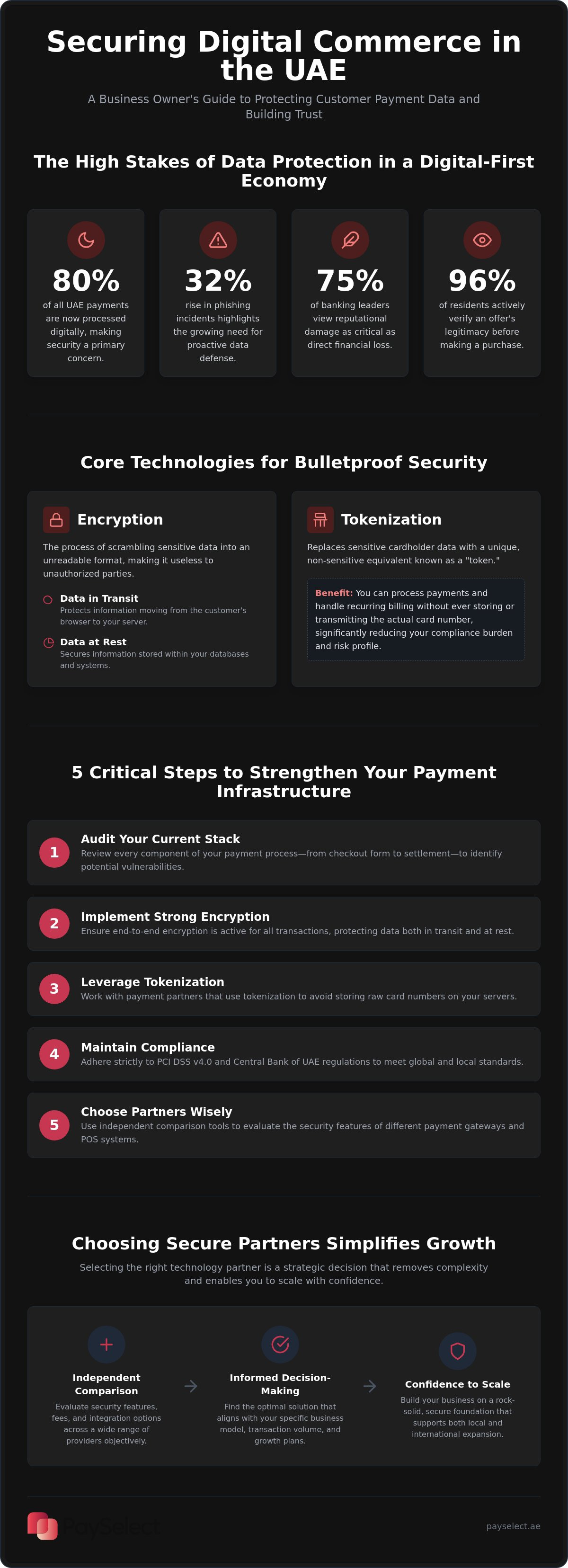
5 Critical Steps to Strengthen Your Payment Infrastructure
Compliance provides the framework, but execution determines your resilience. To build a truly secure environment, you must move beyond passive adherence and take active control of your technical stack. Security demands constant vigilance, which often begins at the front door; implementing a professional visitor management system UAE ensures that physical access to your premises is as secure as your digital transactions. By auditing your current systems, you identify vulnerabilities before they become liabilities. This proactive approach is the most effective way to understand how to ensure payment data security for customers while maintaining operational speed.
Audit your payment stack
Conduct a comprehensive review of every touchpoint where financial data is handled.
Implement TLS
Use Transport Layer Security to encrypt data moving between your customer's browser and your server.
Educate your team
Train staff to recognize social engineering. Phishing incidents in the UAE increased by 32% in early 2026.
Secure physical hardware
Protect your POS systems and machines from physical tampering and unauthorized access.
Patch software gaps
Update all plugins and platforms immediately to close doors for potential attackers.
Optimizing the Digital Checkout
Hosted payment pages are a strategic choice for many merchants. They redirect the customer to a secure environment managed by the provider, removing sensitive data from your own servers entirely. This reduces your risk profile significantly. Real-time fraud detection and 3D Secure 2.0 add essential layers of verification without disrupting the user journey. The goal is a frictionless transition that feels both intuitive and safe. If you're unsure which setup fits your volume, you can compare secure infrastructure options using independent advisory tools.
Securing Physical Points of Sale
In-person transactions require hardware that is inherently tamper-resistant. Modern terminals should utilize EMV chip technology to prevent card cloning and skimming. Managing access controls is equally vital; only authorized staff should handle payment terminals. For businesses expanding internationally, cross-border payment solutions must be vetted for their ability to handle diverse security protocols across different regions. How to ensure payment data security for customers in a physical setting involves a mix of high-end hardware and strict operational discipline. This dual focus ensures your brand remains a rock-solid institutional partner in any market.
Choosing Secure Partners: How PaySelect Simplifies Selection
Selecting the right payment partner is the final, most critical step in your security journey. While individual technologies like encryption and tokenization provide the protection, the provider you choose determines how effectively these tools are integrated into your workflow. Many businesses struggle with the complexity of setting up secure systems, often facing confusion over which gateway features are truly essential for their specific scale. Understanding how to ensure payment data security for customers requires more than just a checklist; it requires an objective partner who can help you navigate a crowded market.
Most providers only showcase their own proprietary features, which makes it difficult to compare performance accurately. This is where an independent perspective becomes a strategic asset. By evaluating security capabilities across the entire industry, you can identify a solution that offers the best balance of safety, cost, and user experience. PaySelect simplifies this process by acting as a bridge between complex global infrastructures and your intuitive business needs.
The Power of Independent Comparison
An unbiased view is essential for both cost and security optimization. PaySelect's digital platform allows you to compare different payment gateways and POS systems without being pushed toward a specific brand. Our comparison tool evaluates security features based on your unique transaction volume and industry-specific risk profile. This ensures you don't overpay for unnecessary features or leave gaps in your defence. You can use our "Take the Test" tool to quickly find a match that aligns with your operational goals, removing the guesswork from infrastructure selection.
Strategic Facilitation for UAE Enterprises
For larger organizations and SMEs with complex needs, PaySelect offers advisory services that go beyond simple comparisons. We provide bespoke payment infrastructure audits and consulting to help you identify hidden vulnerabilities in your current stack. This expert-led approach reduces operational barriers and ensures smooth system connectivity as you expand into new GCC markets. By focusing on the ultimate business outcome, we help you transform technical utility into a strategic tool for growth. When you're ready to secure your future, take the test and find the most secure payment gateway for your business. Discovering how to ensure payment data security for customers has never been more straightforward.
Build a Future-Proof Payment Strategy Today
Securing your transactions is no longer a back-office technicality; it's a strategic asset that facilitates rapid expansion. By integrating advanced encryption with localized compliance, you transform your checkout from a point of risk into a catalyst for trust. You've learned that mastering how to ensure payment data security for customers involves a dual focus on cutting-edge technology and proactive regulatory alignment. This structural clarity ensures that your business remains resilient against evolving threats while maintaining the fluid user experience that modern shoppers demand.
PaySelect acts as your elite facilitator in this fast-moving landscape. As an independent and unbiased digital platform, we provide comprehensive MENA region market data to help you navigate complex infrastructure choices. We offer expert advisory for SMEs and enterprises looking to optimize their systems and remove operational barriers. Don't let fragmented security features or confusing compliance mandates stall your momentum. It's time to align your infrastructure with your international ambitions.
Beyond professional security, establishing a secure digital home for your family's admin is equally important; SafeKeep provides a centralized platform to organize and protect your most critical personal documents.
Compare the most secure payment gateways in the UAE with PaySelect and build a foundation for absolute confidence. Your journey toward a frictionless, secure digital economy starts with the right insights.
Frequently Asked Questions
What is the most secure way to accept online payments for a small business?
Using a hosted payment page is the most secure method for small businesses. This setup redirects customers to a secure environment managed by the provider, ensuring sensitive data never touches your servers. It's an efficient way to reduce your risk profile while maintaining a professional checkout experience that inspires absolute confidence.
Do I need to be PCI compliant if I use a third-party payment gateway?
Yes, PCI compliance remains mandatory even when using a third-party gateway. While the provider handles the technical heavy-lifting, you're still responsible for ensuring your business processes meet the standard. Most SMEs will need to complete a Self-Assessment Questionnaire (SAQ) to verify their compliance status and maintain a secure infrastructure.
How does tokenization differ from encryption in payment security?
Encryption hides data by scrambling it into an unreadable format, whereas tokenization replaces sensitive data with a non-sensitive digital identifier. Tokenization is often preferred for how to ensure payment data security for customers because it removes the actual card data from your system entirely. This prevents attackers from reversing the information if a breach occurs.
What are the penalties for a payment data breach in the UAE?
Penalties for data breaches in the UAE are severe under the Personal Data Protection Law (PDPL) and the Cybercrime Law. Beyond significant financial fines, businesses face mandatory reporting requirements to the UAE Data Office within 72 hours of discovery. The long-term reputational damage often exceeds the direct legal costs, making prevention a strategic priority.
How can I tell if a payment gateway is secure for my customers?
Verify that the provider holds a current PCI DSS v4.0 certification and is licensed by the Central Bank of the UAE. You should also check for features like end-to-end encryption and real-time fraud detection. PaySelect helps you compare these technical differences across various providers to ensure you choose a rock-solid institutional partner for your expansion.
Can secure payment processing actually improve my conversion rates?
Secure processing is a direct driver of higher conversion rates. When customers see trusted security markers and experience a frictionless 3D Secure 2.0 flow, their confidence increases. Reducing the fear of fraud removes a major psychological barrier to purchase, leading to more completed transactions and higher customer lifetime value in the digital economy.
How often should I audit my business payment security protocols?
You should audit your payment security protocols at least once a year. Regular reviews are essential to stay aligned with evolving standards like PCI DSS v4.0. It's also vital to perform an audit after any major update to your website or change in your payment infrastructure to ensure no new vulnerabilities were introduced during the transition.
What is 3D Secure and should my business implement it?
3D Secure is an authentication protocol that adds an extra layer of verification for online card transactions. You should absolutely implement the latest version, 3DS2, as it provides a smoother user experience and facilitates a liability shift. This means the bank, rather than your business, often bears the cost of certain fraudulent transactions, protecting your revenue.
Disclaimer
This content is for informational purposes only and should not be considered financial, legal, or regulatory advice. Payment provider availability, pricing, and approval processes vary depending on individual business circumstances. PaySelect does not guarantee provider acceptance or specific outcomes. Businesses should conduct their own due diligence before entering into any agreements.
Empowering businesses to achieve greater growth