


A low transaction rate does not tell you everything about a payment provider. To understand how to get dedicated support from your payment provider, assess who manages your account, how technical issues are escalated, and whether the support team understands your payment setup. Compare those commitments with the full fee schedule, not just the headline processing rate.
It is reasonable to expect clear answers when a payment issue affects daily operations. Yet support can differ in expertise, access to specialists, and case management, while provider costs may include charges beyond transaction fees.
This article explains what to look for in responsive, knowledgeable support and how to identify fees that affect your total costs. You will also learn how to compare provider pricing and support in the UAE, so you can choose an arrangement that fits your payment operations and growth plans.
Key Takeaways
• Assess support by looking beyond availability: consider technical expertise, escalation paths and familiarity with your payment setup.
• Dedicated support may depend on more than transaction volume; business complexity, payment needs and operational requirements can also matter.
• Prepare clear business and payment details, then review the contract for support commitments, pricing components and other terms that affect total cost.
• Use PaySelect’s comparison and matching tools to assess suitable payment options, or explore advisory support for an existing setup.
Responsive technical support
Responsive support combines knowledgeable staff with a clear process for diagnosing payment issues. In the UAE, assess how support handles your actual payment channels and systems.
Comparing Provider Support Services
Support models differ in how cases are assigned, escalated, and updated. An online checkout fault, for example, may need technical investigation, while a settlement mismatch may involve account support. Ask how each issue is routed and what updates the team provides during its investigation. This helps you judge whether the service fits your workflows.
Qualifying Business Size and Transaction Volume
Eligibility for dedicated assistance can depend on account criteria, but transaction volume alone may not reflect your support needs. A small retailer using several payment channels may need more coordination than a larger business using one. Describe your setup, transaction patterns, and integrations so the provider can assess the service model against your operational complexity.
Define an Operational Escalation Path
Map who reports each payment issue and who tracks its resolution. For example, assign checkout errors to an e-commerce lead and settlement questions to finance. This gives the support team a clear contact and context for each case. Make sure staff responsible for payment operations can access the reporting route during busy periods.
Test Support Against Real Scenarios
Use realistic scenarios to understand how the provider’s process works. Describe a declined card payment during a busy retail period, then ask how the issue would be diagnosed and updates shared. Consider planned changes too, such as adding an online sales channel. These examples help you assess whether the support structure fits daily operations and future growth.
Choose a payment provider with responsive, knowledgeable support. When comparing options, ask how the support team’s experience aligns with your business and whether the people handling a case can explain the next steps clearly. Consider this alongside the routes, contacts, and scenarios already identified, rather than treating support as a separate feature. A provider’s stated capabilities are most useful when they can be matched to the issues your team expects to raise and the way your operation manages them. Include this expertise in your evaluation of operational fit.
What transaction volume or business size qualifies for dedicated payment support?
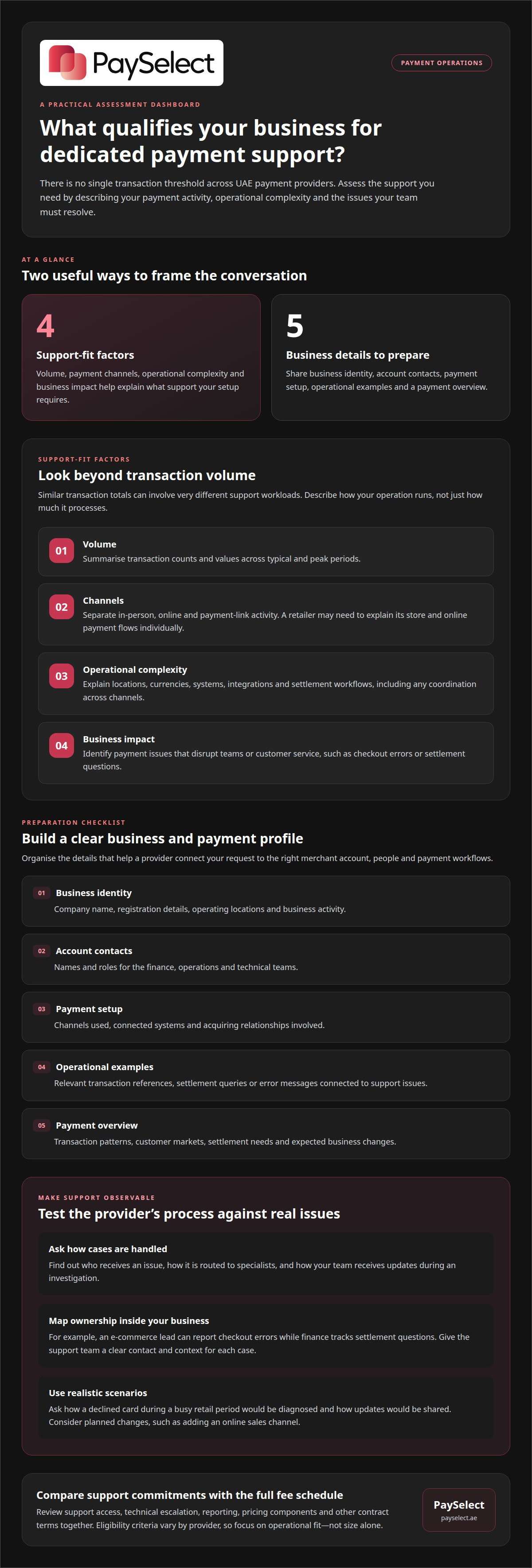
There is no single transaction threshold for dedicated support across UAE payment providers. Each provider sets its own eligibility criteria, so transaction count alone may not determine the support available. Understanding how to get dedicated support from your payment provider means assessing both your payment activity and the operational complexity behind it.
A merchant processing steady sales through one checkout may need less coordination than a business managing seasonal peaks, several channels, multiple locations, or international cards. These differences can shape support needs even when transaction totals are similar. Describe the tasks that require coordination, such as reconciling separate channels or managing changes during expansion.
Prepare a concise profile of your payment operations before discussing eligibility. Include transaction patterns, sales channels, operating locations, settlement needs, integrations, and planned changes. For example, a retailer accepting payments in stores and online should describe each payment flow separately. This gives the provider a clearer picture than a combined volume figure alone.
Volume
Summarise transaction counts and values across typical and peak periods.
Channels
Distinguish in-person, online, and payment-link activity.
Complexity
Describe locations, currencies, systems, and settlement workflows.
Business impact
Identify payment issues that disrupt teams or customer service.
To work out how to get dedicated support from your payment provider, connect your needs to specific account services. Ask whether your account category or payment activity affects access to a named contact, technical escalation, or tailored reporting. A growing business might prioritise support during expansion, while a multi-channel merchant may need help coordinating different payment flows. This keeps eligibility discussions focused on operational fit, not size alone.
What documents and business details are needed to apply for dedicated support?
Prepare a concise business profile before discussing support arrangements with a payment provider. Include your UAE legal business name, registration details, operating locations, and the main contact responsible for payments. These details help connect the request to the correct merchant account and decision-makers.
Explain how customers pay and how your team manages transactions. A retailer, for example, may accept cards in store and online, while a service business may use payment links. Describe your sales channels, transaction patterns, settlement needs, and planned changes. This context helps the provider understand the support workload, not just your company profile.
Useful information to organise includes:
Business identity
Company name, registration details, locations, and business activity.
Account contacts
Names and roles for finance, operations, and technical teams.
Payment setup
Channels used, systems connected, and the acquiring relationships involved.
Operational examples
Recent transaction references, settlement queries, or error messages related to support issues.
Payment overview
Transaction patterns, customer markets, and expected changes to the business.
Organise supporting records by topic. A settlement report can illustrate a reconciliation issue, while an error message can clarify a checkout fault. Share only records relevant to your request, using the provider’s secure process for sensitive business information. Do not send full payment card details in ordinary email or support messages.
Before submitting details, state the outcome you need. For example, explain that your finance team needs a clear escalation route for settlement discrepancies. A focused summary helps the provider understand your account context and discuss a suitable support structure.
Keep policy discussions separate from the account materials you are preparing. Global budgets in United States single-payer proposals are a mechanism to slow cost growth if needed, but this subject is distinct from your company identity, payment setup, operational examples, and support needs. If policy context is relevant to a conversation, label it separately and do not present it as evidence about a merchant account or a request for dedicated support. Keep the application summary focused on details that explain your payment operations and the assistance you seek.
What contract terms or eligibility rules apply to dedicated merchant support?
Dedicated merchant support depends on the provider’s service agreement and account terms. Check whether the contract names an account contact, describes escalation routes, lists support channels, and defines responsibility for unresolved cases. These terms clarify how to get dedicated support from your payment provider, beyond a general promise of “priority assistance.”
Eligibility rules vary by provider and may reflect your business profile, payment activity, product mix, or account category. A retailer accepting payments in stores and online may have different needs from a single-channel merchant. Check whether criteria apply during onboarding, at renewal, or when your business expands, since timing can affect the support arrangement.
Read support terms alongside the commercial schedule. A contract may list transaction pricing, monthly charges, setup costs, and separate service options. Confirm whether dedicated assistance is included, conditional, or covered by a separate arrangement. Reviewing the full schedule helps you understand the cost in relation to the service commitment.
Coverage
Identify the issues and payment channels included in the support arrangement.
Escalation
See how unresolved terminal, checkout, or settlement cases are handled.
Eligibility
Note any account category or activity criteria tied to support.
Changes
Review what happens if your locations, channels, or payment activity change.
Before signing, connect each promised service to a contract clause or written schedule. If your finance team needs help reconciling settlements, for example, confirm that settlement queries fall within the stated support scope. Review renewal and termination terms as well. Together, these clauses show how to get dedicated support from your payment provider and whether the arrangement can change with the wider merchant agreement.
PaySelect
PaySelect helps UAE businesses compare payment providers and offers payments consulting and advisory services; it does not process payments. Its comparison platform and “Take the Test” questionnaire help merchants organise their requirements and see how provider options may fit their business. This can help when dedicated support is one factor in a broader decision about payment setup, pricing, and operational needs.
For a provider comparison, consider the full picture: business activity, payment channels, transaction profile, integrations, and international requirements. The PaySelect provider comparison test uses merchant requirements to identify relevant options. A retailer handling both online and in-person payments, for example, can assess providers against both channels instead of focusing on one feature or rate.
Businesses with an existing provider can use PaySelect’s payment pricing comparison and advisory services to review their current arrangement. This can help clarify whether pricing, service terms, or the overall setup still fits the business. A review does not require an automatic switch. PaySelect helps merchants assess options and commercial terms as they decide whether to keep or change their arrangement.
PaySelect is an independent comparison and advisory service, not the payment provider. The selected provider handles payment processing, account support, and the ongoing merchant relationship. This distinction helps set clear expectations: PaySelect supports the assessment, while the provider’s own contract defines its support commitments. For a tailored discussion of your requirements and suitable payment options, contact PaySelect.
Frequently Asked Questions
How can a business request a dedicated account manager from its payment provider?
Raise your request with the provider’s account or commercial team and explain the business need. A company preparing to add a sales channel, for example, may need one contact to coordinate account questions across teams. Ask who would manage the relationship, which issues they handle, and how to reach them. Keep the request focused on the coordination your business needs.
Does dedicated support cost extra, and what are the typical fees in the UAE?
There is no single typical UAE fee for dedicated support. The provider’s terms determine whether it is included or charged separately. Request an itemised schedule that distinguishes support charges from transaction pricing, account charges, and other service costs. Then compare the total with the support scope to assess the arrangement beyond its headline rate.
What support channels and service-level response times do UAE payment providers offer?
Support channels and response commitments vary by provider and account terms. Ask whether your business can raise cases by phone, email, or a support portal, and how urgent incidents are escalated. Review coverage hours and response targets, and distinguish acknowledgement from resolution: a provider may confirm receipt before fixing the payment issue.
Contact PaySelect to discuss payment requirements and suitable options for your business.
Disclaimer
This content is for informational purposes only and should not be considered financial, legal, or regulatory advice. Payment provider availability, pricing, and approval processes vary depending on individual business circumstances. PaySelect does not guarantee provider acceptance or specific outcomes. Businesses should conduct their own due diligence before entering into any agreements.
Empowering businesses to achieve greater growth
