
What if currency conversion happens at more than one point in an international payment? For UAE businesses, a customer’s payment currency, the currency used for settlement, and the currency paid to a supplier may differ. That can make conversion costs difficult to separate from other charges. Knowing how to handle international currency conversion fees starts with tracing each step, not just checking one exchange rate.
Comparing payment options can be confusing when fee structures vary and settlement arrives in a different currency from the customer’s payment. To compare arrangements fairly, use the same transaction details and settlement needs for each, then look at the full payment flow rather than a single rate.
This guide explains where conversions can occur, what details to compare, and how to build a repeatable process for monitoring costs. PaySelect helps UAE businesses compare cross-border payment solutions based on their industry, transaction volume, and international requirements. Its advisory support and cost-optimization audits can also help businesses review payment arrangements with conversion costs in view.
Key Takeaways
• Conversion costs can arise at different stages of a payment, so trace the flow from customer checkout to settlement.
• Separate the exchange rate from conversion charges and other payment fees to see what each cost represents.
• Compare payment setups using the same transaction, customer currency, and settlement assumptions.
• Build a consistent review process that records the conversion point, applied rate, settlement currency, and disclosed charges.
• Learn how to handle international currency conversion fees by matching payment requirements to your industry, transaction volume, and international needs.
What international currency conversion fees include, and where they arise
A currency conversion fee is a cost associated with exchanging one transaction currency for another. For a UAE business, the exchange might happen when a customer pays in a foreign currency, during payment processing, or when funds are settled into an account in AED. A conversion cost is distinct from a general payment-processing fee, which relates to handling a transaction rather than exchanging currencies. Both can affect the amount the business ultimately receives, so identify them separately.
The cost depends on the currencies involved and where the exchange happens. The price shown to a customer, the currency used to process the payment, and the merchant’s settlement currency may all differ. When they do, the payment arrangement may involve one or more conversions. Mapping those currencies is a practical first step in understanding how to handle international currency conversion fees.
Exchange rate, markup, and processing fee: what is different?
An exchange rate is the value used to convert one currency into another. A reference rate provides a comparison point, but the rate applied to a transaction may differ. That difference is often described as a markup, although how a rate is set and presented depends on the payment arrangement. Check the applied rate and any separately disclosed conversion charge rather than treating them as the same item.
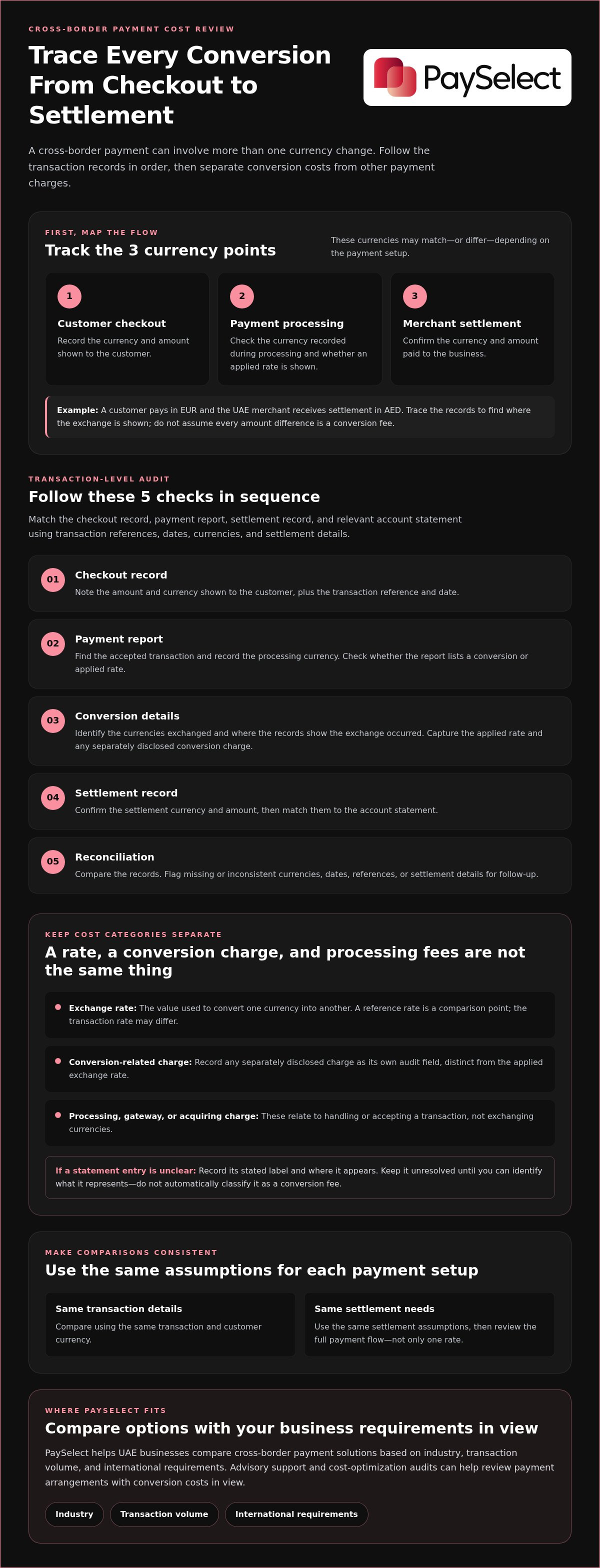
Processing, gateway, and acquiring charges are separate categories of payment costs. They relate to handling or accepting a transaction, while conversion costs arise from exchanging currencies. A statement may present these charges in different ways, so review its labels and pricing terms before drawing conclusions. Keep each cost in its own category when comparing arrangements.
Which currencies matter in an international transaction?
Track three currency points: the currency shown to the customer, the currency used during processing, and the currency in which the business receives settlement. These may match, but they do not have to. If a customer pays in EUR and the merchant receives settlement in AED, the payment flow may involve an exchange between those currencies. The exact route depends on the merchant’s setup.
For in-person payments, a customer may be offered a choice to pay in the card’s home currency rather than the local transaction currency. This is known as Dynamic Currency Conversion (DCC). It can shift where the conversion takes place, so record the currency presented at checkout and the currency ultimately settled to the business.
To make the flow visible, note each currency at checkout, processing, and settlement, then mark where one changes into another. Compare that map with transaction records and settlement statements. If a charge is unclear, keep it separate from the exchange-rate difference until you can identify what it represents. This gives your team a consistent basis for reviewing cross-border payment arrangements and comparing their costs without confusing conversion with payment processing.
Trace conversion fees from payment to settlement
A transaction-level audit shows where a currency changes and what the records say was deducted. Consider a hypothetical UAE merchant whose customer pays in EUR while the business receives settlement in AED. Follow that transaction from checkout to the account statement. Don’t assume every difference between the customer’s payment and the settled amount is a conversion fee. Identify each recorded step before assigning a reason.
Build a transaction-level conversion audit
Gather the checkout record, payment report, settlement record, and relevant account statement. Match them using transaction references, dates, currencies, and settlement details. Together, these records let you compare the transaction currency, the rate applied, the settlement currency, and each statement entry. For context, the International Trade Administration’s exchange-rate information can help explain why a reference rate and a transaction rate are not necessarily the same.
Work through the transaction in sequence:
Checkout
Record the amount and currency shown to the customer, along with the transaction reference and date.
Payment report
Find the accepted transaction and note the currency recorded during processing. Check whether the report shows a conversion or an applied rate.
Conversion
Identify the currencies exchanged and where the records show the exchange occurred. Capture the applied rate and any separately disclosed conversion-related charge.
Settlement
Confirm the currency and amount paid to the merchant, then match them to the settlement record and account statement.
Reconciliation
Compare the entries across records. Flag missing or inconsistent currencies, dates, references, or settlement details for follow-up.
Separate conversion costs from other deductions
Group each visible deduction by its stated purpose. A payment-processing charge, a gateway or acquiring charge, and a conversion-related charge are different categories, even if they appear close together in a report. Record the label used, the amount in AED where applicable, and the document where it appears. If the statement does not explain an entry, mark it as unresolved rather than classifying it as FX.
Keep the applied exchange rate and any separately disclosed conversion charge as distinct audit fields. A rate difference may affect the converted amount without appearing as a separate line item. Compare the rate only against a reference for the same currency pair and a relevant time; otherwise, the comparison may not explain the transaction. Don’t infer a hidden fee from a settlement difference alone.
After tracing a sample transaction, repeat the method for other currency and settlement combinations. This makes it easier to see whether the conversion point or the way charges are reported changes across your payment flow. Businesses reviewing their cross-border setup can use cross-border payment comparisons to assess arrangements against their transaction requirements.
How to compare payment setups for currency conversion
A fair comparison starts with a consistent test. If you assess each payment arrangement using different currencies, checkout steps, or settlement needs, the results won’t show which setup fits your business. Use the same transaction assumptions for every option, then compare the full payment flow rather than relying on a headline exchange rate.
For each scenario, keep the customer-facing currency, transaction details, and required settlement currency consistent. Record which party performs any conversion and when the rate is applied, if that information is disclosed. If a detail is unavailable, mark it as unknown. Don’t estimate missing charges or treat incomplete information as zero cost.
Create an apples-to-apples comparison
Set up a simple comparison sheet before reviewing options. Enter your transaction scenario once, then apply it consistently across each arrangement. This helps you compare currency coverage, rate disclosure, settlement choices, reporting, and related payment charges. Reviewing payment gateway comparison options can help you assess gateway arrangements against the same requirements.
| Comparison point | Arrangement A | Arrangement B |
|---|---|---|
| Customer-facing and processing currencies | Record supported currencies | Record supported currencies |
| Conversion point and applied rate | Note what is disclosed | Note what is disclosed |
| Settlement currency choices | Record available choices | Record available choices |
| Conversion and other payment charges | List by stated purpose | List by stated purpose |
| Transaction-level reporting | Note available details | Note available details |
This structure helps prevent unlike information from being mistaken for a direct comparison. For example, a rate shown without a clear conversion point or settlement currency does not reveal the full cost of a transaction. Record the source and date of each disclosed term so the comparison remains useful when arrangements or pricing information changes.
Assess settlement and reporting needs
Cost visibility is only one part of the decision. Consider whether your business needs settlement in one currency or several, and whether the available reports let your team reconcile conversion details by transaction. A setup that fits your currency needs and reporting workflow can make payment reviews easier to manage.
Compare operational fit alongside fee disclosure and supported currencies. Consider how each arrangement handles the customer journey, how settlement information reaches your records, and whether your team can identify the conversion details it needs. A headline rate alone cannot establish total cost or suitability. A consistent comparison gives you a clearer basis for deciding how to handle international currency conversion fees across your payment setup.
How to manage and monitor international conversion fees
A practical conversion-fee review means checking transaction records and settlement statements regularly, using consistent currency and transaction assumptions. It helps your business identify where conversions occur, which charges are disclosed, and when the payment flow changes. The goal is reliable visibility, not assuming that every difference in settlement is a fee or that one setup will always cost less.
Transaction mix matters. A business serving customers in several markets may process different currencies, use different checkout journeys, or settle funds differently across transactions. A comparison based on one currency pair may not represent the rest of the business. Review the currencies and transaction types in your actual payment activity, keeping each scenario distinct enough to reveal meaningful changes.
Set a repeatable review process
Choose a review interval that fits your transaction volume and internal reporting cycle. At each review, compare transaction-level records with settlement reports and account statements. Record the applied rate, conversion point, settlement currency, and any separately disclosed charges. Keep unclear statement entries marked for follow-up rather than assigning them a cause without evidence.
Use the same sequence each time:
Map currencies
Note customer-facing, processing, and settlement currencies for the transaction types you review.
Review statements
Match transaction records to settlement details and identify visible charges by their stated purpose.
Compare scenarios
Apply consistent transaction and currency assumptions when reviewing payment arrangements.
Track changes
Record shifts in transaction mix, customer markets, settlement arrangements, rate disclosure, or fee descriptions.
This record creates a useful baseline. If the business adds a customer market or changes its settlement arrangement, compare the new flow with the previous one using equivalent transactions. Note the review date and the records used, so another team member can understand how you reached a conclusion.
Reduce avoidable conversion friction
Review whether the currencies offered at checkout and used for settlement suit customer expectations and business operations. A currency choice can affect where conversion takes place, so assess the full payment flow before changing settings or arrangements. Consider how a change may affect the customer experience, settlement records, and your team’s ability to reconcile transactions.
Measure any change against comparable transaction data. Where possible, keep the same currency pair, transaction type, and settlement assumptions, then compare disclosed charges and applied rates before and after the change. If transaction volumes or customer markets have shifted, account for that difference rather than attributing every movement to the setup itself. This makes reviews more dependable and helps your team decide whether further investigation is needed.
For UAE businesses assessing cross-border payment arrangements against their international requirements, compare cross-border payment solutions with PaySelect and build a clearer basis for managing conversion costs.
How PaySelect can help assess cross-border payment options
Your audit can turn a broad search for a payment setup into a focused assessment. Use its findings to define what your business needs from an arrangement, such as clear fee information, useful transaction records, and a settlement approach that supports its operations. This gives the comparison a practical purpose: identify which options align with documented requirements and where you need more information.
PaySelect’s cross-border payment solution matching helps businesses assess options against their international payment needs. Rather than treating one rate as the deciding factor, bring your audit findings into the comparison so conversion details sit alongside reporting, settlement, and day-to-day operating requirements.
Turn fee findings into payment requirements
Prepare a concise brief from your audit. Note the customer currencies involved, your preferred settlement approach, the reporting details your team relies on, and any transaction patterns that affect the review. Include the conversion information you identified and the questions that remain unresolved. This gives each payment arrangement the same criteria for assessment.
Keep fee visibility connected to practical fit. A comparison can consider how well an arrangement supports your payment flow, the records your team needs, and how clearly relevant charges are presented. Mark gaps as open questions rather than estimating them. This helps you distinguish documented information from assumptions and make a more grounded assessment.
Use comparison and advisory support to move forward
PaySelect provides independent payment comparisons and guidance to help businesses structure this assessment. For organizations reviewing more complex payment infrastructure, its advisory support and cost-optimization audits can help examine existing arrangements and identify areas for further analysis. PaySelect supports decision-making rather than directly processing payments.
Use the findings to prioritize what matters most: transparency around conversion, reporting that supports reconciliation, and an operational fit for your business. Evaluate any proposed change against comparable transaction information rather than assuming it will reduce costs. Clear requirements can help your team move from scattered fee details to a more confident comparison.
Compare payment options for your business using the transaction needs and decision criteria you’ve documented.
Make currency visibility part of your growth plan
International payment arrangements should support where your business is going, not just how it operates today. As you consider entering a new market, changing how customers pay, or adjusting settlement preferences, include conversion visibility in the decision. A clear internal record of your requirements can help teams assess changes consistently and understand the trade-offs before they affect day-to-day operations.
Knowing how to handle international currency conversion fees is an ongoing capability, not a one-time exercise. Assign clear responsibility for payment reviews, and revisit your requirements when your business or customer mix changes. This creates a stronger foundation for informed decisions as international activity develops.
PaySelect helps UAE businesses compare payment options against their needs. Compare payment options for your business and take the next step with clear decision criteria.
Frequently Asked Questions
What are international currency conversion fees?
They’re costs linked to exchanging currencies during a cross-border payment. For a business, the practical questions are who bears each cost and where it appears: in the merchant’s settlement, on the customer’s card statement, or in both places. Distinguishing these perspectives helps teams avoid treating every cross-border charge as the same expense and gives them a clearer basis for explaining transaction costs internally.
How can I tell whether a payment includes a currency conversion fee?
Check the currency shown on the customer’s card statement and compare it with the amount and currency the business records for the sale. A cardholder may see a charge from their card issuer that won’t appear in the merchant’s settlement records. A merchant-side cost, in turn, may not be visible to the customer. Keeping these records separate helps prevent attributing one party’s charge to the other.
Who sets the exchange rate for an international card payment?
The rate is determined by the party or payment arrangement that carries out the conversion. Depending on where the exchange takes place, this may be handled within the merchant’s payment arrangement or by the customer’s card issuer. The transaction terms and receipt can help show which route applied. Don’t assume the rate shown to the customer is necessarily the rate used in the merchant’s settlement.
Can a business avoid currency conversion fees?
Some conversions may be avoidable if a business can receive and use funds in the same currency, subject to its payment and account arrangements. Also check whether a transaction is converted more than once as it moves through the business’s payment and supplier workflows. Reducing unnecessary currency changes may help, but it won’t necessarily remove other payment charges or suit every customer and supplier relationship.
How can I compare currency conversion fees between payment setups?
Consider your actual transaction mix, not just one example. If sales span different currencies or vary in size, a single transaction may not reflect the overall impact. Group records by currency and transaction type, then assess the combined effect on business proceeds over the same period for each setup. This helps reveal whether a result reflects your normal activity or an unusual payment pattern.
What happens if a customer is refunded after currency conversion?
The amount credited to the customer and the amount recorded by the business may not match the original transaction’s currency values. The refund’s treatment depends on the payment arrangement and how the original payment was processed. Keep the refund confirmation with the original sale record, and reconcile the related account entries together. This gives your team a clearer record of the customer refund and its effect on the business’s accounts.
Does displaying prices in a customer’s currency eliminate conversion fees?
No. Showing a localized price is a presentation choice; it doesn’t by itself determine how the payment is processed or settled. Check the currency shown on the customer’s payment confirmation, not only the currency displayed on the website. If the confirmation and the business’s settlement records use different currencies, the display setting alone hasn’t removed the need to review how the transaction is handled.
Disclaimer
This content is for informational purposes only and should not be considered financial, legal, or regulatory advice. Payment provider availability, pricing, and approval processes vary depending on individual business circumstances. PaySelect does not guarantee provider acceptance or specific outcomes. Businesses should conduct their own due diligence before entering into any agreements.
Empowering businesses to achieve greater growth