

A declined payment doesn’t always mean a lost sale, but a pattern of declines can reveal where checkout is creating friction. To understand how to improve payment authorization rates, first measure the rate: divide approved authorization attempts by total attempts, then multiply by 100.
A low authorization rate can reflect several different issues, from incorrect card details and issuer decisions to fraud controls that block legitimate customers. Treating every decline the same can lead to unnecessary retries or missed opportunities to fix the underlying cause.
This article explains how soft and hard declines differ, what can cause authorization failures, and how checkout data can help improve acceptance. You’ll also see why results may vary between domestic and cross-border payments, and which parts of your payment setup to review first.
Key Takeaways
• Use decline reasons to distinguish temporary payment problems from hard declines, then respond appropriately instead of retrying every failed payment.
• Break down acceptance by card type, transaction channel, and customer geography to uncover where cross-border payments face friction.
• Apply 3D Secure based on transaction risk and applicable issuer requirements to balance authentication with a smooth checkout.
• Review the customer and transaction details submitted at checkout to spot data gaps that may contribute to avoidable declines.
Soft and hard declines
A decline can signal a temporary issue, a permanent rejection, or a false alarm. Separating these outcomes helps protect checkout conversion without treating every failed payment alike.
Diagnosing Declines by Market and Segment
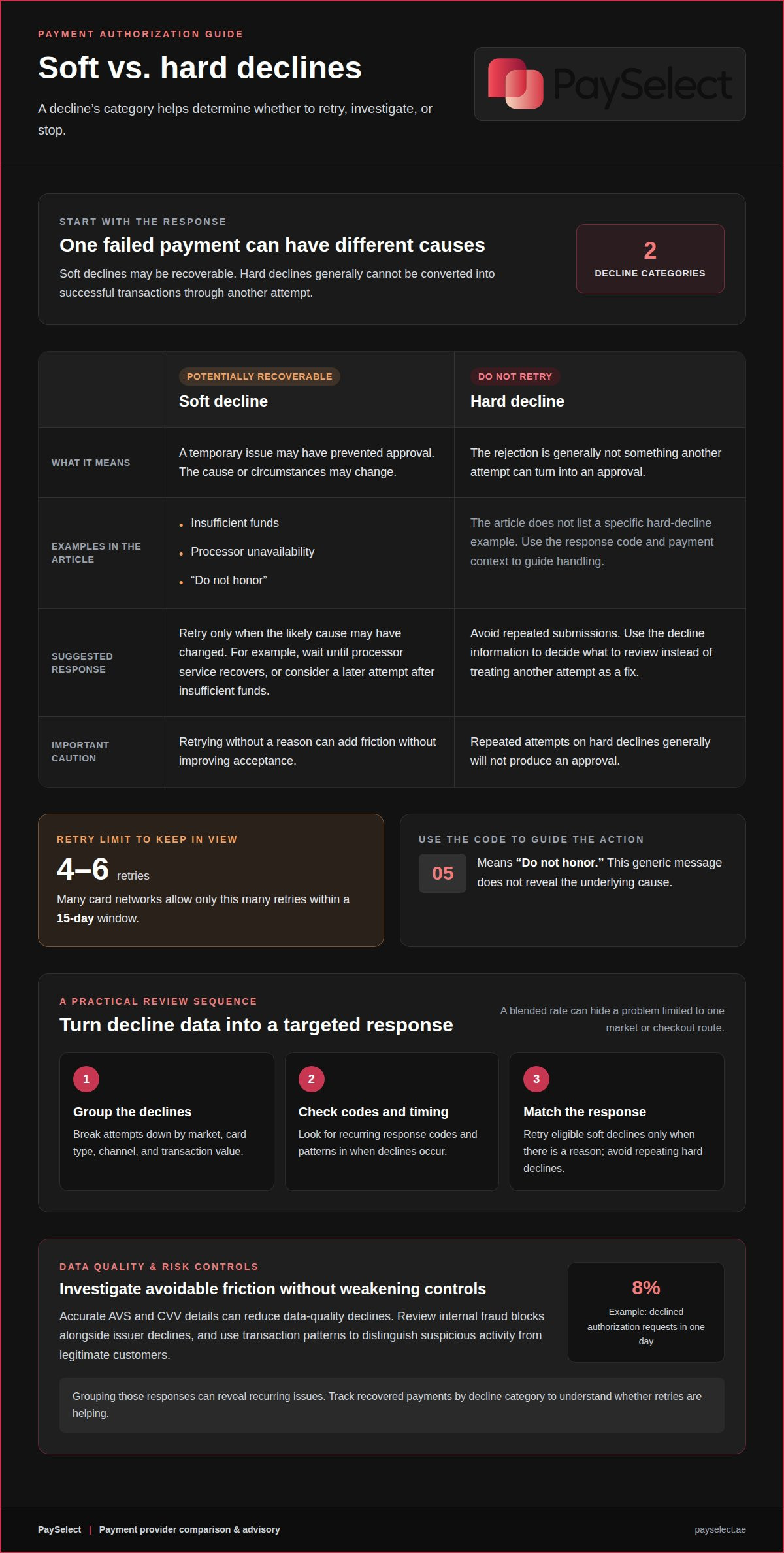
Diagnosing declines means grouping failed attempts by market, card type, channel, and transaction value. A blended rate can hide a problem affecting only international cards or one checkout route. Compare segments to find where declines cluster, then examine their response codes and timing. For example, a rise in declines in one market may point to a different issue than failures across all cards. This breakdown helps target corrective action instead of weakening controls for every customer.
Decline Categories and Codes
Soft declines may be recoverable, while hard declines generally cannot be converted into successful transactions and should not be retried. Insufficient funds, processor unavailability, and “do not honor” are examples of soft declines. Response codes are two-digit pairings indicating whether a transaction succeeded and, if declined, why. Code “05” means “Do not honor,” but the generic message does not explain the underlying cause. If 8% of authorisation requests are declined in a day, grouping those responses can reveal recurring issues. Accurate AVS and CVV details can reduce data-quality declines.
Fraud controls can support approvals while managing chargeback risk by blocking suspicious activity and reducing false positives. Use transaction patterns to distinguish suspected stolen credentials from legitimate customer activity. Review internal blocks alongside issuer declines so fraud rules do not unnecessarily lower your authorization rate.
Retries for Recoverable Declines
Intelligent retries resubmit eligible soft declines when the likely cause may have changed. For insufficient funds, a later attempt may succeed; for processor unavailability, retrying after service recovers may be appropriate. Don’t repeatedly submit hard declines, since they generally cannot become approved through another attempt. Many card networks allow only 4 to 6 retries within a 15-day window, so use the response code to guide the action and timing. Avoid retrying without a reason: repeated attempts can add friction without improving acceptance. Track recovered payments by decline category to see whether retries help.
Why do cross-border transactions have higher decline rates?
Foreign transactions can face more issuer scrutiny, so approval patterns vary by market and card type. Segment-level data helps identify where declines may affect conversion and revenue.
Card-Level and Issuer-Response Features
Card-level features describe a payment’s card type, issuing country, channel, and amount; issuer-response features capture how the bank responds. Reviewing these together shows whether declines cluster around international credit cards, particular transaction values, or online checkout. For example, an overall rate can hide strong domestic debit approvals alongside weaker international credit card results. Track card type, BIN country, transaction channel, and value range to make comparisons meaningful.
Issuer Relationships and Local Acquiring
In the UAE, the acquiring route determines how a transaction reaches the card network and issuing bank, which makes local acquiring relevant to approval analysis. The issuer still makes the approval decision. Cross-border recurring payments typically show an authorization rate of 72-80%, compared with 82-88% when local acquiring is used. These benchmarks help businesses assess routing alongside their own issuer-response data, rather than assuming one route suits every market.
Benchmarks also vary by transaction type. Domestic e-commerce transactions with strong controls and optimized routing typically reach 92-96%, while cross-border e-commerce transactions generally reach 85-92%. Online card authorization rates can be 10% lower than in-person rates. Compare like with like: a domestic card result is not a fair benchmark for an international online transaction.
Routing strategy can matter when acquirers perform differently across transaction segments. Smart routing can lift authorization rates by 1-3 percentage points where acquirer performance varies significantly. Assess approval rates by market and card segment before changing routes; a blended rate may conceal where a better-performing processor could help.
Machine-learning risk tools can assess transaction history, location, device information, and user behavior before network authorization. This helps screen risk while avoiding blanket blocks on legitimate cross-border customers. A focused review of cross-border payment setup can help businesses consider routing and market fit together.
What causes payment authorization failures?
Payment failures can stem from issuer decisions, missing authentication, or checkout data that fails verification. Understanding these causes helps merchants decide how to improve payment authorization rates without adding unnecessary friction or weakening security.
Strong Customer Authentication and Exemptions
Strong Customer Authentication (SCA) verifies a payer’s identity using more than one authentication step, affecting how some online payments proceed. According to the European Commission, PSD2 introduced SCA, involving at least a two-phase authentication of the payer’s identity. Where applicable rules permit an exemption, a payment may proceed without the same authentication flow. Merchants should account for transaction context and applicable requirements when setting checkout rules.
Second-Factor Authentication and CVV Checks
Two-factor authentication asks customers for additional proof of identity, while a CVV check validates card details. These checks can help identify a stolen card or incorrect payment information, but extra steps may interrupt checkout if they are poorly timed or unclear. For example, a customer may abandon payment if an authentication prompt fails to load. Clear instructions and accurate card data support a smoother verification process.
Payment Authentication with 3D Secure
3D Secure adds an authentication exchange between the customer, merchant, and card issuer during an online transaction. 3D Secure 2 is a payment security protocol that can help improve authorization rates. Authentication may happen without a visible challenge or require the customer to complete one. This distinction matters because unnecessary interruptions can add friction, especially on mobile checkout. Reviewing those flows can guide decisions about how to improve payment authorization rates.
Risk-Based 3D Secure Authentication
Risk-based authentication applies 3D Secure according to transaction risk, issuer requirements, customer location, and transaction value. Merchants can use these factors to decide when a challenge is appropriate, rather than applying the same flow to every payment. For example, a higher-risk transaction may require stronger verification, while a lower-risk payment may follow a less disruptive path where permitted. This approach aligns authentication with risk while supporting checkout conversion.
Can collecting more customer data at checkout improve payment acceptance?
Relevant billing and transaction details can help an issuer assess a payment request. Authorization tools involve trade-offs: extra checks may reduce fraud, but unnecessary fields and authentication steps can add checkout friction and deter legitimate customers.
Authorization Optimization in Digital Commerce
Authorization optimization means improving how payment data, transaction flows, and recovery options work together. At checkout, accurate billing details, such as a ZIP code where applicable, and the card verification value (CVV) can help establish payment credibility and reduce data-quality declines. Collect only useful information; extra fields can slow customers without adding meaningful context. For stored cards, account updater services can reduce declines caused by outdated card details.
Payment choice matters too. Offering methods customers use locally can support cross-border acceptance, while a card-only flow may not suit every market. For specialized corridors and international transfers, dedicated fintech services such as ducapp.com demonstrate how adapting payment methods to specific regional needs helps ensure successful transactions. Review failed requests by payment method, card type, and customer location. This helps distinguish a method-specific issue from a broader checkout problem. Keep hard declines separate from recoverable failures, and don’t send repeated requests when the issuer has rejected the card.
3DS Optimization
3DS optimization means matching authentication to transaction risk and preserving a smooth payment flow. 3D Secure can provide issuers with richer transaction context, which may reduce fraud-based declines. Where appropriate, risk-based authentication helps avoid challenging every customer in the same way. The balance matters: a stolen card requires effective controls, but unnecessary steps can disrupt legitimate credit card purchases.
If an authenticated payment falls back to another processor, the original 3D Secure result may be reused where applicable. This can prevent customers from repeating authentication. Payment holds also affect acceptance: a lower hold amount is more likely to be approved than a higher one, so match the hold to the transaction need. Businesses assessing whether their setup supports these changes can review payment gateway options alongside checkout requirements.
PaySelect
PaySelect helps UAE businesses compare payment gateways, cross-border payment solutions, and provider pricing against their business requirements. Its comparison platform can support businesses assessing new options, while its payment consulting and advisory services can help larger organizations review an existing payment setup without necessarily switching providers.
Advisory support can include reviewing transaction and settlement reports, benchmarking current fees, identifying unnecessary costs, and recommending improvements. For businesses weighing their next step, PaySelect can help assess whether to refine existing arrangements or compare alternatives.
Make payment acceptance part of your growth plan
Payment acceptance deserves a place in ongoing business planning, not just a one-time checkout review. As your customer mix, sales channels, and international reach change, your payment setup may need reassessment. If you’re deciding how to improve payment authorization rates, connect acceptance performance with wider decisions about payment infrastructure and expansion.
PaySelect helps businesses compare payment gateways, POS systems, and cross-border payment solutions. Its comparison platform can help you assess options against your business needs, whether you’re reviewing existing arrangements or planning to enter new markets.
Contact PaySelect to discuss your payment setup and identify the next practical step for your business. A clearer payment strategy can support smoother checkout experiences as your business grows.
Frequently Asked Questions
What is the authorization rate?
The authorization rate measures issuer approvals among payment attempts. It differs from checkout conversion, which reflects whether visitors complete purchases. A shopper can leave before submitting payment, while an authorization decline happens after the payment request reaches the issuer. Keeping these measures separate helps identify whether lost sales stem from checkout usability or payment approval.
How do automatic retries help recover failed transactions?
Automatic retries let a payment system make another eligible attempt without asking the customer to restart checkout. For recurring billing, the system can connect a retry to the original invoice and update its status after payment succeeds. This can reduce manual follow-up and confusion. Businesses should also ensure retry processes prevent duplicate charges and keep payment records aligned.
What are authorization rates?
Authorization rates can describe different stages of payment recovery. A first-attempt rate counts approvals on the initial request, while a broader approval rate can include successful recoveries through retries, failover, or another payment method. Naming the measure clearly in reports helps teams avoid comparing unlike results and makes performance discussions more precise.
Why does routing payments to specific processors improve success rates?
Routing determines which processing path handles a payment request. It can support continuity during a technical interruption, provided another suitable path is available and the payment details remain valid. For example, a temporary connection issue may call for a different route, while an issuer rejection may not. Clear routing rules help teams distinguish technical recovery from a declined payment.
What is a payment authorization rate and how is it calculated?
The authorization rate is the share of submitted authorization requests that receive issuer approval, expressed as a percentage. Calculate it by dividing approved authorization attempts by all authorization attempts in the same reporting group. Keep the group consistent: don’t mix test transactions, abandoned checkouts, or unrelated channels with submitted payment requests. This makes the result useful for monitoring payment performance rather than general sales activity.
What is a good payment authorization rate by industry, country, and payment method?
A useful benchmark comes from businesses with a similar industry, customer geography, and payment-method mix. Compare domestic card payments with domestic peers, and cross-border activity with comparable international transactions. Review the trend alongside changes in customer mix and checkout channels. A single broad benchmark can mislead if one business handles recurring payments while another mainly processes one-time purchases.
Disclaimer
This content is for informational purposes only and should not be considered financial, legal, or regulatory advice. Payment provider availability, pricing, and approval processes vary depending on individual business circumstances. PaySelect does not guarantee provider acceptance or specific outcomes. Businesses should conduct their own due diligence before entering into any agreements.
Empowering businesses to achieve greater growth
