
The June 2026 preliminary settlement between major card networks and 12 million merchants has fundamentally rewritten the rules of payment processing. For years, you've likely struggled with opaque fee structures and the rising costs of digital transactions that eat away at your bottom line without warning. It's a common pain point for businesses: monthly statements that lack transparency and a payment stack that feels more like a burden than a tool for expansion. You deserve a payment infrastructure that acts as a catalyst for growth rather than a drain on resources.
Mastering how to negotiate credit card processing fees is now a strategic necessity rather than an optional task. By understanding the new 1.25% cap on standard consumer cards and the ability to decline high-cost premium cards, you can finally remove operational barriers to your success. We'll show you how to reduce Merchant Discount Rates and eliminate hidden costs through professional auditing and strategic negotiation. This guide provides a clear roadmap for auditing your current infrastructure, moving toward transparent pricing models, and using PaySelect's comparison tools to find the most efficient payment setup. We'll examine the latest regulatory shifts, the move toward interchange-plus pricing, and the specific tactics you need to secure a leaner, more profitable future.
Key Takeaways
• Identify the difference between fixed interchange fees and the negotiable processor markup to target the specific areas where you can reclaim lost margin.
• Learn how to negotiate credit card processing fees by requesting a shift to interchange-plus pricing, ensuring every cost is clearly documented and transparent.
• Establish a data-driven baseline by calculating your true "Effective Rate" using six months of processing history to expose hidden junk fees.
• Lower your overhead further by implementing Level 2 and Level 3 data protocols for B2B transactions and optimizing your cross-border payment infrastructure.
• Leverage independent audits and competitive bidding to gain the benchmark data required to secure more favorable terms from your providers.
Demystifying the Components of Credit Card Processing Fees
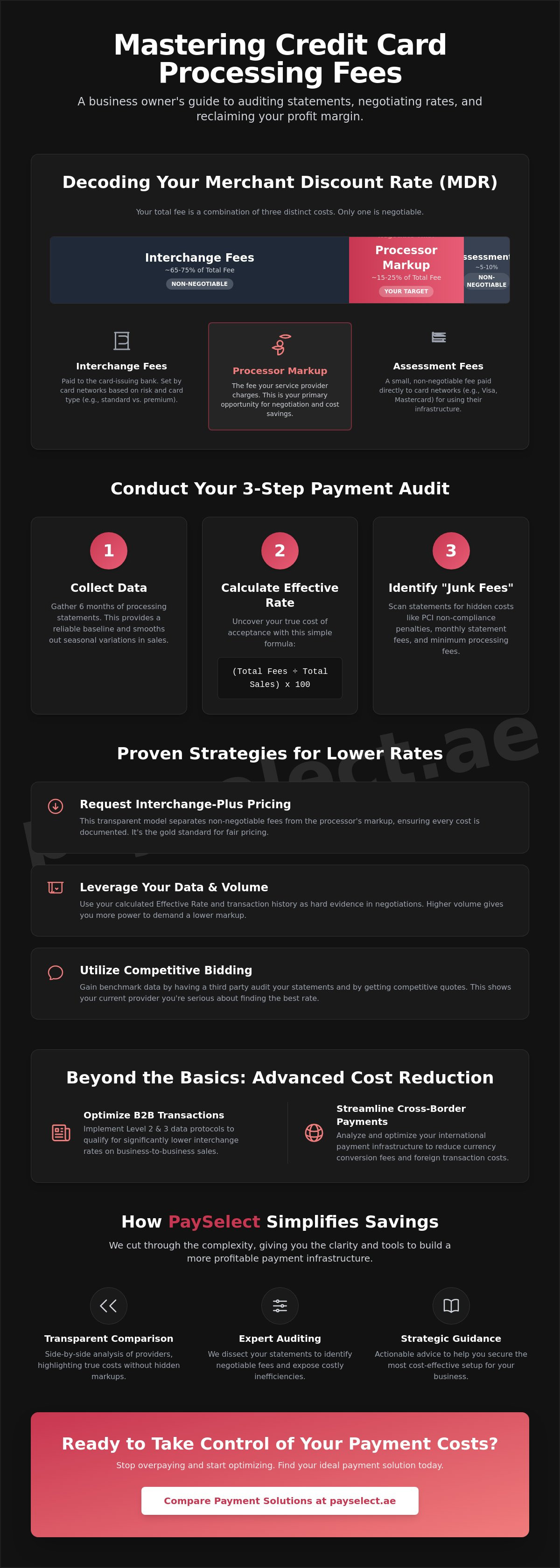
Understanding your monthly statement is the first step in learning how to negotiate credit card processing fees effectively. Most merchants view their processing cost as a single, monolithic charge known as the Merchant Discount Rate (MDR). In reality, this rate is a composite of three distinct layers: interchange, assessments, and the processor markup. By dissecting these components, you can identify which costs are fixed by global networks and which are flexible enough for negotiation. In regions like the UAE, where local card schemes and regional assessments often differ from standard US models, this transparency is even more critical for maintaining healthy margins.
The 2026 market dynamics have shifted power back to the merchant. Recent regulatory changes, including the preliminary approval of the Visa and Mastercard settlement in June 2026, have introduced a 10 basis point reduction in interchange rates. This shift, combined with the new ability for merchants to decline certain high-fee premium cards, creates a fertile environment for cost optimization. If you don't know where the processor's margin ends and the network's fee begins, you're likely overpaying for your payment infrastructure. PaySelect acts as a bridge here, helping you audit these layers to ensure your technical stack remains efficient and cost-effective.
Interchange and Assessment Fees
Demystifying Interchange Fees is essential because they represent the largest portion of your costs. These fees are paid to the card-issuing bank and are set by the card networks based on risk, transaction environment, and card type. For example, as of April 2026, a Mastercard "Core" card carries a 1.65% base rate, while premium "World Elite" cards carry significantly higher costs. Assessment fees are smaller, non-negotiable charges paid directly to the networks for the use of their infrastructure. While these are fixed, they require constant monitoring to ensure your provider isn't inflating them under the guise of mandatory network costs.
The Processor Markup: Your Primary Negotiation Target
The processor markup is the only truly flexible component of your MDR. This is the fee your service provider charges for facilitating the transaction, providing the gateway, and managing your account. Providers often hide their profit margins within "bundled" or "tiered" pricing models, making it difficult to see the actual markup. Identifying the specific "service fee" or "basis points" added on top of interchange is the key to how to negotiate credit card processing fees. Higher transaction volumes typically grant you more leverage to compress this markup. PaySelect helps businesses bypass this complexity by providing a payment pricing comparison that highlights the true cost of acceptance across different providers without the fluff.
Conducting a Comprehensive Payment Infrastructure Audit
You can't fix what you haven't measured. Effective negotiation starts with a deep dive into your own data. Collect six months of processing statements to establish a reliable baseline. This timeframe is long enough to smooth out seasonal spikes and provide a clear picture of your average costs. Use this data to calculate your "Effective Rate" by dividing your total processing fees by your total sales volume. This single percentage reveals the true cost of acceptance, bypassing the confusing terminology of individual line items. Calculating your Effective Rate is a critical component of learning how to negotiate credit card processing fees, as it gives you a clear figure to compare against industry benchmarks.
While analyzing your statements, look for "junk fees" that often go unnoticed. These include monthly statement fees, PCI non-compliance penalties, and minimum processing fees. These aren't just small costs; they're indicators of an inefficient setup. A Federal Reserve analysis of interchange fees underscores that while network costs are rigid, the administrative layer is where processors often pad their margins. Evaluating the technical efficiency of your payment gateways ensures you aren't paying for outdated technology that increases your risk profile. Once you have identified these leaks, you'll have the leverage needed for how to negotiate credit card processing fees from a position of data-driven strength.
Analyzing Transaction Data and Patterns
Segment your volume to understand your specific risk profile. Card-present transactions generally carry lower rates than card-not-present (CNP) digital payments. If your CNP volume is high, your baseline will naturally be higher. Track your average ticket size too. Small tickets are heavily impacted by per-transaction flat fees, while large tickets are more sensitive to percentage-based markups. Your Merchant Category Code (MCC) also dictates your baseline interchange. Knowing your MCC allows you to verify if your processor is applying the correct rates for your industry. If you find these patterns, a Payment Cost Optimization Audit can help pinpoint exactly where your capital is leaking.
Identifying Hidden Operational Costs
Operational friction costs money. Outdated POS machines can lead to higher "downgrade" rates if they lack the latest security protocols, forcing transactions into more expensive categories. Beyond hardware, assess the financial impact of chargebacks and refund fees, which can quickly erode your margin. For businesses operating internationally, look closely at currency conversion markups. These hidden costs in cross-border payments are often bundled into a single line item, masking an expensive foreign exchange spread. Uncovering these hidden markups is a vital step in streamlining your global payment infrastructure.
Proven Strategies to Negotiate Lower Merchant Rates
Negotiation isn't a request for a favor; it's a strategic realignment of your payment infrastructure. Once your audit has exposed the inefficiencies in your current statement, you have the data required to drive a hard bargain. The goal is to transform your payment setup from a stagnant cost center into a fluid catalyst for growth. In the UAE's evolving landscape, where local card schemes and international transactions often mix, merchants who understand how to negotiate credit card processing fees gain a significant competitive edge. Comparing your current rates against lower-fee alternatives like lyrxpay.com is a key part of this process. Use the following five steps to secure a more profitable technical stack.
Step 1: Request Interchange-Plus Pricing.
Demand a move to this model to gain maximum transparency and ensure you only pay the processor a fixed markup over the actual cost.
Step 2: Leverage Competitive Bids.
Use data from multiple providers to create immediate urgency. If your current partner knows you're looking elsewhere, they're more likely to compress their margins.
Step 3: Highlight Business Growth.
Present your projected volume increases. Processors value high-growth accounts and will often trade a lower percentage for the security of a long-term, high-volume partnership.
Step 4: Negotiate Fee Waivers.
Focus on removing "junk fees." Annual, setup, and cancellation fees are often arbitrary and can be waived for established businesses.
Step 5: Secure a Rate Lock.
Don't let your hard-won rates vanish. Negotiate a contract clause that prevents the processor from raising their markup for a specific period, typically 24 to 36 months.
Choosing the Right Pricing Model
The pricing model you select is the foundation of your cost structure. Flat-rate pricing is simple but often expensive for high-volume merchants. Tiered pricing is frequently opaque, hiding "hidden tiers" that can lead to unexpected cost spikes. This guide to credit card processing fees highlights that while network costs are fixed, the service markup is where you find flexibility. Professional businesses favor Interchange-Plus because it provides a clear view of the processor's profit. PaySelect's payment pricing comparison tool helps you identify which model best suits your specific transaction patterns, ensuring your infrastructure remains lean and efficient.
The Power of Comparative Leverage
Leverage comes from having viable alternatives. When you approach a provider, don't just ask for better terms; show them you understand the market. In the UAE, regional nuances like local debit card processing can significantly alter your Effective Rate. If your current provider won't align with market standards, it may be time to consider a migration. Using PaySelect's payment gateway comparison tool gives you the benchmark data needed to challenge your current rates. This data-driven approach removes the guesswork from how to negotiate credit card processing fees, allowing you to focus on scaling your business without the friction of excessive merchant costs.
Reducing Costs Beyond the Baseline Percentage
Efficiency in your payment technical stack isn't just about the percentage you pay; it's about the quality of the data you transmit. While mastering how to negotiate credit card processing fees focuses on the processor's markup, technical optimization addresses the non-negotiable interchange costs. By refining the way transactions are processed, you can qualify for lower rates that are otherwise unavailable to standard configurations. This proactive approach transforms your payment gateway from a simple utility into a strategic tool for business transformation.
B2B merchants often miss significant savings by neglecting Level 2 and Level 3 data processing. These protocols require additional transaction details, such as tax IDs and freight amounts, which signal lower risk to card-issuing banks. Providing this extra data can move your transactions into lower interchange tiers, often saving more than a simple markup negotiation ever could. Similarly, optimizing cross-border payments allows you to bypass the expensive foreign exchange spreads often hidden in bundled rates. Matching your business with the right regional solutions ensures you aren't paying a premium for international fluidity.
Fraud reduction also plays a direct role in lowering your costs. High chargeback ratios lead to increased risk-related assessment fees and can even result in your business being moved to a higher-risk category. Implementing robust security measures doesn't just protect your revenue; it lowers the baseline cost of every transaction you accept. To identify these hidden savings, start a Payment Cost Optimization Audit today.
Technical Optimization for Lower Rates
Security protocols like 3D Secure and Address Verification (AVS) are vital for more than just fraud prevention. These tools provide the "proof of presence" that banks require to offer their best rates. Tokenization further streamlines this process by securing repeat purchases, which lowers the perceived risk of a transaction. When your technical stack is optimized with these features, you reduce the likelihood of "downgrades," where transactions are processed at higher, non-qualified rates due to missing security data.
Alternative Payment Methods
Customer convenience must be balanced with the cost of acceptance. Integrating local card schemes often provides a lower-cost alternative to global brands, especially for domestic transactions. We are also seeing a rise in account-to-account (A2A) payments, which bypass traditional card networks entirely to offer significantly lower fees. By encouraging these lower-cost methods at the checkout level, you can reduce your overall Effective Rate while still providing a frictionless user experience. This strategic shift is a powerful supplement to your efforts in how to negotiate credit card processing fees.
Leveraging Independent Advisory for Long-Term Savings
Navigating the complexities of merchant services alone often leads to sub-optimal results. While the steps to learn how to negotiate credit card processing fees are clear, executing them requires access to high-level benchmark data that most internal teams simply don't possess. Without knowing the current market floor for your specific industry and volume, your negotiation is based on guesswork rather than leverage. Independent advisory bridges this gap by providing the technical expertise and market intelligence needed to secure institutional-grade terms.
Moving from reactive cost-cutting to a proactive payment strategy is the hallmark of a sophisticated enterprise. Instead of waiting for a fee hike to trigger a review, an unbiased payment infrastructure audit identifies inefficiencies before they impact your margin. Professional matching tools simplify the vendor landscape by filtering out providers that don't align with your technical requirements. This results in a fluid, high-performance payment stack that supports your international ambition without the friction of non-transparent costs.
The PaySelect Advantage
We provide the clarity required to validate your current rates against the broader market. Our payment pricing comparison tools allow you to see exactly how your provider stacks up against industry leaders without the bias of a direct sales pitch. For enterprise-scale organizations, our Payment Infrastructure Consulting offers bespoke advisory that aligns your technical needs with the most efficient cost structures. You gain access to a global network of solutions, ensuring your business remains competitive in a fast-moving digital economy.
Next Steps for Your Business
Consistency is the key to long-term savings. Schedule a periodic Payment Cost Optimization Audit to ensure your rates remain competitive as your volume scales. Staying informed on regulatory shifts in the UAE financial landscape, such as changes to local interchange schemes, will help you maintain your leverage. The first step toward a more efficient future is a professional assessment. By shifting the burden of analysis to expert tools, you can focus on what matters most: expanding your reach and serving your customers. This data-driven approach is the most reliable way to master how to negotiate credit card processing fees for sustained profitability.
Secure Your Competitive Edge Through Payment Optimization
Recent regulatory shifts offer a unique window for businesses to reclaim lost margins and eliminate operational friction. By conducting a data-driven audit and shifting to an interchange-plus model, you move from a state of uncertainty to one of total transparency. Mastering how to negotiate credit card processing fees isn't just about the immediate discount; it's about building a technical stack that scales with your ambition. You have the tools to convert a complex cost center into a fluid asset for your brand.
PaySelect acts as your strategic partner in this transition. We provide the independent and unbiased advisory required to navigate the complex vendor landscape in the MENA region. Through bespoke payment infrastructure audits and expert matching, we ensure your business is paired with the most efficient solutions for your specific needs. Don't let opaque fees hold back your international expansion. Take control of your cost structure and turn your payment setup into a catalyst for growth.
Optimize your payment costs today with PaySelect. Your path to a leaner, more profitable infrastructure starts with a single professional assessment. You're ready to lead in the digital economy.
Frequently Asked Questions
Can I really negotiate my credit card processing fees if I am a small business?
Yes, small businesses have significant leverage when they understand how to negotiate credit card processing fees. While you can't change the interchange rates set by networks, the processor's markup is entirely flexible. Providers often compete for high-growth accounts; showing you have competitive bids can force them to reduce their service fees to keep your business. This strategy works best when you present data-driven evidence of your transaction volume and growth potential.
What is a "good" merchant discount rate (MDR) in the UAE for 2026?
A competitive MDR in the UAE is one that remains transparently linked to the actual cost of the transaction. In 2026, a "good" rate is typically an interchange-plus model where the markup is clearly defined and minimal. Since different payment providers offer varying structures for regional versus international cards, you should use comparison tools to ensure your effective rate remains at the lower end of the industry average for your specific category.
Are interchange fees negotiable with my bank?
Interchange fees are non-negotiable because they are set at the network level by entities like Visa and Mastercard. These fees are paid to the card-issuing bank, not your processor or your local bank. However, understanding these fixed costs is essential for how to negotiate credit card processing fees; it allows you to isolate the negotiable markup that your processor adds on top. Knowing the floor helps you target the right areas for savings.
How often should I audit my payment processing statements?
You should perform a comprehensive audit of your payment processing statements every six months. Regular reviews allow you to catch "fee creep" where processors gradually increase markups over time. Periodic audits also ensure your business is benefiting from new regulatory caps, such as the interchange reductions that took effect in early 2026. This proactive approach ensures your payment infrastructure remains lean and efficient as your business scales.
What are the most common hidden fees to look for in a merchant agreement?
Look for non-essential charges like statement fees, PCI non-compliance penalties, and monthly minimum fees. These "junk fees" are often added to pad the processor's margin without providing extra value. A professional audit can help identify these line items so you can request their immediate removal or waiver during your next negotiation session. Eliminating these small costs can lead to significant annual savings for high-volume merchants.
Does switching payment providers cause significant downtime for my business?
What is the difference between a payment gateway and a merchant account?
A payment gateway is the software that securely transmits transaction data, while a merchant account is the specialized bank account where funds are held before being settled. Some providers bundle these services together, while others allow you to choose them independently. Selecting the right combination is a key part of building an efficient infrastructure. The gateway handles the technical communication, while the merchant account handles the financial liquidity.
How does Level 3 data help in lowering my processing costs?
Level 3 data lowers costs by providing line-item detail for B2B and corporate card transactions. By including information like product codes and tax amounts, you signal a lower risk profile to the card networks. This allows the transaction to qualify for lower interchange tiers, which can significantly reduce the overall cost of acceptance. It's a highly effective technical lever for businesses that process a high volume of commercial or government payments.
Disclaimer
This content is for informational purposes only and should not be considered financial, legal, or regulatory advice. Payment provider availability, pricing, and approval processes vary depending on individual business circumstances. PaySelect does not guarantee provider acceptance or specific outcomes. Businesses should conduct their own due diligence before entering into any agreements.
Empowering businesses to achieve greater growth