
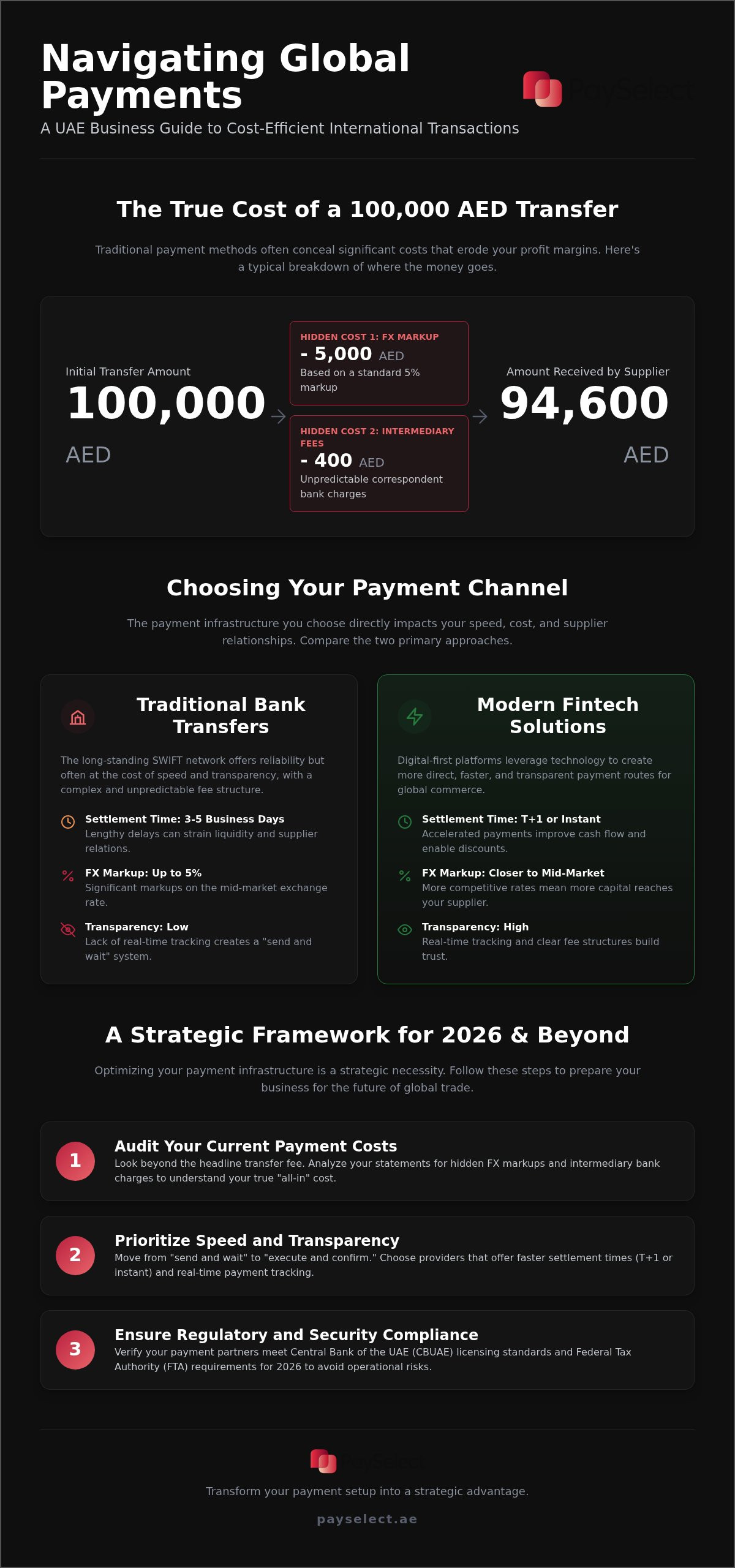
For a UAE business transferring 100,000 AED, a standard 5% foreign exchange markup can quietly siphon 5,000 AED from your profit margins before the funds even reach your supplier. When you add unpredictable intermediary bank fees that often climb to 400 AED per transaction, it's clear that traditional cross-border methods lack the transparency modern commerce demands. You shouldn't have to choose between settlement speed and cost-efficiency when scaling your international operations.
This guide explores the cheapest way to pay international suppliers from uae by optimizing your payment infrastructure for the 2026 digital economy. We'll examine how new Federal Tax Authority requirements and Central Bank of the UAE licensing standards are reshaping the local industry. You'll learn to compare different provider categories, from traditional institutions to agile tech facilitators, ensuring your capital moves with absolute fluidity. We provide a transparent view of available options so you can eliminate hidden markups, accelerate settlement times, and transform your payment setup into a strategic advantage for global growth.
Key Takeaways
• Identify and eliminate hidden costs such as FX markups and unpredictable intermediary bank fees that can erode up to 5% of your transaction value.
• Discover the cheapest way to pay international suppliers from uae by matching your specific trade routes with the most efficient payment channels.
• Stay ahead of 2026 regulatory shifts, including new VAT compliance rules and Central Bank licensing requirements for cross-border transfers.
• Move beyond traditional bank transfers to leverage modern infrastructure that offers faster settlement times and greater transparency.
• Use independent comparison tools to audit your current payment infrastructure and identify the most cost-effective providers for your business volume.
The Landscape of International Supplier Payments in the UAE
UAE enterprises operate at the center of global trade, making efficient capital movement a core business requirement. By 2026, the UAE has solidified its position as the world's second-largest hub for outbound remittances. However, the methods used to settle these invoices are undergoing a radical transformation. Traditional bank transfers, once the undisputed standard, now face intense competition from agile digital solutions that prioritize speed and cost-efficiency.
For modern merchants, finding the cheapest way to pay international suppliers from uae requires looking beyond the headline transfer fee. Hidden costs often lurk in exchange rate markups and unannounced intermediary bank charges, which can reach 400 AED per transaction. These friction points don't just drain capital; they strain supplier relationships and introduce volatility into the supply chain. Ensuring your payment infrastructure is optimized is now a strategic necessity rather than an administrative task.
The Shift from Traditional Banking to Fintech Solutions
Digital-first platforms have disrupted the aging correspondent banking model by creating more direct routes for capital. These global payment systems leverage modern messaging standards like ISO 20022 to provide real-time tracking and enhanced transparency. While traditional wire transfers might take several business days, modern facilitators often achieve T+1 or even instant settlement. This speed is vital for maintaining liquidity and securing early-payment discounts from global partners. It's about moving from a system of "send and wait" to one of "execute and confirm."
Regulatory Compliance and Security in the UAE
Operating within the UAE's robust financial framework requires strict adherence to Central Bank of the UAE (CBUAE) standards. Under Federal Decree-Law No. 6 of 2025, payment providers must meet rigorous licensing requirements by September 2026 to ensure market stability. Businesses must verify that their chosen cross-border payments infrastructure complies with the latest Anti-Money Laundering (AML) and Know Your Customer (KYC) protocols to avoid operational delays or legal complications.
Security is paramount for high-value corporate transfers. Modern solutions utilize advanced encryption and provide clear audit trails, which are essential for meeting the Federal Tax Authority's 2026 VAT compliance rules. By choosing a partner that balances regulatory rigor with technological innovation, businesses can ensure their international transactions are both secure and optimized for growth. Maintaining this balance allows for fluid commerce without compromising on the rock-solid reliability required by institutional partners.
Primary Channels for Settling Global Invoices
Selecting the right settlement channel is a strategic decision that directly impacts your bottom line. While many businesses default to their primary corporate bank, the most efficient route depends on transaction frequency and total volume. Modern merchants now balance traditional institutional security with the agility of digital-first facilitators to find the cheapest way to pay international suppliers from uae. Identifying the cheapest way to pay international suppliers from uae requires a holistic view of both flat fees and exchange rate markups.
Traditional SWIFT Transfers and Bank-to-Bank Payments
The SWIFT network remains the global standard for high-value institutional transfers. It provides a rock-solid audit trail and is deeply integrated into Trade Financing in the UAE. However, this reliability comes with a complex fee structure. Beyond the standard transfer fee, which typically ranges from 50 to 100 AED, funds often pass through multiple correspondent banks. Each intermediary can deduct fees up to 400 AED without prior notice. This lack of transparency can lead to short-payments, causing unnecessary friction with your global suppliers.
Specialized Cross-Border Fintech Providers
Specialized cross-border providers have emerged as a powerful alternative for frequent, mid-sized transactions. These platforms often provide exchange rates significantly closer to the mid-market rate than traditional banks, where FX markups can reach 5%. By using multi-currency accounts, you can manage your liquidity in AED and settle invoices in various foreign currencies without multiple conversion steps. Speed is a major advantage here. Many digital facilitators offer same-day or T+1 settlement; this is a sharp contrast to the three to five business days typical of traditional banking chains.
If your business handles high-frequency trade, these efficiency gains are substantial. To identify which category offers the most value for your specific volume, you can explore a cross-border payments comparison to see exactly where you can optimize your infrastructure. Matching your provider to your specific trade routes ensures that your capital remains fluid and your supplier relationships stay strong.
Navigating Friction Points and Hidden Transaction Costs
Opaque pricing structures often mask the true cost of international commerce. When searching for the cheapest way to pay international suppliers from uae, businesses often prioritize low upfront fees, yet they neglect the impact of settlement uncertainty. If a supplier receives less than the invoiced amount due to hidden deductions, the resulting friction can damage long-term partnership trust. This is a psychological barrier that can lead to delayed shipments or tighter credit terms, ultimately stalling your business expansion.
Identifying the cheapest way to pay international suppliers from uae involves looking at the total cost of ownership, not just the wire fee. Many providers offer "free" transfers as a marketing hook, but these transactions often carry the most significant costs. These hidden expenses are usually buried in the exchange rate spread or applied as "processing fees" later in the settlement chain. It's a common trap that can make a seemingly inexpensive service far more costly than a transparent, fee-based alternative.
Many business owners hesitate to move away from traditional banking due to perceived security risks. However, the modern financial landscape is heavily regulated. As long as a facilitator operates under the oversight of the Central Bank of the UAE, they must adhere to institutional-grade security protocols. The transition isn't about sacrificing safety; it's about upgrading to a more transparent infrastructure that provides absolute clarity on where your capital is at every stage of the journey.
The Hidden Costs of Currency Exchange
The mid-market rate is the real exchange rate used by banks to trade with each other. Any deviation from this is a markup. While a provider might advertise zero commission, a slight spread adjustment can be more expensive than a flat-fee transfer. For companies with high-volume procurement, even a 0.5% markup on a million AED annual spend results in 5,000 AED of avoidable costs. Locking in rates through forward contracts or using providers with transparent spreads allows for more predictable budgeting and protects your margins against FX volatility.
Operational Barriers and Integration Challenges
Resource drain isn't limited to transaction fees. Manual reconciliation across multiple bank portals creates significant bottlenecks for accounting teams. When payments aren't integrated into your existing ERP or accounting software, the risk of human error increases. Automated cross-border payments solutions solve this by offering API integrations and automated payment links. This connectivity ensures that every dirham is tracked and reconciled in real-time. By utilizing an independent platform like PaySelect, you can compare how different providers handle these technical integrations, helping you choose a partner that removes operational barriers rather than creating them.
A Strategic Framework for Choosing Your Payment Infrastructure
Building a robust payment infrastructure requires a shift from reactive spending to proactive strategy. To find the cheapest way to pay international suppliers from uae, you must evaluate potential partners based on three core pillars: geographic reach, support quality, and technical scalability. A solution that works for a single currency corridor may fail when you expand into emerging markets; therefore, your framework must account for the specific currency pairs and regulatory environments of your global suppliers. Reliability is non-negotiable. If your capital is trapped in transit due to poor correspondent bank relationships, the "cheapest" rate becomes the most expensive operational failure in your supply chain.
Dedicated customer support is another critical factor often overlooked during the selection process. When dealing with high-value international transfers, having a direct line to a specialist who understands UAE regulations can save hours of downtime. Your payment partner should act as a rock-solid institutional ally, not just a software vendor. This human element ensures that any technical or compliance hurdles are cleared with speed and precision, maintaining the fluidity of your commerce.
Criteria for High-Volume Enterprise Payments
Large-scale organizations require more than just a basic digital portal. They need sophisticated batch processing tools, multi-entity management, and seamless API connectivity to handle thousands of monthly transactions. High-volume procurement often hides small inefficiencies that aggregate into massive annual losses. For instance, a minor spread difference on a 10,000,000 AED annual spend can impact your bottom line by 50,000 AED or more. Conducting an independent infrastructure audit helps identify these leakages in exchange rates and hidden fees. Bespoke advisory services ensure your technical stack integrates directly with your existing accounting systems; this creates a frictionless flow of data and capital across your entire global network.
Small Business and SME Considerations
For growing teams, speed of implementation is the primary competitive advantage. You need to leverage cross-border payment solutions that offer rapid setup and intuitive user interfaces. This allows you to compete with larger players by maintaining lean operations and high liquidity. Balancing low transaction fees with reliable service ensures that your focus remains on growth rather than administrative troubleshooting. As your volume increases, your chosen platform should offer a clear path to more sophisticated features without requiring a complete system overhaul. Fluidity is the catalyst for international expansion.
You can simplify this complex selection process by using a professional comparison tool. Match your merchant profile with the right cross-border provider to start optimizing your costs today.
Optimising Cross-Border Workflows with PaySelect
PaySelect operates as an independent digital platform within the UAE, acting as a strategic bridge between complex global infrastructures and the intuitive needs of modern entrepreneurs. Most information regarding cross-border transfers comes directly from providers with a vested interest in their own specific solutions. We disrupt this cycle by offering an unbiased, data-driven perspective that prioritizes the merchant's bottom line. By embracing transparency, businesses can finally transition from a reactive approach to a proactive strategy that optimizes every dirham sent abroad. This shift is a catalyst for growth, allowing you to focus on expansion rather than administrative friction.
Leveraging the PaySelect Comparison Advantage
Finding the cheapest way to pay international suppliers from uae shouldn't involve trial and error or hours of manual research. Our "Take the Test" tool allows merchants to input their specific transaction volumes and primary trade routes to find an ideal payment match instantly. This independent data removes the guesswork from provider selection by highlighting the specific functional advantages of each category. It provides a comprehensive view of the market, including payment gateway comparisons, ensuring your entire digital infrastructure is aligned for peak performance. This structural clarity allows you to implement solutions that are ready for immediate deployment, removing operational barriers and improving the overall user experience as a competitive advantage.
Bespoke Advisory for Strategic Scaling
For large-scale organizations, the complexity of global capital flows requires more than just a comparison tool; it requires a comprehensive system strategy. Our bespoke advisory services offer deep-dive payment infrastructure audits designed to identify hidden leakages in your current setup. We focus on enhancing system connectivity and performance, acting as a rock-solid institutional partner to ensure your capital moves with absolute fluidity. Whether you're managing high-value procurement or high-frequency settlements, a professional audit ensures your costs are minimized and your settlement speeds are maximized. You can consult with PaySelect experts today to begin developing a high-end infrastructure that supports your international ambition and results-oriented goals. Our expertise leads you toward a clear decision point without hesitation, ensuring your business values time as much as security.
Mastering Your International Capital Flow
Optimizing your cross-border infrastructure is a strategic tool for business transformation. By auditing your current systems and identifying hidden FX markups, you ensure that your capital remains fluid and your global supplier relationships stay strong. Navigating the complex landscape of 2026 regulations requires a proactive approach that balances institutional security with technological innovation. It's about moving from a reactive state to one of absolute confidence in your financial operations across every trade route you serve.
Finding the cheapest way to pay international suppliers from uae involves more than a simple fee comparison; it requires a transparent view of the entire payment chain. PaySelect provides the independent UAE-based advisory and data-driven comparison tools you need to remove operational barriers. Whether you leverage our "Take the Test" tool or require an expert payment infrastructure audit for a large-scale organization, we act as a rock-solid partner for your expansion. Take control of your margins and ensure your capital moves at the speed of your ambition.
Find the perfect cross-border payment solution for your business and start optimizing your international workflows today.
Frequently Asked Questions
What is the fastest way to pay an overseas supplier from the UAE?
Modern fintech platforms offer the fastest settlement times for international trade. While traditional bank transfers often take 2 to 3 business days, digital-first providers facilitate same-day or near-instant (T+1) transfers. This speed is achieved by bypassing the traditional correspondent banking chain. Faster settlement reduces your exposure to currency risk and ensures your global suppliers receive funds without the typical multi-day delay associated with legacy systems.
How can I avoid high exchange rate markups on business transfers?
You can avoid high markups by utilizing specialized cross-border providers that offer rates closer to the mid-market rate. Traditional bank markups in the UAE can reach 5%, meaning a 100,000 AED transfer could cost 5,000 AED in hidden fees. Comparison tools help you identify the cheapest way to pay international suppliers from uae by revealing the total cost of ownership beyond the basic flat transfer fee.
Are fintech payment providers as secure as traditional UAE banks?
Licensed fintech providers in the UAE are subject to rigorous Central Bank of the UAE (CBUAE) oversight, making them as secure as traditional institutions. Under Federal Decree-Law No. 6 of 2025, entities must obtain specific licenses by September 16, 2026. These providers utilize institutional-grade encryption and adhere to strict Anti-Money Laundering (AML) standards. This regulatory framework ensures your corporate capital is protected during every stage of the transfer.
What information do I need from my supplier to initiate a cross-border payment?
You typically need the supplier's full legal name, their bank's SWIFT/BIC code, and their International Bank Account Number (IBAN). For 2026, new Federal Tax Authority rules also require you to keep a copy of the supplier's official ID or a certificate of incorporation on file for VAT compliance. Providing accurate details prevents funds from being rejected or delayed by intermediary banks during the global settlement process.
How do intermediary bank fees affect the final amount my supplier receives?
Intermediary bank fees can reduce the final amount your supplier receives by up to 400 AED per transaction. These charges are often deducted as funds move through the correspondent banking network without prior notice. If your supplier receives less than the invoiced amount, it can lead to unnecessary payment disputes. Selecting providers with transparent fee structures or full-payment guarantees helps eliminate this uncertainty and protects your supplier relationships.
Can I make bulk payments to multiple international suppliers at once?
Yes, most modern cross-border platforms offer batch processing tools that allow you to pay multiple international suppliers simultaneously. This functionality is essential for high-volume procurement as it significantly reduces the manual workload for your accounting department. By integrating these tools with your existing ERP software via API, you can automate your global settlement workflows. This connectivity ensures that every dirham is reconciled accurately with minimal human intervention.
How does PaySelect help me choose between different payment providers?
PaySelect acts as an independent facilitator by providing a transparent comparison of available cross-border payment solutions. Our "Take the Test" tool matches your specific transaction volume and trade routes with the most cost-effective providers. We don't process payments directly; instead, we offer unbiased data and bespoke advisory services. This helps you identify the cheapest way to pay international suppliers from uae based on your unique business infrastructure and expansion goals.
What are the reporting requirements for international business payments in the UAE?
UAE businesses must comply with Central Bank of the UAE reporting requirements for high-value international transfers. You are responsible for ensuring every transaction has a clear audit trail for tax and accounting purposes. New 2026 regulations also place a greater burden on businesses to verify supplier information for VAT compliance. Maintaining detailed records of every outbound payment is vital to avoid penalties during Federal Tax Authority audits or regulatory reviews.
Disclaimer
This content is for informational purposes only and should not be considered financial, legal, or regulatory advice. Payment provider availability, pricing, and approval processes vary depending on individual business circumstances. PaySelect does not guarantee provider acceptance or specific outcomes. Businesses should conduct their own due diligence before entering into any agreements.
Empowering businesses to achieve greater growth