


A chargeback doesn’t always mean a card was stolen. Friendly fraud occurs when a cardholder disputes a purchase made with their own payment details, or those of someone they know, by mistake or intentionally. Knowing how to protect against friendly fraud starts with understanding why a customer might not recognize or remember a transaction.
For a small business, a dispute can be frustrating: an order may have been fulfilled, yet the payment is challenged. Confusing billing descriptors, forgotten renewals, unclear policies and delivery concerns can all contribute. Clear purchase records and timely communication can help prevent misunderstandings and support your response if a dispute is filed.
This article explains what friendly fraud is, why it happens and how businesses can reduce avoidable disputes. You’ll also learn what records to gather when challenging a chargeback and how to assess whether your payment setup suits your business needs in the UAE.
Key Takeaways
• Friendly fraud can result from confusion or intentional misuse, so clear billing details and timely customer updates help reduce avoidable disputes.
• When a chargeback arrives, review the transaction and preserve relevant order, delivery and customer communication records to support your response.
• Make product details, refund terms and delivery expectations easy to understand, then watch for unusual transaction or dispute patterns.
• If payment setup needs a closer fit, compare gateway, POS, cross-border and pricing options against your business requirements.
What is friendly fraud?
Friendly fraud occurs when a cardholder disputes a purchase made with their own payment credentials, or those of someone they know. The claim may stem from confusion, forgetfulness or intentional misuse. It differs from a transaction made with stolen card details, although merchants still need to review the circumstances. A chargeback reverses funds to the cardholder by taking them from the merchant after reported fraudulent activity. For a small business, a dispute can follow a genuine sale, completed delivery or active subscription.
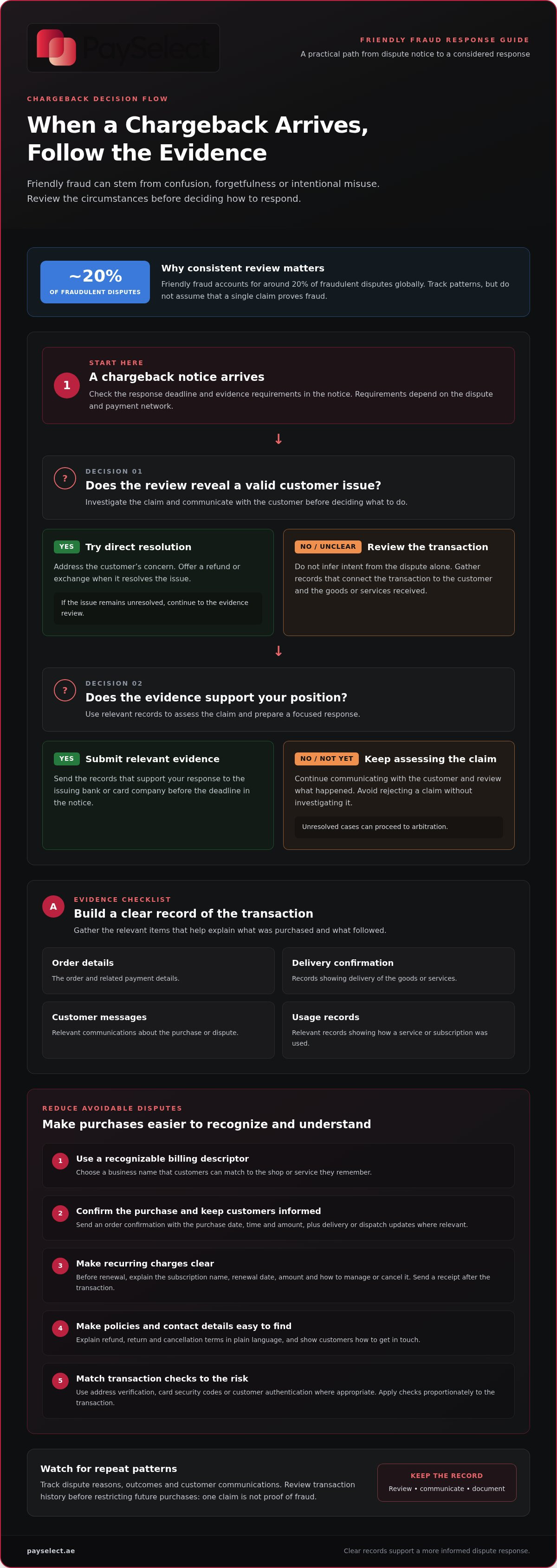
Confusion often starts with the billing descriptor, the merchant name shown on a card statement. If it differs from the shop or service name a consumer remembers, the cardholder may not connect the transaction to the purchase. Use a recognizable business name and, where available, a concise descriptor that reflects the customer-facing brand. Then send an order confirmation with the purchase date, time and amount. For example, a customer can match a د.إ 120 order to a statement when both show the same business name and transaction details.
Timing matters for recurring billing. A subscription renewal a year after sign-up may surprise a customer who has forgotten the original agreement. Send a clear notice before renewal and a receipt after the transaction. Include the subscription name, renewal date, amount and instructions for managing or cancelling it. For a one-time purchase, delivery updates and dispatch confirmation help the cardholder recognize the charge and understand what happens next.
Clear policies can prevent a genuine problem from becoming a bank claim. Make cancellation, return and refund terms easy to find before checkout, then explain the steps in plain language. For instance, state how customers can request a refund and what information to provide. Keep contact details visible on receipts and order pages so a confused cardholder has a direct way to ask questions. A clear response path gives the business a chance to resolve an issue through customer service before it becomes a formal dispute. Consistent terms also help customers know what to expect.
Pre-dispute resolution and chargeback representment
Friendly fraud is a cardholder dispute over a purchase made with their own or a known person’s payment credentials, whether mistakenly or intentionally. A legitimate chargeback challenges a transaction the customer genuinely disputes. In the UAE, follow the response deadline and evidence requirements in the chargeback notice, since the process depends on the dispute and payment network.
Evidence Gathering for Chargeback Disputes
Gathering evidence means collecting records that connect a disputed transaction to the customer and the goods or services received. Review the order, payment details, delivery confirmation, customer messages and relevant usage records. These details help businesses assess the claim, identify misunderstandings and prepare a focused response rather than rely on assumptions about intent.
Visa’s Compelling Evidence 3.0 guidance identifies at least two prior undisputed transactions with matching IP addresses or device IDs as evidence. The benchmark transactions must be older than 120 days and no more than one year old. If your records support a challenge, chargeback representment means submitting relevant evidence to contest the chargeback with the issuing bank or card company.
Chargeback Monitoring and Blacklisting
Chargeback monitoring means tracking disputes over time to spot repeat patterns across customers, cards and transaction details. Record dispute reasons, outcomes and related customer communications; this can reveal recurring confusion or suspicious activity. Friendly fraud accounts for around 20% of fraudulent disputes globally, making accurate classification useful when deciding which processes need attention.
A blocklist can flag customers linked to repeated disputes, but one claim isn’t proof of fraud. Review the transaction history and circumstances before restricting future purchases. A customer may have a valid complaint, or a household member may have made the purchase. Apply consistent criteria and retain the records behind each decision.
Rejecting a chargeback without reviewing the customer’s claim can undermine a valid complaint and weaken the business’s response. Investigate the transaction, communicate with the customer, and offer a refund or exchange when that resolves the issue. If the evidence supports your position, submit the relevant records before the deadline in the notice. Unresolved cases can proceed to arbitration.
Friendly fraud prevention for small businesses
Prevent disputes before they reach an issuer by combining clear purchase information with proportionate transaction checks. For an ecommerce merchant, the goal is to spot confusion or unusual activity early without adding needless friction for genuine customers.
Improving Fraud Prevention Measures
Fraud prevention measures are the business processes and checks that reduce mistaken claims and suspicious purchases. Start by reviewing sales and dispute records for patterns, such as repeated claims involving one product or unusually high-value orders. Then improve the information customers see before paying, including product descriptions, delivery expectations and accessible contact details. Clear information gives customers a chance to resolve questions directly instead of disputing a transaction.
Use Address Verification Service, card security codes and customer authentication where appropriate. Verification codes or multifactor authentication can help confirm that a customer authorized a purchase. Match the checks to the transaction’s risk. A routine order from a returning customer may need less friction than a purchase that differs sharply from their usual activity.
Machine-Learning Fraud Prevention
Machine-learning fraud prevention uses transaction data to identify patterns associated with suspicious activity. A system may assess behavior, transaction history and device information, then flag a purchase for review. For example, a sudden change in device details combined with unusual account activity can prompt closer inspection before fulfilment.
Use these signals to inform decisions, not replace them. Review flagged ecommerce orders against the customer’s history and purchase details. Monitor outcomes too: if a rule repeatedly delays legitimate orders, adjust it. This balance helps merchants respond to risk while keeping checkout practical for genuine customers.
Fraud Prevention Technology
Fraud prevention technology combines payment authentication and transaction screening to help detect risk before a dispute. Address Verification Service and card security codes can add checks at checkout. 3D Secure 2 uses transaction risk scoring to identify low-risk payments for a frictionless experience, while applying additional authentication where needed.
For eligible fraudulent chargebacks, 3D Secure can shift liability from the business to the card issuer. Keep track of how authentication affects approvals, customer experience and disputes. A small business can then adjust its checkout controls using actual transaction outcomes, rather than adding the same extra step to every purchase.
Causes and prevalence of friendly fraud
Friendly fraud falls between an honest misunderstanding and deliberate misuse. A cardholder may authorize a purchase, then dispute it because they don’t recognize the billing name, forget a renewal or believe an order never arrived. In other cases, someone in the household, such as a family member using a shared credit card, made the purchase without the cardholder recognizing it on their statement. The payment was authorized, but the resulting claim may still be inaccurate.
Intent changes the nature of the dispute. A confused customer may contact their bank before the merchant, especially when the transaction description is unfamiliar or a delivery update was missed. Deliberate first-party misuse involves disputing a legitimate payment to seek a refund while keeping the product or service. For example, a consumer might claim a delivered package never arrived. These different situations can produce similar chargebacks, so businesses should review each transaction rather than assume every claim is malicious.
Friendly fraud accounts for around 20% of fraudulent disputes globally, and up to 30% at high-volume online merchants. These figures describe different merchant contexts, not a prediction for an individual UAE business. The underlying causes vary by sales model: ecommerce orders can prompt “not received” claims, while recurring payments can be forgotten between billing dates. Digital services may face disputes when customers don’t connect account usage with a payment.
Friendly fraud poses a business risk, but not every dispute signals intentional abuse. Track dispute reasons alongside order details, delivery status and customer communications. If “unrecognized payment” claims cluster around one descriptor, make the business name clearer on statements. If “not received” claims recur for one delivery method, examine its tracking and customer updates. These patterns can distinguish an operational gap from repeated misuse and guide proportionate action.
For UAE businesses reviewing payment setups across markets, compare payment gateway options against their transaction and customer requirements.
PaySelect: Payment Gateway Comparison Tool
PaySelect’s Payment Gateway Comparison Tool helps businesses compare options based on industry, transaction volume and international requirements. It can be useful when payment needs change, disputes reveal checkout friction or a business plans to expand across borders. Compare relevant features and pricing to make a more informed selection, rather than assuming one setup suits every merchant.
Businesses with in-person sales can also use the POS System Selection Tool, while Cross-border Payment Solution Matching helps assess international payment needs. PaySelect’s payment pricing comparison can clarify how costs differ between payment solutions. These tools support selection and comparison; they don’t replace clear customer communication or sound dispute handling.
To explore payment options for your business, visit payselect.ae.
Build a More Resilient Payment Experience
Make dispute prevention part of how your business evolves, not a one-time fix. As sales channels, customer expectations and markets change, review whether your payment setup still supports a clear, consistent experience. A good fit can help reduce avoidable confusion and make payment operations easier to manage.
Knowing how to protect against friendly fraud also means choosing payment infrastructure that suits your business model. PaySelect’s Payment Gateway Comparison Tool, POS System Selection Tool and Cross-border Payment Solution Matching help businesses assess options against their needs.
If you’re reviewing your setup or planning to expand, contact PaySelect to discuss your needs. A considered next step can help your business move forward with greater clarity and confidence.
Frequently Asked Questions
What are the most common causes and warning signs of friendly fraud?
Forgotten recurring payments, unfamiliar business names and purchases by household members can all lead to friendly fraud claims. Watch for repeated disputes associated with similar customer details or claims that conflict with account records. These are reasons to investigate, not proof of intent. To protect against friendly fraud, compare each claim with the customer’s purchase history and the context of the disputed transaction.
What evidence should merchants collect to challenge a friendly fraud chargeback?
Choose evidence that directly addresses the reason for the dispute. For a claim that an order wasn’t received, retain carrier tracking and delivery confirmation. For a service complaint, keep the service terms and records showing access or use. Add relevant messages and the order record, then organize the documents so the reviewer can follow the transaction without searching across separate systems.
What tools and services help detect and prevent friendly fraud, and how much do they cost?
Businesses can consider card security code checks, Address Verification Service, transaction monitoring and 3D Secure 2, which adds an identity check during checkout when needed. Costs vary with the selected provider, tools and payment setup, so compare pricing against business needs. If you’re assessing how to protect against friendly fraud through payment infrastructure, PaySelect’s Payment Gateway Comparison Tool helps compare options and is free for merchants to use.
Disclaimer
This content is for informational purposes only and should not be considered financial, legal, or regulatory advice. Payment provider availability, pricing, and approval processes vary depending on individual business circumstances. PaySelect does not guarantee provider acceptance or specific outcomes. Businesses should conduct their own due diligence before entering into any agreements.
Empowering businesses to achieve greater growth
