
Every failed transaction is not a security victory; often, it is just a lost customer. When an eager buyer hits an unexpected error screen, your business absorbs the sting of abandoned carts, wasted marketing spend, and damaged customer trust. To effectively reduce payment gateway decline rates uae businesses must look past surface-level payment errors. Cryptic rejection notices and overly aggressive automated fraud rules quietly siphon off healthy revenue right at the final step.
You don't have to accept high fallout at checkout as an inevitable cost of doing business. In this guide, you will master proven technical strategies, smart routing practices, and graceful UX workflows to maximize checkout authorization rates across the UAE. We examine the exact drivers behind soft and hard declines, outline how to deploy frictionless recovery journeys, and show how independent platform evaluation helps you select payment gateways optimized for high acceptance.
Key Takeaways
• Identify the technical triggers behind soft and hard declines to prevent false fraud rejections and retain genuine buyers.
• Discover how dynamic transaction routing and multi-acquirer architectures reduce payment gateway decline rates uae merchants encounter.
• Upgrade checkout error handling with plain-language recovery steps and preserved carts so customers can easily complete purchases.
• Streamline authentication protocols to maintain strict national security standards without introducing disruptive checkout barriers.
• Leverage independent comparison tools and infrastructure consulting to select gateways engineered for higher domestic authorization success.
Understanding Payment Gateway Decline Rates in the UAE
Every digital transaction relies on a delicate chain of communication between your storefront, the merchant acquirer, card networks, and the customer's issuing bank. A payment decline rate measures the percentage of these attempted checkouts that fail to settle. For national online businesses, learning how to reduce payment gateway decline rates uae merchants face is essential to preserving margins. A modern payment gateway acts as the digital pipeline translating purchase requests, but when that pipeline breaks, the consequences ripple across your entire commercial operation.
Authorization patterns across the Emirates show distinct complexities. National merchants frequently manage checkouts involving both domestically issued cards and international cards carried by expatriates or visiting buyers. When local acquiring systems communicate with distant overseas issuers, mismatched fraud indicators and differing authentication steps trigger immediate rejections.
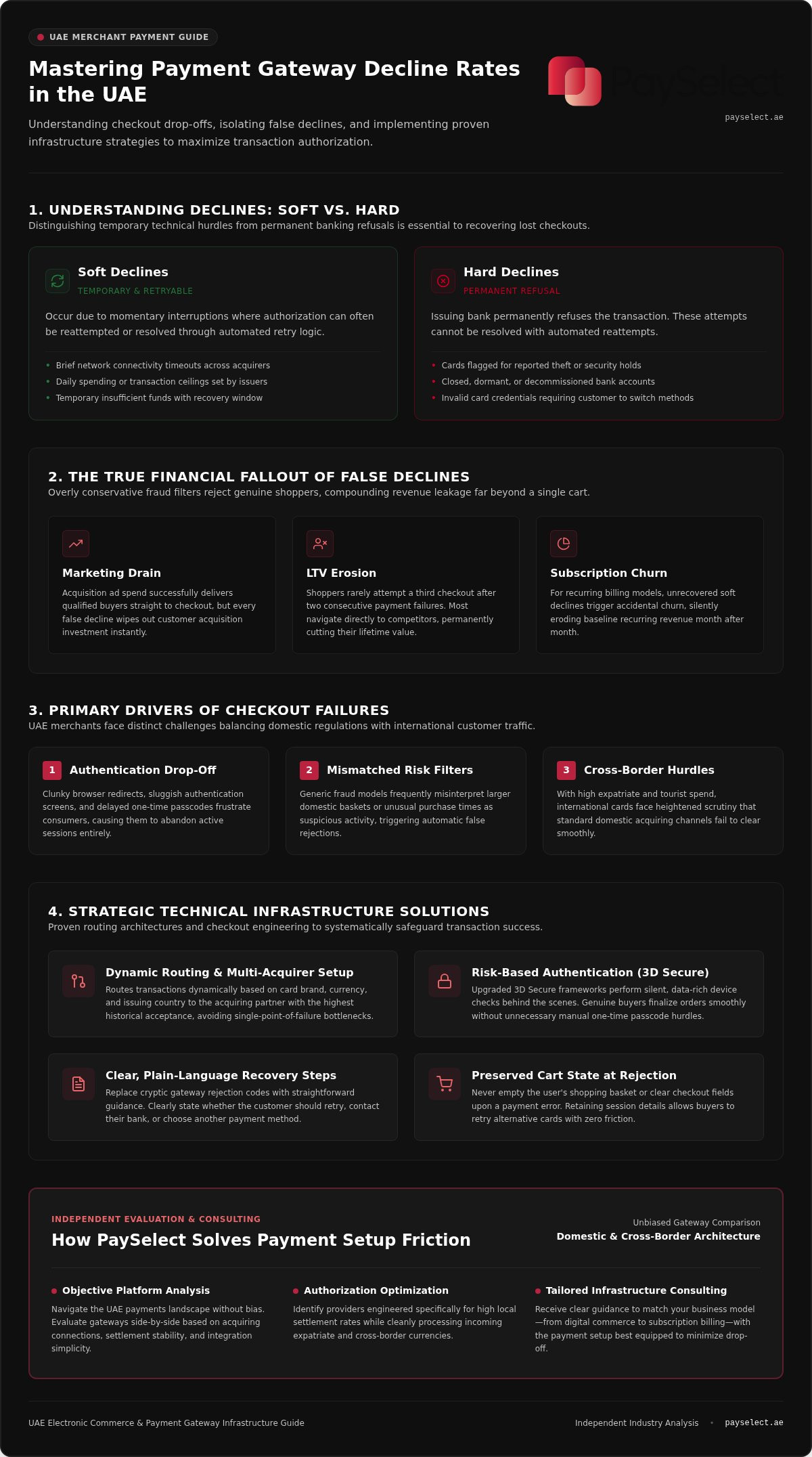
Soft Declines vs Hard Declines Explained
Distinguishing between soft and hard payment failures is the first step toward building an effective transaction recovery process:
Hard Declines
Occur when an issuing bank permanently refuses the transaction due to reported theft, closed accounts, or invalid card credentials. These cannot be resolved through reattempts; the buyer must provide an alternative payment method.
Soft Declines
Represent temporary hurdles, such as brief network connectivity timeouts, daily transaction ceilings, or temporary insufficient funds. Automated retry logic can often recover these attempts successfully.
In basic payment reporting systems, a soft decline signifies a retryable event, whereas a hard decline indicates a permanent rejection that requires immediate customer intervention.
The True Financial Cost of False Declines
The damage caused by payment failures extends well beyond a single lost basket. When overprotective fraud filters reject legitimate shoppers, known as false declines, the financial friction multiplies:
Marketing Drain
Your ad spend brings qualified buyers directly to checkout, but every false decline wipes out that acquisition investment instantly.
Customer Lifetime Value Erosion
Shoppers rarely attempt a third checkout after two consecutive payment failures. Most navigate directly to a competitor, permanently terminating their customer lifetime value.
Compounding Subscription Loss
For businesses operating recurring billing models, unrecovered soft declines cause accidental churn, quietly draining baseline recurring revenue month after month.
Addressing these friction points requires reviewing gateway infrastructure and acquirer alignment. Evaluating how different platforms handle cross-border card traffic helps enterprise merchants reduce payment gateway decline rates uae checkouts regularly encounter, transforming fragile checkout funnels into reliable revenue engines.
Primary Causes of Transaction Declines for National Merchants
Payment failures rarely happen by accident. Instead, they stem from strict banking logic, legacy software links, and unoptimized security parameters operating behind the scenes. As research on eCommerce in the UAE shows, electronic transactions continue to expand rapidly, yet technical handshakes between acquiring processors and card issuers can stall legitimate sales. Pinpointing these specific breakdowns is the most direct path to reduce payment gateway decline rates uae enterprises manage daily.
Authentication Drop-Off and Protocol Friction
Mandatory security verifications often derail conversions when checkout workflows rely on clunky browser redirects. Sluggish authentication screens and delayed one-time passcodes frustrate consumers, prompting them to abandon active sessions entirely. Upgraded 3D Secure frameworks address this by performing silent, risk-based assessments using contextual device data, allowing genuine buyers to finalize payments without unnecessary manual checkpoints.
Mismatched Risk Filters and Cross-Border Hurdles
Automated fraud prevention engines often operate with excessive conservatism. Generic risk models frequently misinterpret larger domestic baskets or unusual purchase times as suspicious activity, triggering false declines. Concurrently, overseas shoppers face heightened verification scrutiny that domestic acquiring channels fail to clear smoothly. Merchants serving an international clientele benefit from specialized cross-border payments solutions designed to communicate effectively with foreign issuing banks.
Technical Latency and Gateway Timeouts
Unstable server communication between storefronts, gateways, and banking switches creates dropped authorizations. When marketing promotions trigger sudden transaction spikes, legacy connectors often fail to handle simultaneous processing requests, forcing the gateway to time out before an approval signal arrives. Consistent network health monitoring prevents these quiet system failures from disrupting peak sales volume.
Resolving these technical bottlenecks requires aligning your operations with the right acquiring partners. Comparing processor routing models through PaySelect gives growing enterprises the clarity needed to select gateways engineered for low latency, flexible risk rules, and superior authorization rates.
Key Infrastructure Strategies to Maximize Approval Rates
Fixing checkout drop-off requires more than cosmetic frontend adjustments. Lasting transaction stability depends on backend resilience, routing intelligence, and credential management. By implementing the right technical foundation, online merchants can actively reduce payment gateway decline rates uae checkouts experience during peak processing periods.
Relying on a single acquiring partner leaves revenue exposed to sudden outages, system latency, and rigid risk rules. Exploring multi-provider solutions via an independent payment gateway comparison helps businesses select infrastructure models that route transactions through optimal settlement pathways.
Smart Transaction Routing and Local Acquiring
Dynamic routing engines evaluate every checkout in milliseconds, steering card authorizations to the processing institution with the highest historical probability of success. Directing locally issued consumer cards through domestic clearing networks dramatically cuts false fraud flags. Processing domestic card transactions through local acquiring networks directly increases authorization confidence while minimizing unnecessary cross-border scrutiny. When a processing pipeline experiences latency, dynamic engines instantly shift traffic to an alternate operational channel.
Network Tokenization and Stored Credentials
Modern recurring checkouts increasingly rely on network tokenization rather than storing static card details. This architecture delivers three operational benefits:
Enhanced Trust
Issuing banks view tokenized requests as highly secure, granting higher authorization scores.
Automatic Updates
When a buyer's physical debit or credit card is replaced, card schemes automatically refresh the underlying token without customer action.
Reduced Data Exposure
Unique digital tokens replace primary card numbers, preventing unauthorized reuse.
Automated Cascading and Intelligent Retries
When a transaction encounters a soft decline, automated cascading instantly submits the payload to a secondary acquiring provider before presenting an error screen to the buyer. This failover mechanism resolves technical hiccups behind the scenes in fractions of a second.
For recurring invoices, intelligent retry algorithms evaluate decline codes alongside customer behavioral patterns to reattempt payment when settlement probability is highest. This automated logic recaptures at-risk income without requiring manual repurchase requests, protecting customer relationships while keeping recurring cash flow intact.
How to Handle Failed Transactions Gracefully at Checkout
A rejected payment shouldn't mark the end of the customer journey. When a checkout attempt fails, the immediate experience determines whether a shopper retries the purchase or abandons the transaction entirely. Establishing an intuitive recovery workflow is a practical, non-technical way to reduce payment gateway decline rates uae online stores face during customer interactions.
Transforming payment friction into completed sales requires a structured, three-step checkout recovery process:
Step 1: Deliver Clear, Non-Accusatory Error Messaging
Never display cryptic numerical error codes or alarming rejection notices. Raw system codes leave shoppers feeling anxious and blamed. Instead, translate banking feedback into polite, plain-language instructions that clarify the exact next step. Inform the buyer whether they should verify their billing details, contact their issuing bank, or try a different card, turning an obstacle into an actionable path forward.
Step 2: Preserve Checkout Context and Cart Data
Nothing accelerates cart abandonment faster than wiping a checkout form clean after a single error. Forcing customers to re-type billing addresses, delivery preferences, and coupon codes builds immediate frustration. Always keep cart state intact so returning shoppers can resolve an issue with a single tap, preserving momentum when it matters most.
Step 3: Trigger Seamless Payment Method Fallbacks
When an initial card transaction fails, immediately display secondary checkout alternatives on the same screen. Offering digital wallets, local account-to-account payments, or Buy Now Pay Later options keeps buyers within the purchase funnel. For businesses managing both online and physical storefronts, directing shoppers to finalize orders via modern POS machines provides another reliable settlement bridge.
For uncompleted sessions, trigger an automated recovery message within thirty minutes. Providing a direct, secure link back to their populated cart allows customers to finalize their order when ready.
If your checkout conversion continues to struggle with high abandonment, an objective audit of your payment setup can pinpoint hidden barriers. You can explore PaySelect's payment gateway comparison tool to identify providers that deliver flexible checkout interfaces and resilient transaction recovery features.
Evaluating Payment Providers to Protect Your Transaction Success
Every payment provider presents distinct operational strengths, banking ties, and technical parameters. Choosing a gateway based solely on onboarding speed or surface integration ease often blinds businesses to underlying authorization discrepancies. To truly reduce payment gateway decline rates uae commercial operators must evaluate potential processing partners through the lens of long-term settlement reliability, structural security, and acquiring alignment.
Settlement performance fluctuates significantly between systems. While one provider might excel at local retail debit processing, another could offer superior authorization handling for cross-border transactions or high-ticket orders. Understanding these structural differences prevents costly processing bottlenecks as transaction volumes scale.
Core Selection Criteria for High-Approval Gateways
Before committing your checkout operations to an acquiring network, benchmark prospective partners against three essential capabilities:
Acquiring Integration Depth
Confirm direct connectivity with domestic clearing networks and regional acquiring banks to ensure smooth transaction passage.
Advanced Technical Protocols
Verify native support for modern 3D Secure frameworks, network tokenization, and dynamic retry logic that capture legitimate sales automatically.
Granular Telemetry
Insist on transparent merchant reporting that breaks down specific refusal reasons, letting your team track authorization trends by card type, currency, and volume.
Auditing Infrastructure with Independent Guidance
Vendor lock-in remains a persistent threat to commercial agility. Merchants frequently stay bound to underperforming gateways simply because assessing alternatives feels overwhelming. Conducting periodic payment infrastructure audits breaks this cycle by highlighting where hidden technical failures and processing expenses quietly deplete realized earnings.
Using an independent payment gateway comparison platform allows enterprises to benchmark providers objectively without processor bias. By reviewing transparent metrics tailored to transaction volume, industry risk profile, and target market dynamics, businesses gain the clarity required to partner with processors offering superior national acceptance. Balancing infrastructure resilience with ongoing transaction costs ensures your payment architecture remains a catalyst for sustainable commercial expansion.
Maximize Your Transaction Success Nationwide
Tackling checkout fallout requires aligning your technical foundation with an intuitive customer recovery workflow. By implementing smart domestic routing, isolating recoverable soft declines, and guiding buyers with plain-language feedback, your business can actively reduce payment gateway decline rates uae checkouts face. Protecting legitimate transactions preserves your marketing investment, strengthens customer trust, and safeguards long-term baseline revenue.
Selecting the right processing partner shouldn't involve trial and error. Objective infrastructure matching allows you to benchmark top payment gateway and POS providers based on your sales volume, industry risk profile, and cross-border needs. To eliminate technical bottlenecks and enhance settlement reliability, compare high-performing payment gateways with PaySelect. With independent evaluation and specialized payment infrastructure consulting, you can build a seamless checkout operation that transforms lost transactions into lasting commercial growth.
Frequently Asked Questions
What is an acceptable payment gateway decline rate for UAE merchants?
A healthy decline rate for established national e-commerce merchants generally falls between 5% and 10% for standard domestic transactions. Businesses managing high cross-border volumes or higher-risk product categories often experience decline rates approaching 15% or more. Monitoring your baseline closely helps you spot technical anomalies quickly and implement targeted strategies to reduce payment gateway decline rates uae stores experience across varied card networks.
Why do domestic issuing banks decline valid local e-commerce transactions?
Domestic issuing banks decline valid transactions primarily due to strict automated fraud filters, mismatched billing information, or daily card spending limits. If a purchase triggers automated velocity rules or deviates from a customer's typical buying behavior, local banks immediately err on the side of caution. Outdated merchant categorization codes can also prompt local issuers to refuse otherwise legitimate checkouts.
How does 3D Secure authentication affect card decline rates nationwide?
Modern 3D Secure authentication reduces declines by exchanging contextual transaction data directly between the gateway and the bank. When risk is low, issuing banks approve transactions through a frictionless background flow without requiring manual buyer interaction. Clunky or outdated authentication setups, however, cause high checkout drop-offs when shoppers encounter delayed verification prompts or failing authentication screens during final payment confirmation.
Can switching payment gateways immediately improve transaction authorization rates?
Switching payment gateways can lift authorization rates if the new provider maintains stronger direct integrations with local acquiring networks. Gateways differ significantly in how they format authorization payloads, handle risk filtering, and manage bank connections. Using independent comparison platforms allows businesses to evaluate acquiring performance and identify processors whose infrastructure delivers higher acceptance for their specific industry and transaction volume.
What is the difference between a technical timeout and an issuer decline?
A technical timeout happens when communication between the merchant storefront, gateway, or banking switch drops before an authorization response returns. The transaction remains unprocessed. An issuer decline, by contrast, occurs when the bank successfully receives the request but actively refuses it due to insufficient funds, suspected fraud, or card restrictions. Timeouts require technical retries, whereas issuer declines require customer action.
How should checkout pages communicate a card rejection to buyers?
Checkout pages should communicate card rejections using polite, plain-language guidance that outlines the exact next step. Avoid displaying raw numerical error codes or ambiguous warnings that cause anxiety. Clearly tell the customer whether they should double-check their card numbers, try an alternative payment method, or contact their card-issuing bank, keeping their cart details intact so they don't restart checkout from scratch.
Can implementing network tokenization reduce payment failure rates?
Implementing network tokenization directly improves authorization rates because card schemes update underlying account numbers automatically when physical cards expire or re-issue. Because network tokens carry cryptographic validation, issuing banks view these requests with higher trust than standard stored cards. This architectural upgrade prevents involuntary subscription churn and helps merchant platforms reduce payment gateway decline rates uae businesses battle across recurring billing cycles.
How does multi-acquirer routing prevent payment gateway downtime?
Multi-acquirer routing prevents downtime by maintaining active technical connections to multiple payment processors simultaneously. If a primary acquiring bank encounters network latency or an unexpected system outage, the routing engine instantly shifts incoming payment traffic to an operational secondary partner. This automated redundancy ensures continuous transaction processing, eliminating single points of failure across your entire digital checkout infrastructure.
Disclaimer
This content is for informational purposes only and should not be considered financial, legal, or regulatory advice. Payment provider availability, pricing, and approval processes vary depending on individual business circumstances. PaySelect does not guarantee provider acceptance or specific outcomes. Businesses should conduct their own due diligence before entering into any agreements.
Empowering businesses to achieve greater growth