


The Baymard Institute reports an overall shopping cart abandonment rate of 70.22%. Cart abandonment happens when someone adds a product to an online cart but leaves without completing the purchase. To understand how to reduce shopping cart abandonment with better payments, focus on the checkout barriers you can address: uncertainty about security, unavailable payment methods, unnecessary steps and card declines.
It’s easy to assume shoppers leave because they’ve changed their minds. But a checkout that feels risky or slow can also stop a ready-to-buy customer. The benchmark gives you a useful reference point, not a target for every store.
This article explains how clear security and refund information, faster payment options, and a plan for card failures can make checkout smoother. It also shows how to calculate your abandonment rate and use it to spot where payment improvements may help your UAE business.
Key Takeaways
• Make payment security, accepted methods, and refund terms easy to find before customers reach the final payment step.
• Reduce checkout friction with guest checkout, fewer fields, and payment options suited to your UAE customers.
• Review decline patterns and payment errors to spot where transactions are getting interrupted.
• Use your own checkout data to benchmark abandonment and identify whether payment setup or another checkout barrier needs attention.
1. Showing payment security and refund information
Trust can decide whether a shopper completes checkout. Baymard Institute research found that 19% of shoppers who abandon carts cite not trusting a site with their credit card information. Display secure payment messaging beside payment fields, explain how payment details are protected, and make refund terms easy to find before the final step. Clear return information also addresses a separate concern: 13% of reported abandonment reasons relate to an unsatisfactory returns policy.
For UAE ecommerce businesses, PCI DSS is a practical security standard for handling payment-card data. Use encrypted payment pages and fraud controls, and avoid storing sensitive payment details when they aren’t needed. These steps help protect customer information, but they don’t replace checking which UAE legal requirements apply to your business. A visible privacy notice and familiar payment-method logos can make checkout feel more transparent.
More payment methods can address a specific checkout barrier, but they don’t guarantee a fixed reduction in abandonment. A Baymard study found that 13% of online shoppers abandon carts when their preferred payment method is unavailable. Offer a relevant mix, such as card payments and digital wallets, based on your customers and sales markets. Compare payment gateway options by the methods they support and how they fit your checkout.
Show the full order total before payment, including shipping, taxes, and other charges. An unexpected fee can turn a clear purchase into a checkout surprise, while showing the total early helps shoppers make an informed decision. State refund conditions beside the total, not only on a separate policy page.
Measure the checkout funnel by tracking payment-page visits, attempts, approvals, declines, and completed orders. Then A/B test one change at a time, such as the placement of security messaging or how payment methods appear. Compare completion rates for each version. Buy now, pay later can add complexity and potential payment or dispute costs; cash on delivery can lead to refused deliveries and return-handling costs. Assess these operational risks before offering either option.
2. Offering one-click and digital wallet payment methods
Every extra field adds friction to ecommerce checkout, especially on a phone. Offer guest checkout, keep required details to a minimum, and let returning customers use an express payment option where available. A one-click flow can make repeat purchases quicker by avoiding repeated data entry, while still showing the order total before customers confirm.
Baymard found that 13% of online shoppers abandon carts when their preferred payment method is unavailable. Treat this as a reason to review your checkout choices, not as a guaranteed reduction from adding a method. For UAE stores, compare your own completed orders, failed attempts, and customer requests to understand which options suit your audience. Too many poorly presented choices can also make payment selection harder.
Offer a relevant mix of card and digital wallet options, and display prices clearly in AED. The right selection depends on your customers, sales channels, and markets. Review transaction patterns and customer feedback before adding methods, then check that each option works smoothly on mobile and desktop.
To add digital wallets, choose a payment gateway configuration that supports them, enable the options in checkout, then test the complete flow on compatible devices. Display only methods that are active and available to the customer. For local card payments, make acceptance clear and check that the gateway setup supports the card types your business intends to accept. Compare payment gateway capabilities against the methods your customers need.
Guest checkout lets first-time buyers proceed without creating an account, while saved payment details can reduce repeated steps for returning customers. Make account creation optional, explain the checkout choices, and let customers decide whether to save their details. After each change, review completion and decline rates by payment method. This helps you see whether a new wallet or shorter flow removes friction or adds unexpected steps.
3. Card payment failures and declines
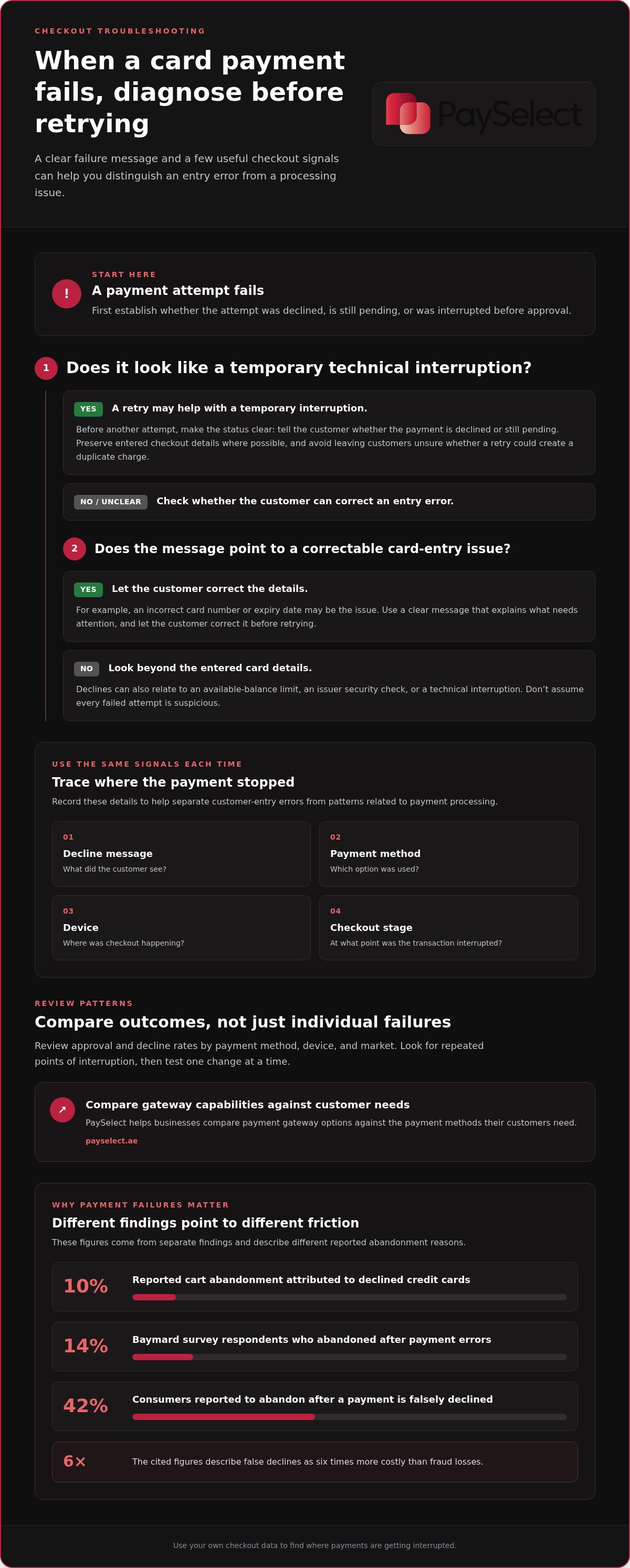
A card decline can stop a purchase even when a customer is ready to pay. The cited estimates attribute 10% of reported cart abandonment to declined credit cards, while 14% of respondents in a Baymard survey abandoned after payment errors. These figures describe different findings, but both show why payment completion deserves attention. A practical part of how to reduce shopping cart abandonment with better payments is finding where failures occur.
Declines can happen for different reasons. A customer may enter an incorrect expiry date, exceed an available balance, or face an issuer security check. Technical interruptions can also stop a transaction before approval. Track the decline message, payment method, device, and checkout stage. This helps distinguish customer-entry errors from patterns related to payment processing.
False declines deserve particular attention. The cited figures report that 42% of consumers abandon after a payment is falsely declined, and describe false declines as six times more costly than fraud losses. Avoid treating every failed attempt as suspicious. Review decline patterns regularly, and use clear error messages so customers can correct details or select another payment method.
Retries can help with temporary interruptions, but repeated attempts may frustrate customers or cause confusion. Let shoppers correct a card number or choose another available method before retrying. Preserve entered checkout details where possible, and explain whether the transaction was declined or is still pending. Customers shouldn’t have to guess whether another attempt could create a duplicate charge.
For teams deciding how to reduce shopping cart abandonment with better payments, compare approval and decline rates by payment method, device, and market. Test one change at a time, such as clearer error wording or a revised retry prompt. The 17% and 18% figures relate to long checkout experiences, not card-decline rates. Keep those reasons separate in reporting to identify whether payment failures affect completed orders.
4. Average cart abandonment benchmarks
The Baymard Institute reports an overall shopping cart abandonment rate of 70.22%. Treat this as a broad reference, not a target or a prediction for a UAE store. Product type, traffic source, device, delivery terms, and checkout design all shape results. Your own trend is more useful than a global average when deciding what to improve.
Calculate the abandonment rate with one consistent definition: divide carts not completed by checkout starts, then multiply by 100. For example, 350 completed orders from 700 monthly cart starts means a 50% abandonment rate. Keep the same period and event definitions each time, or comparisons can mislead. Don’t compare checkout starts in one report with cart additions in another.
A separate example shows why the denominator matters: 1,500 abandoned carts from 5,000 transaction starts in one week equals a 30% rate. Segment results by mobile and desktop, new and returning customers, and payment methods. This helps distinguish a weak conversion rate across the whole store from a specific payment-stage problem.
Benchmarks also need context. Baymard reports that 40% of shoppers who abandon carts cite extra costs such as shipping, tax, and fees. Another Baymard finding says 42% were browsing and not ready to buy. Those reasons require different responses: clearer totals may address checkout uncertainty, while browsing behavior may not call for a payment change. Avoid treating every abandoned cart as recoverable revenue.
Use your baseline to implement one change at a time, such as adding a relevant payment method or improving mobile checkout. Compare the same audience and period before and after the change, then monitor completed orders and declines. If payment setup needs review, compare payment gateway options against your transaction needs and customer markets.
PaySelect: Payment Gateway Comparison Tool
PaySelect’s Payment Gateway Comparison Tool helps businesses compare options based on their industry, transaction volume, and international requirements. Use it when declines, checkout limitations, or unclear pricing suggest your current setup needs review. The comparison can help you assess which payment methods and gateway capabilities fit your customers and sales markets.
For businesses expanding across borders, PaySelect’s Cross-border Payment Solution Matching can help assess payment infrastructure needs across markets. PaySelect also offers payment pricing comparison, so you can evaluate costs alongside checkout fit and functionality. These tools support informed selection; payment processing, settlement, and ongoing provider support remain with the chosen provider.
To explore gateway options for your business, visit PaySelect at payselect.ae.
Turn Checkout Insights Into Your Next Move
Improving checkout is an ongoing process, not a one-time redesign. Use transaction data to identify where customers hesitate, then test a focused change and monitor the results. This helps your team decide how to reduce shopping cart abandonment with better payments while keeping checkout clear for UAE customers.
As your business changes, its payment needs may change too. New customer groups, sales channels, or cross-border plans may call for a fresh review of your setup. PaySelect can help you assess options against your business requirements, without adding complexity for its own sake.
Contact PaySelect to discuss your payment setup and identify a practical direction for your next checkout improvement. Every refinement is an opportunity to make the buying experience work better for your customers and your business.
Frequently Asked Questions
What is cart abandonment?
Cart abandonment is an online purchase that a shopper starts but doesn’t complete. For example, a customer may add a product and enter delivery details, then leave before confirming the order. Track where the session ends, such as the cart, delivery step, or payment page, to identify which part of the buying journey needs attention.
Why do shoppers abandon their carts?
Shoppers leave for different reasons, so an abandoned cart doesn’t always mean checkout has failed. Some are comparing products or browsing without a firm intention to buy; others encounter an unexpected charge, a confusing form, or an unavailable payment option. For a UAE store, compare behavior across devices and customer groups to see whether friction occurs around delivery details, payment selection, or another step.
What are the main payment-related causes of shopping cart abandonment?
Common payment-related causes include customers not recognising checkout as secure, not finding a suitable payment method, or receiving a decline without a useful explanation. A transaction may also fail because card details were entered incorrectly or the payment flow was interrupted. Separate these cases in your reporting. Each points to a different fix, from clearer instructions to reviewing payment-method coverage.
How can faster checkout and fewer form fields reduce payment drop-off?
A shorter checkout gives shoppers fewer chances to pause, mistype information, or abandon the process. Ask only for the details needed to complete the order, and avoid requesting the same information twice. For example, collect delivery information once and make account creation optional. Test the flow on mobile devices, where small fields and repeated entry can make purchases harder to complete.
How should ecommerce stores handle declined payments and retry transactions?
Show a clear status and useful next step when a payment fails. If the message points to an input error, let the customer correct the relevant detail; if the decline reason is unclear, offer another payment method. Don’t trigger repeated retries before checking the transaction outcome. Handle a pending result differently from a confirmed decline to reduce confusion and avoid duplicate attempts.
Disclaimer
This content is for informational purposes only and should not be considered financial, legal, or regulatory advice. Payment provider availability, pricing, and approval processes vary depending on individual business circumstances. PaySelect does not guarantee provider acceptance or specific outcomes. Businesses should conduct their own due diligence before entering into any agreements.
Empowering businesses to achieve greater growth
