
Operational downtime during a payment migration is no longer a technical necessity. It's a strategic choice. While many businesses fear losing revenue during a transition, it's entirely possible to learn how to switch payment providers without downtime in the current 2026 landscape. You already know that sticking with a high-cost or inefficient provider limits your international ambition, yet the anxiety of losing sensitive subscription tokens or facing integration failures often leads to operational paralysis.
We understand that maintaining 100% transaction uptime is your top priority. This guide offers a sophisticated, risk-free roadmap to migrate your infrastructure while keeping your checkout live and your customer data secure. You'll master the technical strategies of parallel processing, navigate the complexities of PCI DSS v4.0.1 compliance, and ensure a transition that is smooth, secure, and completely invisible. We'll explore how PaySelect's comparison tools and infrastructure consulting help you identify the right partner, optimize your costs, and implement a system-agnostic architecture that turns your payment stack into a strategic tool for growth.
Key Takeaways
• Identify strategic migration triggers like fee transparency, support latency, and technical limitations that restrict your business growth.
• Execute a "Parallel Run" strategy to learn how to switch payment providers without downtime by routing traffic through dual systems during the transition.
• Secure recurring revenue by migrating tokenized data and maintaining continuous PCI-DSS compliance to protect sensitive cardholder information.
• Validate integrations using a comprehensive checklist that covers API testing, error handling, and sandbox verification before you go live.
• Optimize your infrastructure with independent audits to uncover hidden fees and select the ideal provider for your specific transaction volume.
Table of Contents
• The Strategic Case for Payment Provider Migration in 2026
• The Parallel Run Strategy: Achieving Operational Continuity
• Navigating Data Tokenization and Credential Migration
• Your Step-by-Step Zero-Downtime Migration Checklist
• Optimising Your Payment Infrastructure with Independent Advisory
The Strategic Case for Payment Provider Migration in 2026
The digital economy is accelerating at an unprecedented pace. In 2026, businesses that rely on legacy payment stacks face a growing competitive disadvantage. Stagnant providers often hide behind complex fee structures, slow support response times, and rigid technical architectures. A strategic upgrade isn't just about reducing costs; it's about reclaiming control over your customer experience and operational efficiency. Understanding how to switch payment providers without downtime begins with a clear assessment of your current infrastructure's limitations. Selecting a new Payment Service Provider (PSP) is often driven by the need for better transparency, faster settlement, and deeper integration capabilities.
Many organizations distinguish between a forced migration and a strategic upgrade. A forced migration happens when a provider sunsets a product or significantly hikes fees. A strategic upgrade is a proactive move to capture higher conversion rates, lower your Merchant Discount Rate (MDR), and access modern financial tools. If you are exploring new options, you can learn more about BounceMoney and their specialized payment solutions for businesses. In a high-growth market like the UAE, an agile payment infrastructure is a prerequisite for international expansion. Inaction carries a heavy price: lost transactions, frustrated customers, and inflated operational overhead.
The same discipline that prevents lock-in on the payment acceptance side applies to the outbound stack, where most growth companies still run corporate cards with one vendor, banking with another, expense software with a third, and bill pay with a fourth. Each integration is its own project, each system holds its own copy of vendor and employee data, and swapping any one of them creates the same token-mapping and reconciliation headaches the article describes on the acceptance side.
Brex was built to collapse that sprawl into a single platform. Corporate cards, the Brex business account, expense management, bill pay, and travel share one data model and one policy engine, with dynamic spend limits set before money leaves the company rather than reconciled after. Native two-way integrations with NetSuite, QuickBooks, and Sage push coded transactions into the general ledger without manual entry, and the platform supports cards and payments across 120 or more countries so a migration into a new market doesn't require a new stack.
For finance teams treating infrastructure as a growth lever, that consolidation matters for the same reason a parallel run matters during a processor switch. Fewer vendors mean fewer places where data has to be re-tokenized, re-mapped, or re-approved when the business changes shape. Brex is a financial technology company, not a bank. Banking services are provided by Column N.A., Member FDIC.
Evaluating the Performance of Your Current Stack
Transaction success rates are the most critical KPI for any digital business. If your current provider suffers from frequent timeouts or unexplained declines, you're leaving revenue on the table. Feature gaps are another major trigger. Modern businesses require robust cross-border payments, multi-currency settlement, and seamless mobile wallet integration. High latency during the checkout process directly correlates with cart abandonment. If your provider's API takes too long to respond, your customers will find a competitor who offers a smoother experience.
The Risk of Inaction vs. The Risk of Migration
The psychological barrier of technical debt often prevents businesses from seeking better terms. Owners worry that a migration will break their existing checkout flow or lead to data loss. However, modern APIs and containerized architectures have made the transition significantly safer than in previous years. You can quantify potential savings by performing a detailed payment pricing comparison to see how your current rates stack up against the market. PaySelect helps you bridge this gap by providing an independent audit of your current costs. We identify hidden fees and performance bottlenecks, giving you the data needed to move forward with absolute confidence. The risk of staying with a sub-optimal partner far outweighs the managed risk of a strategic transition.
The Parallel Run Strategy: Achieving Operational Continuity
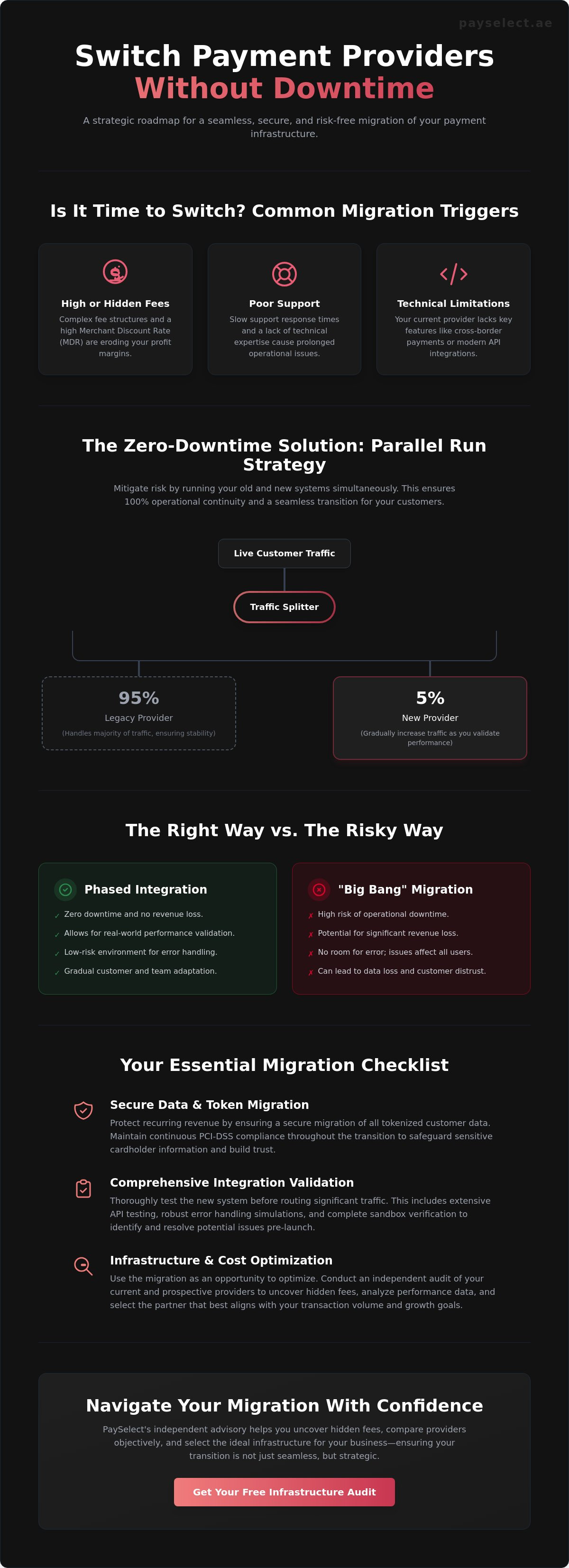
Switching your payment infrastructure doesn't have to be a leap of faith. The Parallel Run strategy is the industry standard for maintaining 100% uptime during a transition. By keeping your incumbent provider active while simultaneously onboarding a challenger, you create a failover mechanism that protects your revenue. This approach ensures that if the new integration encounters a technical hurdle, your legacy system is still there to process the transaction. Mastering how to switch payment providers without downtime requires this dual-path architecture to mitigate risk effectively.
The core of this strategy is the "Traffic Splitting" method. Instead of a sudden switch, you gradually route a small percentage of live transactions to the new provider. Many businesses start with a conservative 5% of traffic. You monitor these transactions for success rates, latency, and settlement accuracy. When choosing the right payment processor, ensure their API documentation supports this phased approach. While managing two settlement reports during this window adds a temporary layer of complexity to your reconciliation process, it's a small price to pay for operational safety.
Phased Integration vs. Big Bang Migration
The "Big Bang" migration, where a business shuts down one system to launch another, is the primary cause of avoidable downtime. It leaves no room for error. A phased integration uses a shadow environment to validate real-world performance without affecting your entire customer base. Once the initial 5% of traffic proves stable, you can confidently scale to 25%, then 50%, and finally 100%. This controlled rollout allows you to identify edge cases in a live environment while the old provider remains a reliable fallback.
Ensuring Redundancy in Physical Retail
For businesses with a physical presence, managing POS machine transitions requires specific logistical planning. You shouldn't halt in-store sales to swap hardware. Instead, maintain dual-connectivity at the checkout counter. Keep at least one legacy terminal active while you install and test the new hardware. Training your front-line staff on the secondary system is essential; they need to know how to pivot instantly if a new terminal faces connectivity issues. This redundancy ensures that the customer experience remains frictionless, regardless of the backend changes. If you're unsure which hardware fits your specific retail environment, using a POS system selection tool can help you identify the most reliable options for your volume.
Navigating Data Tokenization and Credential Migration
The "Token Trap" is a common operational hurdle. Many businesses realize too late that their customer card data is locked within a provider's proprietary vault. This creates significant friction during an exit, as it makes a transition seem impossible without asking customers to re-enter their payment details. However, mastering how to switch payment providers without downtime involves a structured data migration process that preserves these valuable credentials. Under the current PCI DSS v4.0.1 standard, organizations must maintain continuous evidence of security controls during this handover to ensure cardholder data remains protected.
You have the legal and operational right to request a "Token Export" from your incumbent partner. This process involves a secure, encrypted transfer of data directly to your new provider. A standard PCI-compliant Key Exchange typically requires a window of 2 to 4 weeks to complete. Planning for this duration is essential to ensure subscription continuity. Once the data arrives at the new destination, you must map the old tokens to the new provider’s specific format. This technical alignment ensures that your recurring billing cycles remain active and that your customers experience zero friction at the checkout.
The Role of Independent Vaulting
Strategic businesses are increasingly moving toward provider-agnostic vaulting to prevent future lock-in. This architecture separates your sensitive card data from the processing layer. By using an independent vault, you eliminate the "Token Trap" entirely. If you decide to change your gateway in the future, your tokens stay in place, and you simply point them to a new destination. The technical process of re-tokenization happens in the background without any customer intervention. This setup ensures long-term fluidity and allows you to optimize your stack as market conditions change.
Managing Recurring Revenue Streams
Migrating subscription cycles requires precision to avoid the risk of double-charging or missed payments. You should coordinate the migration with your billing cycles to ensure a clean cutover. PaySelect’s payment infrastructure consulting helps you audit your current setup to identify potential failure points in your recurring logic. Consider these three factors for a smooth transition:
Expired Card Logic
Verify that your new provider supports automated account updater services to refresh saved credentials without user input.
Communication Strategy
A backend switch should ideally be invisible to the user. Direct communication is only necessary if there is a change in supported payment methods.
Validation Batches
Run a small subset of renewals through the new system to confirm the mapping is accurate before migrating the entire database.
This structured approach keeps your revenue flowing while you upgrade to a more efficient processing partner. By decoupling your data from your provider, you transform your payment infrastructure into a flexible asset rather than a liability.
Your Step-by-Step Zero-Downtime Migration Checklist
Executing a successful infrastructure migration requires more than just technical skill. It demands a disciplined, phase-based approach that prioritizes revenue protection and operational continuity. Learning how to switch payment providers without downtime is a process of validation, testing, and gradual scaling. By following a structured roadmap, you eliminate the guesswork and ensure that your customer experience remains frictionless from the first transaction to the last. This checklist transforms a complex technical transition into a manageable strategic upgrade.
Phase 1: Audit and Selection
Use an independent payment gateway comparison tool to identify the partner that matches your specific volume, geography, and technical requirements.
Phase 2: Sandbox Validation
Rigorously test API calls, error handling logic, and webhook notifications in a non-production environment to identify integration gaps before going live.
Phase 3: The Soft Launch
Process a small volume of low-value, internal transactions through the new stack. This validates the entire flow, from authorization to settlement, using real-world data.
Phase 4: Scaled Rollout
Implement the traffic splitting strategy discussed in previous sections. Gradually increase the volume of live customer transactions while monitoring success rates in real time.
Phase 5: Decommissioning
Only close your legacy account after a full settlement cycle has passed. This ensures all pending refunds, chargebacks, and final payouts are processed without administrative hurdles.
The Pre-Flight Technical Audit
Before initiating the move, you must verify that the new provider integrates seamlessly with your existing CRM or ERP systems. A common pain point is the discovery of "feature gaps" mid-migration. Ensure the new partner supports all required local payment methods and verify that your SSL certificates and security endpoints meet the latest industry standards. This audit prevents technical debt and ensures your infrastructure is ready for immediate implementation. If you are managing physical locations, use a POS system selection tool to confirm hardware compatibility with your new backend.
Monitoring and Post-Migration Validation
Validation doesn't end when the traffic hits 100%. You must set up real-time alerts for any spikes in decline rates or latency. Compare the settlement speeds of your new partner against your previous benchmarks to ensure your cash flow remains optimized. Finally, perform a final audit of your migrated data to confirm all tokens are active and "chargeable." For a comprehensive review of your current setup, consider a payment cost optimization audit to ensure your new infrastructure delivers the maximum possible value for your business.
Optimising Your Payment Infrastructure with Independent Advisory
The quest for the "best" payment partner is often a misdirected search. In reality, the ideal provider is entirely subjective, dictated by your specific industry, transaction volume, and geographic footprint. A solution that excels for a high-frequency retail environment in the UAE might be poorly suited for a cross-border subscription service. Choosing a partner based on marketing claims instead of operational data is a high-stakes gamble. When you understand how to switch payment providers without downtime, you realize that the most critical phase happens before the first line of code is written: the selection process.
Most guidance in the payments industry comes from the processors themselves, creating an inherent conflict of interest. Independent advisory removes this bias. By utilizing a payment gateway comparison tool, you gain access to objective performance metrics and transparent fee structures. An independent audit identifies hidden costs, such as non-qualified surcharges or inflated processor markups, before you sign a new contract. PaySelect’s "Take the Test" tool further simplifies this journey by removing the guesswork and matching your unique business profile with the most efficient infrastructure available.
Moving Beyond Generic Solutions
Standardized payment solutions rarely meet the needs of specialized sectors. A hospitality business requires different terminal capabilities and settlement logic than a digital-first e-commerce brand. Local market expertise is particularly vital in the UAE, where understanding regional regulatory nuances and preferred local payment methods can significantly impact your conversion rates. Leveraging independent data doesn't just help you find a better fit; it gives you the leverage needed to negotiate more favorable terms. When you know exactly how your volume compares to industry benchmarks, you transition from a passive customer to a strategic partner.
Long-Term Infrastructure Strategy
A truly sophisticated payment stack is built for resilience, not just immediate cost savings. The industry is shifting away from single-provider dependency toward multi-processor architectures. This approach ensures that your business remains operational even if a primary provider faces a global outage or technical failure. By building a provider-agnostic infrastructure, you ensure that future migrations are even simpler and faster. This long-term fluidity allows you to pivot as your business expands into new territories or as market fees shift. Professional payment infrastructure consulting ensures that your stack is a catalyst for growth rather than a bottleneck. Take the first step toward a more efficient future and audit your current payment costs with PaySelect today.
Future-Proof Your Payment Infrastructure
Transitioning your processing infrastructure is a strategic milestone for any expanding enterprise. By implementing a parallel run strategy and securing your data tokens, you've mastered how to switch payment providers without downtime. This methodical approach eliminates the risk of lost revenue while ensuring your customer experience remains seamless during the technical cutover. You are no longer tethered to a single provider's limitations or opaque fee structures. Instead, you've built a resilient system that prioritizes continuity and financial efficiency.
Achieving this level of operational fluidity requires objective data and expert guidance. As an independent advisor based in the UAE, PaySelect offers the comprehensive comparison tools and consulting expertise needed to optimize your costs across gateways, POS systems, and cross-border solutions. Our unbiased audits empower high-volume businesses to make data-driven decisions that fuel international ambition and remove the friction from complex migrations. Find your ideal payment provider with our independent comparison tool. Your journey toward a more resilient and cost-effective payment stack starts today.
Frequently Asked Questions
How long does it typically take to switch payment providers?
A standard migration typically takes between four and eight weeks to complete from the initial audit to the final cutover. The most time-sensitive phase is the secure transfer of cardholder data; a PCI-compliant key exchange usually requires a window of two to four weeks. Planning for this duration ensures you don't rush the technical validation or risk service interruptions during the transition.
Will my website go offline during the payment gateway migration?
Your website will not go offline if you implement a phased parallel run strategy. By maintaining your legacy provider while integrating the new one, you ensure continuous transaction availability. This is the most reliable way to learn how to switch payment providers without downtime while protecting your daily revenue streams and customer experience.
Can I migrate my existing customer credit card data to a new provider?
You can securely migrate customer credentials through a process known as a token export. Your current provider is required to facilitate a secure, encrypted transfer of sensitive data to the new PCI-compliant vault. This process ensures subscription continuity and prevents the need to ask customers to re-enter their payment information during the infrastructure switch.
Is it possible to use two payment gateways at the same time?
Operating two payment gateways simultaneously is a standard practice for high-volume businesses seeking redundancy and cost optimization. This architecture allows for traffic splitting, where you route specific percentages of transactions to different processors. It provides a built-in failover mechanism that ensures your checkout remains live even if one provider faces a technical outage.
What are the most common reasons for transaction failures during a switch?
Most transaction failures during a migration stem from API integration errors or incorrectly configured webhooks. If the data tokens aren't mapped precisely to the new provider's format, recurring charges will fail. Rigorous sandbox validation and processing low-value internal transactions first are essential steps to identify these bottlenecks before you scale the rollout.
Do I need to change my bank account when I switch payment processors?
You generally don't need to change your existing business bank account when switching processors. Most modern providers are bank-agnostic and can settle funds into any corporate account via standard clearing networks. However, you should verify settlement speeds and any potential cross-border fees that may apply to your specific account location and currency requirements.
How do I avoid paying two sets of monthly fees during the transition?
To minimize overlapping costs, review your current contract for early termination fees or liquidated damages before initiating a move. Many reputable providers now offer month-to-month agreements that allow for a cleaner exit. You can also negotiate with your new partner to waive their monthly subscription fees during the initial integration and testing phase.
Will switching providers affect my PCI-DSS compliance status?
Switching providers requires you to update your compliance documentation to reflect the new technical environment. Under the current PCI DSS v4.0.1 standard, you must provide continuous evidence of security controls throughout the transition. Maintaining a provider-agnostic vault can simplify this process by keeping your core data environment stable regardless of which processor you utilize.
Article by
Sissel Nielsen
Sissel Nielsen is a payments expert and the Founder of PaySelect, a platform designed to simplify how businesses choose and integrate payment solutions globally. With over a decade of experience in fintech and financial services, she works closely with merchants and providers across the UAE, Europe, Africa, and Asia. Her expertise spans cross-border payments and payment infrastructure, helping businesses build scalable and efficient payment setups across multiple markets.
Disclaimer
This content is for informational purposes only and should not be considered financial, legal, or regulatory advice. Payment provider availability, pricing, and approval processes vary depending on individual business circumstances. PaySelect does not guarantee provider acceptance or specific outcomes. Businesses should conduct their own due diligence before entering into any agreements.
Empowering businesses to achieve greater growth