


More complete transaction data can do more than document a sale: it can help eligible commercial card payments qualify for lower interchange rates. Understanding what Level 2 and Level 3 card data processing involves starts with the extra information sent with a payment. Level 2 adds fields such as sales tax and a customer reference or purchase order number; Level 3 adds detailed, item-by-item purchase and shipping information.
It’s reasonable to ask whether sending more data will automatically lower the cost of every transaction. It won’t. Eligibility depends on the card and network, and required fields must be submitted accurately through a payment setup that supports them. A consumer card, for example, does not qualify for commercial-card processing levels just because extra details are provided.
This guide explains the Level 2 fields, the line-item details required for Level 3, and the types of businesses that may benefit. It also covers how enhanced data can support clearer reconciliation, what can prevent a transaction from qualifying, and why UAE businesses accepting commercial cards should assess their payment arrangements before expecting a cost reduction.
Key Takeaways
• Distinguish basic payment data from enhanced commercial transaction data to understand where processing levels differ.
• Map required fields to your checkout and payment systems so missing details are less likely to affect qualification.
• Assess whether your transaction mix and business customers make enhanced data processing relevant to your operation.
• Consider how more detailed transaction records could support payment cost reviews and simplify reconciliation.
What are Level 2 and Level 3 data in credit card processing?
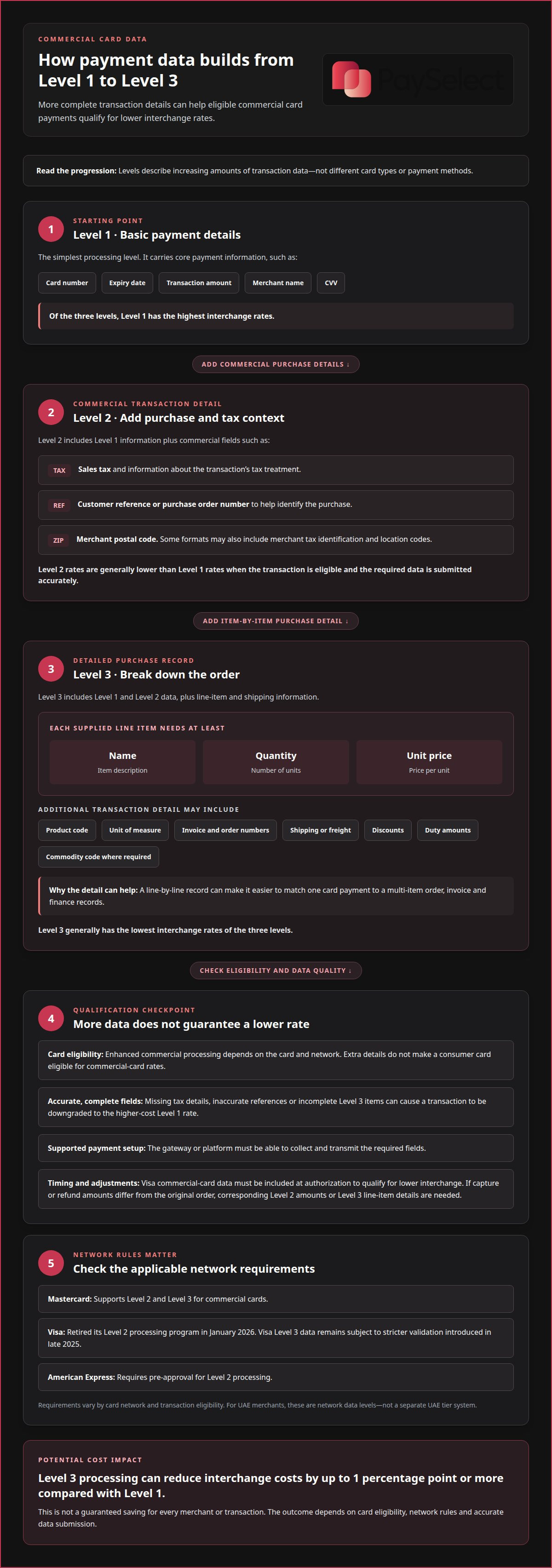
Understanding what Level 2 and Level 3 card data processing means starts with the detail attached to a commercial card transaction. Level I, Level II and Level III are also written as Levels 1, 2 and 3. They describe increasing amounts of transaction data, not different card types or payment methods.
Level 1 carries basic payment information, such as the card number, expiry date, transaction amount, merchant name and CVV. It is the simplest processing level and has the highest interchange rates of the three. Level 2 adds commercial transaction fields, including sales tax and a customer reference or purchase order number. Level 3 includes Level 1 and Level 2 data, plus detailed line items and shipping information. In general, Level 2 rates are lower than Level 1 rates, while Level 3 has the lowest interchange rates.
These tiers matter because complete, accurate data can help eligible commercial card transactions qualify for a lower interchange rate. Sending extra fields doesn’t make a consumer card eligible for a commercial rate. Mastercard supports Level 2 and Level 3 for commercial cards. Visa retired its Level 2 processing program in January 2026, while Visa Level 3 data remains subject to stricter validation introduced in late 2025. American Express requires pre-approval for Level 2 processing.
Missing or incorrect required fields can cause a transaction to be downgraded to the higher-cost Level 1 rate. Common issues include omitted tax details, inaccurate customer references and incomplete Level 3 line items. For UAE merchants, the applicable requirements depend on the card network and transaction eligibility; the tier names describe network data levels rather than a separate UAE tier system.
Organizations that store, process or transmit cardholder data need to account for PCI DSS security requirements. Protecting that information helps reduce risks such as unauthorized access or exposure through payment systems. Level 2 and Level 3 describe transaction-data detail; they don’t replace card-data security requirements.
What data fields are required at each level?
Required fields range from basic payment details to commercial and item-level information. The card network and payment gateway determine which fields the merchant must submit.
Level 2 Transaction Requirements
Level 2 adds commercial purchase details, including sales tax, a customer reference or purchase order number, and the merchant’s postal code. These fields help identify the transaction and its tax treatment, supporting interchange qualification when the card and network are eligible. Some formats also include merchant tax identification and location codes, so the gateway’s field requirements matter.
Level 3 Line-Item and Shipping Fields
Level 3 includes individual product details, such as item name, quantity, unit price, product code and unit of measure. Visa also requires an item commodity code. Transaction records can include invoice and order numbers, shipping or freight amounts, discounts, and duty amounts. These fields let the transaction carry a clearer breakdown of what the buyer purchased and how it was delivered.
For Level 3 card transactions, each supplied line item needs at least a name, quantity and unit price. Visa also requires the commodity code, while shipping, freight and invoice details can add useful transaction context.
Timing matters: Visa commercial card data must be included at authorization to qualify for lower interchange. Submitting complete data with the transaction can help support its processing requirements. If a capture or refund amount differs from the original order, the transaction needs the corresponding Level 2 or Level 3 amounts or line-item details.
A payment gateway or platform must support collecting and transmitting these data fields; a basic setup may not offer the required inputs. Reviewing payment gateway capabilities can help identify whether the integration supports the fields your payment processing needs.
Potential savings depend on card eligibility, network rules and accurate submission. Level 3 processing can reduce interchange costs by up to 1 percentage point or more compared with Level 1, but that figure isn’t a guaranteed saving for every merchant or transaction.
Line-item details included in Level 3 processing
Level 3 data turns a commercial card payment into a more useful record of the underlying purchase. Rather than treating the approved total as an isolated amount, a business can connect payment information with its sales and finance records. This is valuable when one card transaction covers several products or services.
For example, a corporate buyer may pay one amount for a bulk order containing several products. A line-by-line record helps the finance team connect the payment to the order, rather than relying on the total alone. This can make invoice matching, expense tracking and record-keeping easier, especially when purchase records and card statements are managed in separate systems.
The practical benefit depends on consistent data throughout the payment flow. If an item is described differently in the product catalogue and sales record, staff may need to resolve the mismatch during reconciliation. Businesses can reduce this friction by keeping product information consistent across order entry, invoicing and the data submitted with a card transaction. Clear processes also help finance teams understand adjustments and identify the purchase records that support each payment.
Detailed records can also make commercial spending easier to understand. When reviewing a card statement, a finance team can distinguish a bundled purchase from a single-item sale and compare payment details with internal records. This supports expense reviews without leaving each payment as an unexplained total.
Level 3 data can therefore serve two purposes: helping eligible commercial transactions meet network data requirements and creating a more complete record for business operations. It is most useful when the payment integration preserves the connection between each transaction and the company’s purchasing records. For a business with recurring corporate orders, that connection can make reconciliation more structured and help teams manage payment information with less manual matching.
Businesses that may benefit from enhanced data processing
Enhanced data processing is most relevant to businesses that regularly accept commercial cards for detailed business purchases. Examples include B2B software companies billing corporate customers, wholesalers selling multiple products per order, and suppliers processing invoice-based payments. In complex sales environments where transactions flow through multi-tier distribution networks, solutions from Computer Market Research help automate channel management and reporting, keeping B2B sales data organized and aligned with enterprise records.
Enhanced data may be most valuable when eligible commercial-card transactions make up a meaningful share of payment volume. For example, a corporate customer paying for a software subscription may use a commercial card. Accurate transaction data can help an eligible payment qualify for lower interchange. A consumer card does not qualify for commercial processing levels simply because extra details are submitted.
Level 3 data can be especially useful when orders contain many products, shipping charges or discounts. Itemised records help connect a credit card processing entry with an invoice or purchase order. That can support reconciliation and expense tracking, particularly when finance teams handle transactions across departments or business locations.
Enhanced data may matter less to businesses that mainly accept consumer cards or process simple transactions with little item-level information. In these cases, extra fields can add integration work without creating a corresponding opportunity to qualify for commercial interchange rates. The decision depends on the card mix, transaction eligibility, gateway capabilities and whether accurate data can be submitted at authorization.
UAE businesses serving corporate buyers can review transaction reports to understand how much activity involves commercial cards, then assess whether their payment setup can transmit the required fields. This review is useful before changing payment workflows, because missing data can stop an otherwise eligible transaction from receiving the intended rate. Cross-border card acceptance adds complexity: card-network and acquiring arrangements also affect how payments are handled, prompting many firms to streamline their global operations using platforms like KeyBS Pay for multi-currency account management and international settlements.
The practical takeaway is to focus on eligible corporate transactions, not simply total sales volume. Assess your payment setup to see whether enhanced data fits your transaction mix and reporting needs.
PaySelect
PaySelect helps UAE businesses compare payment options and assess how their arrangements fit their transaction needs. For businesses reviewing existing providers, PaySelect’s payment advisory service can assess transaction and settlement reports, benchmark fees, identify potential cost savings and recommend improvements without requiring a provider switch.
Businesses considering a new setup can use PaySelect’s Payment Gateway Comparison Tool to compare providers against their requirements. For international payment needs, PaySelect’s Cross-Border Payments matching helps businesses assess suitable options. The right choice depends on factors such as customer markets, transaction mix and operational requirements.
Whether you’re evaluating a new provider or improving an existing setup, contact PaySelect to discuss your payment requirements and explore suitable next steps.
Make your payment setup work harder
Understanding what Level 2 and Level 3 card data processing involves can help frame a wider review of your payment setup. Consider how your transaction flows, reporting needs and commercial terms work together. That perspective can help you identify which questions to raise when assessing your current arrangement or considering a change.
For UAE businesses, payment decisions affect more than transaction processing. Understanding costs and operational requirements supports informed planning as a business grows or serves customers across markets. PaySelect helps businesses compare payment options and review existing arrangements.
Take the next step with a focused discussion about your business requirements. Contact PaySelect to discuss your processing needs and consider the options available for your payment setup.
Frequently Asked Questions
Do I need a special payment processor to use Level 2 and Level 3?
You need a payment gateway or platform that can collect and transmit the additional transaction fields. A standard setup may send only basic payment details, without supporting enhanced data submission. For example, a business selling to corporate buyers should ensure its checkout or invoicing flow can pass purchase references and item details at authorization. The processor and card network also determine which transactions qualify.
What transactions warrant levels 2 and 3?
These levels are relevant to eligible commercial card transactions, such as a company paying a supplier or corporate buyer purchasing business software. Level 3 is most useful when the sale has itemised products, shipping charges or invoice details to report. A high transaction amount alone doesn’t make a payment eligible, and sending extra data won’t convert a consumer-card purchase into a commercial transaction.
Why Is This Important?
Accurate enhanced data can help eligible transactions qualify for lower interchange, while detailed records can simplify finance processes. For example, a finance team can use invoice references and item details to match a card payment with a purchase record. The benefit depends on the card, network rules and accurate submission. Missing or invalid fields can prevent a transaction from receiving the intended treatment.
What are Level 2 and Level 3 card data processing?
They are ways of submitting more commercial purchase information alongside a card payment. Level 2 adds transaction-level business details, while Level 3 provides a fuller purchase breakdown. Mastercard refers to its three data tiers as Data I, II and III. These labels describe the amount of information accompanying a transaction, not a separate payment method or a different physical card.
What data fields are required for Level 2 card transactions?
Level 2 generally adds sales-tax information, a customer reference or purchase-order number, and the merchant’s postal code to the basic payment data. For example, a supplier could use a buyer’s purchase-order reference to connect the card transaction with its invoice. Exact field validation varies by network and transaction type, so the gateway must support the relevant data format and submission timing.
What are the differences between Level 2 and Level 3 processing?
Level 2 provides a concise commercial transaction summary, while Level 3 carries itemised purchase details. A corporate buyer’s payment for one service may need transaction-level references; an order containing several products may also need quantities, unit prices and shipping information. Level 3 can support more detailed reconciliation, but it requires more fields and accurate line-item formatting through the payment integration.
Disclaimer
This content is for informational purposes only and should not be considered financial, legal, or regulatory advice. Payment provider availability, pricing, and approval processes vary depending on individual business circumstances. PaySelect does not guarantee provider acceptance or specific outcomes. Businesses should conduct their own due diligence before entering into any agreements.
Empowering businesses to achieve greater growth
