
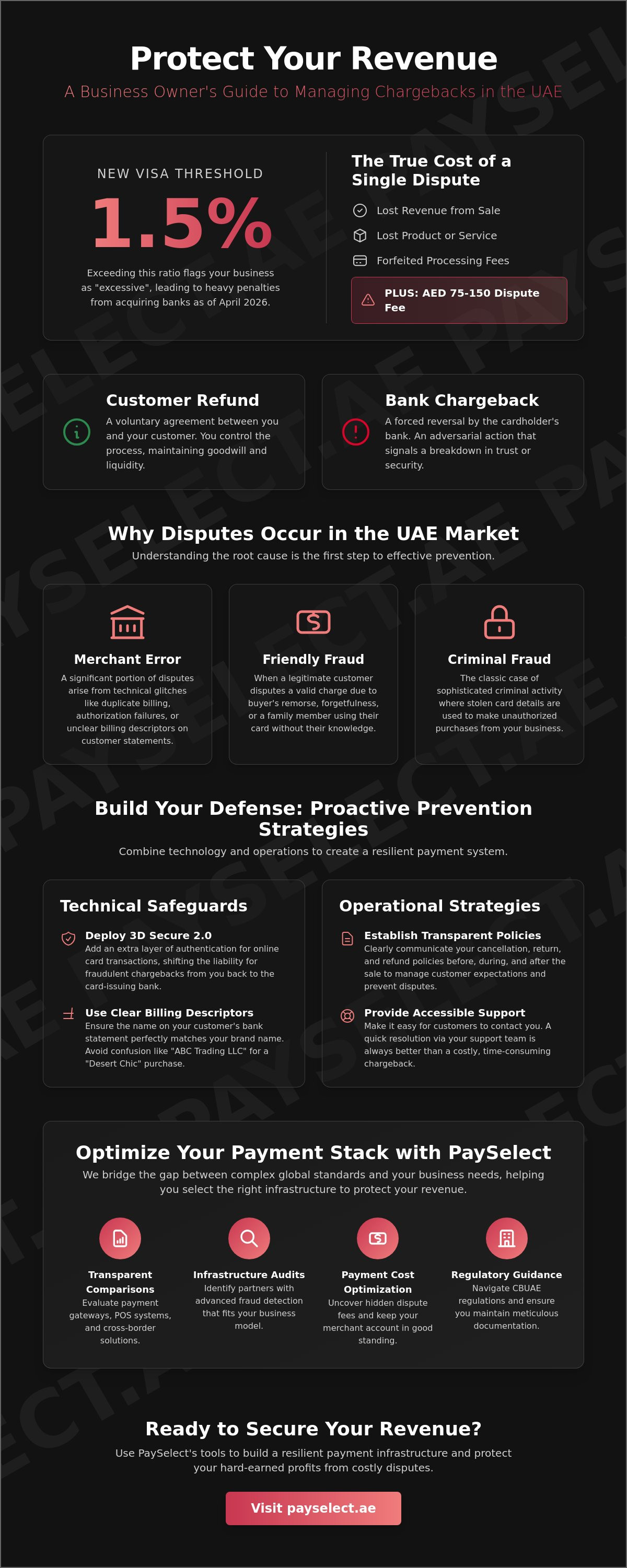
Did you know that as of April 2026, Visa has lowered its chargeback ratio threshold to just 1.5% for UAE merchants? This change makes managing and reducing chargebacks in uae a critical priority, as even a slight increase in disputes can flag your business as "excessive" and trigger heavy penalties. It is a high-stakes environment where "friendly fraud" and high dispute fees, often reaching AED 150 per instance, can quickly erode your profit margins.
You likely feel the pressure of balancing customer satisfaction with the need for rigid security. You deserve a payment system that works as hard as you do. This guide shows you how to protect your revenue by implementing robust prevention strategies and selecting the right infrastructure to support your growth. We will explore how to navigate the latest CBUAE regulations, master dispute response timelines, and optimize your operational costs.
PaySelect facilitates this transition by providing a transparent comparison of payment gateways, POS systems, and cross-border solutions. By using our comparison tools and infrastructure audits, you can identify the partners that offer the best protection, lowest friction, and highest reliability for your specific business model. We help you bridge the gap between complex global standards and your intuitive business needs.
Key Takeaways
• Distinguish between customer refunds and bank-driven reversals to maintain tighter control over your business liquidity and cash flow.
• Deploy technical safeguards like 3D Secure 2.0 and clear billing descriptors to prevent disputes caused by merchant errors or customer confusion.
• Master the art of managing and reducing chargebacks in uae by establishing transparent cancellation policies and highly accessible support channels.
• Use infrastructure comparison tools to identify payment gateways that offer advanced fraud detection without compromising the customer checkout experience.
• Conduct a payment cost optimization audit to uncover hidden dispute fees and ensure your merchant account remains in good standing with acquiring banks.
Understanding the Chargeback Landscape for UAE Merchants
A chargeback is a forced reversal of funds by a cardholder's bank, essentially bypassing the merchant entirely. While a standard refund is a voluntary agreement between you and your customer, a chargeback is an adversarial action that signals a breakdown in trust or a security failure. As digital commerce scales across the Emirates, UAE businesses are seeing a sharp rise in these disputes. Rapid growth often outpaces internal controls, leaving merchants vulnerable to both legitimate errors and fraudulent claims.
The health of your business is measured by your "Chargeback Ratio." This is the percentage of your monthly transactions that result in a dispute. In the UAE, banks monitor this metric with extreme precision. For instance, as of April 2026, Visa has lowered its monitoring threshold to 1.5%. Exceeding this limit flags your business as high-risk, making managing and reducing chargebacks in uae a foundational requirement for operational stability.
The True Cost of a Dispute
The impact of a dispute extends far beyond the initial sale price. When a customer initiates the chargeback process, you lose the product or service already provided. You also lose the original processing fees. On top of this, UAE acquiring banks typically levy dispute fees ranging from AED 75 to AED 150 per instance. These penalties apply regardless of whether you eventually win the case. If your ratio remains high, you face the ultimate penalty: merchant account termination. This effectively cuts off your ability to accept card payments, stalling your business growth indefinitely.
UAE Regulatory Context and Merchant Rights
The UAE banking system operates under a structured framework, recently updated by Federal Decree Law No. 6 of 2025. This law consolidates the regulation of payment providers and banks, ensuring a more transparent environment for merchants. While the law expands consumer protection, it also clarifies merchant obligations. You're required to maintain meticulous transaction documentation, including signed delivery receipts and clear customer communication logs. Your acquiring bank acts as the intermediary, but the burden of proof rests on you.
Different payment providers offer varying levels of support during this process. Some provide automated tools to help you gather evidence, while others offer more hands-on consulting. Using a payment gateway comparison tool allows you to evaluate which infrastructure partners offer the most robust defense against revenue loss. Selecting a partner that aligns with your specific risk profile is the first step in building a resilient payment stack.
Identifying the Root Causes: Why Disputes Occur in the UAE Market
Disputes in the Emirates typically stem from three primary sources: sophisticated criminal activity, technical merchant errors, and the growing phenomenon of friendly fraud. While many businesses focus exclusively on preventing stolen card usage, the reality of managing and reducing chargebacks in uae is often more nuanced. Merchant errors, such as duplicate billing or authorization failures, account for a significant portion of revenue loss. These technical glitches suggest a lack of synchronization between your front-end store and your back-end payment processor.
Unrecognized transactions remain a dominant pain point. This occurs when your billing descriptor—the text that appears on a customer's bank statement—doesn't match your brand name. If a customer buys from "Desert Chic" but sees "ABC Trading LLC" on their mobile banking app, they'll likely initiate a dispute. Clear, recognizable descriptors are essential for maintaining trust and ensuring your revenue remains secure. Service-related issues also play a role; delivery delays and products that don't match their online descriptions frequently lead customers to bypass your support team and call their bank instead.
The Rise of Friendly Fraud
Friendly fraud occurs when a legitimate customer disputes a valid purchase. This often happens because of "buyer's remorse" or simple forgetfulness. In the UAE's family-centric culture, it's also common for family members to use a shared card without the primary cardholder's immediate knowledge. When the statement arrives, the transaction is flagged as unauthorized. While Sanadak, the UAE's financial dispute resolution unit, provides a formal path for resolving complex financial disagreements, merchants should aim to resolve these misunderstandings before they reach a third-party auditor. Effective communication and visible transaction history within your app or website can mitigate these accidental disputes.
Operational Gaps that Trigger Disputes
Operational friction is a silent killer of merchant accounts. Vague shipping timelines, buried cancellation buttons, and invisible contact details force customers into a corner. If a user can't find a way to cancel a subscription or track a late package, they'll use the chargeback mechanism as a tool for resolution. Hidden subscription terms are particularly dangerous; recurring billing without clear prior notification is a frequent trigger for complaints. Ensuring your support channels are accessible and your policies are transparent is a strategic necessity.
Optimizing your payment stack is the most effective way to address these gaps. By using a payment gateway comparison tool, you can evaluate different providers based on their fraud management capabilities and descriptor flexibility. Different gateways offer varying levels of technical support and dispute management tools. Selecting the right infrastructure ensures that your business remains fluid, secure, and ready for international expansion.
Technical Safeguards: Leveraging UAE Payment Infrastructure
Implementing technical safeguards is the most effective way to automate your revenue defense. In the UAE, the digital economy relies on sophisticated authentication protocols that protect both the merchant and the consumer. By integrating the right tools into your checkout flow, you create a frictionless yet secure environment that minimizes the risk of successful disputes. This proactive approach is essential for managing and reducing chargebacks in uae while maintaining a high-fluidity payment experience.
One of the most critical components is 3D Secure 2.0 (3DS2). This protocol is the standard for online transactions across the Emirates, offering a seamless user experience while providing a "liability shift." When a transaction is authenticated through 3DS2, the responsibility for fraudulent disputes often moves from the merchant to the card-issuing bank. This shift provides a robust layer of institutional protection that is fundamental to your long-term stability.
Tokenization also plays a vital role, especially for subscription-based models. By replacing actual card numbers with secure "tokens," you reduce the impact of potential data breaches. It ensures that recurring payments are authorized through a secure, encrypted link, which is a key factor in managing and reducing chargebacks in uae for long-term service contracts.
The Power of Clear Billing Descriptors
Your billing descriptor is the first line of defense against "unrecognized transaction" claims. It is essential that your 'Doing Business As' (DBA) name matches your website URL or the brand name the customer recognizes. Including a customer service phone number directly within the descriptor field allows confused buyers to call you instead of their bank. Implementing a clear, recognizable billing descriptor can reduce unrecognized transaction disputes by up to 30%.
Advanced Fraud Protection Tools
Modern infrastructure allows for real-time scrutiny of every transaction. Velocity checks prevent "card testing" by flagging multiple rapid attempts from a single IP address, while IP geolocation helps verify that the user's location aligns with the card's issuing country. Address Verification Service (AVS) and CVV checks remain fundamental requirements for confirming the cardholder's identity during the checkout process.
Choosing the right payment gateway provides built-in security layers that automate these checks. Different providers offer varying levels of fraud detection sophistication. Some focus on high-speed processing, while others prioritize deep-learning fraud models. Using a comparison tool to evaluate these technical capabilities ensures you select a partner that balances security with a smooth user experience. This strategic alignment is the key to maintaining a healthy merchant account in a competitive digital landscape.
Operational Strategies to Reduce Dispute Ratios
Technical safeguards provide the foundation, but operational excellence is what truly secures your revenue. Managing and reducing chargebacks in uae requires a shift from reactive defense to proactive customer engagement. By refining your internal workflows, you can resolve friction before it escalates into a formal bank dispute. This process involves three core pillars: transparency, documentation, and speed.
Communication should remain constant throughout the customer lifecycle. Sending immediate transaction receipts, providing real-time shipping updates, and offering easy access to support teams reduces the anxiety that leads to "buyer's remorse." When a customer feels informed, they're far less likely to initiate a forced reversal through their bank. Efficiency in these areas signals to both the customer and the bank that you're a reliable institutional partner.
Policy Transparency as a Defense
Clear policies act as a legal shield during the arbitration process. You should place your refund and cancellation terms where they're impossible to miss, particularly on the final checkout page. Implementing an "I agree to the terms and conditions" checkbox ensures the customer has explicitly acknowledged your rules before the transaction is finalized. UAE banks prioritize these documented agreements when reviewing evidence, as they demonstrate a clear, binding contract between the merchant and the consumer.
Record Keeping and Proof of Delivery
Meticulous documentation is the only way to win a dispute once it's filed. For physical goods, integrating tracking numbers directly into your payment platform provides a verifiable audit trail. High-value items require even more rigor; always secure a signed delivery note from the recipient. In the digital services sector, maintain detailed log files that record IP addresses, login timestamps, and usage metrics. These digital footprints prove the service was accessed and utilized, making it difficult for cardholders to claim the transaction was unauthorized.
Proactive Support and Alerts
Speed is your greatest asset in dispute management. Utilizing pre-dispute alerts allows you to identify potential issues before they impact your chargeback ratio. These systems notify you when a customer contacts their bank, giving you a small window to issue a voluntary refund and avoid heavy dispute fees. Your POS system should also be configured to handle digital receipts automatically, ensuring compliance with national consumer protection standards while providing customers with an instant record of their purchase.
Building a resilient business starts with choosing the right infrastructure. You can perform a payment cost optimization audit today to find a partner that simplifies these operational hurdles and protects your bottom line.
Optimizing Your Payment Stack with PaySelect
A generic approach to payments is often the root of high dispute ratios. Many merchants adopt the first provider they encounter, but a one-size-fits-all solution rarely accounts for specific industry vulnerabilities. Managing and reducing chargebacks in uae requires a customized stack that reflects your unique risk profile. High-risk sectors, such as travel or cryptocurrency, often face processing fees up to 5% and require significantly more robust defensive tools than a standard retail operation. Aligning with a partner that understands these nuances is the difference between a thriving business and one facing account termination.
PaySelect, launched on September 18, 2025, serves as an independent digital platform to help you navigate this complexity. We don't process payments; we provide the clarity you need to choose the partners that protect your bottom line. By using our payment gateway comparison tool, you can evaluate providers based on their technical resilience and fraud management performance. This independent advisory ensures you aren't locked into a system that fails to support your growth or protect your revenue.
Choosing the Right Gateway for Risk Mitigation
Not all dispute management dashboards are created equal. Some providers offer real-time alerts that allow you to refund a customer before a chargeback is officially filed, while others provide "chargeback guarantees" or insurance for specific transaction types. You should also evaluate cross-border payment solutions if you serve international customers. These specialized gateways often include advanced fraud protection layers designed to handle the complexities of international card surcharges and varying regulatory frameworks.
Simplifying Your Selection Process
The technical market for payments is dense and often opaque. PaySelect simplifies this by offering a "Take the Test" tool that matches your specific business needs with the most secure and cost-effective providers. This unbiased comparison allows you to see the differences in fee structures, fraud tools, and support levels without the pressure of a sales pitch. It's about finding a partner that offers the right balance of security and fluidity for your customers. PaySelect acts as a bridge between complex infrastructure and merchant needs.
By conducting a payment cost optimization audit through our platform, you can identify hidden fees and operational gaps that contribute to higher dispute ratios. We help you build a payment stack that is not just a utility, but a strategic tool for business transformation. Take control of your financial health and ensure your business remains a leader in the UAE's fast-moving digital economy.
Securing Your Revenue for Sustainable Growth
Mastering the digital landscape requires a precise balance of technical security and operational transparency. By implementing 3D Secure 2.0 and maintaining meticulous delivery records, you transition from reactive defense to proactive scaling. Managing and reducing chargebacks in uae is a continuous process that demands the right infrastructure and a clear understanding of evolving bank thresholds. Protecting your margins isn't just about stopping fraud; it's about building a friction-free experience that inspires customer confidence.
You don't have to navigate this complex ecosystem alone. As an independent UAE-based advisory, PaySelect provides the tools you need to compare top-tier national payment providers and identify the perfect fit for your risk profile. Our expertise in payment cost optimization ensures you eliminate unnecessary fees while strengthening your merchant account health. Build a resilient foundation that allows your business to thrive in a fast-moving economy.
Optimize your payment infrastructure and reduce risk with PaySelect today. Your path to secure, international expansion starts with a single strategic choice.
Frequently Asked Questions
What is the difference between a refund and a chargeback in the UAE?
A refund is a voluntary transaction reversal initiated by the merchant, while a chargeback is a forced reversal mandated by the cardholder's bank. In the UAE, refunds help maintain your merchant standing and preserve customer trust. Chargebacks, however, negatively impact your dispute ratio and incur non-refundable bank fees regardless of the outcome. Choosing the right gateway allows you to issue refunds quickly to prevent disputes from escalating into formal bank actions.
How can I tell if a chargeback is fraudulent?
Fraudulent chargebacks generally fall into two categories: criminal fraud involving stolen credentials and "friendly fraud" where a legitimate customer disputes a valid purchase. You can identify these by cross-referencing IP addresses, shipping destinations, and customer communication logs. Modern gateways provide real-time fraud scoring and velocity checks to help you flag suspicious activity before the transaction is even finalized, protecting your revenue from the start.
Does 3D Secure prevent all chargebacks for UAE merchants?
3D Secure 2.0 provides a liability shift for many fraudulent transactions but it doesn't protect against service-related disputes like "product not received." It's a powerful tool for managing and reducing chargebacks in uae by verifying the cardholder's identity through biometric or SMS codes. However, you must still maintain operational excellence and clear communication to defend against claims regarding product quality or delivery delays.
How much are the typical chargeback fees in the UAE?
Merchants in the UAE typically face dispute fees ranging from AED 75 to AED 150 per instance. These fees are charged by the acquiring bank the moment a dispute is filed, and they aren't returned even if you win the case. Because these costs accumulate quickly, performing a payment cost optimization audit is a strategic way to identify which infrastructure providers offer the most efficient and cost-effective dispute management workflows.
Can a merchant win a chargeback dispute?
Yes, merchants can successfully win disputes by providing compelling evidence that proves the transaction was valid and authorized. For Visa disputes, you generally have a 30-day window to respond, though your specific payment provider may require documentation within 5 to 10 days to meet internal deadlines. Success depends on having organized records, such as signed delivery notes, clear terms of service, and proof of customer usage.
What is a 'good' chargeback ratio for a UAE business?
A healthy chargeback ratio for a UAE business should remain strictly below 1.5%. As of April 2026, Visa's monitoring program has lowered its threshold to this level, meaning anything higher could lead to your business being classified as an "excessive" risk. Maintaining a low ratio is vital for ensuring your merchant account remains active and your processing fees stay within a competitive range for your industry.
How do billing descriptors affect my dispute rate?
Billing descriptors are the text entries on a customer's bank statement, and they directly influence your dispute rate by ensuring brand recognition. If your registered company name differs from your storefront brand, customers may flag the transaction as unrecognized and call their bank. Ensuring these names match is a simple but effective strategy for managing and reducing chargebacks in uae caused by simple customer confusion.
What documentation do I need to fight a service-related chargeback?
To fight service-related disputes, you need verifiable proof of fulfillment such as courier tracking numbers or signed delivery receipts. For digital services, log files showing IP addresses, timestamps, and account activity are essential to prove the customer accessed the service. This documentation demonstrates that the customer received the value they paid for, allowing the bank to rule in your favor during the formal arbitration process.
Disclaimer
This content is for informational purposes only and should not be considered financial, legal, or regulatory advice. Payment provider availability, pricing, and approval processes vary depending on individual business circumstances. PaySelect does not guarantee provider acceptance or specific outcomes. Businesses should conduct their own due diligence before entering into any agreements.
Empowering businesses to achieve greater growth