
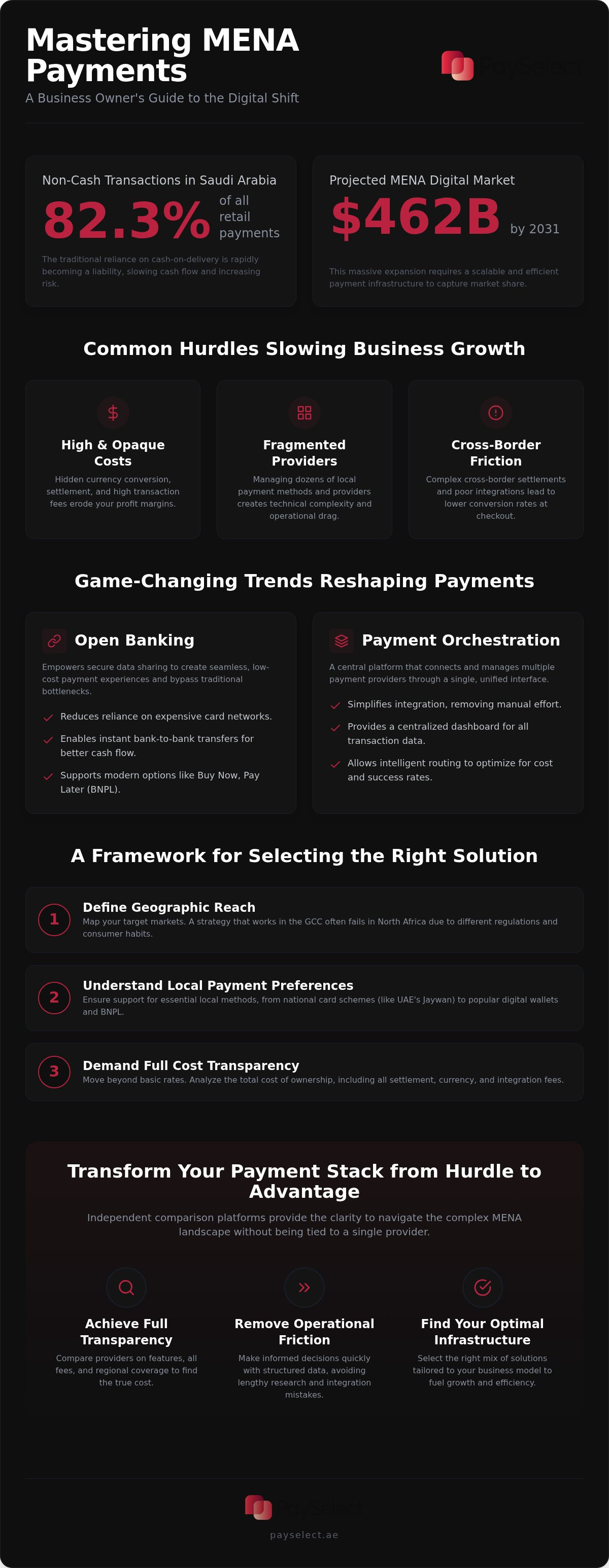
Did you know that non-cash transactions in Saudi Arabia surged to 82.3% of all retail payments by July 2026? This massive shift proves that mastering mena payments is now the primary driver of regional success. While the digital market expands toward a projected USD 462.41 billion by 2031, many businesses still struggle with fragmented providers and opaque pricing structures. You deserve a setup that offers clarity, speed, and performance.
It's exhausting to manage high transaction costs while trying to integrate a dozen different local payment methods. You need a streamlined, cost-effective infrastructure that handles cross-border transactions without the usual technical friction. This guide will show you how to master market complexities and select the optimal infrastructure to fuel your business growth.
We'll explore how new regulations, such as Egypt's biometric verification mandates and the UAE's Jaywan card scheme, are reshaping the industry. You'll discover how to remove operational barriers, optimize your payment costs, and achieve higher conversion rates at checkout. It's time to transform your payment stack from a technical hurdle into a strategic advantage.
Key Takeaways
• Understand the critical shift from cash-on-delivery to digital wallets to remain competitive in the region's digital-first economy.
• Learn how open banking and orchestration tools simplify managing multiple providers through a single, efficient interface.
• Identify the hidden costs that don't always appear upfront in mena payments, such as currency conversion and settlement fees.
• Apply a structured framework to select payment solutions based on your specific geographic reach and transaction volume.
• Discover how independent comparison tools remove operational friction and find the optimal infrastructure for your business growth.
Understanding the MENA Payments Ecosystem
The mena payments landscape has moved past its traditional reliance on cash. It's now a high-velocity environment where digital settlement is the baseline, not the exception. For businesses, this means the old reliance on cash-on-delivery is becoming a significant liability. It creates operational friction, increases the risk of returns, and slows down cash flow. Modern consumers now expect the speed of digital wallets and the directness of account-to-account transfers to be available at every checkout.
The Shift Toward Digital Fluidity
Consumer habits have pivoted sharply toward mobile-first interactions. Contactless and mobile payments are the standard touchpoints for the majority of shoppers. By 2026, the region's digital infrastructure has matured to support near-instant transaction speeds, making real-time payments a standard requirement for any growing enterprise. Businesses that don't adapt quickly find themselves locked out of an increasingly borderless digital economy. To stay competitive, you must offer the specific methods your customers prefer, whether they're using national card schemes or international wallets. Finding this balance requires a clear view of the payment gateways available across different territories.
Regulatory Frameworks and Financial Stability
Regional central banks are no longer just overseers; they're active innovators. Organizations like the Arab Monetary Fund play a significant role in fostering monetary cooperation and modernizing payment systems across Arab states. These efforts have led to increased standardization, which reduces the technical barriers for international merchants looking to expand. Compliance isn't just a legal hurdle; it's a strategic tool for building consumer trust. When a checkout process feels secure and follows established regulatory frameworks, conversion rates naturally climb. This stability is what allows for the rapid scaling of digital commerce across diverse borders.
A major mistake businesses make is treating the region as a single, uniform entity. A strategy that works in the GCC often fails in North African markets due to different regulatory maturity and consumer habits. For example, while some markets have reached over 80% non-cash transaction rates, others are still in the early stages of mandating biometric verification for e-wallets. This diversity makes a "one-size-fits-all" approach impossible. Success in mena payments requires a tailored infrastructure that respects local nuances while maintaining global standards. PaySelect provides the transparency needed to compare these diverse options, helping you remove operational friction without being tied to a single provider.
Strategic Trends: Open Banking and Orchestration
The landscape of mena payments is undergoing a structural shift toward deeper connectivity. Open banking and payment orchestration are no longer just buzzwords; they're essential tools for businesses that want to scale without being held back by technical debt. By mid-2026, the Saudi Central Bank's Open Banking framework alone has onboarded 94 licensed third-party providers, signaling a massive move toward financial transparency. These technologies allow you to bypass traditional bottlenecks, lower merchant fees, and create a more fluid checkout experience.
Unlocking Value Through Open Finance
Open Finance empowers you to move beyond basic transaction processing. By utilizing shared data, you can offer personalized payment experiences that recognize customer preferences instantly. This technology significantly reduces friction in bank-to-bank transfers, allowing for immediate settlement and improved cash flow management. It removes the traditional "card-bias" that often forces merchants to pay higher processing fees. Instead of relying solely on expensive credit card networks, you can leverage direct account access to keep more of your revenue.
The rise of Buy Now, Pay Later (BNPL) has also become a standard requirement at checkout. In Saudi Arabia, the BNPL sector grew by 47% year-over-year, proving that customers demand flexible payment options. Integrating these services through an open framework ensures you stay relevant to modern consumer habits while maintaining a healthy balance sheet.
Orchestration as a Catalyst for Growth
Payment orchestration acts as a sophisticated bridge between your business and a fragmented ecosystem. It allows you to manage multiple providers through a single interface, which removes the operational barriers of manual integration. For enterprises handling high-volume transactions, this is a strategic necessity. Orchestration enables you to:
Unify data
View all your transaction history in one centralized dashboard.
Increase success rates
Automatically route payments to the most reliable provider in real-time.
Reduce costs
Switch between gateways based on the most competitive pricing available for specific regions.
This centralized approach ensures that your cross-border transactions remain seamless, even as you expand into new markets with different regulatory requirements. It transforms your payment stack into a strategic tool for business transformation rather than a source of operational friction. If you're unsure which technologies fit your current scale, you can compare payment gateways to see how different infrastructures handle orchestration and open banking features. Finding the right balance between innovation and reliability is the key to sustainable growth. You can easily start your optimization journey by using independent tools to audit your current setup and identify where costs can be trimmed.
Challenges in MENA Payment Infrastructure
Expanding your digital footprint across borders often reveals a harsh reality: what works in one market rarely translates perfectly to the next. Market fragmentation is the primary obstacle for regional expansion. Businesses often face a paralyzing choice between dozens of providers that appear identical but differ wildly in execution. This selection anxiety is compounded by technical debt from poorly integrated online gateways and physical POS machines. Without a clear framework for comparison, you risk locking your business into a suboptimal system that hinders your momentum.
Navigating Market Fragmentation
The complexity of mena payments stems from diverse local preferences. Every country uses unique national card schemes and digital wallets. If you don't support these specific methods, your conversion rates will drop. Cross-border transactions add further difficulty, often incurring unexpected intermediary fees and settlement delays. You must select infrastructure with a broad regional footprint to maintain fluidity. Failing to bridge these gaps creates a disjointed experience that drives customers toward your competitors. Selecting a partner that understands these local nuances is not just a technical choice; it's a strategic necessity for anyone looking to scale effectively across the region.
Optimizing Infrastructure Costs
Hidden costs are silent killers of profitability. Currency conversion fees and opaque settlement charges erode your margins if your stack isn't optimized. You must audit your system for revenue leaks regularly. Inefficient payment stacks don't just cost money in fees; they lead to transaction failure. When a payment fails, you lose a sale, customer trust, and future retention. Integrating your cross-border payments into a cohesive strategy is the only way to ensure long-term stability and predictable cash flow.
PaySelect solves these pain points through an independent platform. You can compare pricing and functionality without bias. Instead of guessing which provider offers the best terms, you can use specialized tools to see real differences in gateway pricing. This transparency removes operational friction and allows you to focus on growth rather than troubleshooting technical bottlenecks. By using a data-driven approach to select your infrastructure, you ensure that every transaction contributes to your bottom line instead of being drained by unnecessary fees.
A Framework for Selecting Payment Solutions
Mastering mena payments requires a disciplined approach to selection. You shouldn't settle for the first provider that offers a competitive-sounding rate. Instead, use a structured framework to ensure your infrastructure supports long-term expansion rather than creating technical debt. A strategic choice today prevents the operational friction that often stalls international growth.
Step 1: Define your geographic reach.
Identify where your primary customers are located. If you're targeting the 82.3% non-cash retail market in Saudi Arabia, your requirements will differ significantly from a business focused on North African e-wallets.
Step 2: Analyze transaction volume and ticket size.
High-frequency, low-value transactions demand a different fee structure than luxury sales with high average ticket sizes.
Step 3: Evaluate specialized features.
Determine if your business model requires recurring subscription billing, payment links for social commerce, or integrated physical hardware.
Step 4: Compare full fee structures.
Look beyond the headline transaction rate. Factor in monthly minimums, setup fees, and the cost of processing refunds or chargebacks.
Step 5: Assess technical compatibility.
Ensure the solution integrates seamlessly with your existing commerce platform through robust APIs or ready-made plugins.
Evaluating Payment Gateways and POS Systems
A modern payment gateway must offer more than just basic processing. It needs to provide deep data insights and support the latest security protocols like 3D Secure 2.0. If you operate physical locations, integrating your sales with advanced POS machines ensures your digital and offline inventory stay in perfect synchronization. This unified approach removes the administrative burden of reconciling data from different sources.
Mastering Cross-Border Complexity
Selecting the right cross-border payment solutions is critical for regional stability. You must understand how different providers handle settlement times and currency management to avoid "hidden" conversion costs. Strategic partnerships with providers that have a wide regional footprint can significantly reduce the friction of international trade. This ensures your capital remains fluid and ready for reinvestment. To find the right fit for your specific business model, you can use our comparison tool to audit your options and identify the most cost-effective path forward.
How PaySelect Facilitates Strategic Decisions
PaySelect stands as the independent authority in the mena payments space. We don't process your payments; we ensure you choose the provider that does it best for your specific needs. In a market where many "advisors" are actually technology providers in disguise, our independence is your greatest asset. We provide the transparency needed to navigate a crowded field of gateways and processors without the bias of a hidden sales agenda. Our role is to act as your strategic partner, ensuring your infrastructure is built for speed and expansion.
One of the primary ways we remove operational friction is through our "Take the Test" tool. This isn't a simple survey; it's a sophisticated matching engine designed for modern merchants. By analyzing your unique business requirements, transaction volumes, and geographic targets, the tool identifies the most compatible solutions from a wide range of providers. It transforms a complex selection process into a manageable, data-driven decision.
The Power of Independent Comparison
Choosing a payment stack is often clouded by complex contracts and fine print that hides the true cost of doing business. We simplify these complexities by offering a clear, unbiased comparison of payment gateways and pricing models. Because we don't sell our own processing services, our data remains objective and focused entirely on your cost optimization. This independent perspective is essential for identifying which providers offer the best value for your specific industry and scale. We break down the technical jargon into actionable insights that any business owner can understand and implement immediately.
Bespoke Consulting for Elite Organizations
For large-scale retail and hospitality groups, standard off-the-shelf solutions are rarely sufficient. These organizations require a higher level of scrutiny through bespoke infrastructure audits. We act as a bridge between complex global technology and your intuitive business outcomes. By identifying inefficiencies in your current setup, we help you reduce operational overhead and eliminate friction in your cross-border payments. This strategic oversight allows your team to focus on international ambition while we handle the technical validation of your payment stack.
Ultimately, PaySelect is a catalyst for growth. We provide the tools to audit your system for leaking revenue and ensure your POS machines and online systems work in perfect harmony. By prioritizing transparency and unbiased data, we empower you to build a payment infrastructure that's not just a utility, but a strategic advantage for regional expansion.
Secure Your Growth in a Digital-First Economy
The transformation of mena payments has reached a critical tipping point. Success no longer depends on merely accepting digital transactions; it requires a sophisticated, optimized infrastructure that removes operational friction. By mastering market fragmentation and leveraging tools like payment orchestration, you can protect your margins and deliver the seamless experience your customers expect. Whether you're managing new regulatory mandates or expanding across borders, a data-driven approach is your most reliable path to stability.
PaySelect provides the independent and unbiased advisory you need to make these high-stakes decisions with confidence. Our sophisticated matching technology and expert infrastructure audits are designed to help you identify the most cost-effective solutions for your specific scale. Don't let hidden fees or technical debt stall your regional ambition. You have the vision to expand; we have the tools to ensure your payment stack supports that journey without compromise.
Find your ideal payment partner with PaySelect’s comparison tool today. Take control of your financial ecosystem and build a foundation that's ready for the future of international commerce.
Frequently Asked Questions
What are the primary payment methods preferred in the MENA region?
Digital wallets, account-to-account transfers, and national card schemes are the primary methods preferred by modern consumers. While cash-on-delivery is declining, it remains a factor in specific market segments. By 2026, contactless mobile payments have become the baseline expectation for retail. Supporting these diverse local preferences is essential for maintaining high conversion rates. A tailored checkout experience ensures you capture every segment of the rapidly expanding digital landscape across the region.
How does payment orchestration differ from a standard payment gateway?
A standard payment gateway connects your store to a single processor, while payment orchestration manages multiple gateways through one interface. Orchestration uses smart routing to send transactions to the provider with the highest success rate in real-time. This technology reduces operational friction by centralizing your data and providing a unified view of performance. It's a strategic tool for scaling mena payments across several different regulatory environments without increasing your technical overhead.
What should a business look for when comparing cross-border payment fees?
Look for transparency in currency conversion markups and intermediary bank fees when comparing cross-border solutions. Settlement times are also a critical factor, as they directly impact your business liquidity and cash flow. You should prioritize providers that offer clear, predictable pricing structures rather than opaque bundled rates. Selecting a partner with a broad regional footprint often helps minimize these hidden costs and ensures your international trade remains fluid and profitable.
Is it possible to integrate local payment methods without multiple contracts?
Integrating various local payment methods through a single contract is possible by utilizing modern aggregators or orchestration platforms. This approach removes the administrative burden of negotiating individual agreements in every country where you operate. It simplifies your technical infrastructure and significantly speeds up your regional expansion. Using a comparison tool helps you identify which providers offer the most comprehensive coverage under one unified agreement, ensuring your setup remains manageable and efficient.
What role does Open Banking play in reducing merchant transaction costs?
Open Banking reduces costs by enabling direct bank-to-bank transfers that bypass expensive traditional credit card networks. These account-to-account transactions typically carry lower processing fees and offer faster settlement times. This technology also provides deeper financial connectivity, allowing for better risk assessment and more personalized customer experiences. It's a powerful mechanism for lowering merchant fees while improving the overall fluidity of your financial operations across the region's diverse digital markets.
How can a business determine if their current payment stack is optimized?
Identifying an optimized stack involves auditing your transaction success rates and analyzing your total cost of ownership. High failure rates at checkout or unexpected settlement fees are clear signs of system inefficiency. If your team is manually reconciling data from multiple sources, your infrastructure is likely creating technical debt. We offer bespoke infrastructure audits to help you identify these bottlenecks and switch to more cost-effective, streamlined solutions for your mena payments.
What are the security standards required for MENA payment processing?
Security standards include PCI-DSS compliance and the implementation of 3D Secure 2.0 for all digital transactions. In markets like Egypt, biometric verification is now mandated for e-wallet transactions exceeding EGP 5,000 as of September 2026. Building consumer trust requires following these established regulatory frameworks and ensuring data encryption at every touchpoint. These protocols don't just protect your revenue; they act as a strategic advantage by reducing fraud and preventing costly chargeback incidents.
Disclaimer
This content is for informational purposes only and should not be considered financial, legal, or regulatory advice. Payment provider availability, pricing, and approval processes vary depending on individual business circumstances. PaySelect does not guarantee provider acceptance or specific outcomes. Businesses should conduct their own due diligence before entering into any agreements.
Empowering businesses to achieve greater growth