
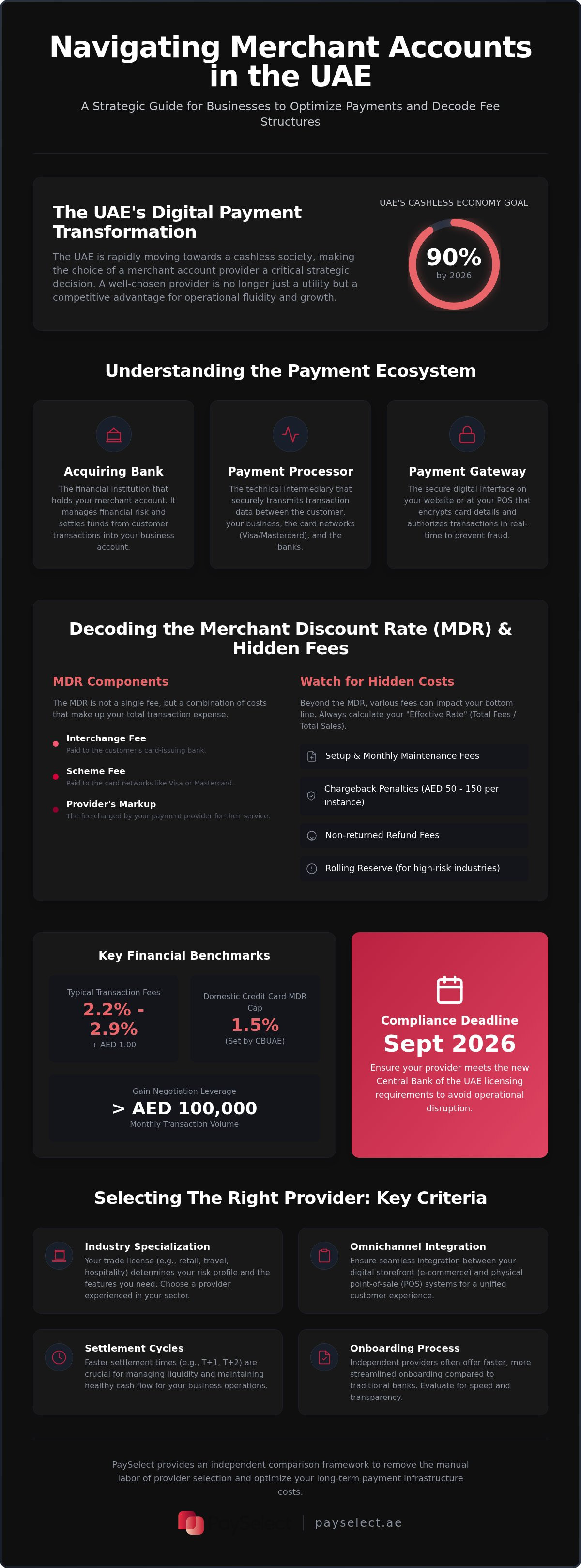
Did you know that the UAE aims for a 90% cashless economy by the end of 2026? This massive digital shift means selecting from the available merchant account providers uae is no longer just a technical checkbox; it's a high-stakes strategic decision. You've likely realized that a "standard" setup often comes with hidden transaction fees, high Merchant Discount Rates (MDR), and onboarding processes that feel unnecessarily opaque.
We understand that your goal is operational fluidity and reduced overhead. This guide delivers a clear, independent framework to help you identify the ideal merchant account for your specific volume and business model. You'll learn how to navigate the new Central Bank licensing requirements effective September 2026 and how to optimize for transaction fees that typically range from 2.2% to 2.9% plus AED 1.00. We'll preview the essential steps to achieve seamless omnichannel acceptance while cutting through the complexity of modern payment infrastructure. By the end of this article, you'll have the tools to transform your payment setup from a cost center into a strategic engine for growth.
Key Takeaways
• Understand the critical roles of acquiring banks and payment gateways to ensure faster settlement cycles and improved cash flow management.
• Decode the components of the Merchant Discount Rate to identify hidden fees and leverage domestic interchange caps for maximum cost efficiency.
• Ensure full compliance with the latest Central Bank of the UAE regulations to avoid operational disruptions before the September 2026 licensing deadline.
• Evaluate merchant account providers uae through a technical lens to secure seamless omnichannel integration between your digital storefront and physical POS systems.
• Discover how an independent comparison framework can remove the manual labor of provider selection and optimize your long-term payment infrastructure costs.
Understanding the Merchant Account Landscape in the UAE
A merchant account is more than just a digital vault; it's the operational bridge that converts customer intent into liquid capital. In the UAE's high-speed commercial environment, this specialized bank account acts as the essential intermediary between a customer’s payment method and your corporate bank account. While many early-stage startups rely on generic payment links, scaling enterprises require a dedicated setup to achieve true payment fluidity. This fluidity acts as a competitive advantage, removing operational friction and ensuring that your capital remains accessible for immediate reinvestment.
The national payment ecosystem functions through three distinct pillars: the acquiring bank, the processor, and the gateway. The acquiring bank manages the financial risk and settles funds, while the processor handles the technical transmission of data across card networks. To understand the digital interface, one might ask, What is a Payment Gateway? It's the secure encryption layer that authorizes transactions in real-time. Leading merchant account providers uae offer integrated solutions that manage these complex layers behind a single, intuitive interface, significantly simplifying your financial stack.
Acquiring Banks vs. Independent Payment Providers
Traditional institutional banks in the UAE offer rock-solid stability and are often the preferred choice for large-scale enterprises with established credit histories. However, these institutions can sometimes be slow to innovate or update their technical stacks. Independent payment providers and fintech aggregators have filled this gap, offering rapid onboarding and superior user experiences. Many modern firms now opt for a hybrid infrastructure, combining the institutional security of a major bank with the agile, feature-rich capabilities of an independent provider to ensure they never miss a transaction due to technical lag.
Why Your Industry Category Determines Your Provider Options
Your trade license category is the primary factor in determining your risk profile. High-risk sectors such as travel, luxury goods, or crypto assets face different scrutiny and reserve requirements compared to low-risk retail. Most merchant account providers uae categorize businesses strictly to manage their own liability. A hospitality business requires specific features like pre-authorization for room deposits, whereas an e-commerce brand prioritizes high conversion rates at the digital checkout. This is why choosing the right payment gateway tailored to your specific industry model is a strategic necessity that directly impacts your bottom line.
Decoding Fee Structures and Settlement Cycles
Transparency in pricing is the bedrock of financial efficiency. While many merchant account providers uae advertise a single percentage, the reality is a layered structure known as the Merchant Discount Rate (MDR). This rate isn't a flat fee; it's a composite of the interchange fee paid to the card-issuing bank, the scheme fee paid to network giants like Visa or Mastercard, and the provider's specific markup. Understanding these layers allows you to identify where your money is actually going.
Beyond the headline MDR, hidden costs often erode your margins. These include setup fees, monthly maintenance charges, and refund fees where the original commission isn't returned. Chargeback penalties are particularly impactful, with typical costs ranging from AED 50 to AED 150 per instance. For industries deemed high-risk, providers frequently implement a rolling reserve. This mechanism holds a percentage of your daily sales for a fixed period, acting as a financial buffer against potential disputes or fraud.
The Real Cost of Transaction Processing
To truly understand your expenses, you must calculate your "Effective Rate." This is the total cost of all fees divided by your total sales volume. It's vital to note that the UAE Central Bank has capped domestic credit card MDR at 1.5% for most merchant categories. However, international transactions or premium cards often incur significantly higher rates. As your monthly transaction volume exceeds AED 100,000, you gain the leverage needed to negotiate lower markups or move toward more transparent "Interchange-Plus" models. If you suspect your current rates are inflated, you can compare payment pricing models to find a more competitive partner.
Optimizing Cash Flow through Settlement Management
Liquidity is the lifeblood of business expansion. In the UAE market for 2026, standard settlement windows typically range from T+1 to T+7. A T+1 cycle ensures funds reach your corporate account just one business day after the transaction occurs. High-velocity businesses, such as retail or fast-moving e-commerce, should prioritize providers offering "Express Settlement" to keep capital moving. Be aware that currency conversion fees can further complicate cross-border payments, as many providers apply a percentage spread on top of the mid-market exchange rate. Aligning your settlement speed with your operational requirements ensures your capital never stays idle during critical growth phases.
Compliance and Onboarding: Navigating UAE Regulations
Navigating the regulatory environment in the Emirates requires more than just a trade license. The Central Bank of the UAE now enforces strict oversight through Federal Decree-Law No. 6 of 2025, requiring all payment service entities to be fully licensed by September 16, 2026. This shift ensures a secure, world-class financial ecosystem, but it also means that merchant account providers uae must perform deeper due diligence than in previous years. While the onboarding process is often criticized for being slow or intrusive, these rigorous checks are designed to prevent future operational barriers, such as sudden fund holds or account terminations.
A proactive payment infrastructure audit can identify compliance gaps before you even submit an application. This preparation reduces the friction during the review phase and accelerates your time-to-market. By aligning your business documentation with national standards early, you transform a perceived hurdle into a streamlined operational advantage.
KYC and AML Requirements for National Businesses
Maintaining long-term account stability depends on your ability to meet Know Your Customer (KYC) and Anti-Money Laundering (AML) standards. These aren't one-time hurdles; they're continuous requirements for any legitimate business. To ensure a successful application in 2026, prepare the following corporate documents:
• A valid UAE trade license relevant to your specific activities
• Passport and Emirates ID copies for all shareholders and ultimate beneficial owners
• Corporate bank account statements covering the last three to six months
• Proof of a physical office address within the UAE
• A website compliance review ensuring clear refund policies and PCI DSS Level 1 security standards
Providers monitor transaction patterns to detect anomalies, so having clear, transparent documentation of your business model is vital for uninterrupted service.
Managing High-Risk and Multi-Jurisdiction Operations
Businesses operating in sectors such as travel, luxury retail, or digital assets face higher scrutiny due to elevated chargeback risks. If your growth strategy includes expanding across the GCC, you'll encounter varying regulatory nuances in each territory. High-risk merchants often benefit from specialized merchant account providers uae that understand these specific sector dynamics. Navigating this multi-jurisdictional complexity requires a strategic approach. Independent advisory services can help you map out these requirements, ensuring that your payment architecture remains fluid and compliant as you scale across international borders.
Technical Integration and Omnichannel Performance
Modern commerce requires a unified approach. Your digital storefront and physical location shouldn't operate as separate entities. Leading merchant account providers uae now offer integrated ecosystems that bridge the gap between online gateways and physical points of sale. This connectivity ensures that inventory, reporting, and customer data remain synchronized across all channels, providing a single source of truth for your business operations.
Security and convenience converge through tokenization. This technology replaces sensitive card data with unique identifiers, allowing you to process recurring billings and "one-click" checkouts without storing actual card numbers. It's a critical component for subscription models and loyalty programs. Integrating robust POS machines into this strategy allows you to capture face-to-face transactions while maintaining the same security standards and data fluidity as your online store.
API Flexibility and Developer Support
A provider's technical documentation is often the best indicator of their service quality. Look for comprehensive SDKs, robust sandboxes for testing, and clear versioning that prevents your integration from breaking during updates. Reliable 24/7 technical support is non-negotiable for mission-critical payment flows where every minute of downtime results in lost revenue. Webhooks are automated notifications sent from the payment provider to your server, enabling your system to receive real-time updates on transaction successes or failures instantly. High-quality APIs allow your developers to build custom checkout experiences that align perfectly with your brand identity.
Future-Proofing with Alternative Payment Methods
The UAE's payment landscape is evolving rapidly beyond traditional credit cards. Digital wallets and Buy Now, Pay Later (BNPL) solutions have become consumer expectations rather than optional extras. Your choice of provider dictates how easily you can adopt these methods, along with NFC-enabled payments and crypto-linked transactions. Tap-to-Phone technology is also gaining momentum, allowing merchants to accept contactless payments directly on a smartphone without additional hardware. Selecting a forward-thinking partner ensures your infrastructure remains relevant as consumer preferences shift toward more frictionless, mobile-first experiences. To ensure your stack is ready for the next wave of innovation, you can access our payment infrastructure consulting for a tailored strategy.
Selecting the Right Provider with PaySelect’s Independent Framework
The search for the perfect payment partner often feels like a fragmented journey through biased marketing claims. PaySelect serves as an independent digital platform based in the UAE, acting as a strategic catalyst for business growth by removing the manual labor of comparing dozens of merchant account providers uae. Instead of navigating dozens of sales pitches, you gain access to a neutral framework that prioritizes your specific transaction volume and operational needs. We don't sell processing; we facilitate the connectivity you need to scale without friction.
Our position as a sophisticated industry leader allows us to act as a bridge between complex global infrastructures and the intuitive needs of modern entrepreneurs. By utilizing a data-driven approach, we help you transition from traditional, stagnant setups to dynamic tech-forward solutions that support international ambition. This ensures that your payment architecture isn't just a utility, but a strategic tool for total business transformation.
The Data-Driven Approach to Provider Matching
Our proprietary "Take the Test" tool simplifies the selection process through three logical steps designed to save time and reduce costs:
Step 1
Input your specific industry risk profile, monthly transaction volume, and international settlement requirements into the platform.
Step 2
Initiate a comparison of matched providers based on transparent pricing models, technical feature sets, and regulatory compliance data.
Step 3
Select the partner that aligns with your projected growth trajectory and technical stack requirements.
This structured flow leads you toward a clear decision point without the hesitation caused by opaque fee structures or technical jargon. Our independent matching framework ensures you find the most efficient merchant account providers uae has to offer without the bias of traditional sales cycles.
Beyond Selection: Continuous Infrastructure Optimization
Selecting a provider is only the first step toward long-term payment fluidity. For large-scale organizations, PaySelect offers advisory services for enterprise-scale cost optimization and periodic payment audits. These audits identify inefficiencies in your current MDR, settlement cycles, and cross-border conversion rates, often uncovering significant opportunities to reduce transaction overhead. By maintaining an independent perspective, we help you ensure that your infrastructure remains high-performing as market conditions and regulations evolve. Take the test to find your ideal provider match and begin your journey toward a more efficient, growth-oriented payment ecosystem.
Transforming Your Payment Infrastructure into a Growth Engine
The UAE's transition to a digital-first economy requires a shift from reactive setups to strategic infrastructure. Success in 2026 depends on your ability to decode complex MDR layers and align with the Central Bank's evolving licensing standards. By prioritizing technical fluidity and omnichannel performance, you ensure that your business remains resilient in a fast-moving market. Selecting from the diverse pool of merchant account providers uae shouldn't be a matter of guesswork or biased sales pitches.
PaySelect provides the independent clarity you need to navigate this landscape. Through our proprietary matching algorithm and independent comparison of over 20 national providers, we remove the operational barriers that hinder international ambition. Whether you require a specialized advisory for enterprise-scale cost reduction or a simple tool to optimize your daily transaction overhead, our platform acts as your dedicated partner in commerce. It's time to replace friction with performance.
Match your business with the right UAE merchant account provider today and secure the financial foundation your business deserves.
Frequently Asked Questions
What is a merchant account and why does my UAE business need one?
A merchant account is a specialized financial arrangement that allows your business to accept credit and debit card payments securely. It acts as the critical bridge between the customer’s bank and your corporate bank account. With Dubai targeting a 90% cashless economy by the end of 2026, having a dedicated account is essential for operational fluidity. It ensures you can capture every sale while maintaining high security standards and professional payment processing.
How long does it take to get a merchant account approved in the UAE?
Approval timelines depend on the provider type and your business risk profile. Traditional institutional banks typically require two to four weeks for thorough due diligence and document verification. Modern fintech aggregators often offer faster onboarding, with some approving accounts within 3 to 7 business days. Ensuring your corporate documents are complete and compliant with Central Bank of the UAE standards is the most effective way to accelerate this process.
Can a startup apply for a merchant account without a long trading history?
Startups can secure accounts even without extensive trading records. While traditional banks may be more cautious, many merchant account providers uae offer specialized plans for new businesses and SMEs. These providers prioritize your business model and trade license validity over historical volume. Startups should prepare for slightly higher initial rates, which can be negotiated down as transaction volumes grow and your business establishes a reliable processing history.
What are the typical transaction fees (MDR) for merchants in the UAE?
Transaction costs vary based on volume and card type. For domestic credit cards, the Central Bank has capped the Merchant Discount Rate at 1.5% for most categories. New businesses typically encounter rates between 2.2% and 2.9% plus a fixed fee of approximately AED 1.00 per transaction. High-risk sectors may face rates up to 5%. Merchants processing over AED 100,000 monthly gain significant leverage to negotiate lower, customized pricing models like Interchange-Plus.
Is it possible to accept international payments with a local merchant account?
Accepting international payments is a standard feature for most UAE-based merchant accounts. While domestic transactions benefit from specific interchange caps, international cards usually incur higher fees and currency conversion spreads. Most providers support major global networks like Visa and Mastercard, allowing you to reach customers worldwide. Check if your provider offers multi-currency settlement to avoid excessive conversion costs when dealing with high volumes of international sales.
How does PaySelect maintain independence when recommending providers?
PaySelect operates as an independent digital platform and does not provide direct payment processing services. We function as a neutral bridge between businesses and the complex payment landscape. Our recommendations are generated through a proprietary matching tool that uses real-time data to align your specific industry and volume with the most suitable providers. This ensures our matching process remains objective, data-driven, and focused entirely on your business’s strategic growth.
What happens if my merchant account application is rejected?
A rejection is usually linked to industry risk, incomplete documentation, or website compliance issues. If your application is declined, you should request a specific reason to address the underlying problem. Often, moving from a traditional bank to a specialized fintech aggregator can solve the issue, as different merchant account providers uae have varying risk appetites. Conducting a payment infrastructure audit can help you identify and fix compliance gaps before you reapply.
Do I need separate accounts for my online store and physical retail shop?
You don't necessarily need separate accounts if you choose a provider that supports omnichannel commerce. Many modern providers offer unified solutions that bridge the gap between digital gateways and physical POS terminals. This setup allows you to manage all transactions, inventory, and reporting through a single interface. A unified approach improves data fluidity and provides a more seamless experience for your customers, whether they shop online or in-person.
Disclaimer
This content is for informational purposes only and should not be considered financial, legal, or regulatory advice. Payment provider availability, pricing, and approval processes vary depending on individual business circumstances. PaySelect does not guarantee provider acceptance or specific outcomes. Businesses should conduct their own due diligence before entering into any agreements.
Empowering businesses to achieve greater growth