What if the company processing a customer’s payment isn’t the company legally selling to them? That distinction is central to understanding what is a merchant of record model. A payment gateway or payment service provider can support a transaction while your business remains the seller. Under a merchant of record arrangement, another company takes the seller role for the transaction, with responsibilities set out in the agreement.
It’s easy to group these services together because they all play a part in getting paid. But they don’t necessarily carry the same legal, financial, or customer-facing responsibilities. An MoR can simplify some parts of selling across borders, but the arrangement may also affect how customers see your business, how refunds and queries are managed, and how much control you retain over the buying experience.
This guide explains what an MoR does, how it differs from payment processing and payment facilitation, and which responsibilities to clarify before adopting the model. For UAE businesses comparing payment routes, PaySelect provides an independent way to explore payment provider options based on business needs. We’ll also cover practical questions to weigh an MoR alongside other payment setups, without assuming one model fits every business.
Key Takeaways
• To understand what is a merchant of record model, identify which entity is named as the seller and what responsibilities its agreement assigns.
• Separate the roles across a sale: payment technology can support transaction processing without making its provider the legal seller.
• Compare an MoR, payment gateway, PSP, and payment facilitator by their function and agreed responsibilities, not by their labels alone.
• Assess market reach, operational capacity, business model, and customer experience before deciding whether an MoR arrangement suits your business.
• PaySelect’s free test matches UAE merchants with payment options based on their answers, including industry, volume, payment methods, and international needs.
What Is a Merchant of Record Model, and Who Is the Seller?
To understand what is a merchant of record model, start with one question: which entity is identified as the seller in the transaction? The merchant of record (MoR) is the entity named in that seller role under the arrangement. It may be the business customers recognize at checkout, or a separate entity involved in selling the product to them.
The title alone doesn’t define every responsibility. The parties’ contract, the product being sold, and the relevant markets shape how duties are allocated. An MoR arrangement may cover certain parts of the sale, but businesses shouldn’t assume every MoR takes on the same obligations. The agreement and transaction records provide the practical detail.
What does merchant of record mean in a transaction?
For customers, a sale appears straightforward: they choose a product, place an order, and pay. Behind that experience, the seller role belongs to the entity presented as selling the product under the transaction arrangement. Check the checkout terms, order confirmation, invoice, and payment records to see how the parties describe the sale. The significance of each record depends on the arrangement and the market involved.
That seller role is separate from the technology that moves payment information. A payment gateway can transmit transaction details between checkout and payment systems. Providing that technology doesn’t automatically make the gateway the seller. Likewise, a company’s role in processing payment information doesn’t, by itself, establish which entity is the MoR.
For example, imagine a UAE-based business that creates a downloadable design tool and sells it online. In an illustrative arrangement, a separate company is named as the seller in the checkout terms, while payment technology supports the transaction. The creator still makes the product, but the other company occupies the MoR role for that sale. This example assumes particular contract terms; a real arrangement may allocate roles differently.
Is the MoR always the business that created the product?
No. Creating a product and selling it to the end customer are distinct roles. A business may develop software, own its intellectual property, and let another entity act as seller under an agreed arrangement. The MoR designation doesn’t, on its own, establish who created the product or who owns the rights to it.
Ownership and permitted use depend on the agreements between the parties. A contract may address how the seller can offer or distribute the product, while separate terms govern intellectual-property rights. Read these documents together and distinguish the seller named in a customer transaction from the creator or rights holder. That distinction helps clarify who the customer is buying from without implying that seller status transfers ownership of the product.
How the Merchant of Record Model Works Across a Sale
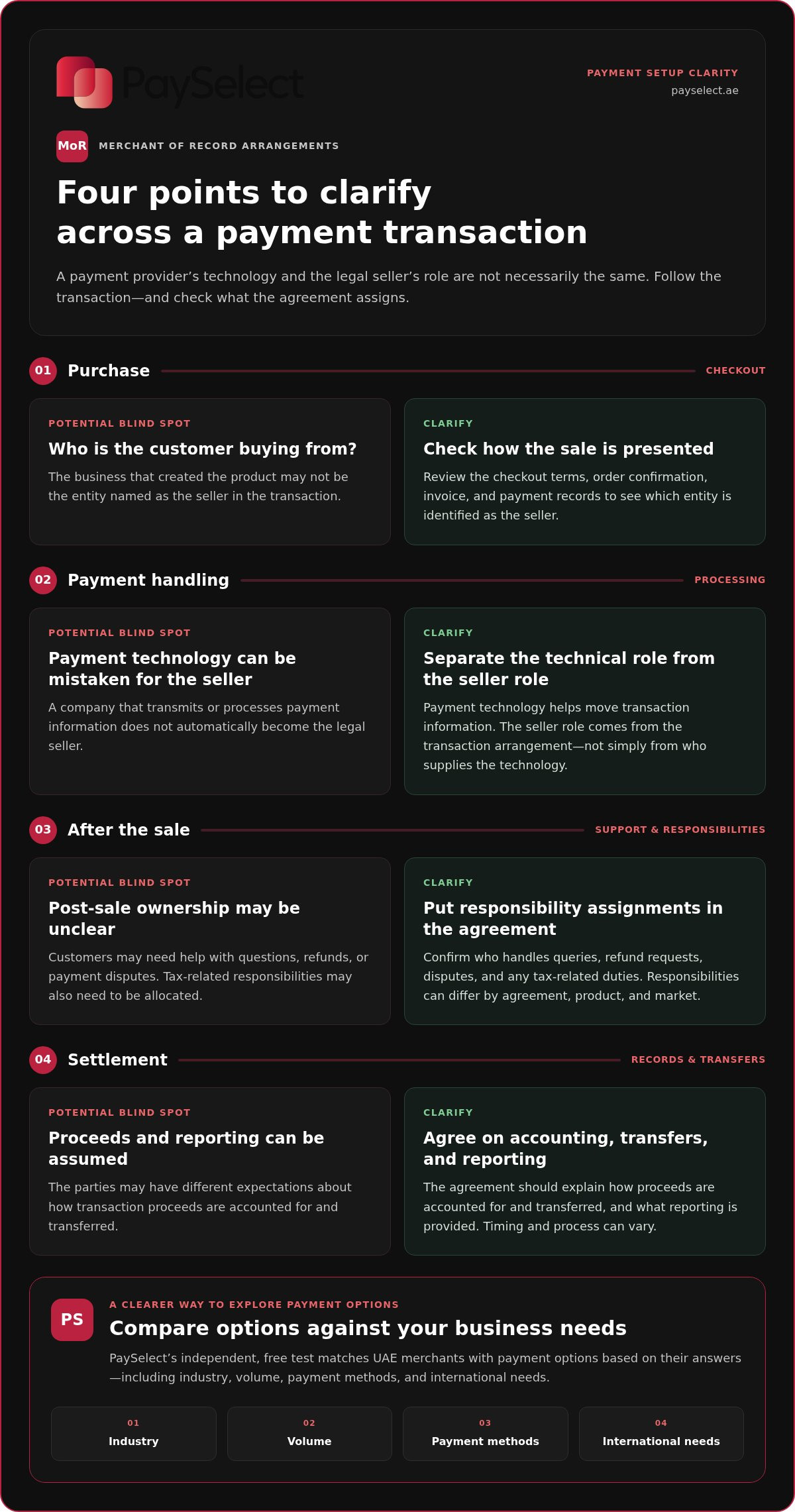
Understanding what is a merchant of record model in practice means following a transaction from checkout through the arrangements made after a customer pays. The MoR’s role sits within a wider setup that may also include the business supplying the product and technology providers supporting payment processing. These functions can connect, but they aren’t interchangeable.
Use this four-stage flow to identify where responsibilities may sit. The precise division depends on the parties’ agreements and the markets involved.
Purchase
The customer chooses a product and reviews the checkout details, including the seller identified for the transaction. The business may shape the shopping experience, while the MoR’s role is determined by the agreed seller arrangement. The MoR doesn’t necessarily build or own the checkout page.
Payment handling
The customer submits payment details through the checkout. Payment technology helps transmit transaction information through the relevant payment process. This technical function doesn’t, by itself, determine which party is the seller or what responsibilities the MoR has.
Post-sale responsibilities
The parties’ agreement should explain how customer queries, refund requests, and payment disputes are handled. It should also clarify any allocation of tax-related or other responsibilities for the product and relevant markets. Don’t assume that every MoR takes on the same tasks.
Settlement arrangements
The agreement should set out how transaction proceeds are accounted for and transferred between the parties, along with relevant reporting arrangements. The steps and timing can vary, so avoid assuming a standard settlement schedule or process.
From checkout to payment record
The customer-facing checkout and the payment technology behind it can involve different parties. A business may design the storefront and checkout experience, while technology providers supply tools to transmit or process payment information. The MoR’s seller role is established by the transaction arrangement, not simply by who owns the checkout software. Compare the checkout terms with order confirmations and transaction records to see how the sale is presented and recorded.
After payment: refunds, disputes, and settlement
Post-sale processes need clear ownership. The agreement should identify who responds to customer questions, makes refund decisions, and handles the steps involved in a dispute or chargeback. It should also explain how the parties coordinate when a customer contacts the business rather than the MoR. These responsibilities depend on the arrangement; they aren’t automatic features of every MoR model.
The contract, not the MoR label alone, determines how responsibilities are divided across a sale. Before relying on the model, map each step to the party responsible and check that the customer-facing terms and internal processes align. If payment technology is part of your setup, comparing payment gateway options can help clarify the technology layer separately from the seller arrangement.
Merchant of Record vs. Payment Gateway, PSP, and Facilitator
These terms describe different parts of a payment setup. A merchant of record (MoR) refers to the seller role in a transaction. A payment gateway, payment service provider (PSP), or payment facilitator describes payment infrastructure or services. One organization may perform more than one function, but its name or product label alone doesn’t show which responsibilities it has in a specific arrangement.
The distinction behind what is a merchant of record model becomes clearer when you compare each role by what it does and what it doesn’t establish by itself:
Merchant of record
The entity identified as the seller under the transaction arrangement. Its responsibilities depend on the contract, product, and relevant markets.
Payment gateway
Technology that helps transmit payment information between a checkout and payment systems. Supplying a gateway doesn’t automatically make the provider the seller.
Payment service provider
A provider that supports payment acceptance through services or technology. The exact services differ, and providing payment support doesn’t alone determine who is the seller.
Payment facilitator
A payment-related role that may support sub-merchants in accepting payments. Its scope and responsibilities depend on the arrangement and shouldn’t be assumed to match an MoR’s.
Seller of record
A term for the entity presented as selling to the customer. It may overlap with the MoR role, but terminology and responsibilities can vary between arrangements and markets.
Merchant of record vs. payment gateway or PSP
The simplest distinction is between the sale and the payment setup. The MoR role answers who is identified as selling the product. A gateway or PSP supports payment acceptance, but those services don’t automatically decide who holds the seller role. In some arrangements, one organization may provide payment technology and also be named as seller. The agreement and transaction records clarify which functions it performs.
For UAE businesses reviewing payment infrastructure separately from seller responsibilities, comparing payment gateway options can help bring the technology choices into focus.
Merchant of record vs. payment facilitator or seller of record
A facilitator may support payments for businesses or sub-merchants, while an MoR is identified as the seller for a transaction. “Seller of record” is also used to describe the seller-facing role, but the exact meaning can depend on the agreement and context. Some arrangements combine functions, so a label alone can’t settle who handles each task. Review the contracts and customer-facing terms together.
Payment infrastructure answers how payment is enabled; seller responsibility answers who is selling to the customer. Keeping those questions separate helps businesses assess an existing setup without assuming that a payment provider is also the MoR, or that an MoR must supply every payment tool.
When to Consider an MoR, and What to Assess First
Understanding what is a merchant of record model is only the starting point. The decision is whether the arrangement fits your markets, product, internal capacity, and desired customer experience. An MoR may be worth assessing if selling in multiple markets creates operational demands your team isn’t equipped to manage. That doesn’t mean every business expanding internationally needs one.
Which business needs might an MoR arrangement address?
Start by listing the work involved in your current or planned sales. Consider whether your team can support the payment operations and market requirements involved, and whether an MoR arrangement would address a specific gap. The answer can differ for a digital product, a physical item, or a service. It also depends on your transaction mix, existing systems, and how much operational work your team can take on.
Weigh four factors:
Market reach
Which markets do you serve now, and where do you plan to sell? Confirm that the arrangement’s scope matches those plans.
Operational capacity
Identify the tasks your team handles today and where you need a different allocation of responsibilities.
Business model
Consider how your product is sold, delivered, and supported. The arrangement should fit the real customer journey.
Customer experience
Decide how much control you need over checkout, communications, and post-sale support.
Delegating work doesn’t have to mean giving up the customer relationship. But it can change who appears during checkout, who answers a query, or who manages a refund. Map the customer journey before committing. Note where your brand needs direct involvement, then compare those expectations with the proposed division of roles.
What should the agreement make clear?
Review the written terms, not just the MoR label. Look for a clear allocation of customer communications, refunds, disputes, and transaction reporting. Understand which markets and products the arrangement covers, what sales or transaction information you can access, and how customer data is handled. Also review termination terms, including how records and ongoing customer matters are managed if the relationship ends.
Make the review practical. Trace a typical sale from checkout through a customer query or refund request. For each step, record who acts, what information your team receives, and where responsibility changes. This can reveal gaps between the written arrangement and the operating process before they affect customers. If international reach is a key consideration, explore cross-border payment solutions to compare payment options against your market plans.
A suitable model should address a defined business need while preserving the customer experience and visibility your team requires. Compare the documented scope with your operational priorities before deciding whether an MoR arrangement is the right fit.
How PaySelect Helps Businesses Understand Payment Options
Once you understand what is a merchant of record model, the next step is to compare payment options without confusing a payment provider with the seller in a transaction. PaySelect is an independent comparison and referral platform. It helps UAE businesses explore payment provider options, but it isn’t a merchant of record or a licensed payment service provider, and it doesn’t process payments.
What PaySelect does, and does not do
PaySelect compares payment providers and refers merchants to licensed providers. The provider you select handles payment acceptance, ongoing support, and settlement under its own arrangement with your business. PaySelect may assist with collecting initial KYC documents, but provider onboarding remains with the provider. This distinction matters: comparing options can help you assess payment infrastructure, but it doesn’t assign or supply an MoR for your sales.
To make a comparison more relevant, PaySelect’s free test uses your answers about your business, including:
• Your industry and transaction volume
• The payment methods you need to accept
• Your international selling requirements
The test typically takes less than two minutes, and you don’t need to register to use it or explore provider options. Its matches reflect your answers and partner data, so they’re a starting point for comparison, not a universal recommendation. Different businesses can have different requirements, even when they operate in the same industry.
Explore payment options with clear expectations
Use the results to understand which provider options may fit your stated needs, then consider them alongside your wider setup. For example, a business planning to sell across borders may have different payment-method and market needs from one serving customers in a single market. A match can help narrow the comparison, but it doesn’t determine which entity is the seller in your MoR arrangement or replace your ongoing relationship with the provider.
Your information is shared only with providers matched to you, and only after you give explicit consent. Data handling complies with UAE data-protection regulations. You remain in control of whether to share information for a provider referral.
For UAE merchants comparing payment gateway options, PaySelect offers a free way to explore matches based on business needs, without taking over payment processing or provider onboarding. Compare payment gateway options with PaySelect.
Make Your Next Payment Decision With Confidence
As your business plans its next stage of growth, use the distinction between the seller role and payment infrastructure to guide practical decisions. Knowing what is a merchant of record model can help you frame the right questions, but the best payment setup also needs to fit your customers, operations, and plans for new markets.
Start by identifying what your current setup needs to support: the payment methods your customers use, the markets you plan to serve, and the tasks your team needs a provider to handle. Then compare payment options against those priorities. A clear view of your requirements can make discussions with potential providers more focused and help you assess how each option fits alongside any MoR arrangement.
Use PaySelect’s free comparison tool to explore payment gateway options matched to your business needs. Compare payment gateway options with PaySelect.
A well-informed comparison helps you understand the roles in your payment setup and make your next decision with greater clarity.
Frequently Asked Questions
Does a merchant of record own the product or its intellectual property?
Not necessarily. A company can create a product and retain its intellectual-property rights while another party sells it under an MoR arrangement. For example, a software creator may grant permission for a separate seller to offer subscriptions without transferring ownership of the software. The actual rights depend on the agreements between the parties, so review product ownership and licensing terms separately from the terms covering customer sales.
Can a business use a merchant of record in only some markets?
Yes, an arrangement can apply to defined markets, products, or sales channels. For example, a business might use one setup for sales in a particular market and keep other transactions under its existing arrangements. To understand what is a merchant of record model for your business, map which transactions fall within the agreement and which do not, then check that responsibilities are clear for each group.
Does using an MoR guarantee that every payment will be accepted?
No. An MoR arrangement doesn’t guarantee payment approval. A transaction can be declined based on details such as the customer’s payment method, the information submitted, risk controls, or the processes used by the relevant payment provider. If approvals are a concern, review how declined transactions are reported and what information your team can access. The MoR label alone isn’t a promise that every attempted sale will succeed.
Can customers still recognize a business’s brand when an MoR is involved?
Yes, but the customer’s experience depends on how the parties set up the purchase journey. A business might retain its branding on product pages while a different company appears on a receipt or payment statement. Before agreeing, consider a customer’s view of the checkout, confirmation, billing details, and support contact. Reviewing those touchpoints together can reveal where the MoR arrangement may be visible to buyers.
Can a business move away from a merchant of record later?
Possibly, but changing arrangements can involve more than switching payment tools. For subscription sales, for example, the business may need to plan how renewals, customer notices, payment credentials, and support will work after the change. These items don’t necessarily transfer automatically. Review termination and data-transfer terms early, then outline the practical steps needed to maintain service for customers during a transition.
Does an MoR automatically remove every tax obligation from a business?
No. The MoR label alone doesn’t establish that all tax-related responsibilities have moved to another party. The allocation can depend on the agreement, product, and markets involved, and a business may retain responsibilities under its own circumstances. Before relying on a particular allocation, review the written terms and seek advice from a qualified tax professional familiar with the business and its relevant markets.
Is a merchant of record the same as a reseller?
Not automatically. A reseller generally describes a commercial role in which a party resells goods or services, while an MoR label describes a role connected to a customer transaction. One arrangement may involve both roles, but the terms aren’t interchangeable in every context. For a useful comparison, look at the actual sales flow, the parties’ written commitments, and which party is identified to the customer.
Disclaimer
This content is for informational purposes only and should not be considered financial, legal, or regulatory advice. Payment provider availability, pricing, and approval processes vary depending on individual business circumstances. PaySelect does not guarantee provider acceptance or specific outcomes. Businesses should conduct their own due diligence before entering into any agreements.
Empowering businesses to achieve greater growth